Reports in the Country Reports category.
The Indian media and entertainment sector reached a valuation of INR2.32 trillion in 2023, marking an 8.1% growth rate driven primarily by digital media and online gaming. While television remains the largest individual segment, the industry is transitioning into a "linear and digital" hybrid market, with digital media expected to become the dominant segment by 2024. Total industry revenue is projected to exceed INR3 trillion by 2026, supported by a 10% CAGR and a massive expansion of active screens, which are expected to reach nearly one billion by 2030.
The digital surge is characterized by a "vernacular-first" strategy and the rapid rise of Connected TV, which is anticipated to reach 100 million homes by 2030. Online gaming has emerged as a powerhouse, surpassing filmed entertainment to become the fourth-largest segment despite a new 28% GST mandate. While traditional mediums like print and radio remain resilient and profitable, they are pivoting toward niche audiences and hyper-local advertising to maintain relevance. Meanwhile, the filmed entertainment sector saw record revenues in 2023, fueled by a revival in Hindi cinema and premium experiential offerings, even as theater admissions faced pressure from rising costs.
The industry is currently navigating a "profitability-first" era defined by consolidation and technological integration. Generative AI is expected to provide an INR450 billion boost by 2027 through enhanced content creation and operational efficiencies. However, significant challenges remain, including low digital monetization relative to high engagement levels, digital ad fraud, and a tightening regulatory landscape. New frameworks, such as the Digital Personal Data Protection Act and updated broadcasting bills, are forcing companies to balance aggressive AI-driven personalization with stringent compliance and data transparency requirements.
The Japanese mobile app market maintains its status as a global powerhouse, generating $17.9 billion in consumer spending and 2.5 billion downloads in 2023. Despite a marginal decline in annual installs, the market demonstrated a strong recovery in the first quarter of 2024, characterized by a 3.5% rise in spending and a 3% increase in downloads. This growth is underpinned by high user engagement and a notable 30% ATT opt-in rate within the gaming sector, signaling a resilient ecosystem for data-driven marketing and monetization.
Mobile gaming remains the primary revenue driver, with RPGs accounting for nearly half of all consumer spend and achieving a high average revenue per monthly active user of $5.09. However, the landscape is evolving toward deeper immersion, as evidenced by simulation games reaching average session lengths of over 40 minutes. Simultaneously, the finance and e-commerce sectors are experiencing rapid expansion. Finance apps saw a 53.5% spending surge in early 2024, while e-commerce lifetime value in Japan reached $9.67 by the end of the first month, nearly doubling global medians.
Strategic shifts in user acquisition are evident across all segments, with a marked transition toward paid channels. The paid-to-organic install ratio for gaming reached 2.31 in early 2024, while finance and e-commerce also saw significant increases in paid acquisition efforts. This trend is complemented by the emergence of Connected TV as a critical performance channel. With ad spend projected to reach 170 billion yen by 2025, advertisers are increasingly reallocating budgets from social media to CTV to leverage its high viewership and its proven ability to assist in driving mobile app installs through sophisticated measurement and AI-driven creative optimization.
The European video games industry represents a high-growth strategic sector that generated €26.8 billion in revenue in 2024, with digital channels accounting for 90% of all sales. This robust economic activity supports over 116,000 skilled professionals across 6,000 studios and serves a diverse player base comprising 54% of the European population. Mobile gaming remains the dominant platform, utilized by 71% of the region's 127 million players. To manage this vast ecosystem, the industry relies on the PEGI age-rating system across 40 countries, ensuring a standardized approach to consumer protection and responsible gameplay.
Central to the industry’s operational integrity is a rigorous regulatory framework focused on monetization transparency and online safety. Updated standards mandate the disclosure of loot box probabilities and strictly prohibit the exchange of virtual items for real-world currency. Safety protocols are reinforced by comprehensive parental controls, currently adopted by 67% of parents, alongside mandatory age-verification tools and reporting mechanisms for harmful content. Compliance is maintained through a tiered enforcement system, where severe violations of age-rating or safety standards can result in financial penalties of up to €500,000.
Beyond economic and regulatory concerns, the sector is increasingly defined by its commitment to social and environmental responsibility. Major regional initiatives across Spain, the United Kingdom, and Germany are driving diversity and inclusion through measurable policy changes and scholarships aimed at increasing female participation. Simultaneously, the industry is pursuing aggressive decarbonization through the Playing for the Planet Alliance and voluntary agreements that have already yielded significant energy savings in hardware manufacturing. These efforts are complemented by the integration of environmental themes into gameplay and the development of carbon calculators to assist studios in achieving long-term sustainability goals.
The Africa Games Industry Report 2024 presents a data‑driven assessment of the continent’s gaming ecosystem, targeting investors, policymakers, developers and the broader public. It argues that Africa’s youthful demographics, rapid mobile penetration and cultural diversity create a fertile environment for game development and monetisation. The report identifies fre‑to‑play with in‑app purchases as the dominant revenue model, while premium titles, ad‑based income, subscriptions and licensing remain viable alternatives for developers willing to overcome higher entry barriers.
Key findings show that the Sub‑Saharan gamer base has more than doubled from 77 million in 2015 to 186 million in 2021, with mobile gaming accounting for 95 % of players and nearly 90 % of the region’s $778.6 million revenue in 2022. Approximately one‑third of players make in‑app purchases, underscoring significant monetisation potential. The industry is largely composed of small to medium studios and solo developers, with Unity the preferred engine and mobile/PC platforms dominating. Yet only 36 % of respondents earn income from games, and infrastructure challenges—unreliable power (71 %) and costly internet (57 %)—continue to impede growth.
The report calls for coordinated action from investors, studios, policymakers and the public. It highlights mobile network operators and alternative payment systems as critical partners for expanding reach, while outlining a five‑factor ecosystem—reliable infrastructure, talent pathways, informed investors, connected industry and evidence of success—to unlock high‑value jobs, cultural exports and foreign investment. The overarching thesis is that Africa’s gaming sector is poised for rapid expansion, offering substantial economic and creative opportunities if these systemic barriers are addressed.
India’s media and entertainment landscape is in the midst of a rapid digital pivot, with online platforms projected to surpass traditional television as the leading revenue driver by 2024. The sector is expected to grow at a 10 % CAGR, reaching INR 3.1 trillion ($37 billion) by 2026, driven largely by new‑media segments such as OTT video, gaming and digital advertising. Traditional channels—print, radio, out‑of‑home (OOH) and regional TV—continue to expand modestly, reinforcing a “linear + digital” model that balances legacy audiences with emerging consumption patterns.
Key growth engines include a surge in mobile‑first media, where 904 million broadband subscriptions and 574 million smartphone users fuel a daily mobile media spend of over four hours. OTT video viewership now covers 98 % of smartphone owners, with regional‑language content rising from 47 % to 52 %. Gaming dominates the mobile gaming market, with Free Fire and BGMI generating a quarter of in‑app purchase revenue, while esports viewership climbs to 78 % of gamers. Music and radio also expand through digital monetisation, with streaming revenues growing 10 % to INR 24 billion and radio advertising up 17 %.
The sector’s future hinges on cross‑platform content strategies, bundled FAST/OTT offerings, AI‑driven personalization and unified audience measurement. Challenges persist: low OTT profitability, ad‑rate pressure, regulatory uncertainty around gaming and gambling, and the need for first‑party data in a cookie‑less environment. Nonetheless, India’s position as the world’s largest app‑download market and its growing 1 billion active screens by 2030 underscore a resilient, technology‑driven growth trajectory across film, television, gaming, music and live events.
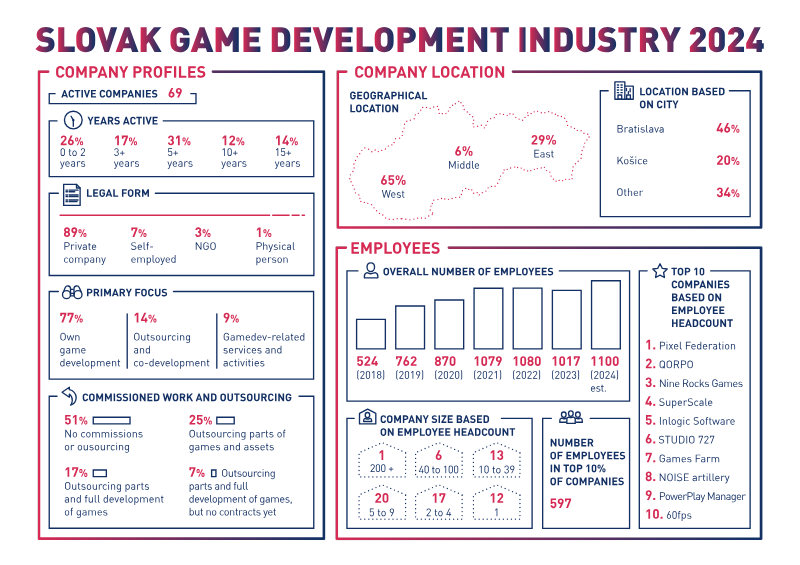
The Slovak game development industry in 2024 is characterized by a stable ecosystem of 69 active companies, primarily concentrated in the western region of the country, particularly Bratislava. The sector is dominated by private companies, with 77% focusing on original game development rather than outsourcing. While the industry experienced a slight contraction in headcount during 2023, it is projected to rebound to approximately 1,100 employees by the end of 2024. The workforce is relatively young, with a median age of 31, and women represent 21% of the total labor force, primarily occupying roles in graphic arts and marketing.
Financial data indicates a mature but concentrated market. The overall industry turnover for 2023 reached over 70 million EUR, a figure expected to remain stable through 2024. However, wealth is highly centralized, with the top 10% of companies—led by major players like Pixel Federation and Nine Rocks Games—accounting for 83.5% of total revenue. Funding remains largely internal, as 65.2% of projects are self-funded, though public funding supports roughly one-third of the industry.
Technologically, PC remains the primary development platform, utilized by 72.5% of developers, followed by mobile and console platforms. Despite the industry's creative success, developers face significant hurdles in recruitment, particularly for programming and game design roles. To foster future growth, industry stakeholders express a strong desire for increased state support, specifically in the form of R&D funding, tax incentives, and improved educational infrastructure to streamline the employment of both domestic and foreign talent.
The 2024 overview of Finland’s game sector presents a comprehensive assessment of an industry that remains a global technology leader while confronting a tightening financing environment. Employment reached roughly 4,300 individuals, equivalent to about 3,800 full‑time positions, underscoring the sector’s significance within the national economy. However, a pronounced drop in private risk capital and publisher backing has pushed many studios toward B2B subcontracting, co‑development agreements, and an expanding reliance on European Union and national public R&D programmes, especially after recent reductions in regional funding streams.
Talent depth continues to drive innovation, with Finnish teams at the forefront of AI‑assisted development, proprietary engines, and cloud‑gaming solutions. Persistent shortages of senior developers and specialists in Unreal Engine, together with increasing regulatory complexity and geopolitical uncertainty, pose constraints on future growth. New public R&D instruments and targeted regional SME support aim to mitigate these pressures and sustain the ecosystem’s dynamism.
Geographically, the industry is anchored by a network of regional hubs, notably Jyväskylä’s EXPA, which serves as a northern innovation cluster. The ecosystem is highly diversified, ranging from global powerhouses such as Supercell—employing over 800 staff and delivering seven worldwide hit titles—to agile indie studios like Snowhound, which hosts more than 120 employees from over twenty nationalities, and niche ventures such as Soihtu DTx, which secured a $4.2 million seed round for a clinically validated mental‑health game. Across the board, firms are expanding into cross‑platform and co‑development projects, exemplified by collaborations between Ubisoft RedLynx and Zaibatsu Interactive, reflecting a broader trend toward collaborative, multi‑disciplinary production.
The Middle East and North Africa (MENA) gaming market, specifically within the Gulf Cooperation Council (GCC), represents a high-growth frontier projected to reach $3.24 billion in player spending and 38.9 million gamers by 2028. This expansion is fueled by 96% internet penetration, high per capita income, and substantial government investment. Despite Arabic being the fifth most spoken language globally, a significant supply gap persists, as only 3.5% of Steam titles are currently localized for the region. This disparity exists even though 41% of regional gamers prioritize localized titles and over 50% highly value content tailored to their linguistic and cultural background.
Successful market entry demands a sophisticated approach to localization that transcends literal translation. Technical execution must account for right-to-left user interface formatting and complex cursive script rendering to avoid the legibility errors that have plagued previous major releases. Strategically, developers should utilize Modern Standard Arabic for text while employing regional dialects for voice-overs to enhance immersion. Culturalization is equally critical, as 40% of players are more likely to recommend games that include accurate religious considerations and regional festivals. Conversely, 27% of players will abandon a title if it relies on inaccurate stereotypes or disrespectful portrayals, highlighting the reputational risks of superficial localization.
Case studies indicate that deep culturalization can lead to exponential growth, with some titles seeing their MENA-based revenue and daily active users jump from 3% to 80% of their global total within months. Achieving these results requires integrating regional voice talent, ensuring historical accuracy, and leveraging local influencers for community engagement. To navigate these sensitivities and technical requirements effectively, international developers benefit most from partnering with regional experts. Such collaborations ensure that games resonate authentically with Arabic-speaking audiences, transforming a title from a foreign product into a culturally relevant experience.
The Australian game development industry demonstrated resilience and stability during the 2024 financial year despite significant global economic headwinds. Total income generated by local studios reached $339.1 million, representing a minor 1.9% decrease from the previous year. Employment remained steady with 2,465 full-time equivalent workers, a marginal 0.3% increase. The sector is heavily export-oriented, with 93% of all revenue generated from outside Australia. Furthermore, 85% of studios focus on developing their own original intellectual property rather than work-for-hire projects.
The industry landscape is characterized by a mix of emerging and established entities. While 56% of studios were formed within the last five years, a quarter of the sector consists of mature studios operating for a decade or more. Small businesses dominate the ecosystem, with 47% of studios employing five or fewer staff members. Geographically, Victoria serves as the primary hub, hosting 52% of head offices and 36% of the national workforce, followed by Queensland and New South Wales.
Government support remains a critical pillar for the industry. The Digital Games Tax Offset, which passed in mid-2023, is already being utilized by 25% of respondents to fund new projects or expand existing ones. Despite this support, developers identified securing international and local publishing deals and attracting early-stage development funding as their primary challenges.
The findings are based on a voluntary survey of 137 Australian game development studios conducted by Bond University on behalf of the Interactive Games & Entertainment Association. The data covers the period from July 1, 2023, to June 30, 2024. Looking ahead, the sector maintains a cautiously optimistic outlook, with 81% of studios predicting stable or increased revenue and 61% planning to hire new staff in the coming year.
The analysis provides a comprehensive overview of Japan’s mobile‑gaming ecosystem in 2024, measuring the market’s size, growth dynamics, and competitive landscape. Total in‑app purchase (IAP) revenue reached roughly ¥2.5 trillion, marking a modest increase over 2023, while the combined share of the Apple App Store and Google Play stabilized at about 55 % and 45 % respectively. Advertising‑derived income expanded by 35 % year‑on‑year, now accounting for roughly 8 % of overall mobile‑gaming revenue, driven largely by user acquisition through YouTube, TikTok and Instagram.
Top‑grossing publishers dominate the market, with Mixi, Bandai Namco, CyberAgent, miHoYo, Square Enix and GungHo each securing multiple titles in the upper echelon of revenue. Flagship games such as Fate/Grand Order, eFootball, Pokémon GO, and the One Piece franchise collectively generated more than ¥1 trillion, underscoring the continued strength of established IPs. Genre analysis shows 3D titles now represent roughly half of the top‑performing apps, reflecting a shift toward richer visual experiences, while 2D and casual games retain a sizable user base.
The study covers the period January through July
The Turkish gaming market has emerged as a global powerhouse, reaching a valuation of approximately $810 million in 2024 with a trajectory toward $1 billion by 2029. This growth is supported by a massive domestic audience of over 48 million players and a population characterized by high digital engagement, with 76 million internet users spending nearly seven hours online daily. While mobile gaming remains the dominant segment—accounting for $490 million in revenue—the industry is currently undergoing a strategic pivot. Developers are shifting focus from hyper-casual mobile titles toward more complex PC and console projects, exemplified by the global success of titles like Supermarket Simulator and Liars Bar.
The ecosystem is bolstered by a sophisticated infrastructure of over 1,400 active studios, 26 incubation centers, and a robust financial network of 60 regulated payment institutions. Despite economic headwinds, such as high interest rates affecting hardware sales and the removal of local pricing on major platforms, investment remains resilient. In the first half of 2024, the sector saw over $120 million in deal flow across 20+ transactions. Furthermore, Türkiye has solidified its status as an esports leader, ranking second globally at the World Esports Championship and maintaining a licensed athlete base of nearly 100,000.
However, the market faces significant regulatory and technical challenges. New legal frameworks mandate that foreign platforms appoint local representatives, while recent bans on platforms like Discord and Instagram have disrupted community engagement. Additionally, with Türkiye ranking 65th globally in English proficiency, professional localization—including Turkish characters and voiceovers—is identified as a critical factor for market penetration. Moving toward 2025, the industry is expected to integrate AI-driven development tools and 5G technology more deeply, leveraging its position as a top European gaming hub to attract further international investment and expand its influence across the MENA region.
The Turkish gaming market in 2022 serves as a critical case study of a high-growth production hub navigating significant domestic economic volatility. While the player base expanded to over 44 million users—with 81% of adults engaging in mobile gaming—total market revenue saw a sharp correction, falling from $1.2 billion in 2021 to approximately $625 million. This decline was primarily driven by the depreciation of the Turkish Lira and weakened consumer purchasing power, which has accelerated a shift toward free-to-play titles, subscription services, and a demand for high-quality localization to reach a population with generally low English proficiency.
Despite these fiscal challenges, Türkiye has solidified its position as a global leader in gaming investment and development. Istanbul ranks second in Europe and fifth globally for gaming transactions, securing over $424 million in investments across dozens of deals. The domestic ecosystem is maturing beyond its historical focus on hyper-casual mobile titles, with over 2,943 publishers on Google Play and a strategic pivot toward indie, PC, console, and hybrid-casual development. This evolution is supported by a robust infrastructure of 25 entrepreneurship centers and 19 university programs, though a deficit in qualified instructional talent remains a hurdle for long-term sustainability.
The region has also emerged as a premier esports destination, evidenced by hosting the VALORANT Champions Tour and the formal legal recognition of the Turkish Esports Federation, which oversees more than 15,000 licensed players. While traditional segments like internet cafes have declined due to rising operational costs, the integration of gamification into e-commerce and corporate sectors is expanding. Moving forward, the industry is expected to maintain a compound annual growth rate of 24.1% through 2026, driven by blockchain integration, AI technologies, and a transition toward more complex, mid-core gaming experiences.