Reports in the Country Reports category.
The United Kingdom’s entertainment market reached a historic peak of £11.1 billion in 2022, representing a 6.9% year-on-year increase and nearly doubling its total value since 2015. This growth is fundamentally underpinned by a comprehensive transition to digital consumption, with digital services now commanding a 91% market share across the video, music, and gaming sectors. While physical formats generally continue a long-term decline, specific niches such as vinyl and 4K UHD Blu-ray demonstrate notable resilience, with vinyl revenue surpassing CD sales for the first time this century.
The video games sector remains the largest individual segment, valued at £4.66 billion. Digital software sales account for 90% of this spend, led by mobile gaming and console downloadable content. Although hardware sales faced challenges due to global supply chain constraints, the market remains robust, with digital sales for major titles like Elden Ring and FIFA 23 significantly outperforming physical retail. Similarly, the video market reached a record £4.43 billion, fueled by a 17.6% surge in subscription video-on-demand services. Approximately 68% of UK households now maintain an average of 2.5 streaming subscriptions, cementing the dominance of online distribution.
The music industry mirrors these trends, with subscription streaming accounting for 84% of its £1.99 billion valuation. Interestingly, 2022 saw a nuanced recovery for physical retail as high-street specialists and independent shops experienced a 12.6% growth in sales following the normalization of post-pandemic trading. Despite this resurgence of local brick-and-mortar outlets, online channels still facilitate nearly 95% of total music spending. Strategic initiatives like Record Store Day and the implementation of advanced data tracking continue to support the industry's evolution, ensuring that both digital innovation and traditional retail advocacy remain central to the UK’s creative economy.
The Finnish game industry established itself as a premier global hub between 2021 and 2022, maintaining a record annual turnover of €3.2 billion. This performance places Finland among the top five national game industries in Europe. Despite a shift toward the "games-as-a-service" model and macroeconomic headwinds that reduced the frequency of new game launches, the sector experienced a surge in startup activity and employment. By late 2022, the industry supported 232 active studios and approximately 4,100 employees, characterized by a highly international workforce and a stable presence of female professionals.
While mobile remains the dominant platform by revenue, there is a significant strategic pivot toward PC and multiplatform development, with 64% of studios now targeting the PC market. This evolution is supported by a sophisticated funding ecosystem that includes over €300 million in private investment and substantial public R&D support from Business Finland. The industry’s maturity is further evidenced by high-profile acquisitions from global giants such as Sony, Netflix, and Playtika, alongside the continued success of established leaders like Supercell, Rovio, and Remedy Entertainment.
The ecosystem is anchored in Helsinki, which accounts for the vast majority of turnover and employment, but it also benefits from thriving regional clusters in Tampere, Oulu, and Kajaani. These hubs specialize in diverse technologies ranging from VR and Web3 to simulation and narrative-driven titles. Despite challenges such as rising marketing costs due to privacy changes and a persistent talent shortage, the industry remains resilient through robust institutional support from organizations like Neogames and Suomen Pelinkehittäjät ry. This collaborative infrastructure, combined with a focus on original intellectual property and emerging technologies like Creative AI, ensures Finland’s continued influence on the global gaming landscape.
The 2023 annual survey of the French video game industry provides a comprehensive analysis of the sector’s economic health, production trends, and workforce dynamics during 2022. Conducted by the Syndicat National du Jeu Vidéo (SNJV) between February and June 2023, the study relies on a self-administered online questionnaire sent to 577 qualified development companies, achieving a 23% participation rate. The scope covers approximately 1,000 companies across France, including 580 development studios, with a significant concentration of 44.6% located in the Île-de-France region.
Findings indicate a robust but maturing production landscape, with nearly 1,260 games in development and over 850 new intellectual properties created. While the number of games in production fell by 7% compared to 2020, the industry saw a rise in professionalization, with 62% of studios working with publishers. Financial growth is evident, as 27% of studios now generate over 1 million euros in revenue, a 9-point increase from 2020. However, the sector remains dominated by smaller entities, with 55% of companies earning less than 300,000 euros annually. Despite this growth, optimism has tempered; only 28.6% of respondents expect revenue growth in the coming year, compared to 66% in 2020.
Employment remains stable with 76% of staff on permanent contracts, though gender diversity shows slow progress, with women making up 24% of the workforce. The industry is also navigating structural shifts in work culture, as 33% of companies have adopted full-time remote work. Corporate Social Responsibility is emerging as a priority, with 65.5% of companies implementing gender equality actions and nearly half planning carbon footprint assessments. France remains highly attractive to 85% of studios, primarily due to tax incentives and the quality of specialized training.
The Swedish games industry underwent a period of rapid expansion in 2021, characterized by a 22% increase in domestic revenue to €2.7 billion and a 43% surge in global revenue to €5.8 billion. This growth was fueled by a record-breaking year of international acquisitions, with 81 public transactions led by major groups such as Embracer and Stillfront. By late 2022, Swedish-owned entities operated 197 studios across 49 countries, employing approximately 28,000 people worldwide. This international footprint is reflected in consumer reach, as an estimated one in four players globally has engaged with a Swedish-developed title, and Swedish-associated games accounted for 6% of all Twitch watchtime in 2021.
The domestic workforce grew by 17% to nearly 8,000 employees, with women representing 22.1% of the total staff and 26% of new hires. While gender diversity is improving—evidenced by 29 companies achieving at least 50% female representation—the industry continues to struggle with a severe domestic skills shortage. This talent gap has forced Swedish firms to expand their foreign subsidiaries aggressively, with over 11,000 staff members now based abroad. Although regional hubs in Stockholm and Skåne remain dominant, growth is increasingly supported by specialized educational clusters and post-secondary programs designed to cultivate local talent.
Despite its commercial success and cultural influence, the sector faces structural hurdles that could impact future scalability. Critical challenges include complex work permit processes for international recruits and a lack of early-stage financing compared to other global markets. Methodological shifts in industry tracking now prioritize national group turnover to ensure better comparability with other sectors, revealing a robust ecosystem of 785 active companies. While the industry remains a powerhouse of the Swedish economy, its long-term sustainability depends on addressing recruitment barriers and maintaining the momentum of its global acquisition strategy.
The European video game industry demonstrated significant economic resilience and social expansion in 2022, generating €24.5 billion in revenue and achieving a 5% year-on-year growth rate. This sector now engages approximately 126.5 million people, representing 53% of the population aged 6 to 64. Demographic shifts indicate a maturing and diversifying market, as women now comprise nearly 47% of the player base and the 45-64 age group has emerged as the largest playing demographic. While engagement has stabilized at an average of 8.8 hours of weekly playtime, the industry’s economic footprint is bolstered by a workforce of over 110,000 employees, which saw a 12% increase in staffing levels.
Despite this robust growth, the industry faces a critical talent shortage that threatens future expansion. Projections suggest a widening digital skills gap, exemplified by Sweden’s anticipated deficit of 25,000 developers by 2031. To sustain its trajectory, the sector is increasingly focusing on workforce diversity—where women currently hold 23.7% of roles—and the implementation of comprehensive social responsibility frameworks. These include the expansion of the PEGI rating system and the deployment of advanced parental control tools to ensure a safe environment for the evolving player base.
Environmental sustainability has also become a central pillar of the European gaming landscape. Through collaborative efforts like the Games Consoles Voluntary Agreement, the industry achieved a reduction of 54TWh in energy consumption across previous console generations. Major publishers and trade associations across 18 countries are now prioritizing carbon neutrality, with sector-wide initiatives successfully offsetting significant carbon footprints. These combined economic, social, and environmental strategies reflect a maturing industry that is balancing rapid commercial growth with long-term ecological and demographic responsibilities.
Brazil has established itself as the preeminent games market in Latin America and the 12th largest globally, generating approximately USD 2.3 billion in 2021. The ecosystem is defined by rapid professionalization and internationalization, evidenced by a 102% increase in active studios since 2018. With over 1,000 companies and a workforce exceeding 12,000 professionals, the industry has transitioned from a historical period of informality to a sophisticated hub for original intellectual property and high-quality external development services. While the Southeast and South regions remain the primary geographic hubs, the sector’s reach is global, with over half of local companies serving international markets, particularly in the United States and Europe.
The industry demonstrates increasing maturity through longer studio lifespans and a shift toward diverse platforms. While mobile and PC development remain dominant, console production grew significantly to 17% of the market by 2021. Beyond entertainment, Brazilian studios maintain a strong presence in educational and corporate gamification. Despite this growth, structural challenges persist, including a lack of formal inclusion policies for underrepresented groups and a "wage war" for senior talent driven by the rise of remote work for foreign firms. Furthermore, the workforce is navigating a transition where 93% of companies now focus on proprietary IP, moving away from a pure service-provider model.
Economic and regulatory hurdles continue to shape the landscape. Federal funding has reached historic lows, forcing a reliance on founder capital and state-level initiatives. Developers face significant "legal insecurity" due to the absence of a specific regulatory category for games and a tax system that treats development hardware as luxury entertainment rather than capital goods. Nevertheless, the resilience of the sector is underscored by a 336% revenue increase in USD since 2015 and the emergence of "unicorns" like Wildlife. The industry remains a vital component of the global value chain, increasingly recognized for its technical proficiency in engines like Unity and its expanding role in emerging technologies such as blockchain and the metaverse.
This analysis provides a comprehensive overview of the European video games industry as of 2021, detailing its economic impact, demographic reach, and social contributions. Jointly produced by ISFE and EGDF, the findings highlight a sector that remained stable following the pandemic-induced surge of 2020, maintaining a market value of €23.3 billion across key European territories. The industry supports a significant workforce, employing over 98,000 people across Europe, with 74,000 located within the EU. Data is primarily sourced from Ipsos, GameTrack, and GSD, covering major markets including France, Germany, Italy, Spain, and the United Kingdom.
The demographic data reveals that video gaming is a mainstream cultural activity, with 52% of the European population aged 6 to 64 participating. The average player age is 31.3 years, and women represent nearly 48% of the total player base. While engagement remains high, average weekly playtime returned to pre-pandemic levels of nine hours. The digital ecosystem dominates the market, accounting for 81% of total revenue, driven largely by app-based gaming and in-game extras.
A significant portion of the analysis focuses on industry responsibility and social impact. It underscores the effectiveness of the PEGI age rating system and the prevalence of parental control tools, noting a sharp decline in unsupervised in-game spending by minors. Furthermore, the industry is positioned as a driver for digital literacy and mental well-being, with specific initiatives targeting STEM education for girls and climate change through the Green Game Jam. The report concludes that the sector is a vital component of Europe’s digital economy, increasingly recognized for its pedagogical value and commitment to diversity and environmental sustainability.
The Swedish games industry experienced a transformative period of growth in 2020, reaching a record revenue of EUR 3.3 billion. This 43% increase significantly outpaced global market trends, marking the sector's twelfth consecutive year of profitability. The landscape is increasingly defined by corporate consolidation and international expansion, with 667 active companies and 19 listed entities commanding a combined market capitalization of EUR 10.7 billion. Major players such as Embracer Group, King, and Mojang have transitioned Sweden from a target for foreign acquisition into a dominant global investor, with Swedish-owned firms now employing more personnel abroad than domestically across 126 international studios.
Despite this commercial success, the industry faces a critical bottleneck regarding skilled labor. While domestic employment rose to over 6,500 positions, a severe talent shortage and a cumbersome work permit process hinder further expansion. These systemic issues are compounded by a lack of early-stage financing and tax incentives for smaller developers, who must also navigate digital regulations often tailored for larger tech platforms. Furthermore, while Swedish-developed titles like Minecraft and Candy Crush have achieved over six billion downloads, the sector continues to grapple with internal demographic challenges. Women currently represent only 21% of the workforce, and over 100 companies remain entirely male-operated, prompting a surge in diversity initiatives aimed at leveling the playing field.
Geographically, while Stockholm remains the primary hub with over 4,000 employees, regional development clusters and educational programs are expanding throughout Sweden to support the growing ecosystem. The industry is also pivoting toward long-term sustainability, addressing workplace culture and the environmental implications of energy-intensive cloud gaming. As the sector matures, its primary challenges have shifted from achieving market viability to managing rapid globalization, securing specialized talent, and fostering a more inclusive and sustainable professional environment.
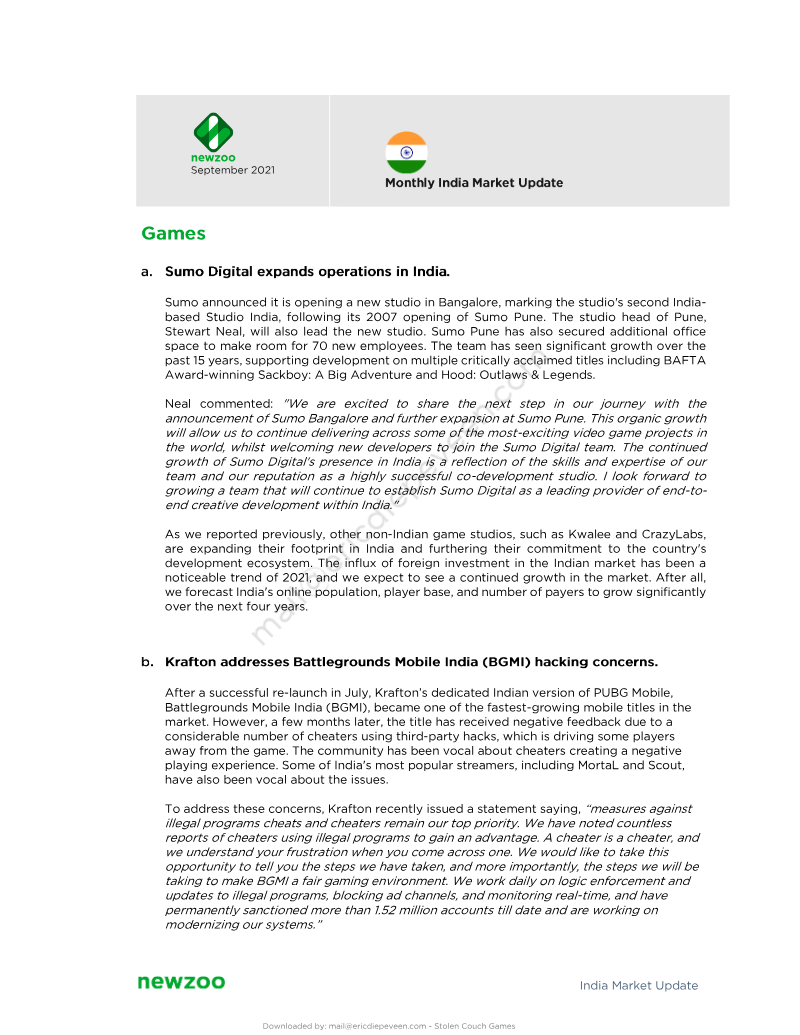
The Indian gaming and esports landscape is undergoing a period of rapid institutional growth and diversification, characterized by significant foreign investment and the expansion of domestic infrastructure. During the 2021 period, international developers such as Sumo Digital, Kwalee, and CrazyLabs have deepened their commitment to the region. Sumo Digital’s establishment of a second studio in Bangalore and the expansion of its Pune facility highlight a strategic shift toward utilizing India as a hub for end-to-end creative development rather than just a support center. This trend aligns with forecasts predicting substantial increases in India’s online population, player base, and total number of paying users over the next four years.
The mobile gaming sector remains a primary driver of market activity, though it faces operational hurdles. Krafton’s Battlegrounds Mobile India has seen explosive growth but must navigate the technical challenge of maintaining competitive integrity. The company has permanently sanctioned over 1.52 million accounts to combat cheating, illustrating the friction between accessibility in free-to-play titles and the necessity of robust anti-cheat measures. Simultaneously, the real-money and fantasy gaming segments are accelerating, evidenced by Mobile Premier League reaching a $2.3 billion valuation following a $150 million Series E funding round intended to fuel global expansion into markets like the United States.
The esports ecosystem is maturing through consolidation and the convergence of gaming with broader entertainment sectors. Market leader NODWIN Gaming has expanded its reach into the casual and mid-core demographics by acquiring OML Entertainment’s IP business and partnering with PVR Cinemas to pilot in-theater esports viewing. These moves signify a transition toward a more integrated media model where gaming, music, and comedy intersect to drive brand engagement. Overall, the Indian market is evolving into a sophisticated environment defined by high-value capital raises, localized content strategies, and the professionalization of the broader creator economy.
The Turkish gaming market experienced a transformative period of growth and institutionalization in 2021, reaching a total market volume of $1.2 billion. Despite global challenges such as hardware shortages and pandemic-related delays in AAA titles, the local ecosystem expanded to include over 42 million active players. This growth was primarily catalyzed by the mobile segment, which generated $620 million in revenue and solidified Turkey’s position as a global leader in the hyper-casual genre. The year was further defined by record-breaking financial activity, with $266 million invested across 54 startups and the emergence of Dream Games as a new industry "unicorn."
Strategically, the market is shifting toward a "gaming-focused entertainment" model, characterized by the rapid adoption of Web3 technologies, including blockchain, NFTs, and Play-to-Earn (P2E) frameworks. While mobile gaming remains the dominant force, there is a burgeoning esports ecosystem supported by approximately 6 million followers and a national federation overseeing 165 licensed clubs. Turkey’s selection as the host for the Global Esports Games 2022 underscores its rising international profile. However, industry experts note a strategic need to diversify beyond mobile platforms into PC and console development to ensure long-term sustainability.
The regional landscape reveals Turkey as the primary gaming powerhouse in the Middle East, outperforming neighboring markets in both revenue and player engagement. Success for international entrants remains contingent on high-quality localization and cultural adaptation, given the country's low English proficiency and unique consumer preferences for competitive genres and specific musical influences. As the sector transitions into 2022, the focus remains on bridging the talent gap through specialized academic programs and leveraging the return of large-scale physical exhibitions to maintain momentum in the evolving Metaverse and digital advertising spaces.
The Finnish game industry has transitioned from a hobbyist niche into the nation’s largest cultural export, maintaining an annual turnover exceeding €2 billion for six consecutive years. By 2020, the sector reached a turnover of €2.4 billion, driven by a maturing "middle class" of 46 studios generating over €1 million in annual revenue. While the total number of active studios decreased to approximately 200 due to global competition and regional funding shifts, employment reached a record 3,600 professionals. The industry demonstrates increased stability through a decreasing reliance on its largest player, Supercell, whose share of total turnover fell to 54% as other studios scaled.
Geographically, the industry remains highly concentrated in the Capital Region, which accounts for 96% of turnover and nearly 80% of the workforce. However, vital regional hubs in Tampere, Oulu, and Turku provide specialized support through incubators and university programs. While mobile gaming remains the dominant sector—anchored by global giants like Rovio and Fingersoft—there is a notable shift toward a "post-mobile" era. This evolution is defined by growth in multiplatform console and PC development, led by studios such as Remedy Entertainment and Housemarque, as well as emerging interests in cloud gaming, the metaverse, and AI integration.
The ecosystem is supported by a robust infrastructure, including over €150 million in R&D funding from Business Finland and a proactive private investment climate that attracted over €100 million between 2019 and 2020. Despite this strength, the industry faces challenges such as a global shortage of senior talent, increased protectionism in foreign markets, and platform volatility. Future growth is expected to stem from strong intellectual property, significant M&A activity, and a commitment to workforce diversity and social responsibility. The industry remains a resilient economic driver, characterized by high professional organization and a collaborative culture that sustains its status as a premier global hub for game development.