
Northeastern University
Northeastern University is a global research university. It publishes academic reports on game mechanics, procedural content generation, and game corpus analysis.
Documents
Analysis of Robustness of a Large Game Corpus
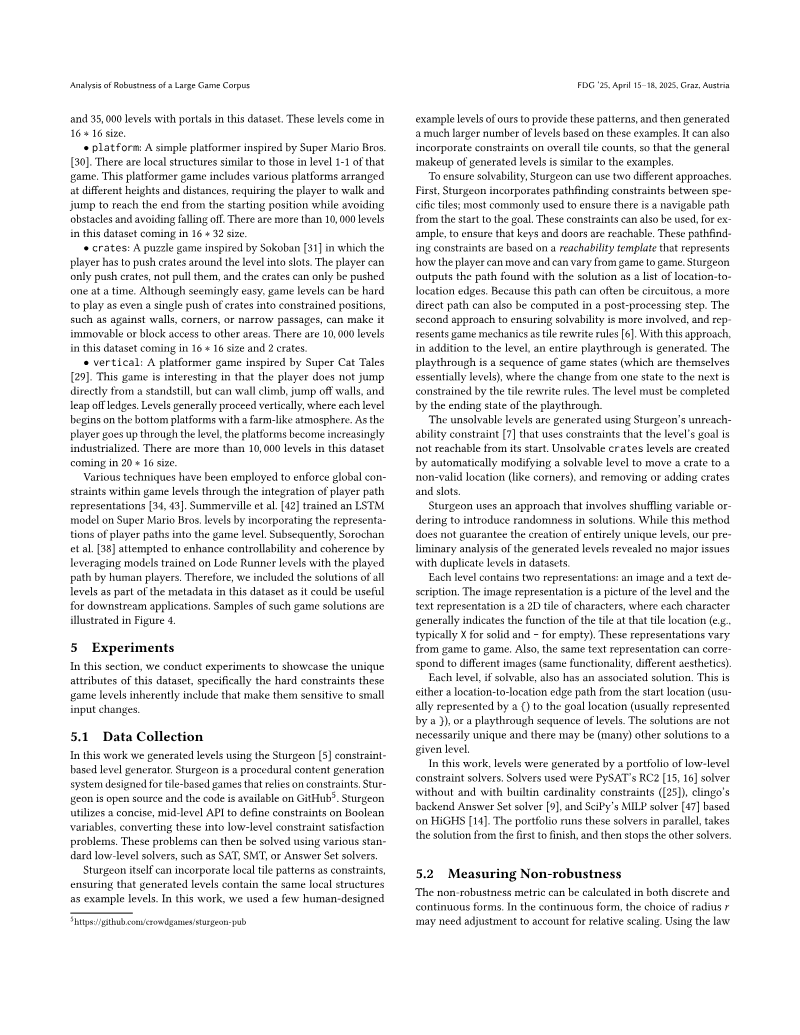
The Generated Game Level Corpus (GGLC) serves as a critical resource for advancing procedural content generation through machine learning by addressing the persistent scarcity of high-quality training data.
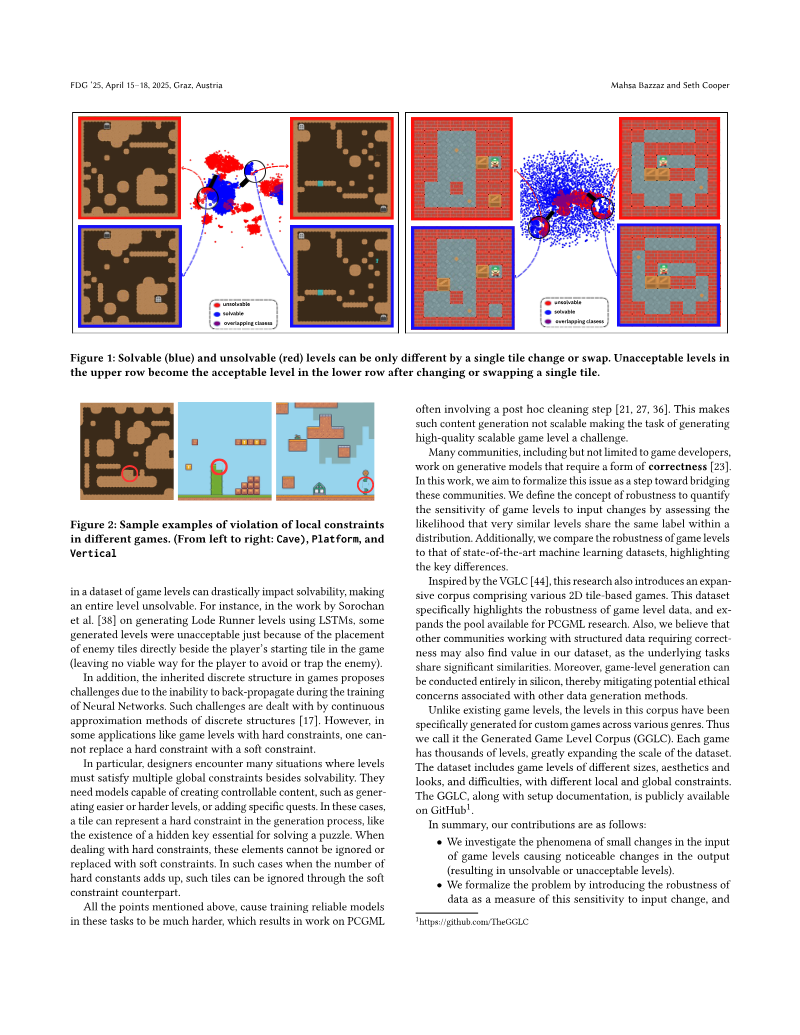
- Game levels are significantly more sensitive to input perturbations than standard visual datasets like CIFAR-10, as a single tile modification can render a level unsolvable.
- Unlike traditional image data, game levels are governed by rigid structural and local constraints that dictate their functional integrity.
- The Generated Game Level Corpus (GGLC) provides a formal framework and standardized metric to quantify the non-robustness of procedural content generation models.
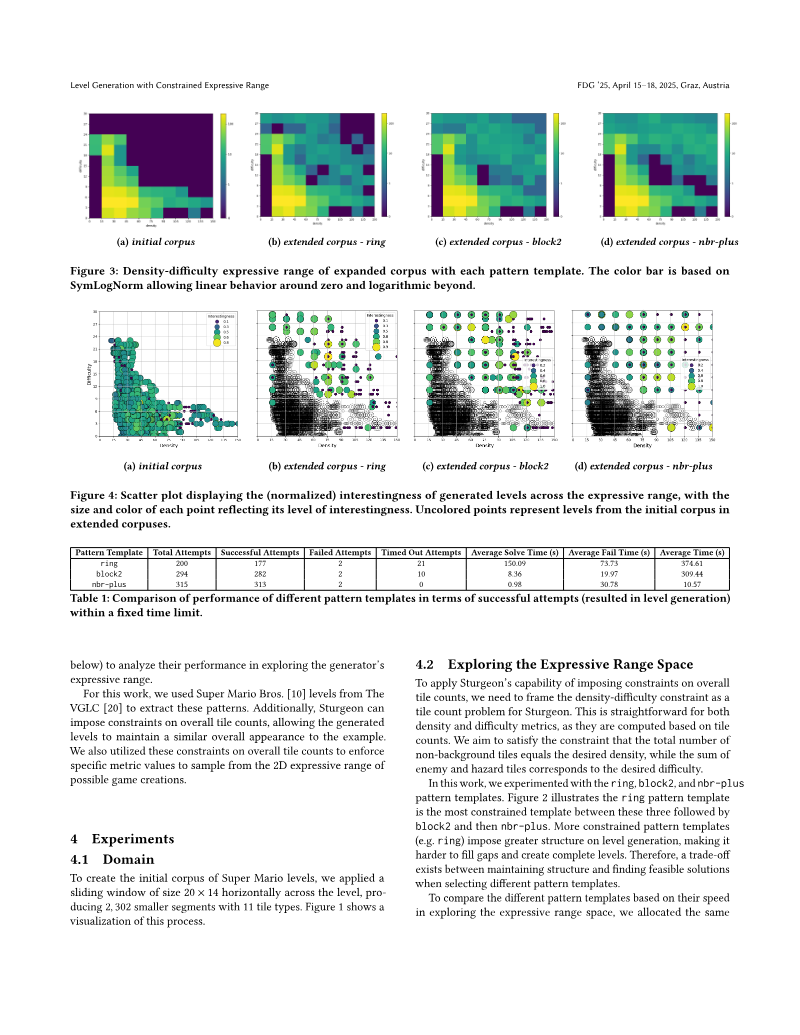
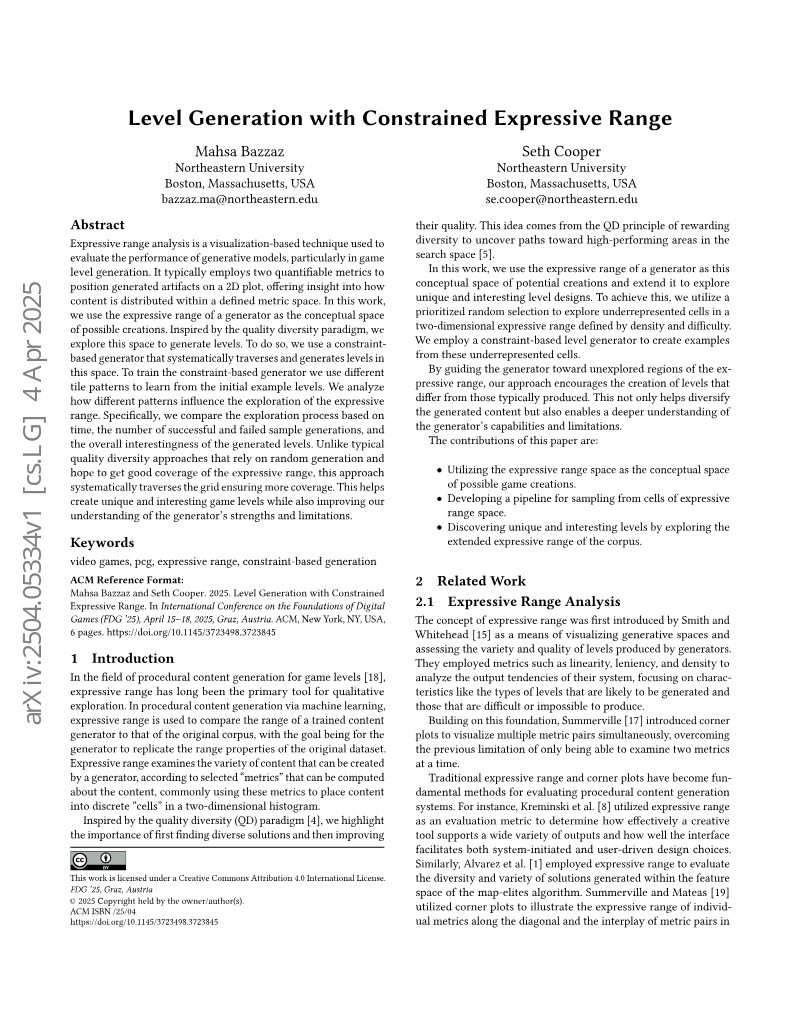
Level Generation with Constrained Expressive Range
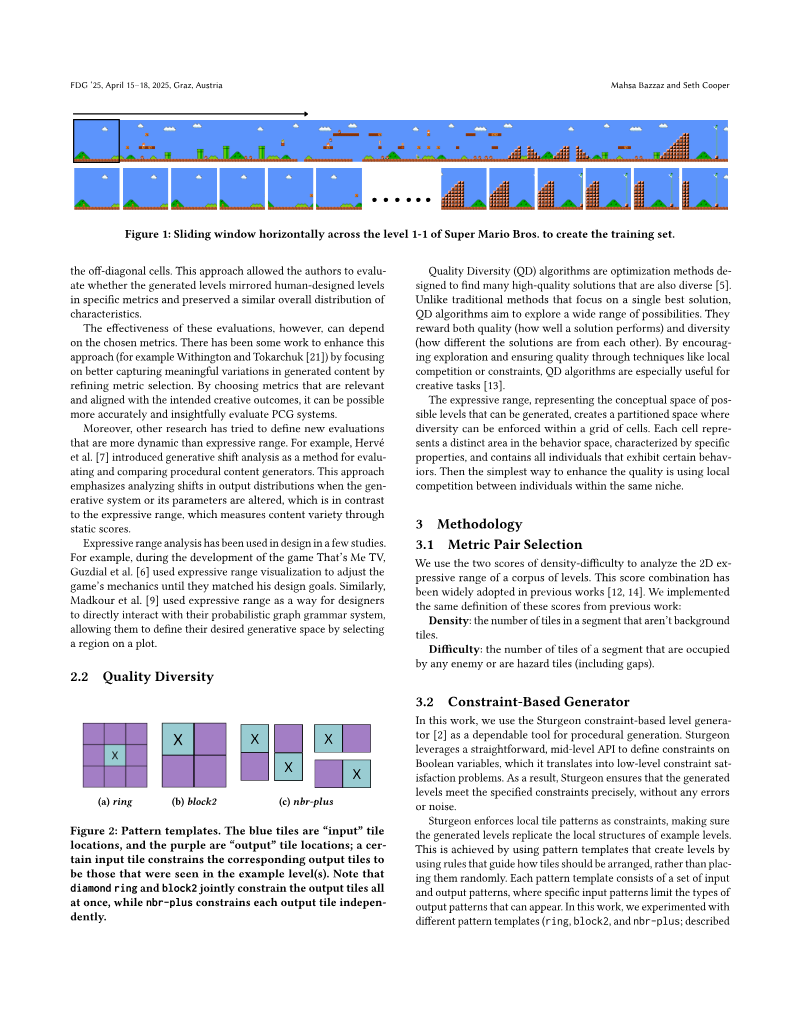
This research introduces a systematic approach to procedural content generation by utilizing expressive range analysis as a conceptual space for guiding level design.
- Systematic traversal of a defined metric space using quality diversity principles significantly outperforms purely random generation in uncovering unique, underrepresented level design variations.
- The study utilized the Sturgeon constraint-based generator to process 2,302 segments from the Video Game Level Corpus to create Super Mario Bros. levels.
- There is a direct trade-off between structural constraint and generation efficiency: highly restrictive templates like 'ring' produce more structured levels but suffer from higher failure rates and longer solve times.
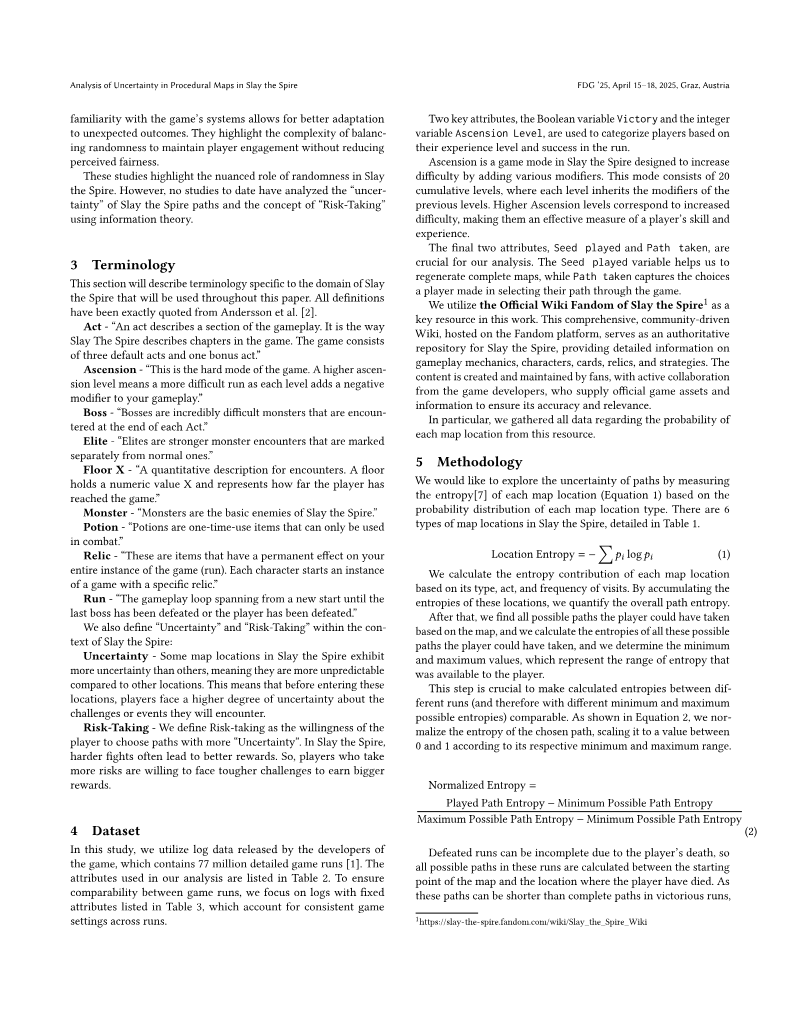
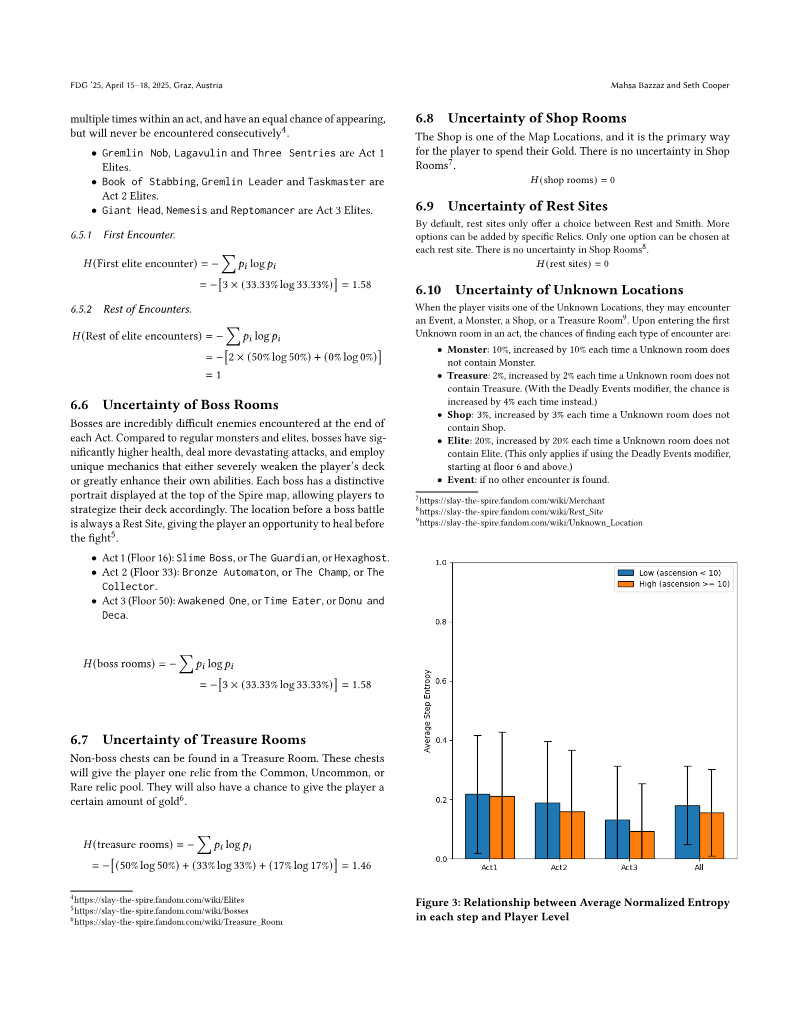
Analysis of Uncertainty in Procedural Maps in Slay the Spire
Procedural map generation in Slay the Spire serves as a critical variable in player decision-making, where the navigation of uncertainty directly correlates with long-term success.
- Analysis of 20,000 runs confirms that victory in Slay the Spire is driven by calculated risk-taking rather than prioritizing predictable, safe paths.
- Higher normalized entropy in route selection is a primary indicator of successful outcomes, favoring players who embrace the volatility of procedural encounters.
- While early-game decision-making is uniform across all skill levels, high-skill players distinguish themselves by shifting their strategy during the later, more complex acts.
Snake Story: Exploring Game Mechanics for Mixed-Initiative Co-creative Storytelling Games
Snake Story explores the intersection of high-intensity twitch mechanics and generative artificial intelligence to address the persistent imbalance in interactive storytelling games, where narrative depth often comes at the expense of mechanical engagement.
- Integrating high-intensity twitch mechanics with GPT-3-driven generative storytelling creates significant friction, often forcing players to sacrifice narrative coherence for mechanical survival.
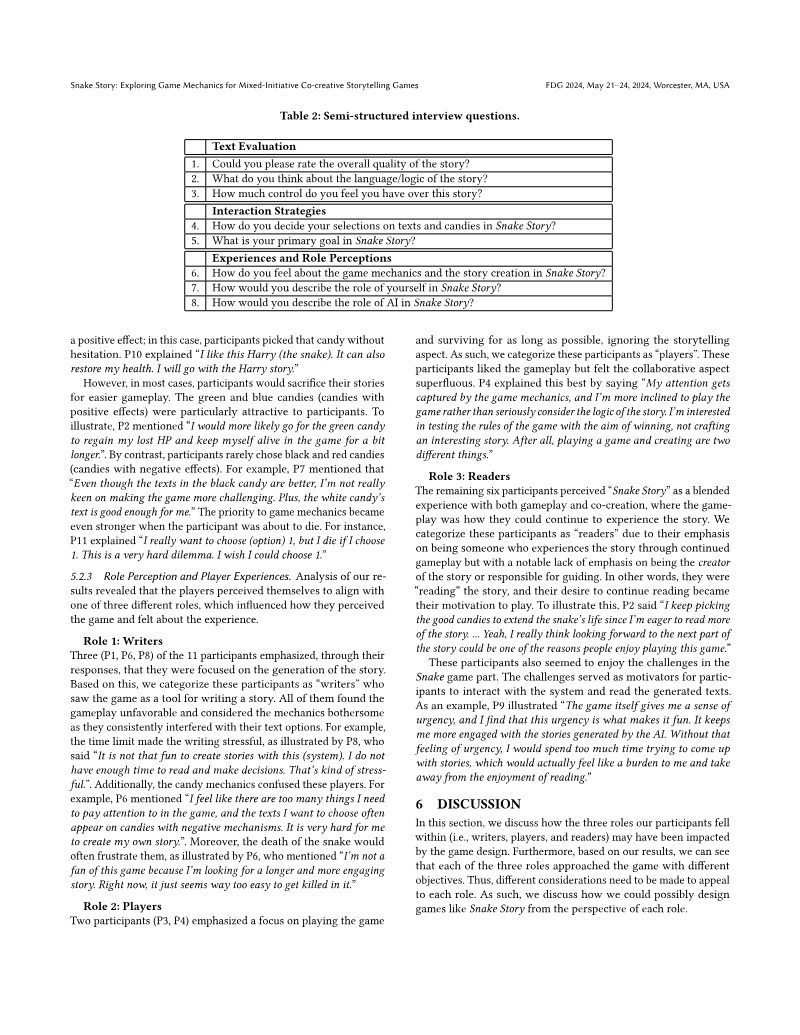
- Player behavior in mixed-initiative games tends to fragment into three distinct archetypes: 'writers' who prioritize creative control, 'players' focused on mechanical objectives, and 'readers' who balance both.
- Tight coupling of creative tasks and high-pressure gameplay reduces overall player agency, as the demands of survival frequently override the desire for narrative engagement.
EvolvingBehavior: Towards Co-Creative Evolution of Behavior Trees for Game NPCs
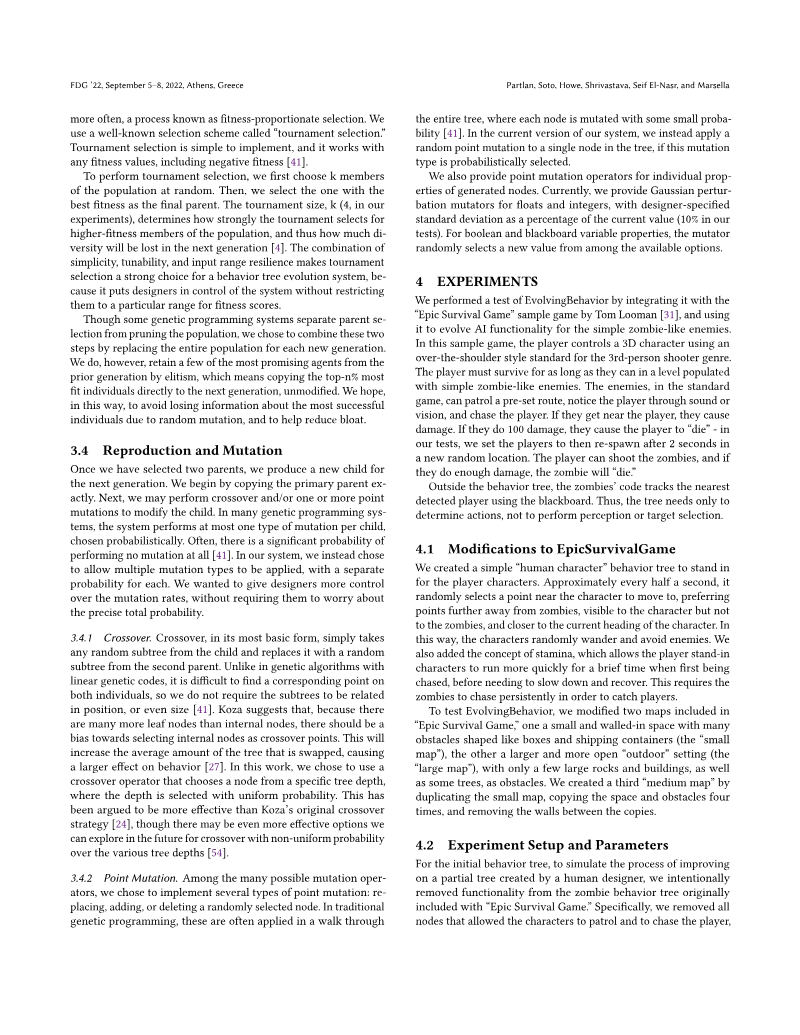
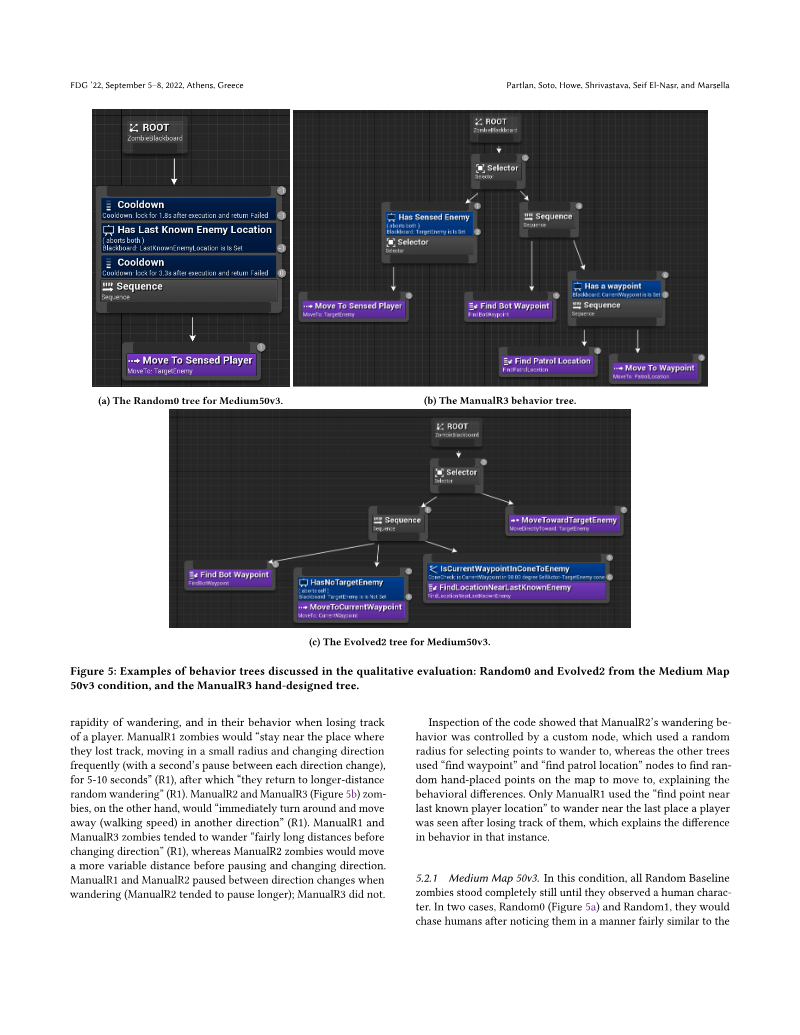
EvolvingBehavior introduces a genetic programming framework integrated into Unreal Engine 4 designed to facilitate the co-creative development of non-player character (NPC) behavior trees.
- EvolvingBehavior utilizes a genetic programming framework within Unreal Engine 4 to automate the creation of NPC behavior trees while maintaining human-readable, inspectable logic.
- The system employs evolutionary operators—specifically tournament selection, elitism, and mutation—to optimize AI logic, with performance validated against random baselines using the Friedman test.
- Evolved agents demonstrate patrolling and chasing behaviors that match the efficacy of hand-crafted designs without the excessive code bloat typically associated with automated program synthesis.
Design-Driven Requirements for Computationally Co-Creative Game AI Design Tools
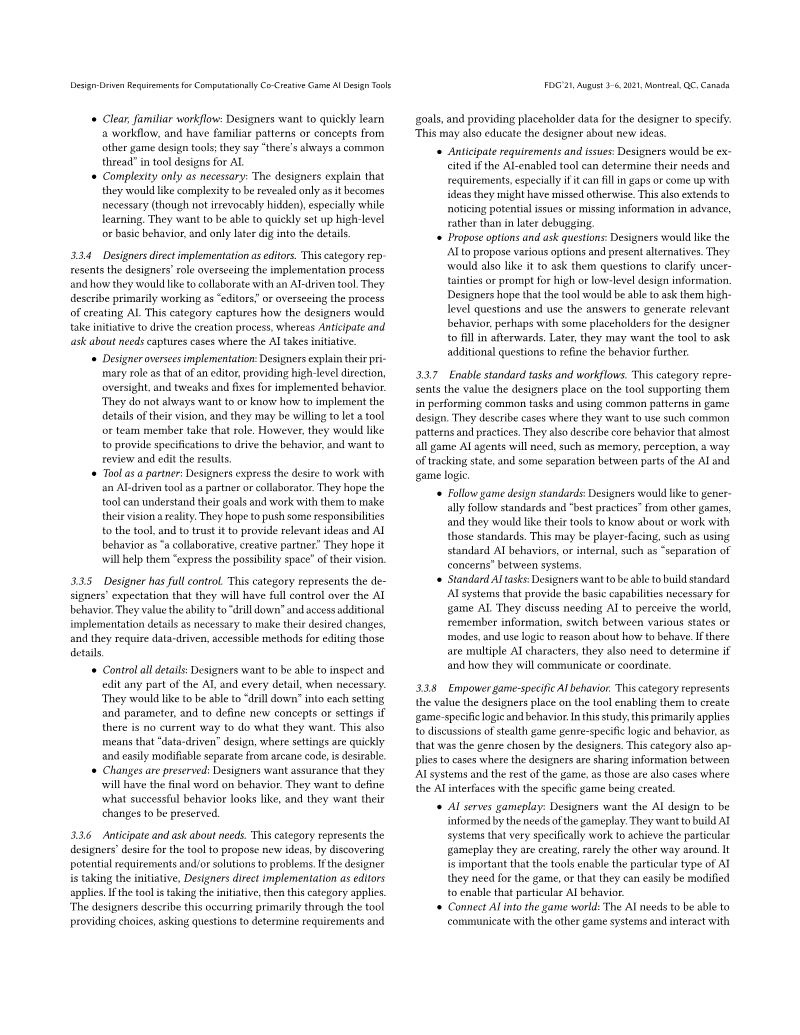
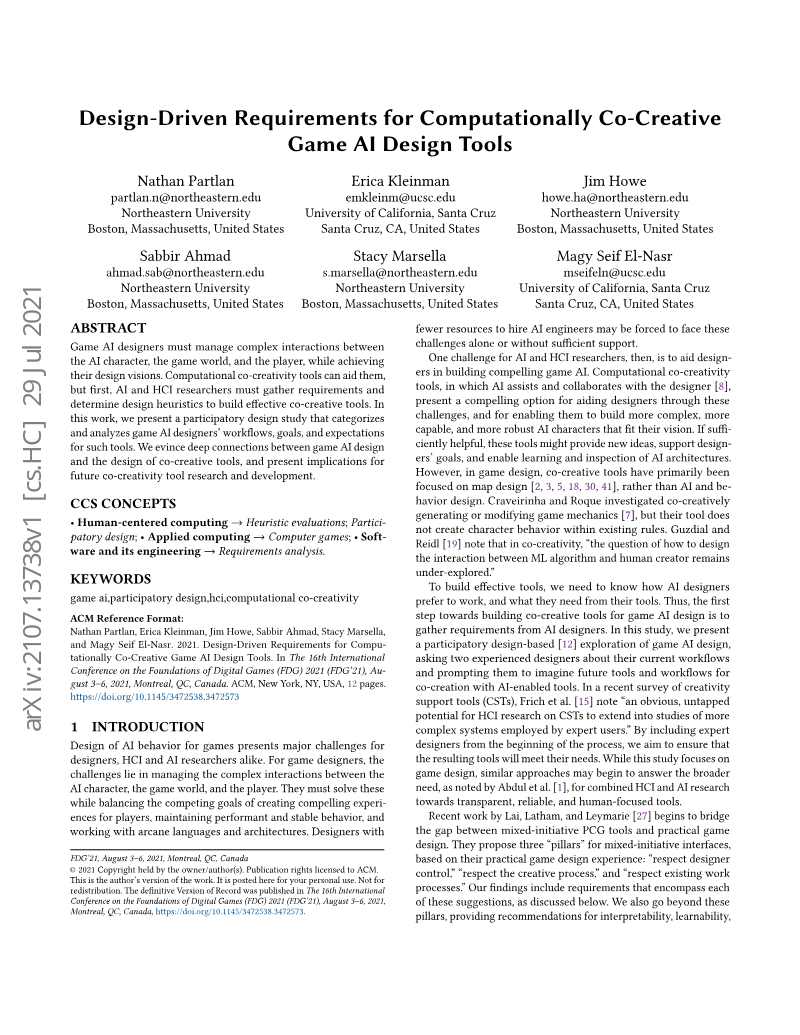
Computationally co-creative game AI tools must prioritize the alignment of technical capabilities with the nuanced workflows of professional designers.
- Game AI tools must prioritize human-in-the-loop workflows that position designers as editors, ensuring creative oversight remains central while AI manages technical complexity.
- Effective co-creative systems require thirteen specific design requirements to bridge the gap between advanced algorithmic development and practical production needs.
- Designers prioritize granular control, visual debugging, and interpretability over technical perfection, favoring tools that produce characterful and varied behaviors.
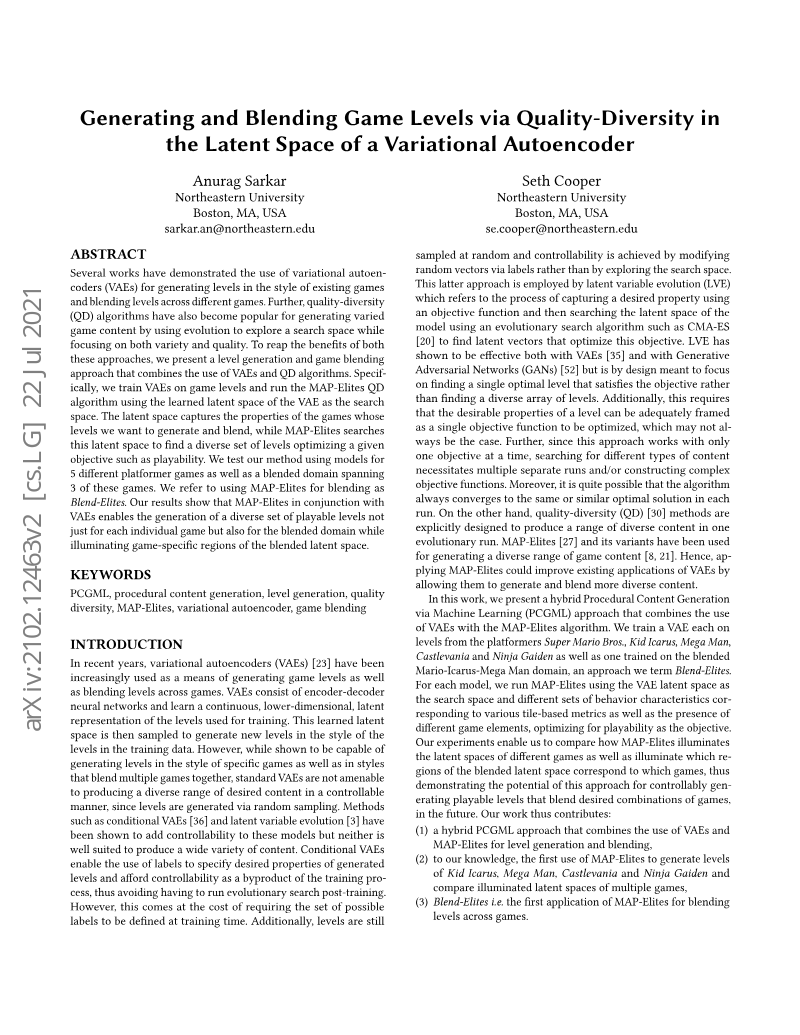
Generating and Blending Game Levels via Quality-Diversity in the Latent Space of a Variational Autoencoder
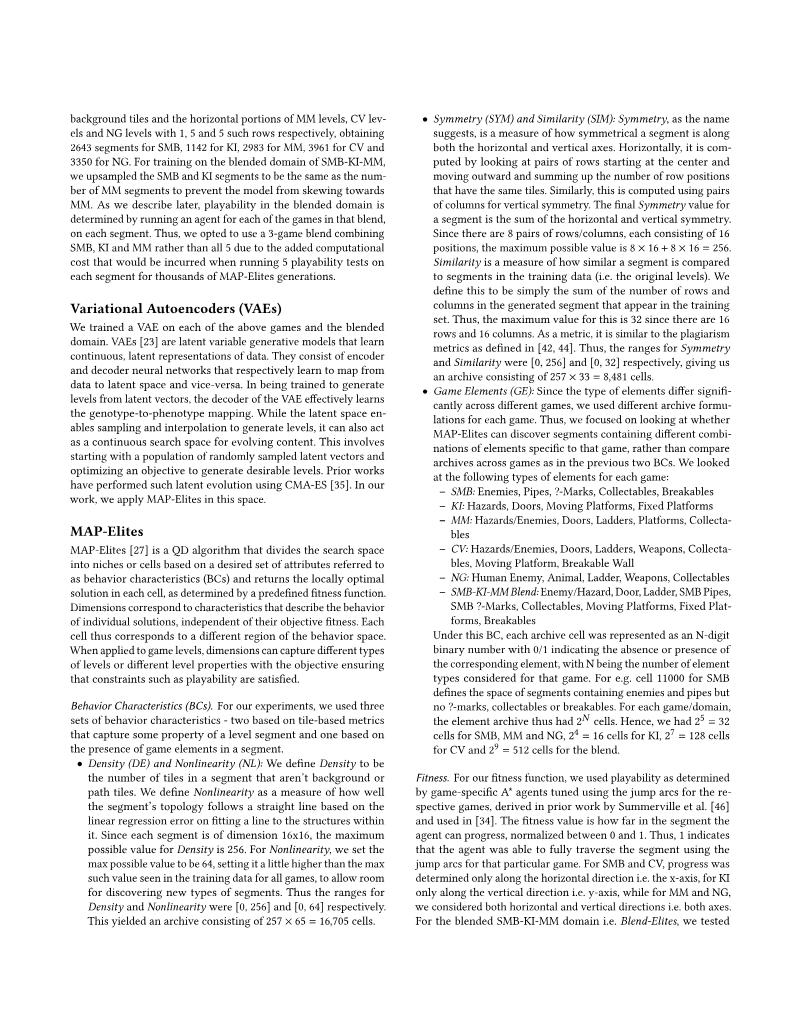
The integration of Variational Autoencoders with the MAP-Elites quality-diversity algorithm provides a robust framework for procedural content generation in platformer games.
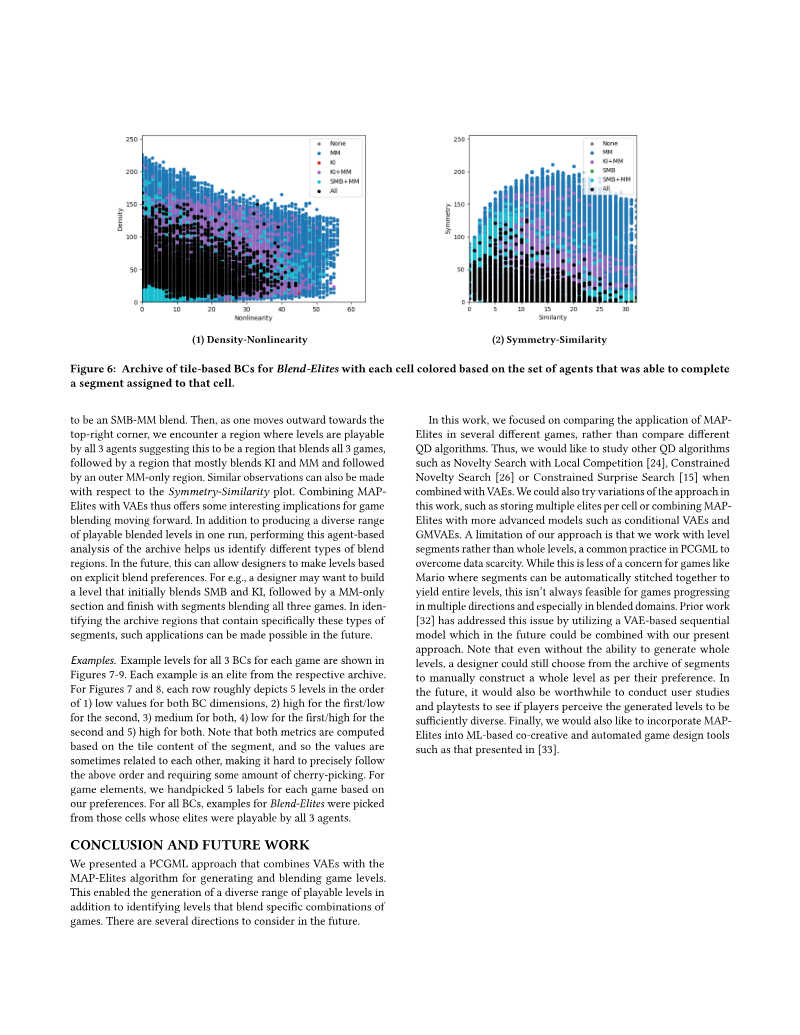
- The 'Blend-Elites' framework combines Variational Autoencoders (VAEs) with the MAP-Elites quality-diversity algorithm to systematically generate and blend diverse, playable platformer level segments.
- This methodology enables designers to exert granular control over procedural content generation by searching the structured latent space of a VAE to discover high-quality level configurations.
- The system was validated across five distinct NES-era platformer titles, demonstrating its ability to synthesize complex content that remains functionally compatible with multiple game agents.

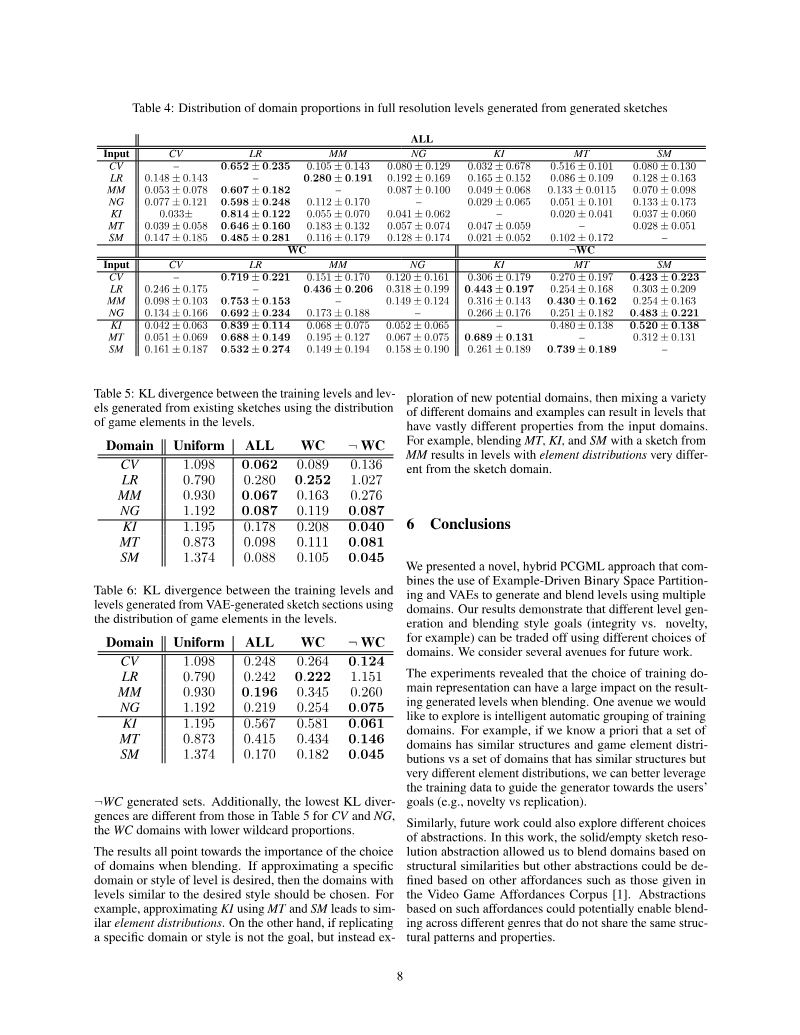
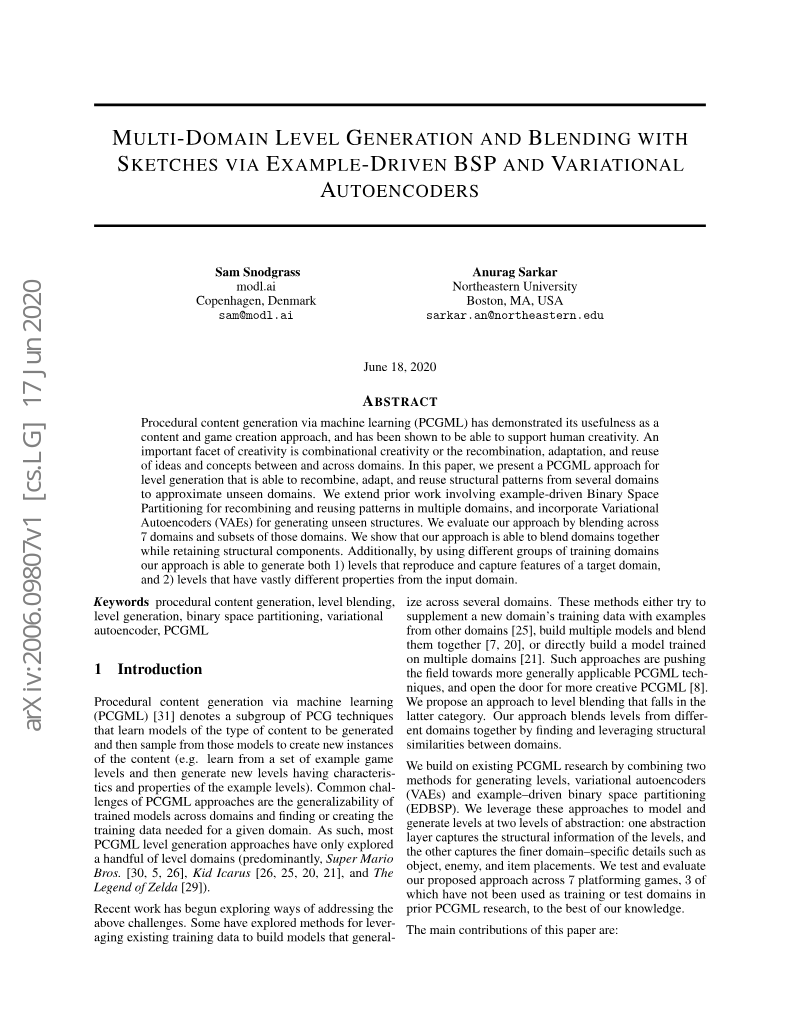
Multi-Domain Level Generation and Blending with Sketches via Example-Driven BSP and Variational Autoencoders
Procedural content generation in the gaming industry is evolving through a hybrid approach that integrates machine learning with structural partitioning to create versatile level designs.
- A hybrid procedural generation pipeline combining Variational Autoencoders (VAEs) with Example-Driven Binary Space Partitioning (BSP) allows for the automated creation of platforming levels.
- This methodology has been successfully validated across seven distinct platforming game domains, demonstrating its versatility in reproducing existing patterns or generating novel environments.
- The system functions by generating abstract structural sketches via VAEs, which are then populated with domain-specific details through BSP.
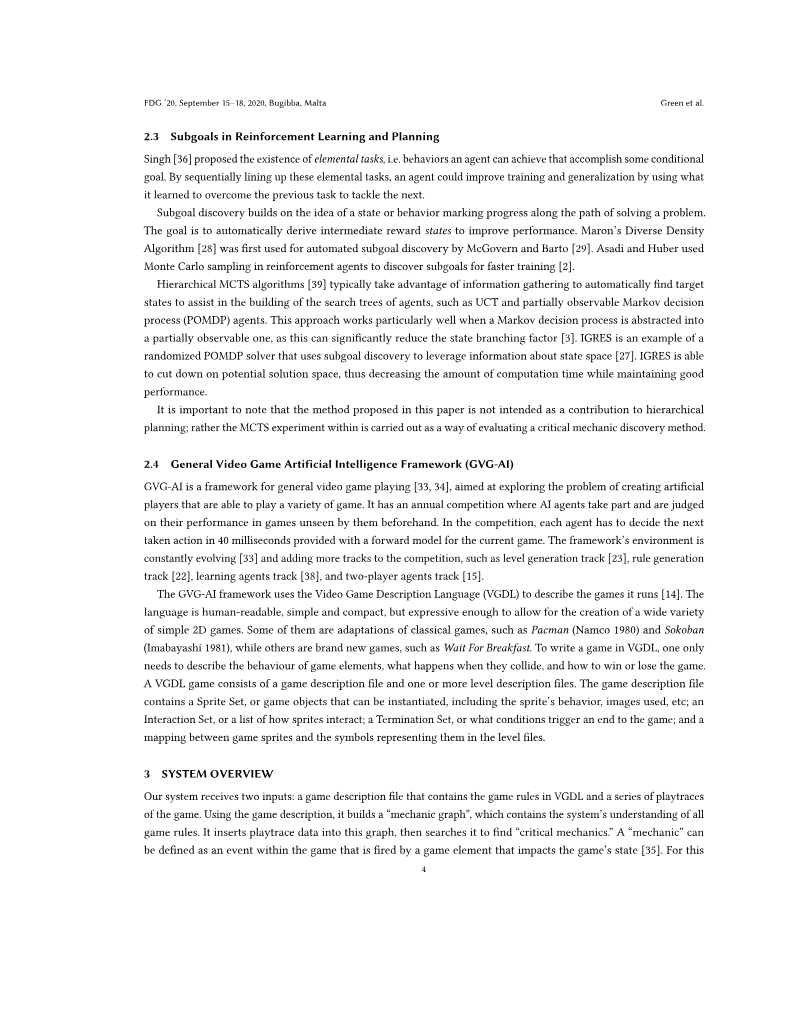

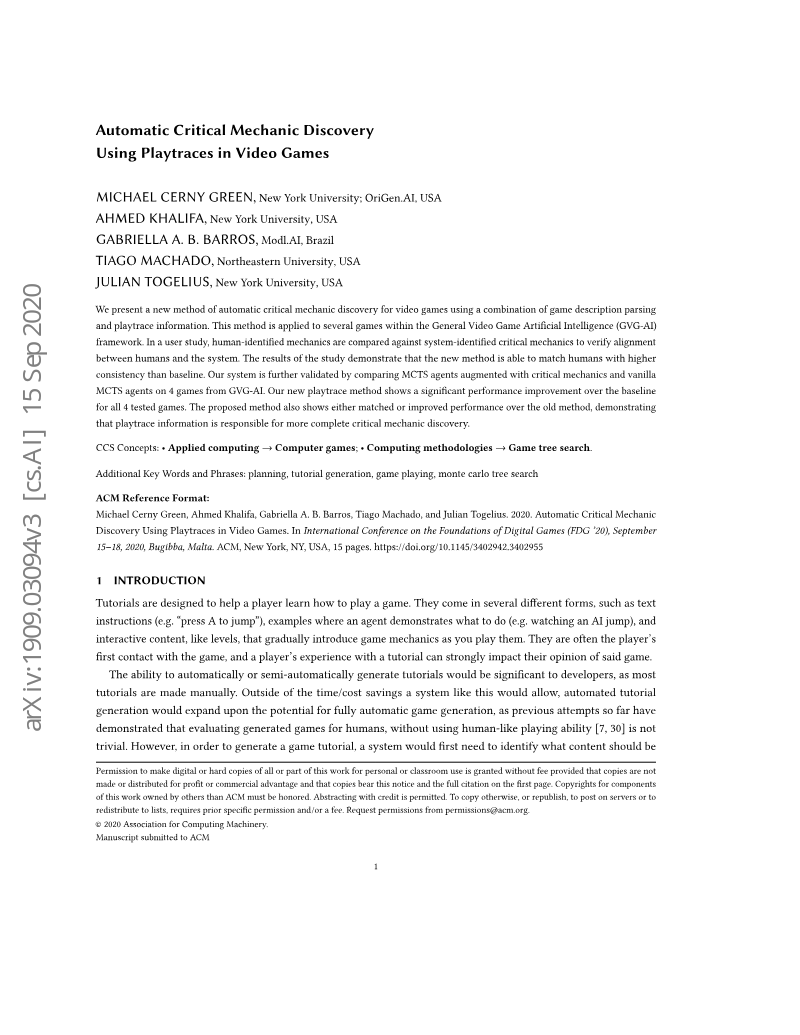
Automatic Critical Mechanic Discovery Using Playtraces in Video Games
Automated identification of critical game mechanics—the essential actions required to achieve victory—represents a significant advancement in computational game analysis.
- Automated identification of critical game mechanics by combining game description parsing with empirical playtraces more accurately reflects human-identified priorities than baseline methods like AtDelfi.
- Integrating discovered critical mechanics into Monte Carlo Tree Search agents significantly improves win rates in complex game environments such as Plants.
- Prioritizing critical actions within an agent's decision-making framework increases the efficiency and goal-orientation of the planning process.
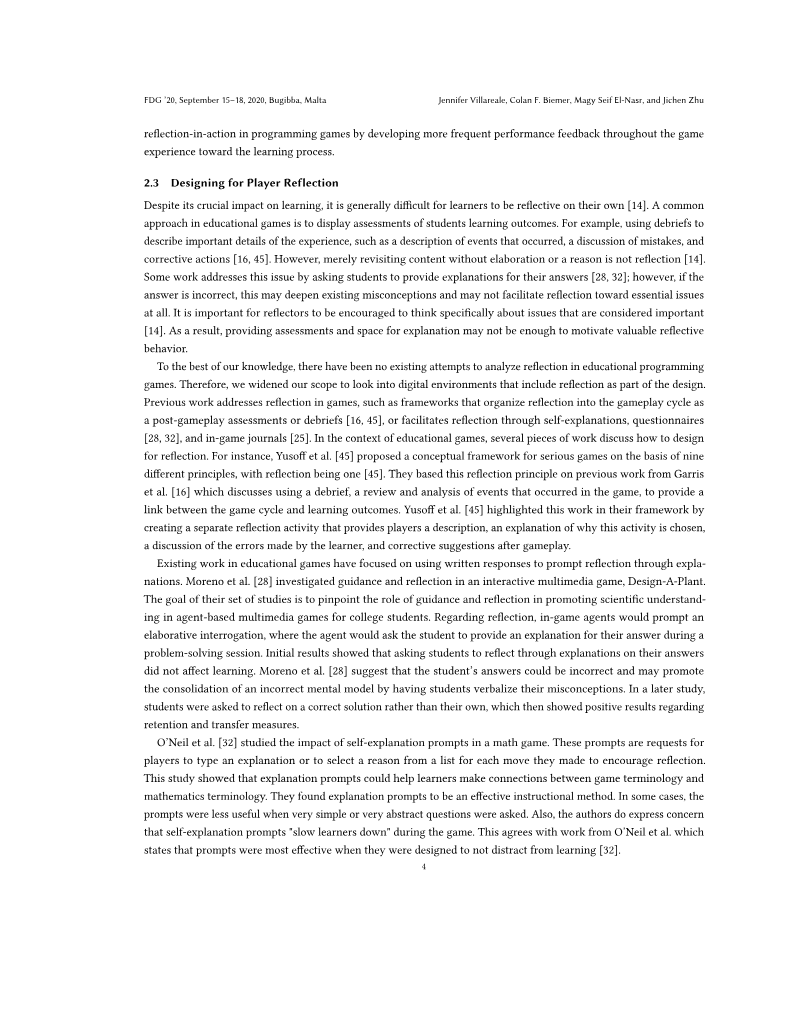
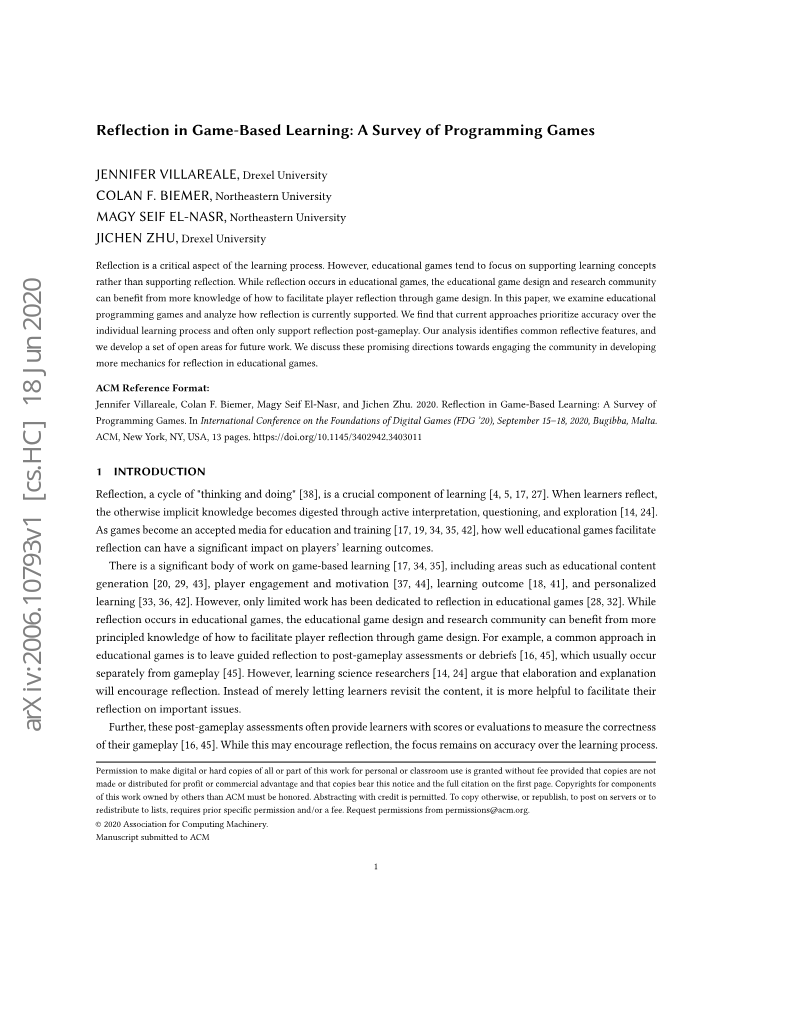
Reflection in Game-Based Learning: A Survey of Programming Games
Educational programming games frequently prioritize evaluative accuracy over the cognitive processes required for deep learning.
Data-Driven Game Development: Ethical Considerations
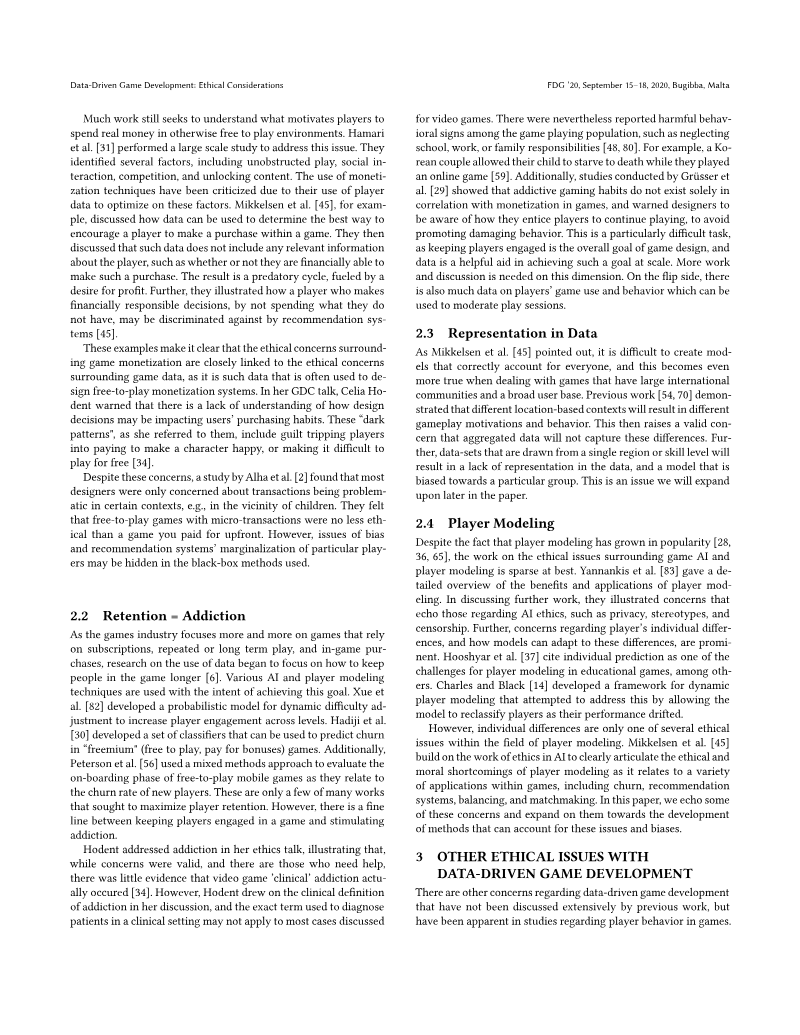
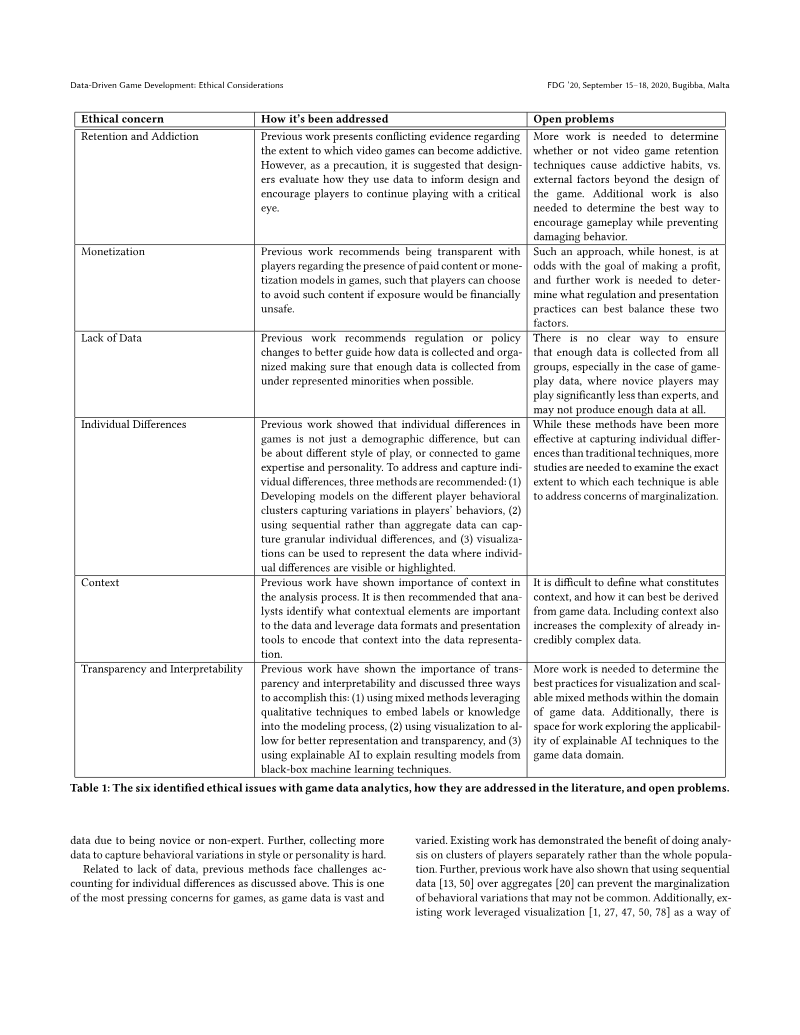
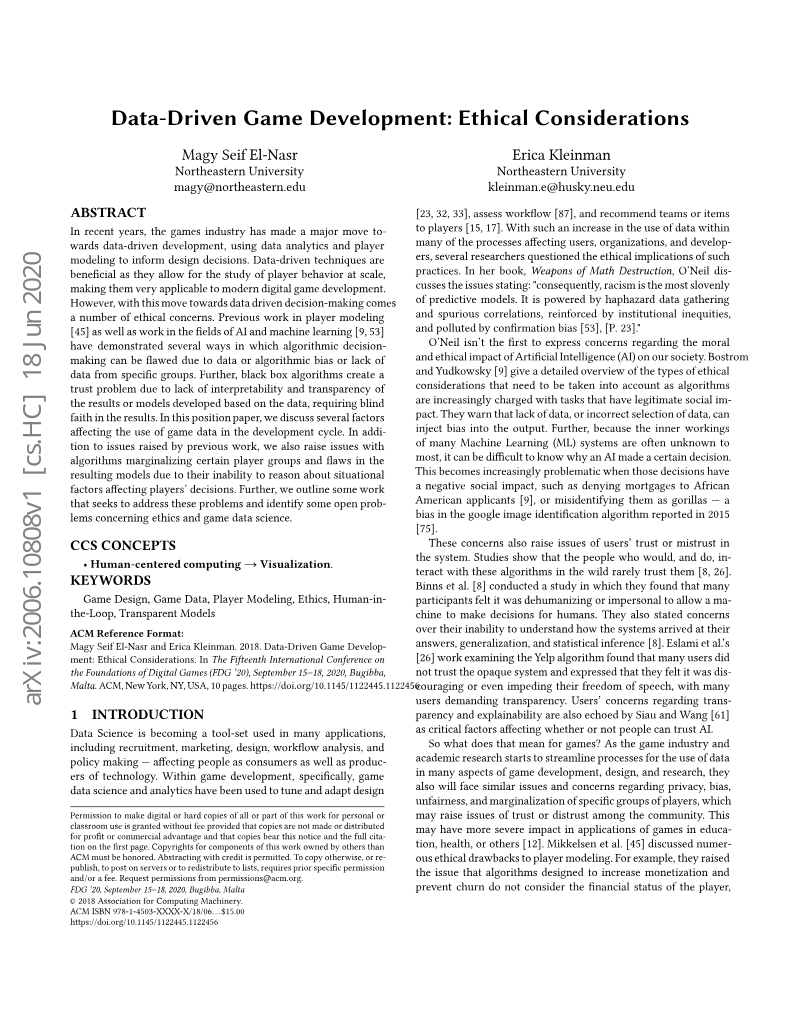
The modern game industry is undergoing a fundamental shift toward data-driven development, a transition that necessitates a rigorous examination of the ethical implications inherent in algorithmic decision-making.
- Data-driven development risks normalizing predatory monetization and addictive engagement loops if left unchecked by ethical oversight.
- Algorithmic bias in data aggregation threatens to marginalize minority player groups, necessitating a shift toward more inclusive design practices.
- The industry's reliance on opaque, black-box models prevents the transparency required for accountability in game design.

And then they died: Using Action Sequences for Data Driven, Context Aware Gameplay Analysis
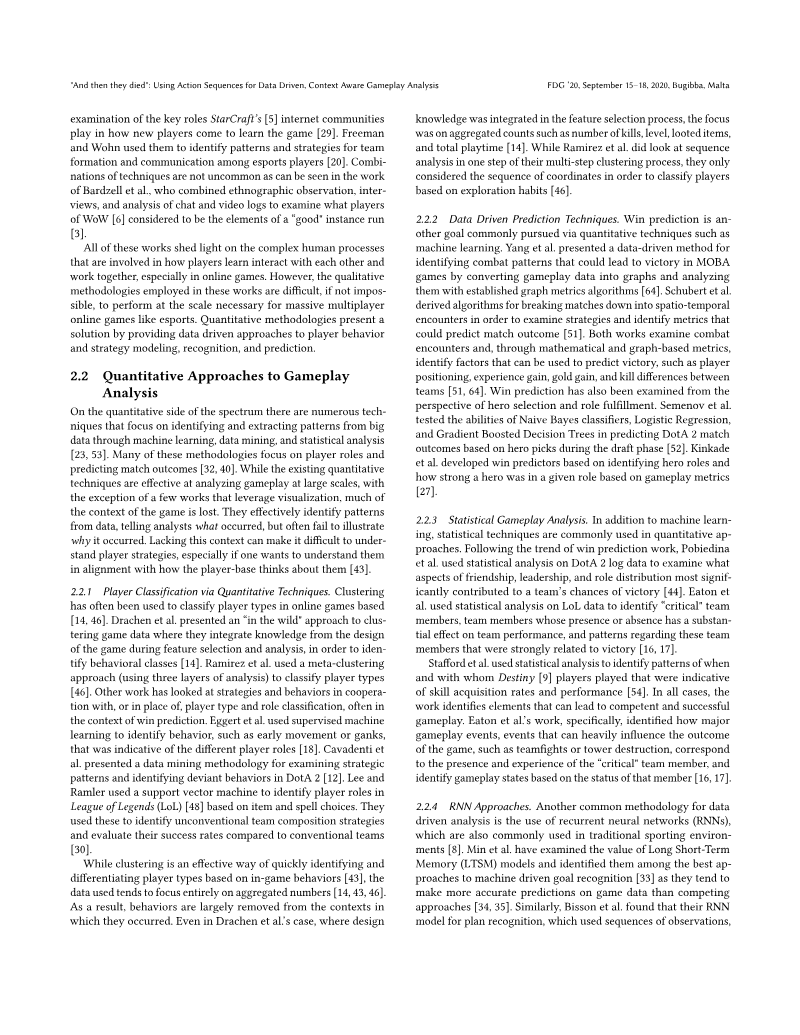
A novel mixed-methods framework integrates sequence analysis with interactive behavior analytics to provide a scalable, context-aware approach to gameplay evaluation.
- The proposed mixed-methods framework bridges the gap between high-level quantitative telemetry and qualitative observation by abstracting raw player data into actionable, context-aware behavioral sequences.
- The methodology utilizes a human-in-the-loop approach to improve inter-rater reliability, significantly reducing the subjectivity inherent in traditional manual annotation processes.
- Analysis of Defense of the Ancients 2 (Dota 2) demonstrates that the framework successfully identifies distinct strategic shifts, such as early-game focus on neutralizing carry heroes versus late-game prioritization of objective control.
Do you work at Northeastern University? Get a free report of how these documents are read and cited here.