Key insights
6 slides
The core model
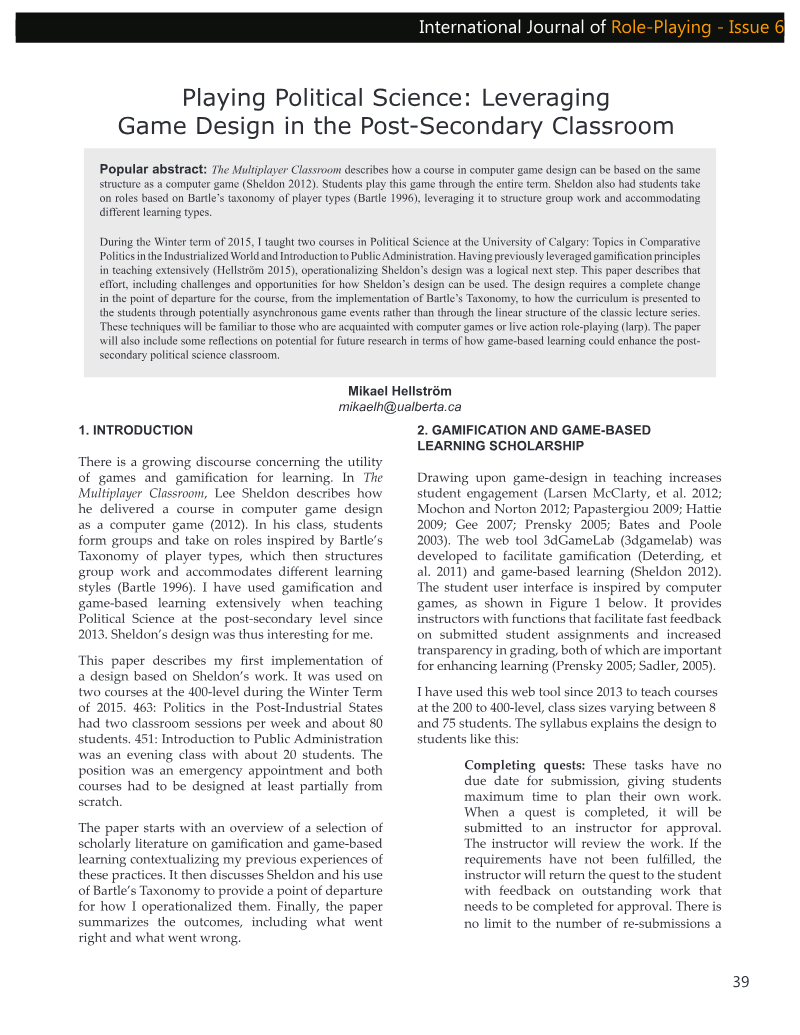
A course was run as a persistent game with experience points.
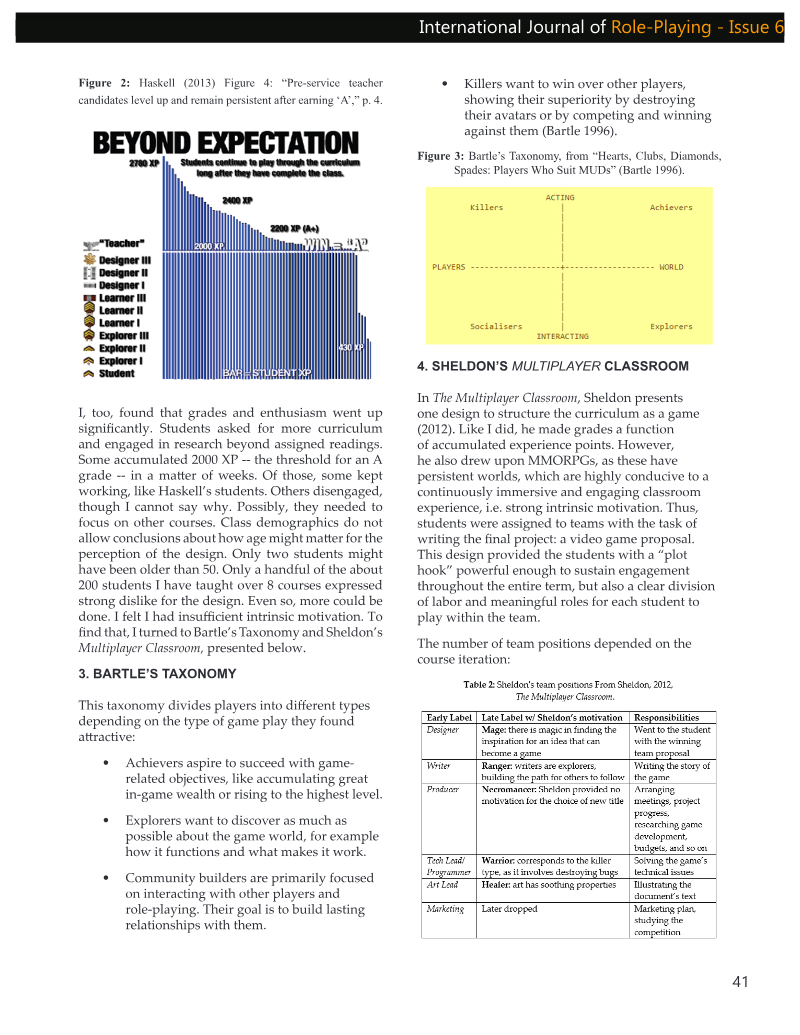
The design drew on Lee Sheldon's Multiplayer Classroom model and Richard Bartle's taxonomy of player types. Quests and character-style roles structured the course.
1 / 6
- 01The paper applies Lee Sheldon's 'Multiplayer Classroom' model, treating a course as a persistent game with experience points, quests, and player roles drawn from Richard Bartle's player-type taxonomy.
- 02The design was implemented in Winter 2015 at the University of Calgary across a 400-level comparative politics seminar (about 75–80 students) and an evening public administration course (about 20 students).
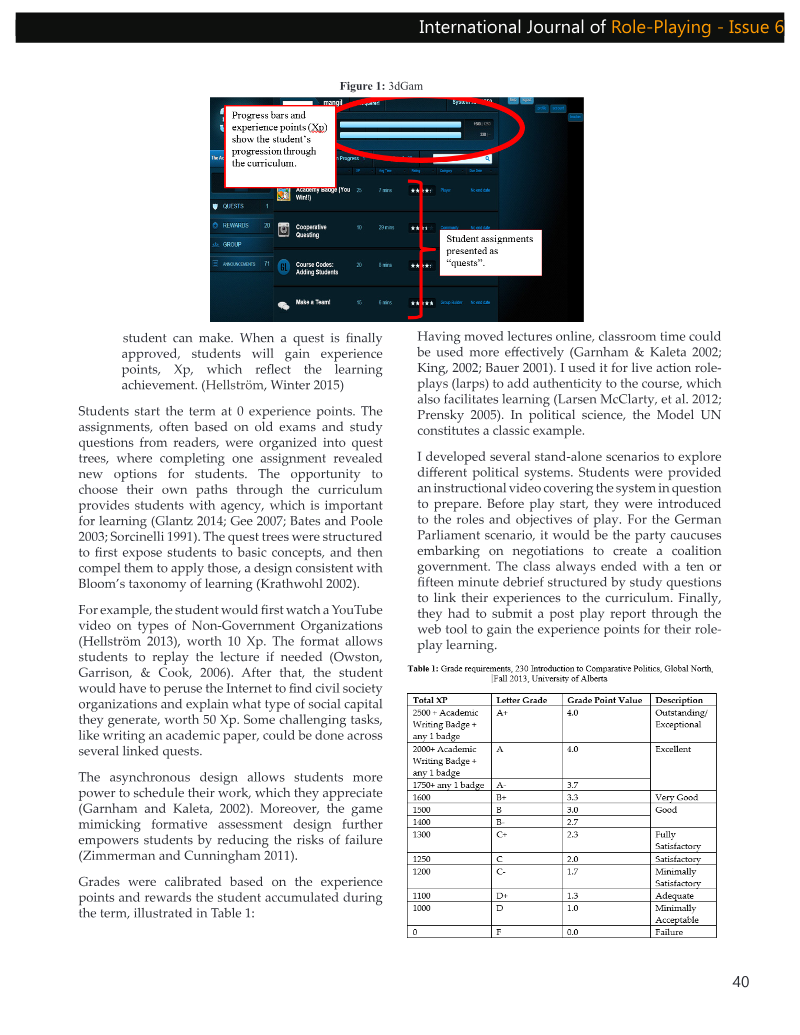
- 03Students could resubmit quests without limit, and experience points determined final grades, with 2,000 XP serving as the threshold for an A; some students reached it within weeks and pursued research beyond the assigned readings.
- 04Roughly 80 percent of students expressed strong enthusiasm, but the evidence is anecdotal, drawn from the instructor's observations and course evaluations rather than a controlled study.
- 05Overall instruction ratings averaged about 85 percent, down from the author's typical 95 percent, with content organization receiving the lowest scores in both courses, partly attributed to a rushed emergency appointment timeline.
- 06Narrative cohesion was uneven, some transitions felt contrived, and the political capital mechanic remained unclear to students.
- 07The author concludes the design needs simpler status-tracking systems so instructors can focus on assessing learning, and recommends future research on game-based approaches in political science education.
Ask AI about this article
Summary
Mikael Hellström's paper examines how game design principles can be applied to structure a post-secondary political science course, drawing on Lee Sheldon's "Multiplayer Classroom" model, which treats a course as a persistent computer game with experience points, quests, and player roles derived from Richard Bartle's taxonomy of player types. The author implemented this design during the Winter 2015 term at the University of Calgary in two courses: a 400-level comparative politics seminar with roughly 75 to 80 students and an evening introduction to public administration course with about 20 students. The paper argues that asynchronous quest trees, character-class roles, and continuous narrative can increase engagement, though it presents its findings as an experiential account rather than a controlled study.
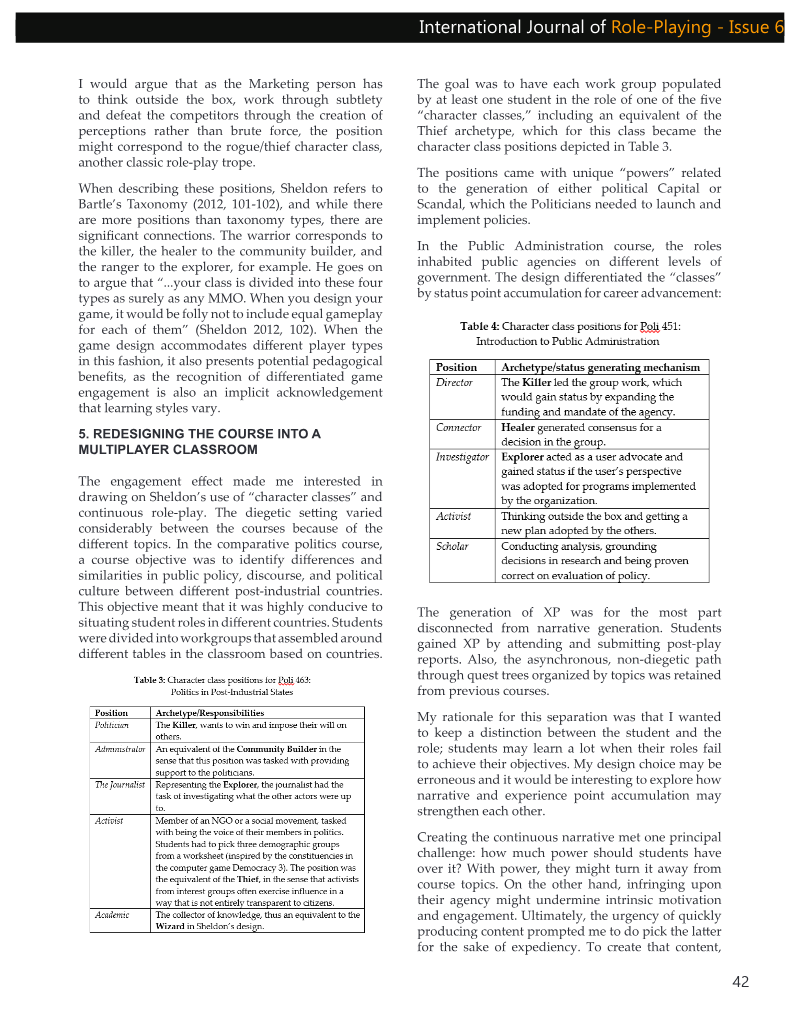
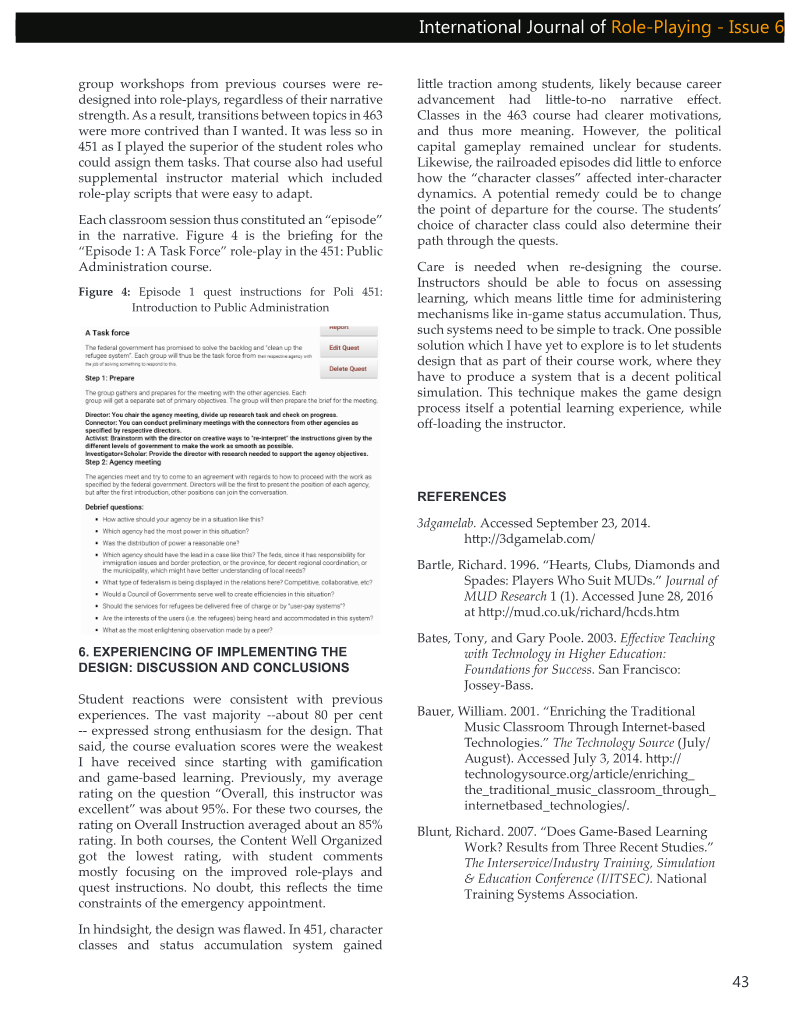
Course structure in the design rested on quests that students could resubmit without limit, experience points that determined final grades, and classroom sessions framed as narrative episodes such as role-played parliamentary coalition negotiations or interagency task forces. Roles were adapted from Sheldon's classes, including Politician, Journalist, Activist, and Academic in the comparative course, and Director, Investigator, and Activist in the public administration course. The author reports that roughly 80 percent of students expressed strong enthusiasm, that some students exceeded the 2,000 XP threshold for an A within weeks and pursued research beyond assigned readings, and that others disengaged. The evidence is anecdotal, based on the instructor's observations and course evaluations.
The paper is candid about shortcomings. Overall instruction ratings averaged about 85 percent, down from the author's typical 95 percent, and content organization received the lowest scores in both courses, which the author attributes partly to the rushed timeline of an emergency appointment. Narrative cohesion proved uneven, with some transitions feeling contrived and the political capital mechanic remaining unclear to students. The author concludes that the design needs simpler status-tracking systems so instructors can focus on assessing learning, and suggests future research on how game-based approaches could enhance political science education.