GREE
Game Co.192 documents
Documents
Financial5 pages
FY2018 1Q Result Presentation
GREE, Inc. reported its financial results for the first quarter of fiscal year 2018, ending June 2018, highlighting a period of strategic transition and growth. The company achieved net sales of ¥21.6 billion and an operating income of ¥2.7 billion, marking four consecutive quarters of revenue growth. This performance was driven primarily by the successful release and operation of native mobile games and a stable browser-based business. While net income appeared lower year-on-year, the decline was attributed to a one-time ¥10 billion tax and profit effect from the previous year’s North American reorganization; excluding this, net income showed an upward trend.
The company’s strategy focuses on three pillars: native game development, global expansion, and media operations. In the gaming segment, GREE is leveraging high-profile intellectual properties (IP) and engine-driven development. Key titles such as Another Eden and SINoALICE performed well, with the latter benefiting from major collaborations. To drive future growth, the company is expanding into overseas markets through partnerships with entities like Crunchyroll and Sumitomo Corporation. The development pipeline remains active, with one title scheduled for release in the first half of the year and five more in the second half.
In the media and advertising sector, GREE is aggressively investing to expand its user base. Monthly active users for the LIMIA platform reached one million, and total page views across media properties grew 2.4 times quarter-on-quarter. To support this growth, the company increased advertising spending by over ¥500 million, focusing on domestic markets and TV commercials. Despite these rising variable costs and commission fees, GREE maintained stable operating margins by reducing fixed costs and optimizing its labor structure following the closure of certain overseas operations. The company expects moderate performance in the second quarter before a new wave of product releases.
- GREE reported Q1 FY2018 net sales of ¥21.6 billion and operating income of ¥2.7 billion, marking four consecutive quarters of revenue growth.
- Net income performance was impacted by a one-time ¥10 billion tax and profit effect from a prior-year North American reorganization, though underlying net income trended upward.
- Growth in the gaming segment was driven by high-profile titles including Another Eden and SINoALICE, with a pipeline of six new titles scheduled for the remainder of the fiscal year.
- Media and advertising operations saw significant expansion, with the LIMIA platform reaching one million monthly active users and total page views growing 2.4 times quarter-on-quarter.
- The company increased advertising expenditure by over ¥500 million to support media growth, while maintaining operating margins through fixed cost reductions and labor optimization.
+1
GREEOct 2017

Financial44 pages
FY2017 Fourth Quarter Financial Results
Fiscal year 2017 marked a significant strategic turnaround for GREE, characterized by a successful transition toward native mobile gaming and a robust recovery in financial performance. The company reported annual net sales of ¥65.4 billion and operating income of ¥8.0 billion, figures that exceeded initial projections. This growth was primarily driven by a fourth-quarter release blitz where four new native titles reached the top 20 sales rankings. Consequently, quarterly coin consumption surged to 21.5 billion, with native games surpassing 50% of total consumption for the first time. This shift underscores a fundamental evolution in the revenue model from legacy web-based games to modern mobile applications.
The operational focus for the upcoming 2018 fiscal year centers on a Japan-based global development model, leveraging established intellectual property and a proprietary game engine to scale international operations. Plans include the release of six new titles and aggressive upfront investments to solidify this global footprint. Beyond core gaming, there is a concerted effort to diversify earnings through the expansion of advertising and media segments, supported by high-quality video production and strategic joint ventures like Library Cross Infinite. These initiatives aim to establish a secondary pillar of profitability alongside the revitalized game business.
Financial stability remains a cornerstone of the corporate strategy, as evidenced by a strong cash position of ¥82.38 billion at the close of the fiscal year. While native game consumption saw temporary fluctuations earlier in the period due to title transfers, the year ended with high momentum and a workforce of 1,463 employees concentrated in Japanese development hubs. Projections for the first quarter of fiscal year 2018 anticipate net sales of ¥20.5 billion, reflecting continued confidence in the current release pipeline and the long-term viability of the multi-genre investment strategy.
- GREE achieved a strategic turnaround in FY2017 with ¥65.4 billion in net sales and ¥8.0 billion in operating income, both exceeding initial projections.
- Native mobile games now account for over 50% of total coin consumption, marking a successful transition away from legacy web-based gaming models.
- The company's Q4 performance was bolstered by a release blitz that placed four new native titles in the top 20 sales rankings, driving quarterly coin consumption to 21.5 billion.
- GREE maintains a strong financial position with ¥82.38 billion in cash reserves to support its FY2018 global development strategy.
- The FY2018 roadmap includes the release of six new titles and a focus on diversifying revenue through advertising and media segments, such as the Library Cross Infinite joint venture.
+1
GREEAug 2017
Financial8 pages
FY2017 4Q Result Presentation
GREE, Inc. reported its fiscal year 2017 fourth-quarter results, highlighting a successful turnaround of its game business and a strategic shift toward global distribution. For the full year, the company achieved net sales of ¥65.4 billion and an operating income of ¥8 billion. The fourth quarter saw quarter-on-quarter growth with ¥19.2 billion in net sales and ¥2.4 billion in operating income, driven by the successful launch of four native games—including Another Eden and SINoALICE—all of which reached the top 20 rankings.
A primary finding is the completion of a strategic pivot in overseas operations. The company decided to close international subsidiaries and consolidate all game development within Japanese studios to focus on global distribution. This transition resulted in a one-time extraordinary loss of approximately ¥6 billion due to asset write-downs and closure costs. Despite these charges, the company restored a double-digit operating income margin and reported that native games now account for more than half of total coin consumption, which reached a target of 10 billion coins.
The outlook for fiscal year 2018 emphasizes a medium-term growth strategy centered on three pillars: game engines, intellectual property (IP), and global distribution. By reusing technical bases across different titles, the company aims to reduce development costs and increase investment in content quality. The pipeline includes six approved titles, with a focus on balancing first-party, co-developed, and third-party IPs. Additionally, GREE plans to expand its advertising and media business as a second major earnings pillar, focusing on high-retention apps and video production. While net sales are forecast to grow to ¥20.5 billion in the next quarter, operating income is expected to decline temporarily due to aggressive front-loaded investments in marketing and promotion to ensure long-term sustainability.
- GREE achieved FY2017 full-year net sales of ¥65.4 billion and an operating income of ¥8 billion, with Q4 performance reaching ¥19.2 billion in sales and ¥2.4 billion in operating income.
- The company completed a strategic pivot by closing international subsidiaries to consolidate development in Japan, incurring a one-time extraordinary loss of approximately ¥6 billion.
- Q4 growth was driven by the successful launch of four native games, including Another Eden and SINoALICE, all of which reached the top 20 rankings.
- Native games now account for over 50% of total coin consumption, which reached the company's target of 10 billion coins.
- The FY2018 growth strategy focuses on three pillars: leveraging shared game engines to reduce costs, expanding IP development, and prioritizing global distribution.
GREEAug 2017
Financial3 pages
Summary of Main Questions and Answers at the FY2017 Fourth Quarter GREE Results Briefing
The fiscal year 2017 fourth quarter results briefing for GREE highlights a strategic pivot toward sustainable earnings growth driven by high-quality native game development and global expansion. Management indicates that the company has successfully enhanced its development capabilities, allowing for a more robust pipeline and improved user retention. A central component of this strategy involves leveraging strong first-party and third-party intellectual property, such as the smartphone adaptation of the classic RPG Wild Arms, while ensuring compatibility between chosen IPs and internal game engines.
Financial performance and cost structures are increasingly influenced by the shift from web-based games to native applications. While native games based on popular IPs drive sales growth, they also carry higher commission fees and advertising costs. For the first quarter of fiscal year 2018, the company anticipates increased spending on outsourcing to bolster operating systems and quality assurance, alongside higher marketing expenses for successful new launches. These costs are partially offset by reduced labor expenses following the closure of certain development bases and the transfer of overseas operations.
The geographic scope of operations is expanding through a global strategy that emphasizes simultaneous development for Japanese and international markets. GREE is currently implementing operating systems designed to support localized versions of its native titles to capitalize on global demand. Furthermore, the company reports positive momentum from recent releases like Library Cross Infinite and AKB48 Stage Fighter 2 Battle Festival, noting that pre-registration volumes exceeded internal targets. This performance, combined with more effective television advertising and content updates for existing titles, supports the company’s outlook for long-term fan engagement and stabilized revenue streams.
- GREE is pivoting its business model from web-based games to high-quality native applications to drive long-term earnings growth.
- The company is prioritizing the development of native titles using both first-party and third-party intellectual property, exemplified by the smartphone adaptation of Wild Arms.
- Financial performance is being impacted by higher commission fees and advertising costs associated with native apps, which the company is offsetting by closing development bases and streamlining overseas operations.
- For Q1 FY2018, GREE plans to increase spending on outsourcing for quality assurance and operating systems, alongside higher marketing budgets for new product launches.
- GREE is implementing a global strategy that features simultaneous development for Japanese and international markets, supported by localized operating systems.
+2
GREEAug 2017
Financial35 pages
FY2017 Third Quarter Financial Results
GREE’s financial results for the third quarter of fiscal year 2017 demonstrate a period of strategic transition and growth, characterized by a recovery in the domestic native game business and expansion into video-related media. The company reported net sales of ¥15.9 billion and operating income of ¥1.5 billion, representing quarter-on-quarter growth in both metrics. This performance was driven primarily by increased coin consumption in domestic native games, which rose to 5.4 billion coins following a successful "release blitz" of new titles.
The operational scope focuses heavily on the Japanese mobile gaming market, supplemented by overseas operations and a growing advertising and media segment. During the period, the company released two first-party IP titles, Rara-MAGI and A Farewell to Arms, both of which achieved strong starts in sales rankings. The development pipeline remains robust with ten titles in progress, including high-profile collaborations such as SINoALICE with Square Enix. Beyond gaming, the company integrated the new subsidiary 3Minute, which achieved record-high monthly sales, signaling a strategic pivot toward video-based advertising and lifestyle media.
Financially, the company maintains a strong balance sheet with ¥79.4 billion in net cash. While total costs increased to ¥14.3 billion due to higher commission fees and the consolidation of new subsidiaries, advertising expenses were reduced through improved efficiency. Looking ahead to the fourth quarter, the company forecasts steady net sales of ¥15.9 billion and operating income of ¥1.4 billion. The strategy centers on sustaining the momentum of recent launches and investing in the FY2018 pipeline to drive long-term top-line growth.
- GREE reported Q3 FY2017 net sales of ¥15.9 billion and operating income of ¥1.5 billion, marking quarter-on-quarter growth for both metrics.
- Domestic native game performance recovered, with coin consumption rising to 5.4 billion following a successful release blitz of new titles.
- The company released two new first-party IP titles, Rara-MAGI and A Farewell to Arms, and currently has ten titles in development, including the SINoALICE collaboration with Square Enix.
- The acquisition and integration of subsidiary 3Minute drove record-high monthly sales, supporting a strategic pivot toward video-based advertising and lifestyle media.
- GREE maintains a strong financial position with ¥79.4 billion in net cash, despite total costs increasing to ¥14.3 billion due to higher commissions and subsidiary consolidation.
GREEApr 2017
Financial2 pages
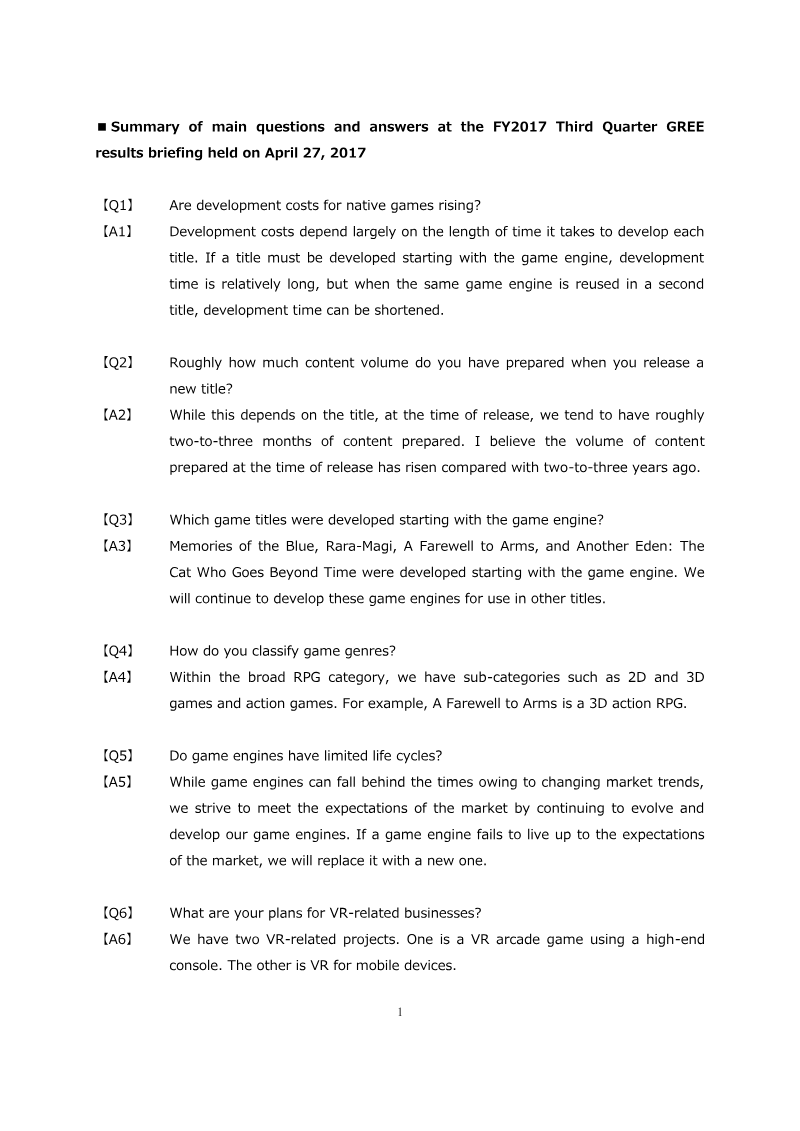
Summary of Main Questions and Answers at the FY2017 Third Quarter GREE Results Briefing Held on April 27, 2017
The fiscal 2017 third-quarter briefing for GREE highlights a strategic shift toward high-quality native mobile game development and the optimization of internal technology stacks. A primary focus of the discussion involves the management of development costs, which are increasingly tied to the creation and reuse of proprietary game engines. While initial investments in engines for titles such as Another Eden and A Farewell to Arms are substantial, the subsequent reuse of these engines for future projects is expected to shorten development timelines and improve cost efficiency.
Market expectations for content volume at launch have increased significantly compared to previous years. Current standards require approximately two to three months of content to be prepared prior to a title's release to ensure sustained player engagement. To meet evolving consumer demands, there is a concerted effort to replicate the depth of home console experiences on mobile devices. This involves categorizing RPGs into specialized sub-genres, such as 3D action RPGs, and maintaining a flexible approach to engine lifecycles, where technology is either evolved or replaced based on shifting market trends.
Beyond core mobile gaming, the business is diversifying into virtual reality and digital media. The VR strategy bifurcates into high-end arcade experiences and mobile-based applications. Simultaneously, the advertising and media segment is pivoting toward video-centric content, bolstered by the acquisition of 3Minute to internalize specialized production expertise. These initiatives reflect a broader objective to leverage technological infrastructure and video know-how to secure long-term growth across multiple digital entertainment platforms.
- GREE is prioritizing high-quality native mobile game development by investing in proprietary game engines for titles like Another Eden and A Farewell to Arms to improve long-term cost efficiency.
- Market standards now require two to three months of content to be prepared prior to a title's release to ensure sustained player engagement.
- The company is shifting its mobile RPG strategy toward console-quality experiences, specifically focusing on specialized sub-genres such as 3D action RPGs.
- GREE is diversifying its business model into virtual reality, splitting its strategy between high-end arcade experiences and mobile-based applications.
- The advertising and media segment is pivoting toward video-centric content, supported by the acquisition of 3Minute to internalize production expertise.
+2
GREEApr 2017
Financial33 pages
FY2017 Second Quarter Financial Results
GREE’s financial results for the second quarter of fiscal year 2017 highlight a significant strategic pivot toward native games and new business segments, resulting in the first quarter-on-quarter sales growth in four years. Net sales reached ¥15.3 billion with an operating income of ¥1.5 billion. While sales grew, operating income saw a ¥1.0 billion decrease from the previous quarter, primarily due to increased advertising investments and depreciation costs following the acquisition of the DragonSoul title.
The domestic native game market showed strong momentum, driven by a major update to Shometsu Toshi 2, which doubled coin consumption. The company maintains a robust development pipeline with ten titles in progress, including high-profile collaborations like the smartphone version of Wild Arms with ForwardWorks. Overseas, the acquisition of DragonSoul in October 2016 contributed to an upturn in the top line, with coin consumption in international markets rising to 3.6 billion. Conversely, the legacy web game business continued its downward trend, with coin consumption falling to ¥11.9 billion.
Beyond gaming, there is a concerted effort to diversify into video-related and virtual reality (VR) businesses. The acquisition of 3Minute in February 2017 aims to accelerate growth in video media, where sales have already increased 3.5 times year-over-year. In the VR sector, the company began supplying attractions to amusement facilities like VR PARK TOKYO. Looking ahead to the third quarter, net sales are forecast to remain stable at ¥15.3 billion, while operating income is expected to decrease slightly to ¥1.2 billion as fixed costs rise with the launch of new titles in the second half of the fiscal year.
- GREE achieved its first quarter-on-quarter sales growth in four years, reaching ¥15.3 billion in net sales for Q2 FY2017.
- Operating income declined by ¥1.0 billion to ¥1.5 billion due to increased advertising spend and depreciation costs associated with the acquisition of the DragonSoul title.
- The company is shifting focus toward native games, supported by a pipeline of ten titles including a Wild Arms smartphone collaboration with ForwardWorks and strong performance from Shometsu Toshi 2.
- Legacy web game performance continues to decline, with coin consumption dropping to ¥11.9 billion, while international coin consumption rose to 3.6 billion following the DragonSoul acquisition.
- Diversification efforts in video media, bolstered by the February 2017 acquisition of 3Minute, resulted in a 3.5x year-over-year sales increase.
GREEFeb 2017
Financial3 pages
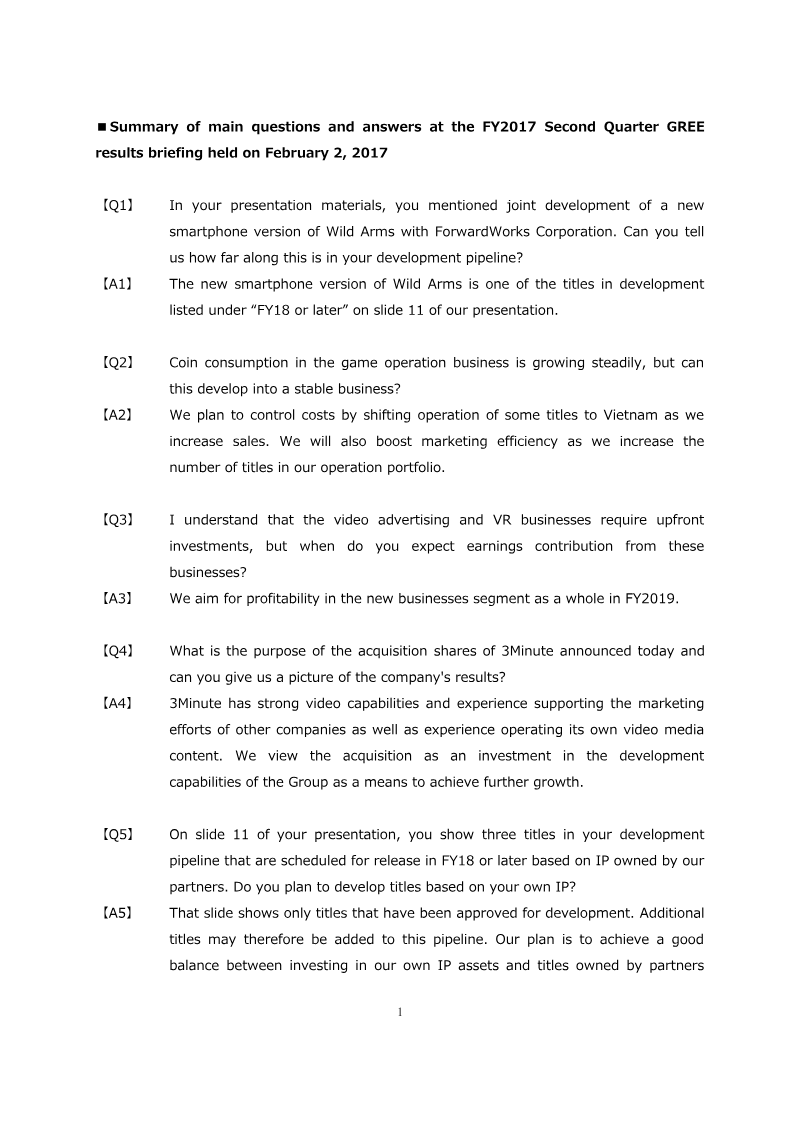
Summary of Main Questions and Answers at the FY2017 Second Quarter GREE Results Briefing
The second quarter fiscal year 2017 financial briefing for GREE highlights a strategic pivot toward balancing internal intellectual property development with high-profile partner collaborations. A primary focus of the mid-term pipeline is the joint development of a smartphone version of Wild Arms with ForwardWorks, currently slated for release in fiscal year 2018 or later. Management intends to maintain a diversified portfolio by combining established fan bases from partner IP with original assets, while simultaneously refining the release schedule for six additional titles expected to launch across the third and fourth quarters of the current fiscal year.
Operational efficiency remains a core objective for the game operations business. To stabilize earnings and control costs, the company is shifting specific operational tasks to Vietnam and leveraging a larger portfolio to improve marketing efficiency. While coin consumption for existing overseas titles has seen a quarter-on-quarter decline, the company is mitigating this through the development of new international titles and a rigorous evaluation process for underperforming games. Management indicated a willingness to shutter titles that do not meet growth expectations or lack sufficient content depth to maintain user momentum.
Beyond core gaming, significant investments are being directed toward video advertising and virtual reality. The acquisition of 3Minute serves as a strategic move to bolster video production and marketing capabilities. Although these segments currently require upfront investment, the company targets overall profitability for the new business segment by fiscal year 2019. Despite an anticipated short-term decline in operating income for the third quarter due to rising fixed costs associated with new launches, the long-term outlook emphasizes a transition toward sustainable growth through diversified media and enhanced development capabilities.
- GREE is pivoting toward a hybrid strategy that balances internal IP development with high-profile collaborations, including a smartphone version of Wild Arms developed with ForwardWorks for release in FY2018 or later.
- The company plans to launch six additional titles across the third and fourth quarters of the current fiscal year to bolster its portfolio.
- Operational costs are being managed by shifting specific tasks to Vietnam and implementing a rigorous evaluation process that includes shuttering underperforming titles.
- GREE is targeting overall profitability for its new business segments—specifically video advertising and virtual reality—by fiscal year 2019.
- The acquisition of 3Minute is a strategic effort to enhance the company's internal video production and marketing capabilities.
+2
GREEFeb 2017
Financial31 pages
FY2017 First Quarter Financial Results
GREE’s financial performance for the first quarter of fiscal year 2017 reflects a strategic pivot toward profitability growth and operational efficiency. Despite a marginal decline in net sales to ¥14.9 billion, operating income rose to ¥2.5 billion, a result primarily attributed to aggressive cost-control measures that reduced expenditures by ¥1.1 billion quarter-over-quarter. This fiscal stability is bolstered by a positive outlook for the first half of the year, with projected net sales of ¥30 billion and operating income of ¥4 billion, supported by a robust pipeline of six new domestic titles and the strategic acquisition of the mobile game DragonSoul.
The operational focus has shifted decisively toward native game development and global market expansion to offset the natural decline of legacy web-based titles. While total coin consumption dipped to 19.0 billion during this transition, the successful integration of DragonSoul—which experienced a 2.4-fold increase in consumption—and the international launch of licensed intellectual properties like Naruto Shippuden demonstrate the viability of this new direction. High-profile projects such as Another Eden and A Farewell to Arms remain central to the upcoming release schedule, signaling a commitment to high-quality, original content.
Beyond core gaming, diversification into emerging technologies and service platforms is driving secondary growth. Net sales for home-related and advertising media platforms increased 1.5 times year-over-year, while strategic partnerships with Square Enix and Adores have expanded the corporate footprint in the virtual reality sector. These initiatives, combined with a disciplined approach to resource allocation, position the organization to navigate the evolving digital entertainment landscape while maintaining a focus on long-term value creation through both internal development and external acquisitions.
- GREE achieved an operating income of ¥2.5 billion in Q1 FY2017, driven by a ¥1.1 billion quarter-over-quarter reduction in expenditures despite a slight decline in net sales to ¥14.9 billion.
- The company projects a first-half fiscal performance of ¥30 billion in net sales and ¥4 billion in operating income, supported by six new domestic titles and the acquisition of the mobile game DragonSoul.
- Strategic focus has shifted toward native game development and global expansion to mitigate the decline of legacy web-based titles, evidenced by a 2.4-fold increase in coin consumption for DragonSoul.
- Diversification efforts are yielding results, with net sales for home-related and advertising media platforms growing 1.5 times year-over-year.
- GREE is expanding its footprint in the virtual reality sector through strategic partnerships with Square Enix and Adores.
+1
GREE Inc.Nov 2016
Financial2 pages
Summary of Main Questions and Answers at the FY2017 First Quarter GREE Results Briefing
The financial performance and strategic direction for the first quarter of fiscal year 2017 center on a transition toward high-growth segments within the Japanese mobile gaming market. A primary focus is the consolidation of development efforts into the broadly defined RPG category, which is identified as the largest and most resilient market segment in Japan. This strategic concentration is intended to leverage internal development expertise, streamline game operations, and facilitate more effective collaborations with intellectual property partners. Key upcoming titles such as Another Eden and Senki Zesshou SYMPHOGEAR XD Unlimited are expected to drive revenue through diverse monetization models involving character progression, music, and live events.
While overall coin consumption experienced a decline during the first quarter, projections indicate a recovery in net sales starting in the second quarter. This anticipated upturn is supported by a successful turnaround in the domestic native games business. However, operating income is forecasted to decrease by approximately 1.0 billion yen in the second quarter due to planned strategic investments. these expenditures include increased advertising costs, rental expenses, and goodwill amortization, all aimed at securing long-term growth.
The long-term growth strategy also incorporates a significant expansion into the virtual reality sector. The current approach involves partnering with arcade game companies and established IP holders to build a user base ahead of the emergence of major VR platforms. While these initiatives are critical for future positioning, they are not expected to contribute significantly to earnings until after the conclusion of fiscal year 2017. Consequently, the immediate financial recovery remains dependent on the performance of the core mobile gaming portfolio and the successful launch of the current development pipeline.
- GREE is consolidating its development resources into the RPG category, targeting it as the most resilient segment of the Japanese mobile gaming market.
- The company expects a recovery in net sales starting in the second quarter, driven by a turnaround in its domestic native games business.
- Operating income is projected to decrease by approximately 1.0 billion yen in the second quarter due to strategic investments in advertising, rental expenses, and goodwill amortization.
- Upcoming titles Another Eden and Senki Zesshou SYMPHOGEAR XD Unlimited are central to the revenue strategy, utilizing monetization models based on character progression, music, and live events.
- GREE is expanding into the virtual reality sector through partnerships with arcade companies and IP holders, though these initiatives are not expected to impact earnings until after fiscal year 2017.
+2
GREENov 2016
Financial2 pages
Summary of Main Questions and Answers at the FY2016 Fourth Quarter GREE Results Briefing
GREE’s financial performance for the fourth quarter of fiscal year 2016 was characterized by significant one-off costs and a strategic pivot toward native game development. These non-recurring expenses, which impacted the quarter’s bottom line, were primarily driven by increased advertising spend, goodwill amortization, and rental costs. The latter was framed as an upfront investment intended to reduce long-term operational overhead. While these specific costs are not expected to recur, the company anticipates a narrower operating margin in the first quarter of fiscal year 2017 due to continued aggressive investment in domestic game operations and North American business units.
The strategic roadmap for fiscal year 2017 focuses on a "release blitz" of eight new native games for the Japanese market, with approximately one-fourth of these titles targeted for the first quarter. Management defines a successful "hit" as any title reaching the top ten in the App Store rankings. To achieve this, GREE is leveraging specialized internal studios: Wright Flyer Studios focuses on action RPGs and quantitative analysis, while Pokelabo concentrates on the Group-versus-Group (GvG) genre. Both studios are increasingly integrating external intellectual property (IP) to enhance market competitiveness and mitigate the risks associated with the shift from web-based to native mobile gaming.
Capital allocation remains focused on long-term stability and strategic expansion. GREE intends to maintain a strong financial base to support multi-year development cycles while remaining active in the M&A market, as evidenced by the recent acquisition of ADFULLY to bolster its ad media business. Future profitability and the return to an operating margin above 20% are heavily contingent on the successful launch and sustained performance of the upcoming pipeline, as the company moves past its initial optimistic scheduling toward a more disciplined, quality-driven development process.
- GREE is targeting a return to operating margins above 20% by shifting from web-based to native mobile gaming, supported by a disciplined, quality-focused development process.
- The company plans a 'release blitz' of eight new native games for the Japanese market in fiscal year 2017, with two titles scheduled for the first quarter.
- Management defines a successful game 'hit' as any title that achieves a top-ten ranking in the App Store.
- Internal studios Wright Flyer Studios and Pokelabo are leading the development strategy by specializing in action RPGs and GvG genres, respectively, while increasingly utilizing external IP.
- Operating margins for the first quarter of fiscal year 2017 are expected to remain narrow due to continued aggressive investment in domestic and North American business units.
+2
GREEAug 2016
Financial36 pages
FY2016 Fourth Quarter Financial Results
GREE, Inc. concluded fiscal year 2016 with net sales of ¥69.9 billion and an operating income of ¥14.2 billion, meeting internal forecasts despite a broader year-over-year decline in financial performance. The fourth quarter specifically reflected the impact of ¥1.0 billion in restructuring and one-off costs, resulting in a quarterly operating income of ¥2.2 billion. While domestic coin consumption in Japan dropped significantly from 25.0 billion to 17.5 billion coins over the year, the company successfully fortified its balance sheet. Net cash reserves grew to ¥80.2 billion, and the shareholders' equity ratio rose to 91%, supported by a ¥3.3 billion reduction in annual costs achieved through labor consolidation and lower commission fees.
The strategic focus has shifted toward a transition from legacy web games to native mobile titles and diversified digital services. Although delayed releases hindered sales growth in 2016, the company is initiating a release blitz for fiscal year 2017, planning eight new native titles from Wright Flyer Studios and Pokelabo. This game-centric strategy is complemented by the expansion of third-party game operations and the Ad Media business, the latter of which saw video advertisement sales increase twentyfold. These efforts aim to establish more sustainable earnings pillars to offset the contraction of older segments.
Beyond mobile gaming, investment is increasingly directed toward emerging technologies and platform services. Aggressive capital allocation continues in the virtual reality sector and home-related service platforms as part of a long-term diversification strategy. By streamlining the workforce to approximately 1,466 employees and focusing resources on the Japan Game Business, the organization seeks to leverage its high liquidity and reduced cost base to return to a growth trajectory through high-quality content production and expanded digital advertising reach.
- GREE, Inc. concluded FY2016 with ¥69.9 billion in net sales and ¥14.2 billion in operating income, meeting internal forecasts despite a year-over-year decline in performance.
- Domestic coin consumption in Japan fell significantly from 25.0 billion to 17.5 billion coins over the fiscal year, highlighting the contraction of legacy web game segments.
- The company strengthened its financial position, increasing net cash reserves to ¥80.2 billion and achieving a 91% shareholders' equity ratio through ¥3.3 billion in annual cost reductions.
- A strategic pivot toward native mobile titles includes a planned release of eight new games in FY2017 from subsidiaries Wright Flyer Studios and Pokelabo to replace legacy revenue streams.
- The Ad Media business has become a key growth area, evidenced by a twentyfold increase in video advertisement sales during the fiscal year.
GREEAug 2016