GREE
Game Co.192 documents
Documents
Financial5 pages
Fiscal Year 2019 Fourth Quarter Financial Results Briefing
GREE, Inc. reported its financial results for the fiscal year ending June 2019, achieving net sales of ¥70.9 billion and an operating income of ¥5.5 billion. The fourth quarter performed in line with forecasts, generating ¥17.4 billion in net sales and ¥1.3 billion in operating income. This performance was driven by the sustained success of existing game titles, particularly during anniversary events for SINoALICE, Another Eden, and SYMPHOGEAR, alongside strategic expansions into overseas markets.
The strategic framework for the period focused on three core pillars: gaming, live entertainment, and advertising and media. In the gaming segment, the company utilized an "engine, IP, global" strategy to improve profitability. This involved transitioning toward self-distribution and first-party IPs to capture higher margins, while expanding onto multiplatform environments including Nintendo Switch and Facebook Games. Geographically, the company successfully launched titles in North America, Europe, and parts of Asia, with plans to enter the Chinese market pending regulatory approval.
Looking toward fiscal year 2020, the company is prioritizing long-term operational stability and aggressive investment in emerging sectors. The live entertainment division is centered on the REALITY platform, a VTuber distribution service, where investments will focus on production, platform functionality, and business solutions. While the advertising and media segment remains in an upfront investment phase, losses are expected to narrow as vertical media portfolios expand. For the upcoming fiscal year, the company plans to launch two new titles and has four to six additional projects in development for 2021 and beyond. To ensure shareholder returns, a new dividend policy based on a 2% Dividend on Equity (DOE) ratio has been established.
- GREE, Inc. closed fiscal year 2019 with ¥70.9 billion in net sales and ¥5.5 billion in operating income, with Q4 results meeting forecasts at ¥17.4 billion and ¥1.3 billion respectively.
- The company is shifting its gaming strategy toward self-distribution and first-party intellectual property to improve margins while expanding onto multiplatform environments like Nintendo Switch and Facebook Games.
- Future growth is anchored by the REALITY platform, a VTuber distribution service, which is receiving aggressive investment in production and platform functionality.
- The company has established a new shareholder return policy based on a 2% Dividend on Equity (DOE) ratio.
- Upcoming product pipelines include two new title launches for fiscal year 2020, with four to six additional projects currently in development for 2021 and beyond.
GREEJan 2019
Financial30 pages
FY2019 First Quarter Financial Results
The financial results for the first quarter of fiscal year 2019 detail a period of strategic transition characterized by steady operating income despite a year-over-year decline in net sales. Net sales reached ¥18.2 billion, a decrease from ¥21.6 billion in the same period the previous year, while operating income remained stable at ¥1.6 billion. This stability was achieved by offsetting declining revenue with a reduction in variable costs, specifically through more efficient advertising spend and lower commission fees. The operating income margin improved slightly to 8.9% on a quarter-over-quarter basis.
The business strategy focuses on three primary pillars: mobile game engines, intellectual property (IP) development, and global expansion. Key operational highlights include the release of Wild Arms: Million Memories and the expansion of Danmachi: Memoria Freese into South Korea and Taiwan. The company is also diversifying its platform reach by developing titles for the Nintendo Switch and the LINE QUICK GAME platform. Furthermore, there is a significant push into the live entertainment sector with the launch of REALITY, a dedicated livestreaming platform for VTubers, supported by joint ventures with King Records and Idea Factory.
Geographically, the focus remains on the Japanese market while aggressively pursuing growth in North America, Europe, and Greater China through both self-distribution and partnerships. For the second quarter of fiscal 2019, the earnings forecast anticipates net sales between ¥17 billion and ¥18 billion, with operating income projected between ¥1 billion and ¥1.5 billion. This outlook reflects the expected performance of existing titles and the continued rollout of newly developed overseas projects. The consolidated headcount grew to 1,604 employees by the end of the first quarter, reflecting ongoing investment in development and new business segments.
- Net sales for Q1 FY2019 declined to ¥18.2 billion from ¥21.6 billion year-over-year, though operating income remained stable at ¥1.6 billion due to reduced advertising and commission costs.
- The operating income margin improved to 8.9% on a quarter-over-quarter basis through strategic cost efficiencies.
- The company is diversifying its platform strategy by developing titles for the Nintendo Switch and LINE QUICK GAME, alongside the release of 'Wild Arms: Million Memories' and the regional expansion of 'Danmachi: Memoria Freese'.
- A new growth pillar is the live entertainment sector, marked by the launch of the VTuber livestreaming platform 'REALITY' in partnership with King Records and Idea Factory.
- Q2 FY2019 earnings forecasts project net sales between ¥17 billion and ¥18 billion, with operating income expected to range from ¥1 billion to ¥1.5 billion.
GREE Inc.Oct 2018
Financial42 pages
FY2018 Fourth Quarter Financial Results
GREE achieved significant year-over-year growth during fiscal year 2018, recording net sales of ¥77.9 billion and operating income of ¥9.4 billion. This performance was primarily driven by the robust operational success of mobile titles such as SINoALICE and Another Eden, alongside the successful North American expansion of DanMachi. While the company missed initial profit forecasts due to aggressive upfront investments and a ¥3.15 billion impairment loss in the advertising and media segment, it maintains a strong financial foundation with ¥87.2 billion in net cash. A notable shift in consumer behavior is evident as coin consumption recovered to 22.9 billion in the fourth quarter, fueled by modern mobile applications that effectively offset the ongoing decline of legacy web-based gaming.
The strategic focus for the 2019 fiscal year centers on diversifying revenue through three core pillars: mobile games, vertical media, and live entertainment. The company is committing ¥10 billion to a dedicated subsidiary focused on the virtual YouTuber ecosystem while simultaneously scaling its vertical media platforms, which saw a nearly fivefold increase in page views across lifestyle and travel sectors. To support long-term sustainability, investments are being directed toward proprietary game engines and multiplatform development, including the Nintendo Switch, to broaden market reach beyond traditional mobile environments.
Geographically, the company is prioritizing full-scale overseas expansion to capitalize on the global mobile market. This transition is supported by a workforce of over 1,500 employees concentrated in the games and entertainment divisions. By balancing aggressive investment in emerging technologies like VTubers with the steady optimization of its existing game portfolio and media assets, the organization aims to establish a more resilient and diversified earnings structure for the coming years.
- GREE reported FY2018 net sales of ¥77.9 billion and operating income of ¥9.4 billion, supported by a strong financial position of ¥87.2 billion in net cash.
- Profit forecasts were missed due to a ¥3.15 billion impairment loss in the advertising and media segment and aggressive upfront investment spending.
- Mobile titles including SINoALICE, Another Eden, and the North American release of DanMachi served as the primary drivers for year-over-year growth.
- Q4 coin consumption recovered to 22.9 billion, as modern mobile applications successfully offset the continued decline of legacy web-based gaming revenue.
- The company is committing ¥10 billion to a new subsidiary focused on the virtual YouTuber (VTuber) ecosystem as part of a broader diversification strategy.
GREEAug 2018
Financial1 pages
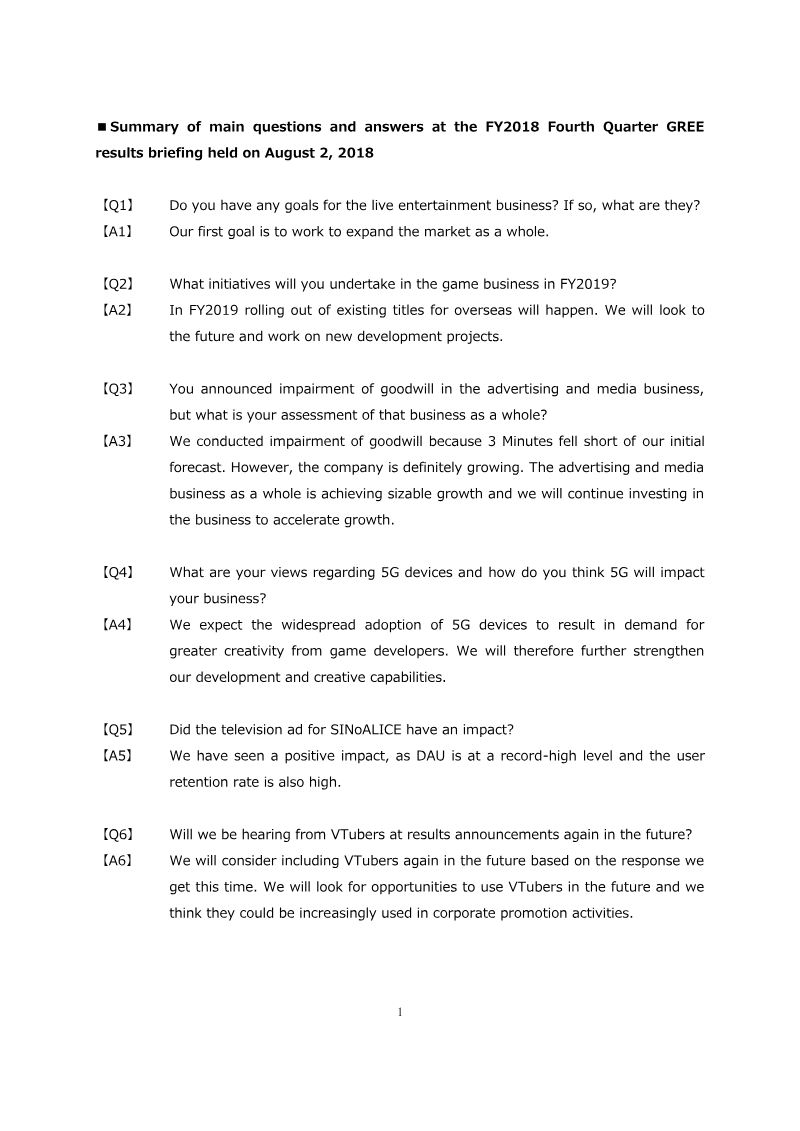
Summary of Main Questions and Answers at the FY2018 Fourth Quarter GREE Results Briefing Held on August 2, 2018
The fiscal year 2018 fourth quarter results briefing highlights a strategic pivot toward emerging digital entertainment sectors and the international expansion of existing intellectual properties. A primary focus for the upcoming fiscal year involves the global rollout of established game titles alongside the initiation of new development projects. Performance in the gaming segment remains robust, evidenced by record-high daily active users and strong retention rates for SINoALICE following successful television advertising campaigns. Management anticipates that the impending widespread adoption of 5G technology will necessitate higher levels of creative output, prompting a commitment to further strengthen internal development capabilities.
The live entertainment business is currently prioritized as a market-expansion endeavor, with a specific emphasis on the burgeoning Virtual YouTuber (VTuber) sector. There is a clear intent to integrate VTubers into future corporate promotions and results announcements, reflecting a belief in their growing utility for brand engagement. This focus on new media formats coincides with a period of transition for the advertising and media segment. While the subsidiary 3 Minutes fell short of initial forecasts, leading to an impairment of goodwill, the broader advertising and media business continues to demonstrate sizable growth, justifying ongoing investment to accelerate its trajectory.
Geographically centered on the Japanese market with an eye toward global distribution, the briefing outlines a transition from traditional mobile gaming toward a diversified portfolio of digital media and next-generation connectivity. The methodology for these conclusions relies on internal performance metrics, such as user retention and daily activity, as well as market projections regarding hardware evolution. The overall outlook suggests a period of reinvestment where short-term financial adjustments in specific subsidiaries are balanced against the long-term potential of 5G-enabled gaming and virtual talent platforms.
- GREE is pivoting toward a diversified portfolio of digital media and next-generation connectivity, moving beyond traditional mobile gaming to prepare for the widespread adoption of 5G technology.
- The gaming segment reported record-high daily active users and strong retention rates for the title SINoALICE, bolstered by successful television advertising campaigns.
- The company is prioritizing the Virtual YouTuber (VTuber) sector as a key market-expansion endeavor, with plans to integrate virtual talent into corporate promotions and future results briefings.
- Management is committing to increased internal development capabilities to meet the anticipated demand for higher creative output driven by 5G infrastructure.
- The advertising and media segment is undergoing a transition period, marked by an impairment of goodwill for the subsidiary 3 Minutes after it failed to meet initial financial forecasts.
+3
GREEAug 2018
Financial43 pages
FY2018 Third Quarter Financial Results
GREE’s financial performance for the third quarter of fiscal year 2018 reflects a strategic pivot toward a diversified, three-pillar business model comprising gaming, advertising and media, and live entertainment. While net sales reached ¥17.9 billion—slightly below initial targets—operating income exceeded expectations at ¥2.8 billion due to rigorous cost-management initiatives and enhanced operational efficiency. This profitability is underpinned by a robust liquidity position, with the company maintaining ¥85.8 billion in net cash to fund future growth initiatives.
The gaming segment remains a primary driver of revenue, characterized by the successful North American expansion of DanMachi and the strong domestic performance of titles such as Another Eden and In Love with News. Total coin consumption reached 22.9 billion during the quarter, bolstered by high user engagement and top-tier sales rankings for new mobile releases. Beyond mobile platforms, the company is actively expanding its console presence via the Nintendo Switch and leveraging its internal game engines and intellectual property to secure a global footprint.
A central component of the long-term strategy involves a ¥10 billion investment into the live entertainment sector, specifically targeting the burgeoning global Virtual YouTuber market. By integrating its existing expertise in virtual reality and 3D interaction, the firm aims to establish a sustainable earnings framework that complements its traditional digital media segments. This transition is supported by a workforce of over 1,400 employees focused on a "Game engine, IP, and global" development philosophy intended to ensure stability and growth in an evolving digital landscape.
- GREE reported Q3 FY2018 net sales of ¥17.9 billion and operating income of ¥2.8 billion, with the latter exceeding expectations due to cost-management initiatives.
- The company maintains a strong liquidity position with ¥85.8 billion in net cash to fund future growth and strategic initiatives.
- GREE is investing ¥10 billion into the live entertainment sector, specifically targeting the global Virtual YouTuber market to diversify its earnings.
- The gaming segment remains the primary revenue driver, evidenced by 22.9 billion in total coin consumption and strong performance from titles like Another Eden, In Love with News, and the North American release of DanMachi.
- The company is diversifying its platform strategy by expanding its console presence on the Nintendo Switch and utilizing internal game engines to scale its global footprint.
+1
GREEApr 2018
Financial35 pages
FY2018 Second Quarter Financial Results
GREE’s financial results for the second quarter of fiscal year 2018 reflect a period of strategic transition and cost optimization. The company reported net sales of ¥19.5 billion and an operating income of ¥2.3 billion, surpassing internal targets despite a quarter-over-quarter decline in revenue. This performance was supported by a significant reduction in total costs, which fell by ¥1.8 billion to ¥17.1 billion, driven primarily by more efficient advertising spend and the closure of overseas bases.
The report highlights a major strategic shift as GREE entered the console game market with the global release of Fishing Star for the Nintendo Switch. This move complements the core mobile game business, which focused on strengthening the operations of existing titles like Another Eden and SINoALICE while progressing a development pipeline of five new titles. Notably, the January release of Library Cross Infinite saw a strong start. In the advertising and media segment, the company achieved steady growth, with page views for platforms like LIMIA and MINE BY 3M increasing 1.8x quarter-over-quarter.
Geographically, the company is pivoting toward a Japan-based development system aimed at global distribution, utilizing a mix of first-party, co-developed, and third-party intellectual property. Financial data indicates a stable balance sheet with ¥83 billion in net cash and a consolidated headcount of 1,360 employees. Looking ahead to the third quarter, GREE forecasts steady net sales of ¥19.5 billion and a slight increase in operating income to ¥2.5 billion, maintaining a focus on cost control and the expansion of its "game engine, IP, and global" strategy across both mobile and console platforms.
- GREE reported Q2 FY2018 net sales of ¥19.5 billion and operating income of ¥2.3 billion, exceeding internal targets despite a quarter-over-quarter revenue decline.
- Total costs decreased by ¥1.8 billion to ¥17.1 billion, primarily achieved through more efficient advertising spend and the closure of overseas business bases.
- The company entered the console market with the global release of Fishing Star for the Nintendo Switch, marking a strategic expansion beyond its core mobile business.
- GREE’s advertising and media segment saw significant growth, with page views for platforms LIMIA and MINE BY 3M increasing 1.8x quarter-over-quarter.
- The company maintains a stable financial position with ¥83 billion in net cash and a consolidated headcount of 1,360 employees.
GREEFeb 2018
Financial2 pages
Summary of Main Questions and Answers at the FY2018 Second Quarter GREE Results Briefing
The fiscal year 2018 second quarter briefing highlights a strategic pivot toward multiplatform and multiregional development as a means of extending the corporate value chain. A primary focus of this transition is the entry into the console market, specifically with the release of Fishing Star for the Nintendo Switch. This title marks a departure from the company’s traditional mobile business model, as it is designed as a one-time downloadable purchase without planned in-game transactions. The move into console gaming is intended to reach a broader demographic of gamers while maintaining strict cost controls by avoiding high-budget, major titles in the initial phase of market entry.
Operational performance remains centered on strengthening the lifecycle of existing hit titles through consistent content updates. Successes in the second quarter were driven by the addition of new scenarios to Another Eden: The Cat Who Goes Beyond Time, which improved overall customer engagement. While the pace of new title releases has moderated, the development pipeline remains active with several unannounced projects. The company is also refining its internal systems to more rapidly deploy content that aligns with evolving user preferences across its mobile portfolio.
Global expansion serves as another critical pillar of the current growth strategy. Preparations for overseas distribution are progressing steadily, particularly for titles such as Is It Wrong to Try to Pick Up Girls in a Dungeon: Memoria Freeze. This international push involves selecting local partners and determining optimal release windows to maximize fan engagement in foreign markets. Simultaneously, the advertising and media business continues to receive consistent investment, with the scale of future funding contingent upon the projected returns and the long-term viability of the segment.
- GREE is pivoting toward multiplatform development by entering the console market, starting with the release of Fishing Star for the Nintendo Switch.
- The company is testing a new revenue model for console gaming by releasing Fishing Star as a one-time purchase without in-game transactions.
- To maintain profitability during its console market entry, GREE is avoiding high-budget, major titles in favor of strict cost controls.
- Operational performance in Q2 FY2018 was driven by content updates for existing titles, specifically new scenarios added to Another Eden: The Cat Who Goes Beyond Time.
- The company is actively pursuing global expansion by preparing overseas distribution for titles such as Is It Wrong to Try to Pick Up Girls in a Dungeon: Memoria Freeze.
+2
GREEFeb 2018
Financial4 pages
Summary of Main Questions and Answers: FY2018 Third Quarter Results Briefing
The third quarter of fiscal year 2018 marks a strategic pivot for GREE as it aggressively expands into the emerging Virtual YouTuber (VTuber) market and strengthens its international publishing footprint. A central pillar of this strategy is a planned 10 billion yen investment in the VTuber sector, with 4 billion yen dedicated to supporting creators and illustrators through a specialized fund and 6 billion yen earmarked for advertising and market development. This initiative leverages the company’s existing technical expertise in 3D character rendering and user interaction derived from its virtual reality business, aiming to capitalize on the convergence of influencer culture, anime, and gaming.
Global expansion remains a primary growth driver, centered on a strategy of utilizing established intellectual property and optimized game engines. The successful North American launch of Is It Wrong to Try to Pick Up Girls in a Dungeon: Memoria Freese serves as a proof of concept for this international push. Management intends to release future titles either simultaneously worldwide or within a six-month window following Japanese launches, depending on partner coordination and localization requirements. Original titles like Another Eden and Fishing Star are also being adapted for console platforms and Facebook Instant Games to diversify distribution channels and reach broader audiences.
Operational efficiency is being addressed through Funplex, which focuses on the specialized management and operation of existing game titles. This allows the broader organization to focus on high-quality content updates for top-ranking titles like SINoALICE. By separating development from long-term operations and utilizing a track record of collaboration with publishers and record companies, the company aims to build a sustainable ecosystem across mobile, console, and emerging digital media platforms. The overall outlook emphasizes front-loaded investment in new cultural markets to establish a foundation for long-term profitability.
- GREE is committing 10 billion yen to the VTuber market, allocating 4 billion yen to creator support and 6 billion yen to marketing and development.
- The company is shifting its global strategy to prioritize simultaneous worldwide releases or a maximum six-month delay following Japanese launches.
- GREE is diversifying distribution for existing titles like Another Eden and Fishing Star by porting them to console platforms and Facebook Instant Games.
- The North American launch of 'Is It Wrong to Try to Pick Up Girls in a Dungeon: Memoria Freese' is being used as the primary proof of concept for the company's international expansion strategy.
- The subsidiary Funplex has been tasked with managing legacy game operations to allow the core development team to focus exclusively on high-performing titles like SINoALICE.
+3
GREEJan 2018
Financial7 pages
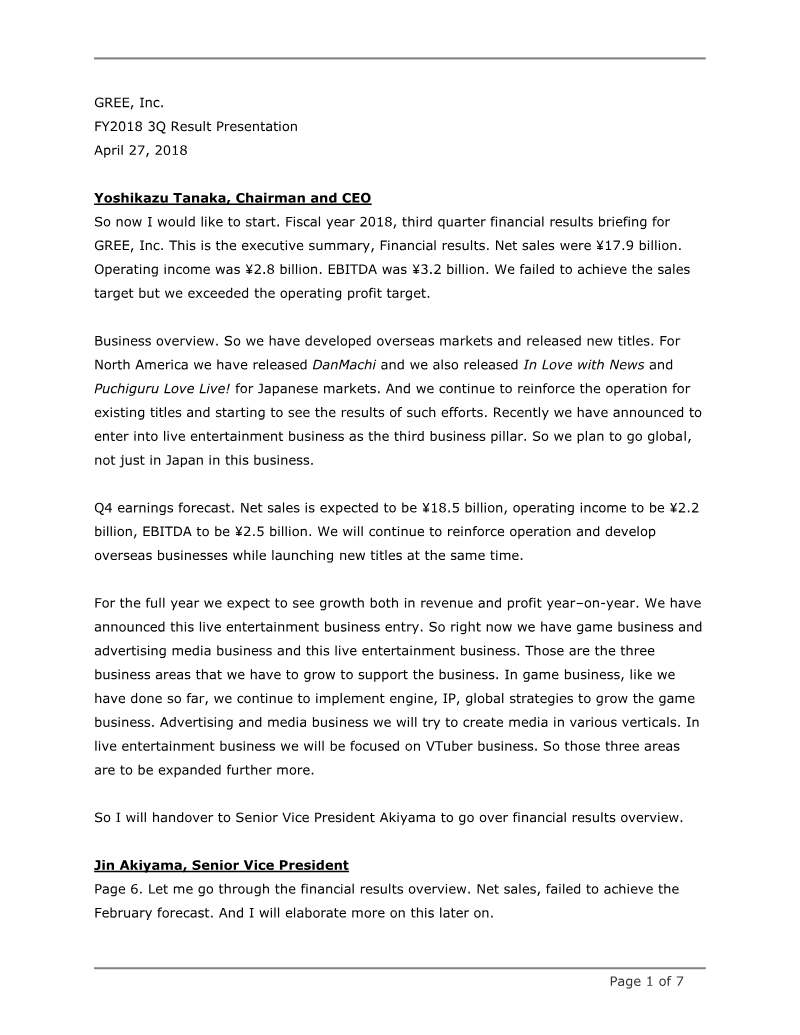
FY2018 3Q Result Presentation
This financial presentation details GREE, Inc.’s performance for the third quarter of fiscal year 2018, ending March 31, 2018. The primary thesis centers on a strategic transition toward a three-pillar business model comprising mobile gaming, advertising and media, and a newly established live entertainment segment. Geographically, the report covers the Japanese domestic market and ongoing expansion efforts into North America, with future plans for Asia and Europe.
Financial results for the quarter show net sales of ¥17.9 billion and operating income of ¥2.8 billion. While the company missed its revenue targets due to delays in title launches and business acquisitions, it exceeded profit expectations through aggressive cost reductions. Fixed costs were reduced by ¥500 million, and advertising spending was optimized, resulting in a 15% operating margin. For the fourth quarter, the company forecasts a slight revenue increase to ¥18.5 billion, supported by the global rollout of titles like DanMachi and the domestic performance of new releases such as In Love with News and Puchiguru Love Live!.
A significant strategic shift highlighted is the entry into the live entertainment business, specifically focusing on the Virtual YouTuber (VTuber) market. GREE intends to leverage its existing 3D engineering capabilities from its gaming and VR divisions to manage production, distribution, and IP development for VTubers. Additionally, the company is diversifying its gaming portfolio by moving successful mobile IPs like Another Eden to consoles, including the Nintendo Switch. In the media segment, the travel application aumo is noted for its high category ranking, signaling steady growth in vertical media and client acquisition.
- GREE, Inc. reported Q3 FY2018 net sales of ¥17.9 billion and operating income of ¥2.8 billion, achieving a 15% operating margin.
- The company missed revenue targets due to delayed title launches and acquisitions but exceeded profit expectations by cutting ¥500 million in fixed costs and optimizing advertising spend.
- GREE is pivoting to a three-pillar business model consisting of mobile gaming, advertising and media, and a new live entertainment segment focused on the Virtual YouTuber (VTuber) market.
- The company projects Q4 revenue to reach ¥18.5 billion, driven by the global release of 'DanMachi' and domestic performance of 'In Love with News' and 'Puchiguru Love Live!'.
- GREE is diversifying its gaming strategy by porting successful mobile IPs, such as 'Another Eden', to consoles including the Nintendo Switch.
+4
GREEJan 2018
Financial7 pages
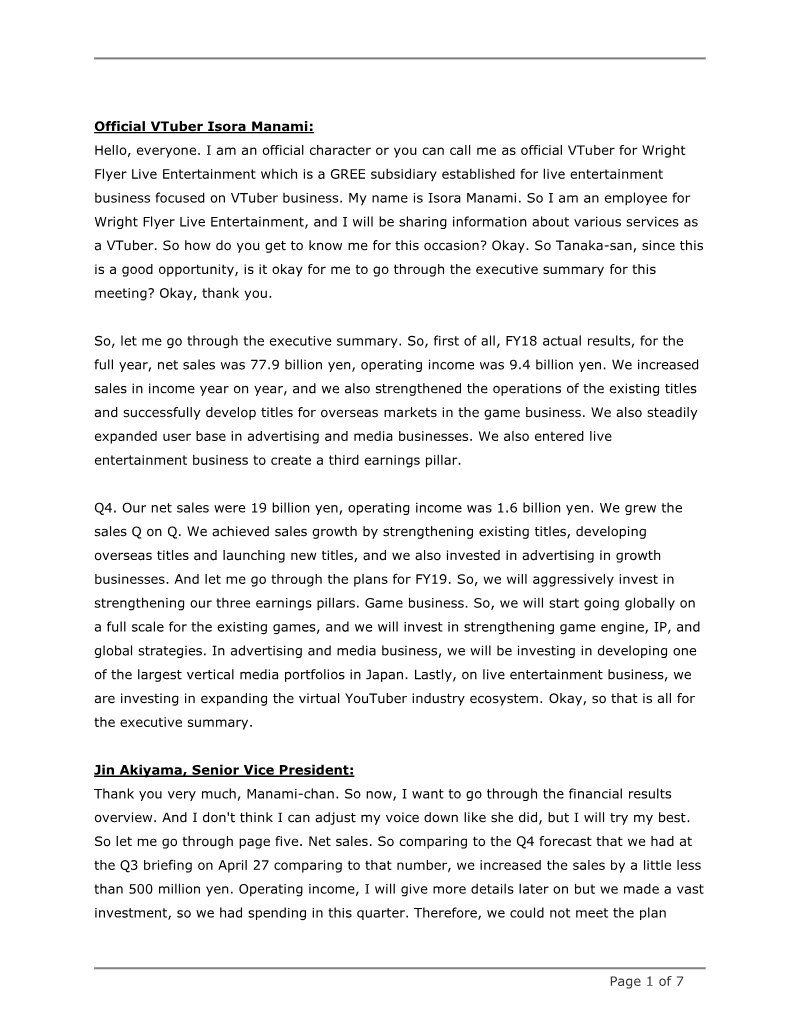
FY2018 4Q Financial Results Presentation Transcript
This transcript details the financial results for GREE, Inc. for the fourth quarter and full fiscal year ending in 2018. The primary thesis of the presentation is that the company has successfully transitioned from a period of declining sales to a growth phase driven by a three-pillar strategy: mobile gaming, advertising and media, and the emerging live entertainment sector.
For the full fiscal year 2018, the company reported net sales of 77.9 billion yen and an operating income of 9.4 billion yen, marking the first increase in both sales and profit in six years. Fourth-quarter sales reached 19 billion yen with an operating income of 1.6 billion yen. While sales grew quarter-on-quarter, operating income was impacted by aggressive investments in growth businesses and an impairment loss on goodwill related to the acquisition of Three Minutes. To celebrate its 10th anniversary and reflect this return to growth, the company issued a commemorative dividend, bringing the total annual dividend to 14 yen per share.
The game business remains the company's foundation, with key titles like SINoALICE and Another Eden showing strong performance through reinforced operations and one-year anniversary events. A significant portion of the growth strategy involves global expansion; for example, the North American release of DanMachi increased its business scale by 1.5 to 2 times. Looking toward FY2019 and beyond, the company plans to release four to five titles annually and expand existing IPs into multi-platform environments, including Nintendo Switch and Facebook Instant Games.
The company is also heavily prioritizing its new live entertainment pillar, specifically focusing on the Virtual YouTuber (VTuber) ecosystem. This includes a planned 10-billion-yen investment and the establishment of a dedicated subsidiary, Wright Flyer Live Entertainment. Simultaneously, the advertising and media segment is being developed to create one of Japan’s largest vertical media portfolios. The geographic scope is primarily Japan, with increasing emphasis on North American, European, and Chinese markets.
- GREE, Inc. achieved its first year-over-year increase in sales and profit in six years, reporting 77.9 billion yen in net sales and 9.4 billion yen in operating income for FY2018.
- The company is launching a 10-billion-yen investment strategy into the live entertainment sector, specifically targeting the Virtual YouTuber (VTuber) ecosystem through a new subsidiary, Wright Flyer Live Entertainment.
- Mobile gaming remains the core revenue driver, supported by strong performance from titles like SINoALICE and Another Eden and a successful North American expansion of DanMachi that increased its business scale by 1.5 to 2 times.
- Future growth plans include releasing four to five new game titles annually and expanding existing IPs to multi-platform environments such as Nintendo Switch and Facebook Instant Games.
- Fourth-quarter operating income of 1.6 billion yen was impacted by aggressive growth investments and an impairment loss on goodwill following the acquisition of Three Minutes.
+1
GREEJan 2018

Financial31 pages
FY2018 First Quarter Financial Results
GREE’s financial results for the first quarter of fiscal year 2018 reflect a period of significant growth driven by the successful scaling of native mobile games and strategic investments in media operations. The company achieved net sales of ¥21.6 billion and an operating income of ¥2.7 billion, representing both quarter-on-quarter and year-on-year increases. This performance was primarily fueled by high coin consumption in hit titles such as Another Eden and SINoALICE, alongside the expansion of the advertising and media segment, where page views grew 2.4 times over the previous quarter.
The scope of these results covers the company’s consolidated global operations for the three-month period ending September 30, 2017. While the game and entertainment business remains the core revenue driver, the company is diversifying through its advertising and media arm and emerging VR initiatives. Geographically, the company is pivoting its strategy by closing certain overseas bases to reduce fixed labor costs while simultaneously signing joint publishing agreements with partners like Sumitomo Corporation to aggressively export Japanese anime-based intellectual property to international markets.
Methodological data indicates a shift in the cost structure, where a ¥2.73 billion increase in variable costs—driven by higher advertising spend and platform commission fees—was partially offset by a ¥0.64 billion reduction in fixed costs. The development pipeline remains robust with five titles currently in progress, primarily focusing on third-party IP. Looking ahead to the first half of FY2018, the company maintains a conservative forecast of ¥40.5 billion in net sales, anticipating a temporary decline in existing titles following their initial peak performance while continuing aggressive investment in growth-oriented media businesses.
- GREE reported Q1 FY2018 net sales of ¥21.6 billion and operating income of ¥2.7 billion, marking growth both quarter-on-quarter and year-on-year.
- Revenue growth was primarily driven by high coin consumption in hit titles 'Another Eden' and 'SINoALICE', alongside a 2.4x increase in page views within the advertising and media segment.
- The company is shifting its cost structure by increasing variable spending on advertising and platform commissions by ¥2.73 billion while reducing fixed costs by ¥0.64 billion.
- GREE is pivoting its global strategy by closing select overseas bases to cut fixed labor costs while partnering with Sumitomo Corporation to export Japanese anime-based IP.
- The development pipeline currently includes five titles, with a strategic focus on leveraging third-party intellectual property.
+1
GREEOct 2017
Financial3 pages
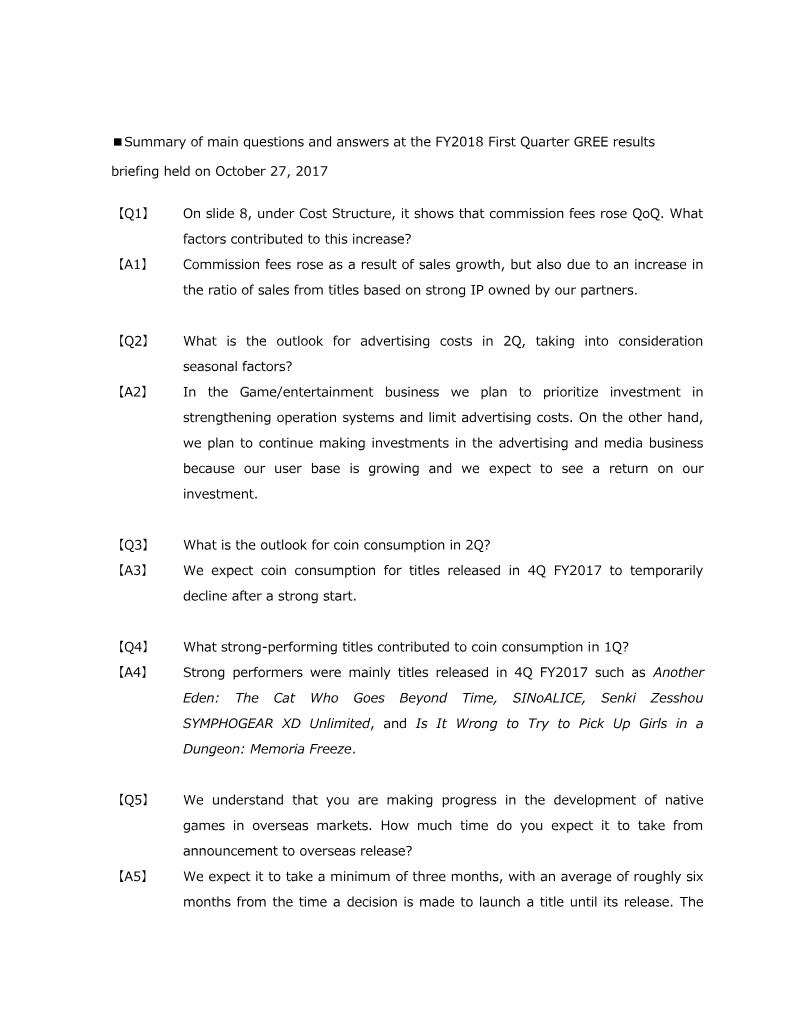
Summary of Main Questions and Answers at the FY2018 First Quarter GREE Results Briefing Held on October 27, 2017
The first quarter results for fiscal year 2018 reveal a strategic shift toward high-quality native game development and international expansion, particularly within the Chinese market. Financial performance during this period was characterized by an increase in commission fees, driven by both overall sales growth and a higher proportion of revenue generated from titles utilizing third-party intellectual property. Key contributors to coin consumption included successful late-2017 releases such as Another Eden, SINoALICE, and Senki Zesshou SYMPHOGEAR XD Unlimited. While a temporary decline in consumption is anticipated for these titles following their initial launch peaks, the long-term strategy focuses on scaling operational teams to enhance content depth and sustain user engagement.
The operational outlook emphasizes disciplined spending in the game and entertainment segments, prioritizing internal system strengthening over aggressive advertising. Conversely, investment in advertising and media remains a priority due to a growing user base. Regarding international growth, the timeline for overseas releases is estimated at three to six months following a launch decision. Success in the Chinese market is specifically tied to maintaining the authenticity of original Japanese versions while collaborating with local partners for fine-tuned regional operations.
Broader industry trends indicate rising user expectations and increased difficulty in player acquisition. To remain competitive, the strategy leverages a strong financial base to fund large-scale development and multi-media collaborations. Beyond mobile gaming, there is a continued commitment to the virtual reality sector, focusing on building development expertise and expanding accessibility through location-based VR experiences. This multifaceted approach aims to transition successful domestic titles into global hits while diversifying the technological portfolio to meet evolving market demands.
- GREE is prioritizing high-quality native game development and international expansion, specifically targeting the Chinese market by maintaining original Japanese content authenticity through local partnerships.
- Financial performance in Q1 FY2018 was driven by titles such as Another Eden, SINoALICE, and Senki Zesshou SYMPHOGEAR XD Unlimited, though the company expects a post-launch decline in coin consumption for these games.
- Commission fees increased during the quarter due to overall sales growth and a higher reliance on revenue generated from third-party intellectual property.
- The company is shifting its operational strategy toward internal system strengthening rather than aggressive advertising, though it continues to prioritize ad spend to support a growing user base.
- GREE is maintaining a long-term commitment to the virtual reality sector, focusing on the development of location-based VR experiences to diversify its technological portfolio.
+2
GREEOct 2017