
Game Developers Conference
Game Developers Conference (GDC, now the GDC Festival of Gaming) is the professional event for the games industry. It publishes recorded talks and interviews, annual industry survey reports such as the State of the Game Industry, and news articles.
Documents
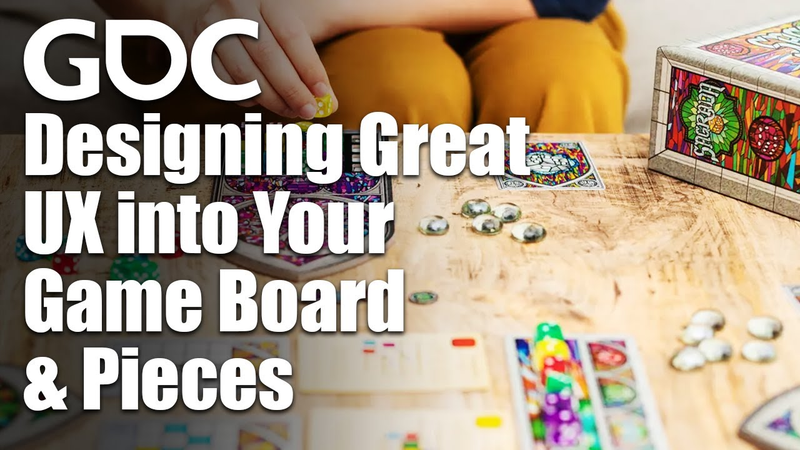
Designing Great UX into Your Game Board and Pieces
Prioritizing intuitive user experience in board game design requires shifting the burden of learning from the player to the developer.
- Prioritize UX design within the game board and pieces themselves to reduce reliance on rulebooks, as players intuitively attempt to learn games by assembling components and identifying patterns before reading instructions.
- Use iterative prototyping tools like laser cutters and 3D printers to test board layouts early, as late-stage production changes are significantly more costly than refining physical components during development.
- Streamline the user experience by replacing ambiguous or language-dependent iconography with clear, consistent visual cues, such as using specific colors to map dice results to victory point conditions.

Growing as a VFX Artist
Career advancement for visual effects artists in the gaming industry relies on a strategic synthesis of technical proficiency, sustainable work habits, and disciplined project management.
- Professional growth is driven by the adoption of procedural workflows, such as Houdini, which enable scalable asset creation and efficiency in modern production environments.
- Artists should prioritize rapid iteration over perfection, utilizing structured workflows and self-imposed deadlines to overcome creative stagnation.
- Technical proficiency is enhanced by using tools like Redshift, which prioritize speed and high-quality rendering to reduce the need for labor-intensive, multi-layer compositing.

Lessons from Labor Union Organizers
The modern labor movement within the gaming and digital media industries is defined by a strategic shift toward horizontal, community-driven organizing.
- Gaming labor organizing has shifted from isolated, shop-by-shop negotiations to a horizontal, industry-wide model that prioritizes broad solidarity across professional boundaries.
- Organizers are utilizing digital infrastructure like Slack and Discord to build resilient, cross-discipline networks that mitigate the isolation traditionally used to suppress collective action.
- The movement employs flexible, industrial-style bargaining models to accommodate a highly mobile workforce that frequently relies on freelancers and independent contractors.
Breaking the Ankh: Deterministic Propagation Netcode in 'Spelunky 2'
The implementation of online multiplayer in Spelunky 2 centers on the challenge of maintaining a responsive, low-latency experience within a resource-constrained environment.
- The Spelunky 2 team pivoted from a deterministic propagation netcode to a refined rollback system that uses virtual memory to manage state swaps, avoiding the high computational cost of frequent data copying.
- To enable reliable rollback, the developers refactored the entire game simulation to eliminate side effects and shared data dependencies, ensuring the engine could handle deterministic state transitions.
- The implementation of replay technology allowed the team to transform unreproducible bugs into deterministic scenarios, significantly accelerating the debugging process and facilitating the scaling of global server infrastructure.
'Final Fantasy VII' Remake: Automating Quality Assurance and the Tools for the Future
Modern game development requires sophisticated quality assurance strategies to manage the increasing complexity of large-scale titles like Final Fantasy VII Remake.
- Automated testing systems for Final Fantasy VII Remake utilize a centralized server architecture and platform-specific watchdogs to execute non-deterministic testing as early as the vertical slice phase.
- The testing framework records both gamepad inputs and granular game state data, using a synchronization stack to automate regression testing and minimize manual labor.
- Continuous 3D grid-based exploration and replay analysis allow teams to identify rare, intermittent bugs occurring in fewer than 0.3 percent of sessions.

The 2022 Game Developers Choice Awards (Full Video)
The 22nd annual Game Developers Choice Awards serves as a comprehensive recognition of excellence within the global interactive entertainment industry for the 2021 calendar year.
- Inscryption was named the Game of the Year at the 22nd annual Game Developers Choice Awards, which recognized excellence in the 2021 calendar year.
- Valheim achieved significant market impact by securing both the Best Debut and the Audience Award.
- Ratchet & Clank: Rift Apart demonstrated industry-leading technical and artistic standards by winning awards for both Best Visual Art and Best Technology.

The 2022 Independent Games Festival Awards (Full Video)
The 24th annual Independent Games Festival Awards served as a vital celebration of creative resilience, emphasizing the role of independent developers in fostering joy and human connection through interactive media.
- Daniel Mullins Games dominated the 24th annual Independent Games Festival (IGF) Awards, with their title 'Inscryption' winning four major categories: Excellence in Design, Excellence in Audio, Excellence in Narrative, and the Seumas McNally Grand Prize.
- The Nuovo Award, which recognizes innovative and experimental game design, was presented to 'Memory Card' by Lily Zone.
- The Audience Award, determined by public voting, was won by 'Mini Motorways' from developer Dinosaur Polo Club.

The Subtle Art of Not Making VFX
Long-term career success in game development, particularly within the specialized field of visual effects, depends as much on interpersonal proficiency as it does on technical mastery.
- Long-term career success in game development depends equally on interpersonal proficiency and technical mastery due to the highly iterative and unpredictable nature of production.
- Effective collaboration requires multi-modal feedback, which combines verbal discussions with visual aids and written summaries to ensure clarity and depersonalize critiques.
- Fostering a high-trust environment involves adopting a 'yes-and' approach to brainstorming and normalizing the sharing of unconventional ideas to encourage experimentation.

Games that Care: Lessons from Teaching Grief-Based Game Design
This analysis examines the pedagogical shift toward integrating care-based methodologies into game design education to address the industry’s systemic instability and the burnout of creative talent.
- Game design education should shift from a focus on 'hireability' and labor-market integration—which often leads to student burnout and the sacrifice of personal well-being—toward fostering reflective, empathetic, and sustainable development practices.
- Participatory design, historically rooted in Scandinavian labor unions to include end-users in workplace development, can be adapted into game curricula to help students create games that address complex, stigmatized human experiences like grief and bereavement.
- When designing for sensitive topics, educators should use 'cultural probes'—activity packs like scrapbooks and postcards—to facilitate meaningful, non-quantifiable feedback loops between students and participants, rather than relying on traditional usability testing.
Building an Expansive 'Star Wars' World in Mobile VR
The development of Star Wars: Tales from the Galaxy’s Edge for mobile virtual reality platforms, specifically the Oculus Quest and Quest 2, required extensive technical optimization to maintain high-fidelity interactive storytelling within constrained hardware environments.
- To overcome mobile CPU bottlenecks, the team implemented a custom object pooling system to eliminate hitches caused by spawning and despawning actors.
- Engineers optimized complex component hierarchies by replacing scene components with actor components and utilizing skeletal mesh detachment to allow animation graphs to function independently.
- The team developed a custom, automated pre-computed visibility system using navigation mesh geometry to limit cell placement, which significantly reduced computation time compared to standard occlusion methods.

The 'Flappy Bird' That Laid the Golden Egg: Success in Hyper-Casual
The hyper-casual game industry has evolved into a high-volume, data-driven market that prioritizes rapid prototyping and aggressive user acquisition over traditional game design depth.
- Hyper-casual games now account for over 50% of all mobile game downloads, driven by a business model centered on the arbitrage of rewarded video ads.
- Publishers like Voodoo utilize a 'swarm' strategy, testing hundreds of prototypes simultaneously to identify hits based on day-one retention and cost-per-install metrics.
- Success in the sector is dictated by mathematical efficiency and rapid prototyping rather than creative innovation, mirroring the pop music industry's focus on a singular, addictive hook.

Why My Students Design Escape Rooms
Designing escape rooms functions as a highly effective pedagogical framework for teaching foundational game design principles.
- Designing escape rooms is an effective pedagogical tool for teaching game design fundamentals because it allows students to practice brainstorming, rapid prototyping, iteration, and fine-tuning without requiring complex coding or software skills.
- Escape room projects are highly egalitarian and accessible, enabling teams of four to five students to function as dedicated designers who can collectively build, test, and balance physical puzzles using low-cost materials.
- The curriculum utilizes a three-week structure: week one focuses on research and thematic brainstorming, while subsequent weeks prioritize rapid prototyping and live playtesting.