The 'Flappy Bird' That Laid the Golden Egg: Success in Hyper-Casual
15 Mar 202228 min video
Transcript
foreign [Music] and I'm here to talk about the Flappy Bird that laid the golden egg so uh just briefly about me and why I care about hyper casual games so probably like a lot of you been making hyper casual games for a very very long time didn't call them that didn't know it was hyper casual but uh any mini games little prototypes little plays with mechanics little Twitchy Loops little arcady things been doing that forever for various Brands and mini games and websites we've also done a few uh what are now called idle games um so uh milky weiner High profits uh with East Side games and and we're working on an i o game so a multiplayer hyper casual game uh coming out and we're excited to to see how that goes so you know the interesting thing about hyper casual is how did we get here how did this become
a thing right well you know just as a as a quick spoiler a little later on we're going to show you some numbers and basically half the downloads in Mobile are hyper casual um how did that happen so you could really blame this guy uh Dong Nguyen and this is what dong did please count please count oh so thanks actually I need that back sorry oh in the spotlight too all right so dong was inspired by that very activity in fact I think it was the even stupider one with the uh elastic attached to it and to make a game so he was a a programmer in Vietnam and he coded a game in three days called Flappy Bird so who here has played Flappy Bird okay now raise your other hand now flat
no go that looks so cool all right um so dong you know hobbyist guy kind of messing around he wanted to make a game that was just incredibly simple uh and really the game was Mindless and I say this with genuine respect um almost in a Zen level of mindlessness you you lose your mind you lose your concept of mind when you're playing the game it's one touch game you're touching it there's pipes there's birds and there's a score you live that score you need to beat that score and before you know it hours have passed right so that said it was a crappy game right it was a crappy simple little hyper casual game but 50 million downloads later uh Publishers started paying attention uh hobby started paying attention everyone started saying how do we do this right how do we replicate this success in fact the initial launch of Flappy Bird had no ads in it and eventually dong was so overwhelmed by all of the success of the
game he took it down so uh Publishers started playing with this model and doing what uh you know I think looking back we can call super casual so they took casual games which were deeper but uh Mass Market games and took these simple mechanics often borrowed from historical great games like crossy Road borrowing from Frogger uh you know stick hero barring from any numerous arcade games and uh simplify them down to a core made them really really uh tight and easy and rolled them out and you can see the numbers here I mean this these are ridiculous uh even more ridiculous is a lot of these numbers came by and large organically people you know kids talking on the schoolyard and sharing their sharing the game at school with their friends uh you know game a game could easily get to the top of the charts and that just would amplify the download numbers so you really got this crazy this this way of achieving crazy huge downloads
right so it seems seems kind of easy on the surface right make a simple game get crazy use downloads profit and uh buy an island um super casual gameplay you know to really break it down is really the same thing we've been seeing even in coin op games from the uh 70s and 80s right just you put in a quarter you very simple friendly Graphics you understand by looking at it what's going on you jump in no tutorials or fatouies I always want to do that every time I say that word um you just jump in it's quick to start really really uh easy to get hooked and and usually it's usually if you like it you play again you want to you want to get a little better at your score and there's usually this very typical thing in game uh design where you ramp a challenge right you want things to get more and more challenging you want that pain you want to achieve that you want the pleasure of uh of doing that and that's how these games work very simple
stuff we all know as game designers programmers anyone who's ever you know played a game uh with any depth right nothing nothing kind of new here so the company that best exemplified this super casual era from 2015 to 2016 was ketchup so ketchup or uh two brothers out in France they created a few of these games very simply masterfully they uh cloned a lot of existing games that that were actually premium games and made them free and and achieved success that way they uh published a number of Indies that created games and put them out there and they got just crazy amount of downloads overall um and you know ended up netting millions of dollars per year uh ended up selling actually to I think Goldman Sachs recently another very interesting story in this era is uh the skin color switch color switch was actually built by a a veteran who didn't know how to program he picked up a tool
called buildbox he just had this idea for a game that the ball changes color and can only go through moving objects of the same color again it's a mechanic we've seen before in various ways he just did it masterfully really put love into the levels and it became a huge success millions of downloads and did quite well with that so then something changed in 2017 amid all this other stuff going on which was uh video ads rewarded video ads so of course rewarded video ads are always with us they've always been out there but ads at this point became uh the the the networks became much more mature so it was actually very cheap on places like Facebook or app loving to uh buy these ads uh put put a little a little clip of your Glam pay out there and and people especially young people and kids would really click on them and always want to try the latest thing right it was just easy click on the ad try it and and move on
um and the other thing that was happening is because so many people were using these ads the cpms the money you would get by putting these ads in your game became quite high as well so it didn't take uh rocket science but it did take some insight to realize that you could Arbitrage the system pretty well right if you could figure out a way to show more ads to players then you would spend to acquire the players you could do quite well and indeed many companies took advantage of this Arbitrage nobody more than the monster we call Voodoo uh Voodoo we're indie game players had a few small hits of their own they came out with the game paper i o very hyper casual uh quote unquote multiplayer game wasn't really multiplayer but it felt like it was and uh you know within within years they were they had I think 40 games the first year maybe a few hundred games a second year and they achieved just in
2018 over a billion downloads so how did Voodoo do this they actually got even more Mindless than Flappy Bird and again I say this with great respect they took this super casual model of being easy to grok quick to master and the quick sessions right and what they did that's really really counter-intuitive to anyone who's studied game design or anybody that's that's really gotten to the essence of what makes a game they took away the challenge really in a lot of cases they actually made the game rewarding you play the game and you do better and better and better and better uh do you get bored quickly eventually you do the retention is pretty low but you really have fun for a few days while you're at it so one could ask you know philosophically are these real games is this really just uh a linear experience disguised as interactivity and I have
strong opinions on the subject but we won't go down that path for now but the point is they worked and they worked really well not just Voodoo but many other companies Indies folks 2018 was the year of the of the hyper casual game and and it continues to this day which I think if you look at the the download stats right now uh 55 percent maybe even sick close to 60 of the games out there uh in terms of downloads are hyper casual games right so what we saw if you want to break this little uh casual game Market into epochs you have your era of 20 from 2007 2012 of the premium casual Epoch casual free to play from 2013 to 2016. the super casual creeped in there from 16 to 17 and then we are now in the era of the hyper casual game now of course that's not to say there aren't many other genres blah blah blah but if we're talking about casual this is really uh where the business has gone so monetization goes way down uh premium
casual you'd actually spend a little money to buy a game hyper casual there's often no in-app purchases at all you're just playing and then you're being monetized by ads retention as we discussed also has plummeted but obviously there's something that's driving this and it's down low it's it's just the sheer ease and ability to get massive massive amounts of downloads and that volume drives profit so let's talk about profit and I mean I don't know how many of you you all consider yourself uh business folks cool that's that's about the quarter um and you know so if you're who can who considers themselves uh hardcore Indie gamer or game maker game developer okay also a small amount so the you know a lot of times you won't think about the math if you're making a game you think about the fun right but you really have to understand the math of how this works
and how this breaks down because it's going to drive your every decision in terms of how long you spend on the game how polished the game is and uh of course what the final game is and and how you distribute it so you know and if you want to break it down in one chart it's not rocket science right the way you make money in the free to play business is you bring in more Revenue per customer than you spend acquiring them right and and uh hyper casual these numbers are low casino these numbers are incredibly high right you'll actually maybe spend 100 bucks to to bring in a real money Casino uh player but they'll earn you much more than that once they stay so let's look you know very quickly at a profit and law sheet for a successful hyper casual game so on the expense side not including the development cost which essentially washes out once you have a profitable game on the expense side you you have ads
right you have to spend money on ads to acquire your players now you might get some cross promotion with a publisher you might get featured but you shouldn't count on it you should count on ads as the thing you can predict if you're putting together a business plan uh so a good hyper casual game will have a ad cost about 40 cents an ad so that's the target we have to be if we can make more than 40 cents we have a profitable game so how do we figure that out the the beautiful thing about hyper casual games and about the crappy retention in hyper casual games is you could know very quickly by looking at the day one retention how much money your game is going to make it's actually a proxy for the entire revenue of your game and let me explain why right like that chart on the on the right is your a typical retention chart where 100 of people play on day one after day two uh maybe 60 of people are not interested they're not going to come back uh 40 might be and day three that drops even more and that you know that that curve is very steep for hyper
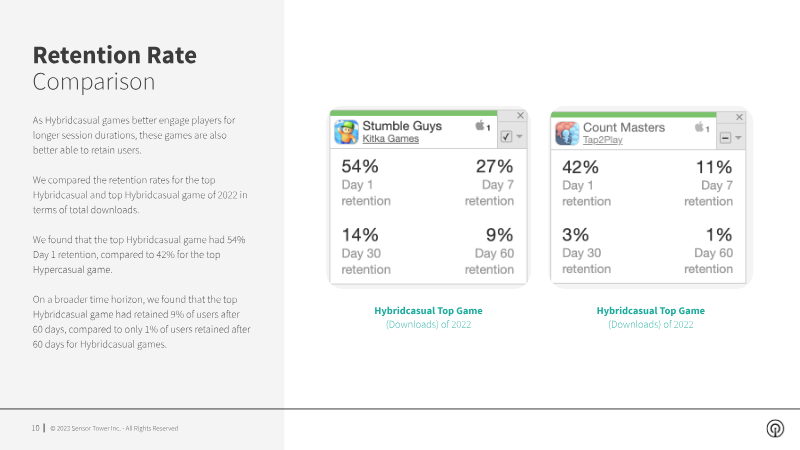
casual games because as we mentioned they kind of get boring after a while we're going to move on to the new one but if you can get your uh retention to about 50 that typically typically uh kind of breaks out to about a five day lifespan on average for players uh and most games again again this varies wildly but most games will get about three sessions a day uh of people actually coming back and playing maybe you'll show three video ads per session and let's say you can make a penny per video ad which is reasonable a bit on the high end so if you take five times three times three right you get 45 times a penny so now we have 45 cents we've made from each player boom we have a profitable game make sense kinda so if we zoom in on hyper casual from a from you as a Studio's point of view or from a Publisher's point of view our goal is to be above this line right and profit so if you take any hundred hyper casual
games that there's probably everyone in this audience that say makes a hyper casual game we have a game jam and everyone makes a decent game so I'm not even talking about the really bad ones just everyone makes a decent game that's somewhat fun and and fun to pass around to friends it's really really really difficult to know looking at it if it's going to succeed or fail but what we have and what's wonderful about hyper casual games and some would say horrible but hyper casual games is Market testing so you take 100 games and actually put it out there and after a day or two you can actually see what your day one retention is and plot that a lot of your games are going to be zero retention right there's just no one's going to come back you might have a few outliers on the top that people are actually love and they're coming back for weeks and weeks or even months and months then do the same thing with video ads for those games make a test video ad for the game do your best shot put it out there and remarkably the the cost for these video ads varies a lot and
actually remains consistent oftentimes even even though you could do slight optimizations the video ad actually remains uh the whatever cost you see for the video ad if you test it for a few days actually ends up being the video ad cost that you would run for for uh you know up to a million players so uh again you'll see very cheap video costs for most of them some of them you might see really expensive CPI costs because maybe the video art just doesn't appeal to people for whatever inexplicable reason uh maybe uh the game looks too similar to something else that's already just they've just played and you just don't know until you try it so you put it out there try it now you take these hundred games and you plot the cost per install based on the video ad and the lifetime customer value based on the retention and as you can see you'll you'll have a couple little dots that eek above the profit line and this is unfortunately what the picture really looks like
but if you can take the ones that are near the line and put in some tricks that improve retention like coming back and and getting bonuses or achievements that that that give you uh you know reason to come back and better push notifications and all the typical bag of tricks that increase return increase retention um and of course if you can smartly show more ads to players you've now increased your lifetime customer value and now you have more hits that have creeped above the line then finally on the publisher side the publisher uses the vast amount of data they have and plus their Network to cross promote between all their games to drive down the cost per install Now by driving down the cost per install you've even lifted more of those dots above the line so most of them just to be a million percent clear will fail but the few that rise above the line you now have a system a provable system to
pump uh marketing money into it and profit well very very handsomely so I mean I almost view hyper casual games as the uh is as this is the crowdsourcing way of of proving hits right and again kind of works with the thing we all know deep in our gut is that none of us know what we're doing when it comes to making games and this this model lets you take some tries take some shots and prove right away if you have something that can be a good business or not so where this is all going and I think is pretty clear and it's been this way for a while certainly was in the social game business and now it is in the mobile game business we're basically replicating what we're seeing in pop music and in pop in general right so if you if you're a new studio coming out and you want to create a game you can either put a lot of money into it and use uh
use use months and months and months if not years of development cost a huge team maybe get a big license uh do a soft launch for many months and tweak your uh your metrics into you until you've you know got it working and then spend tons of money on marketing and and plus you know use your relationships to get Apple and Google featuring and do quite well and that of course Works um but if it doesn't work it's a very big risk for for many companies or you could be the Nimble dwarf right just make make a playable game kind of a step or two above a prototype lure players in with the cheap video ads to see if they like it and see if they retain long enough to profit yeah so is this easy money is this uh a whale farting a rainbow out of its blowhole it's it's it's really not as I think you know if that chart wasn't clear to you and was maybe didn't illustrate enough hopefully this picture will
um you know if you partner with the publisher what Publishers do is this is this essentially this crowdsourcing they will take your game as part of a swarm military tactic which is a valid military tactic and swarm the Machine Gun Nest and most of you will die in fact here this was the reason I want the ball back can you say that again most of you will die thank you but the ones that succeed you know for very little effort very little time put into the game can do incredibly well and the numbers prove that out right even though it's a few cents per user because of the multi-million downloads that amounts to a great business uh now whether you go at it alone or use a publisher is of course up to you um every deal is different you have to shop around Publishers do have some great benefits for a pop system like this just like a
big music label has a big benefit to an aspiring songwriter they've done a lot of deals with UA they know how to optimize the price and get the cheapest ads they've seen a lot about what works and doesn't work can provide some some really good advice and of course they'll have other games oftentimes that they can promote your game in and get you a lot of free traffic so as far as which publisher to go to uh Voodoo is still quite uh dominant with almost 30 percent of the downloads single-handedly as a company uh there's a new uh attempted king of the jungle there starting in August with line Studios there's an option an offshoot from the ad company off app 11. and there's some other players out there and and in the green band that's just other Publishers and there's a lot of smaller up and coming Publishers and you know I predict uh a few of them will get up there in this
big Echelon of downloads in 2019. here's a list of a bunch of them and by the way at the end I'm going to post the link to the slides so don't worry about all the math and and and logos uh this will all be available online and you know like like I'm saying this really is resembling now to me if you pull back the pop music industry you have tons and tons of eager hopefuls many with quite a bit of talent you have a a product that's aiming for Mass Appeal you are are putting craft and speed over your your Artistry when you're actually building that product you're trying to do something that's trendy not Innovative you often are using repetitive beats and rhythms or in our case repetitive taps and you know ultimately you there's a marketing and promo machine that proves out the winners and you know of course there is some risk sometimes it fails but almost always if the machine tells you you're going to have a hit on your
hands you do and it makes sure you do right and if there was a great uh NPR piece on Planet Money about how the pop music business works and it's it's pretty fascinating right you get you know once you're vetted as a talented songwriter by uh you know by good producers they'll have you come in and write a few songs uh of course throw most of those away but the ones that work they might get a a better producer to really lay down a track and do a vocal duster and finally um you know they might get some people to come in and focus test it and hear it they might mix in mac and and Master it all that's pretty cheap right that's about maybe 70 80 000 dollars and then they'll once it's once it's at that point they'll play it in some test markets make sure their thesis Works in terms of marketing and then spend the big money and jam it into everybody's uh ear hole whether you want whether you want to hear it or not you're going to hear the pop song and it obviously works
right they it's become a big business and it's about doing the marketing at the tail end so I think the question you have to ask yourself as a game makers are you Esther Dean and for those who don't know uh esterdeen she's a face behind many of the hit songs that we listened to and in my case forced to listen to um all the time right she's she's written many many hits for people like Rihanna Katy Perry Nicki Minaj Beyonce Drake Usher I could go on and on and on um songs like fireworks and Etc uh and her process is is pretty amazing if you have a chance to see her on YouTube and just see her process she's I mean she's got a good voice but really what she's got uh is this this uncanny sense of of finding a hook right finding this part of a song that people can't get out of their head and whatever this is her process she just goes in there and screams and yells and chants and strange language you know strange gutturals and when she feels that chill she knows
she's hit it everyone in the room knows she's hit it and boom they've they start printing the money so it's it's a pretty crazy but if you feel you have that esterdeen Talent equivalent in game mechanic design go for it and you will do well so I want to leave you with a few just big weighty thoughts about what this all means in terms of the game's business because again it's some of it as from a data science level and a business level is fascinating from a creative game making level it's a bit disturbing and unsettling uh so this is the first prediction you know right right now uh if you're into the world of uh ad networks there is a lot of what they call AI it's really just uh a b testing done through algorithm uh happening in ad networks in
other words you'll see one ad with a blue button one ad with a yellow button they'll see which one gets more clicks and then they'll show more of that one and then they'll show one with this little tagline uh they'll show them with this little tagline which everyone gets more clicks they'll give more uh you know dominance too and it works right you you end up getting ads that drive more clicks in the market you're crowdsourcing your problem and the market is proving out which ad works the best and which ad they like the most this is used not just in the game industry this is used in all advertising games I believe someone and I think it's a problem people are working on now as we speak people are creating systems that will Design their own game mechanics and again as game designer it's a little bit scary but these systems will blend the mechanics and colors and art and shapes and music from all these other hit games and create some truly horrible hybrid monsters but somewhere in there they'll also create I
believe what a hit that makes Flappy Bird uh you know look like what's what's a good bird metaphor I don't know it'll make Flappy Bird look like a flop right so it's uh it's scary but you know talk to me in a year we'll see if this happens big prediction number two uh and this is like maybe a ray of Hope but you know this is not gonna necessarily last quite the way it is it never does none of these Trends and markets do uh everything's getting crowded there's too many people trying to go after the same prize too many Publishers making too many games that are too much the same uh too many of these ads look the same so audiences are getting bored with the same old same old Publishers will hit a revenue ceiling no matter how many uh you know aspiring Studios and and Indies they work with to create that swarm effect they'll just
get to hit a ceiling of how many hits they're gonna be able to get and uh guess what everyone will discover this magical thing called engagement with uh good old-fashioned social features and narrative and and deep Play Systems and multiplayer uh systems and Saga maps and and actually difficulty and level design and deep economies and blah blah blah all the stuff that that we've been doing uh in Mobile and probably before so that's pretty much it that's the flap and hopefully uh giving you some food for thought thank you so much [Applause]
Auto-generated captions from YouTube — names and numbers may be misheard.
Key insights
Distilling the key insights…
Ask AI about this video
Cite this video
Citation
Generating citation…

















Comments