1 free read left. Create a free account for unlimited reading + AI research.
Create free accountArticle G|A|M|E – The Italian Journal of Game Studies
1 free read left. Create a free account for unlimited reading + AI research.
Create free accountArticleG|A|M|E – The Italian Journal of Game Studies
The essays, edited by Pat Harrigan and Matthew G. Kirschenbaum, span history, design, academic applications, and literature.
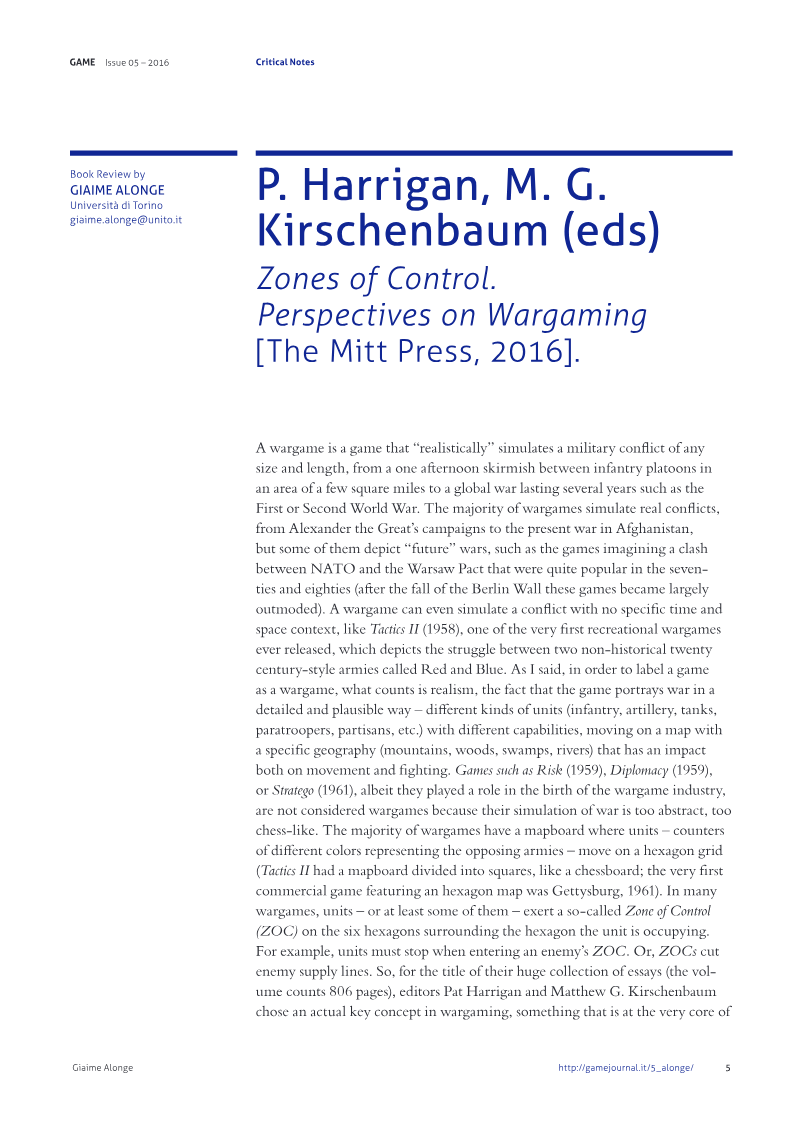
This document is a 2016 book review by Giaime Alonge of "Zones of Control: Perspectives on Wargaming," an 806-page collection of essays edited by Pat Harrigan and Matthew G. Kirschenbaum. The review frames wargaming as a hobby and analytical tool, tracing its origins from 19th-century Prussian Kriegsspiel through the commercial industry launched by Avalon Hill in the late 1950s and 1960s. It distinguishes wargames, which prioritize realistic simulation of units, terrain, and movement, from more abstract games such as Risk and Stratego, and notes the collection's nine thematic sections, which span history, design, academic applications, and literature.
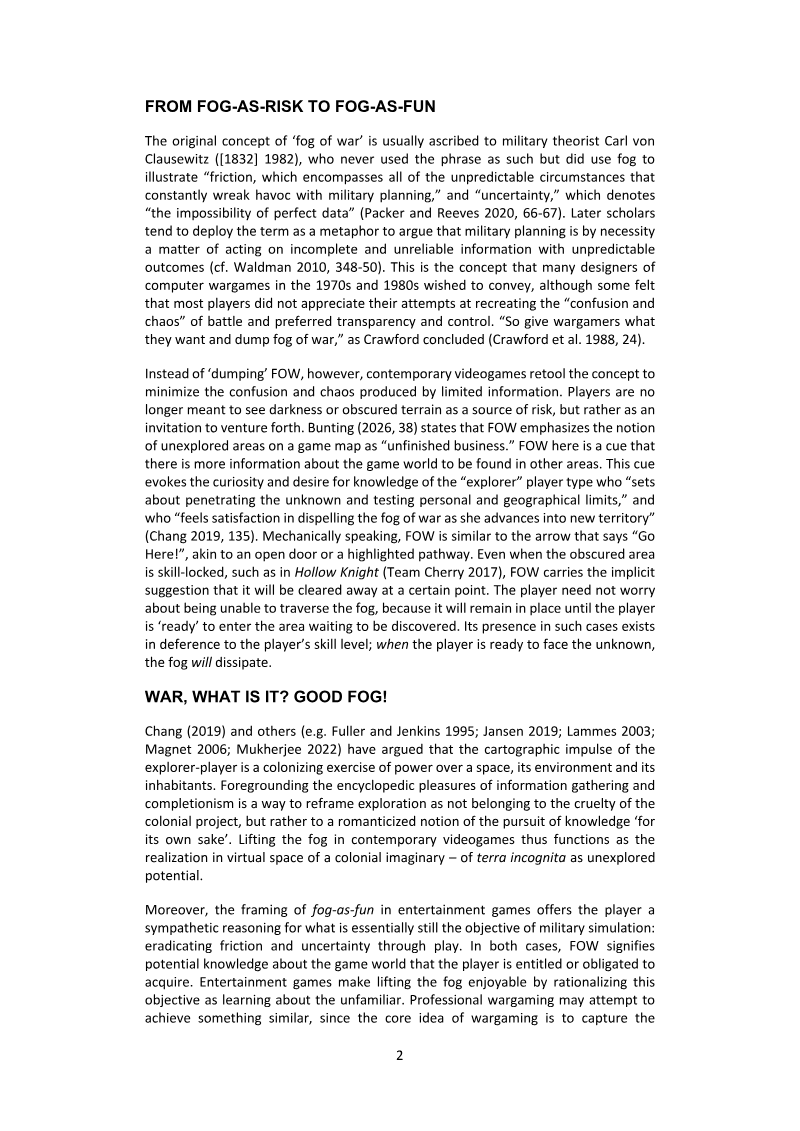
The review identifies several recurring tensions across the volume: recreational versus "serious" uses, analog versus digital formats, and the hobby's historically narrow demographic and military ties. It highlights the decline of traditional wargames amid competition from role-playing games and video games, and the revival of card-driven wargames from the mid-1990s onward, such as We the People and Twilight Struggle. Greg Costikyan's essay argues that digital wargames failed to address core analog problems like the fog of war and spatial simulation, instead favoring less sophisticated formats.
The reviewer also examines the political and gender dimensions of wargaming, noting the editors' acknowledgment of its Anglo-American and male-dominated heritage, while praising the collection's inclusion of diverse contributors. The review gives particular attention to the ethical tension in depicting war, including the "devil's beauty" of its appeal, and critiques specific essays for historical inaccuracies regarding Nazi-era units. Overall, the review judges the book an excellent and likely indispensable reference, while faulting it for limited coverage of card-driven games.
Each row is a game or company this document names, each column a document, oldest first. A mark means that document names it. Select a row to see those documents.

G|A|M|E – The Italian Journal of Game Studies · 2026

G|A|M|E – The Italian Journal of Game Studies · 2026

G|A|M|E – The Italian Journal of Game Studies · 2026

G|A|M|E – The Italian Journal of Game Studies · 2026

G|A|M|E – The Italian Journal of Game Studies · 2026

G|A|M|E – The Italian Journal of Game Studies · 2026

G|A|M|E – The Italian Journal of Game Studies · 2026

G|A|M|E – The Italian Journal of Game Studies · 2026

G|A|M|E – The Italian Journal of Game Studies · 2026

G|A|M|E – The Italian Journal of Game Studies · 2026

G|A|M|E – The Italian Journal of Game Studies · 2026

G|A|M|E – The Italian Journal of Game Studies · 2026
DiGRA · 2026