
European Conference on Games Based Learning (ECGBL)
Annual European conference on game-based learning and serious games; its proceedings are published open access (CC BY) by Academic Conferences International.
Documents
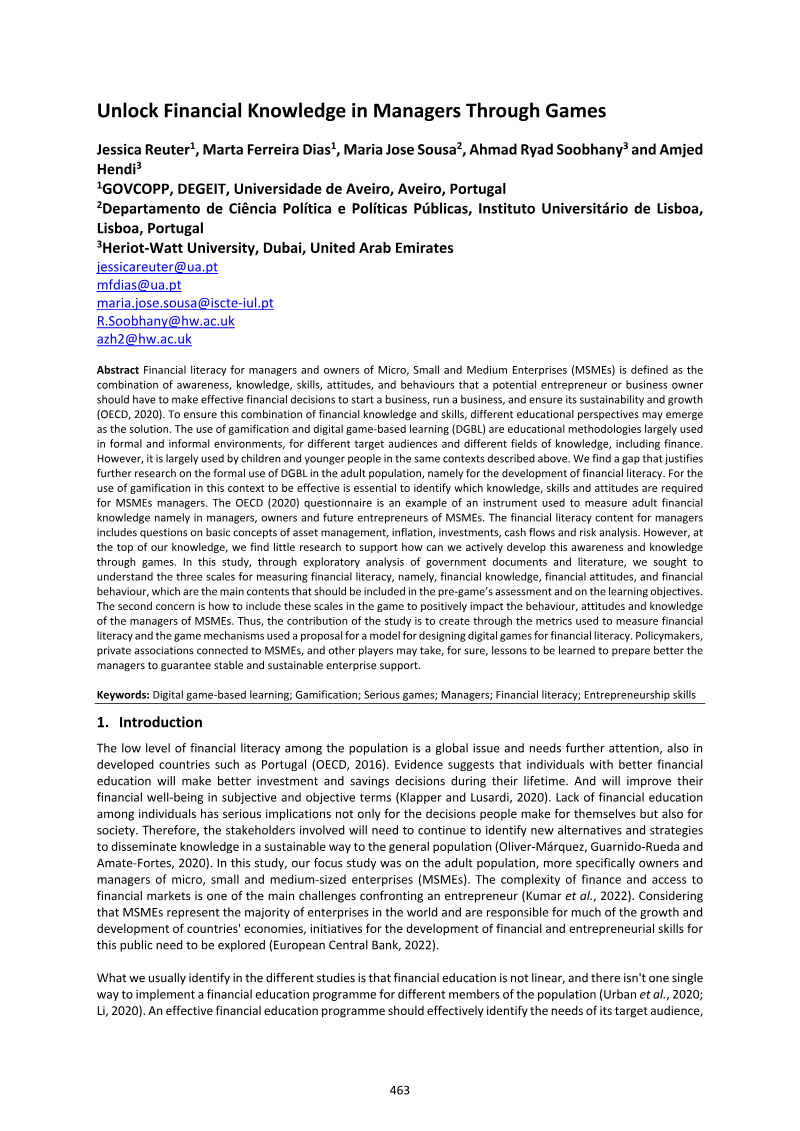
Unlock Financial Knowledge in Managers Through Games
This study examines how digital game-based learning and gamification can build financial literacy among owners and managers of micro, small, and medium enterprises (MSMEs).
- Financial literacy strongly shapes MSMEs' access to finance, risk management, and long-term sustainability, yet games designed for adult managers remain underexplored.
- The authors argue serious games can complement traditional financial training for MSME owners and managers, but only if their design is tightly tied to specific learning objectives.
- The OECD competency frameworks for adults (2016) and MSMEs (2018) define awareness, skills, and attitudes as the core elements of financial literacy that such games should target.
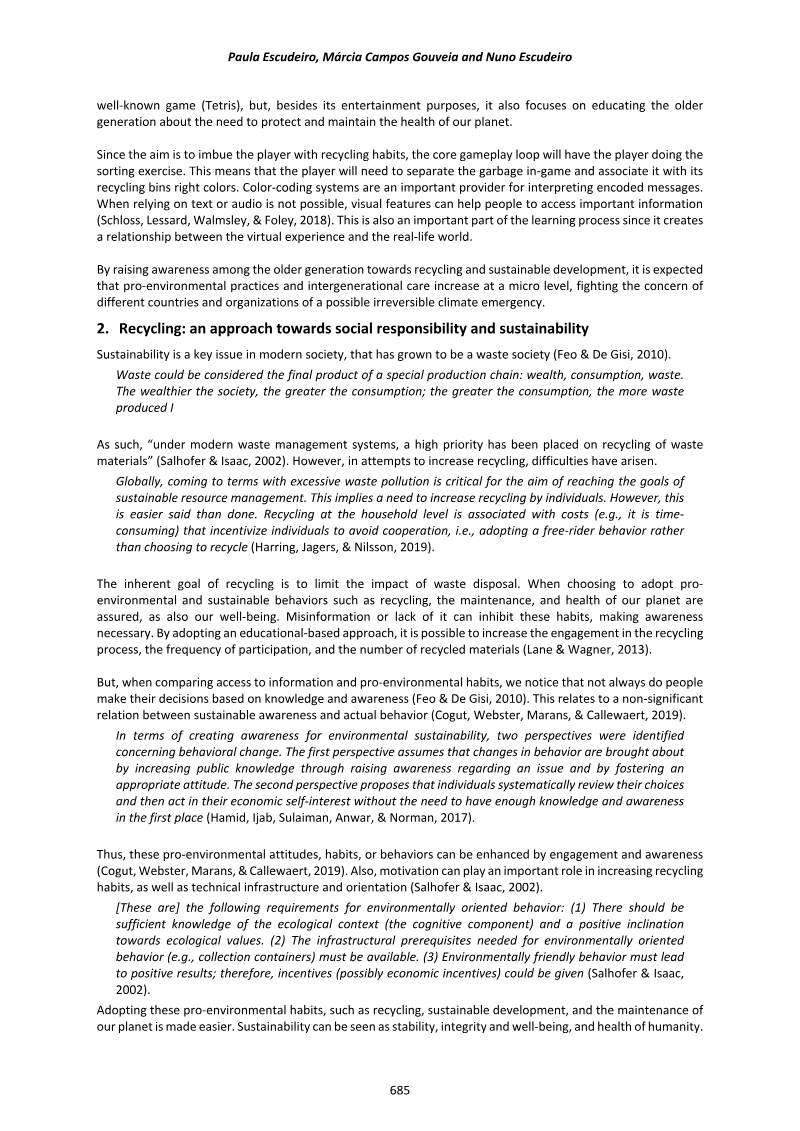
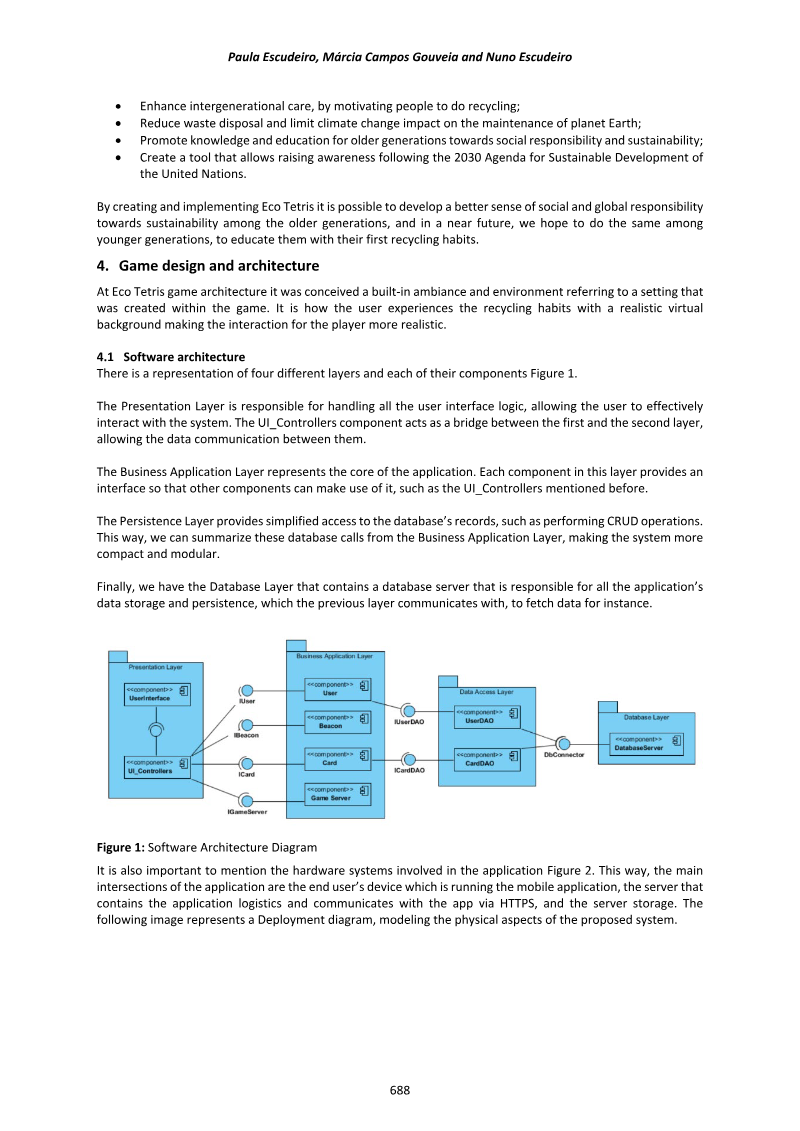
Eco Tetris: A Serious Game on Sustainability
Eco Tetris is a serious game designed to build recycling habits and environmental awareness, particularly among older adults.
- Eco Tetris is a serious game developed by researchers at the Games, Interaction and Learning Technologies group of the Instituto Superior de Engenharia do Porto in Portugal, which adapts classic Tetris so players sort falling garbage into color-coded recycling bins.
- The game adds card collecting, multiplayer play, and geo-referenced beacons that link in-game activity to real recycling points, where augmented reality content provides positive reinforcement and environmental information.
- The authors frame recycling as a persistent collective action problem and argue that individual behavior change depends on knowledge, infrastructure, and incentives, linking the project to the United Nations 2030 Agenda.
Designing a Game to Promote Equity in Cybersecurity
This paper presents the design and early playtesting of HEX of the Turtle Islands, a 2D isometric adventure game intended to introduce underrepresented youth to cybersecurity concepts through narrative and puzzle-based play.
- The paper argues that cybersecurity's workforce diversity problem partly stems from its typical placement as a late-stage capstone topic in computer science higher education, and that game-based learning could build novice identities and self-efficacy earlier.
- The authors identify two shortcomings in prior cybersecurity games: they often use the subject superficially, or when conceptually accurate, they reproduce a narrow professional stereotype with limited avatar and character diversity.
- HEX of the Turtle Islands, a 2D isometric adventure game, is organized around three principles: multiple intertwined narratives as hooks for diverse players, authentic cybersecurity and computational thinking puzzles (ciphers, logic, pathing, modular arithmetic), and exploration linking narrative and puzzles.
Using Game-Based Learning Methods to Demystify Cyber Security Concepts for Adult Learners
The paper presents the Gamified Intelligent Cyber Aptitude and Skills Training (GICAST) project, a game-based learning resource designed to introduce cyber security concepts to low-confidence adult learners aged 24 to 65 who lack degree-level qualifications and work in low-paid or low-skilled jobs vulnerable to automation.
- The GICAST project embeds narrative-driven mini-games at the start of each week of an eight-week badged open course on the OpenLearn platform, targeting low-confidence adult learners aged 24 to 65 without degree-level qualifications, many in low-paid or automation-vulnerable jobs.
- The course achieved a 20.8% completion rate within three months, compared with a 12.9% median from an earlier study, and learners completed it in about four weeks versus eight for a comparable non-game course.
- Around 94% of respondents reported enjoying the course, and 71% credited the games' fun element with increasing their engagement.
Ganking the Ranking: The Self-Reported Learning Potential from a Selection of Game Genres to Develop Self-Directed Learning
This study examines how third-year Bachelor of Education history students perceive six video games as tools for game-based learning (GBL) and self-directed learning (SDL), framing self-direction as a critical 21st-century skill that games might cultivate.
- Only 24 of 80 invited students completed the survey (a 30% completion rate), so findings rest on a small, self-selected sample from one North-West University cohort of third-year Bachelor of Education history students, limiting generalisability to South African pre-service history education.
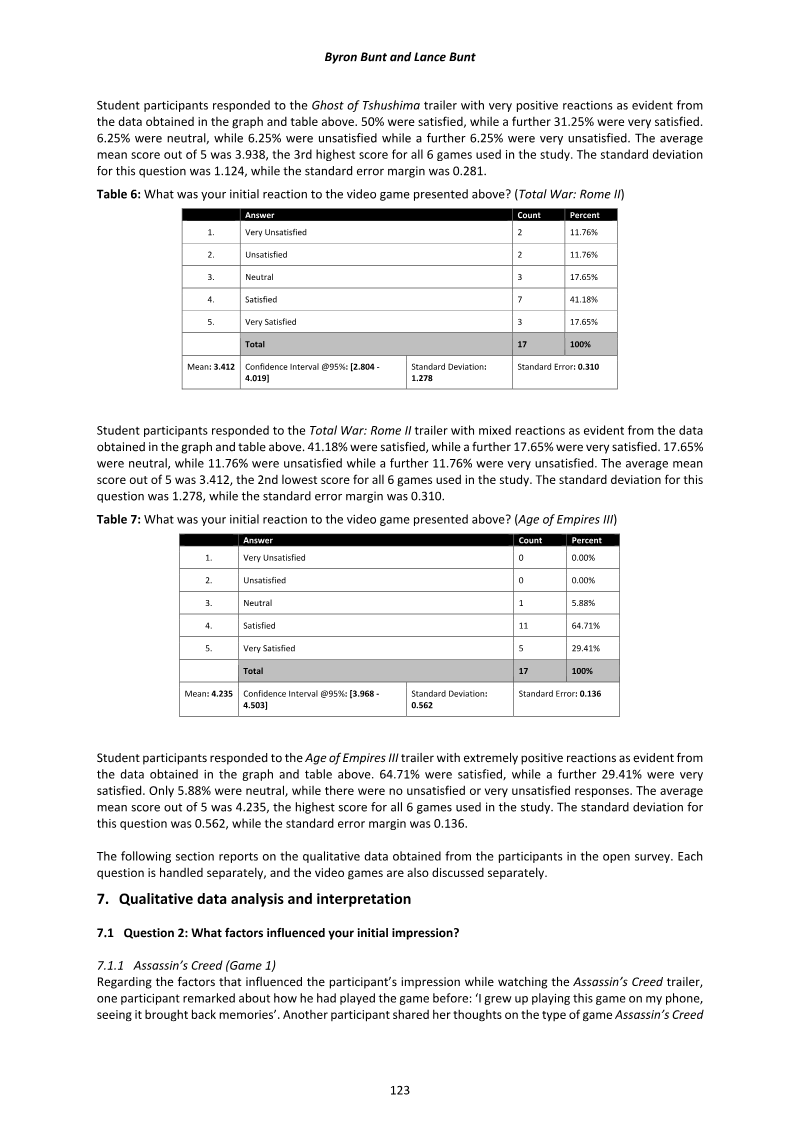
- Participants rated Age of Empires III highest (mean satisfaction 4.235 out of 5), followed by Assassin's Creed (4.111), while Total War: Rome II (3.412) and Valiant Hearts: The Great War (3.292) drew more mixed reactions, with Valiant Hearts scoring lowest overall.
- Initial impressions were driven by nostalgia, genre preference, historical setting, storytelling approach, emotional response, and familiarity with the depicted content, and the authors caution that positive first reactions alone do not demonstrate a game's educational suitability.
ARtales: AR Mobile Application Using Transformative Learning Through Aesthetic Experience
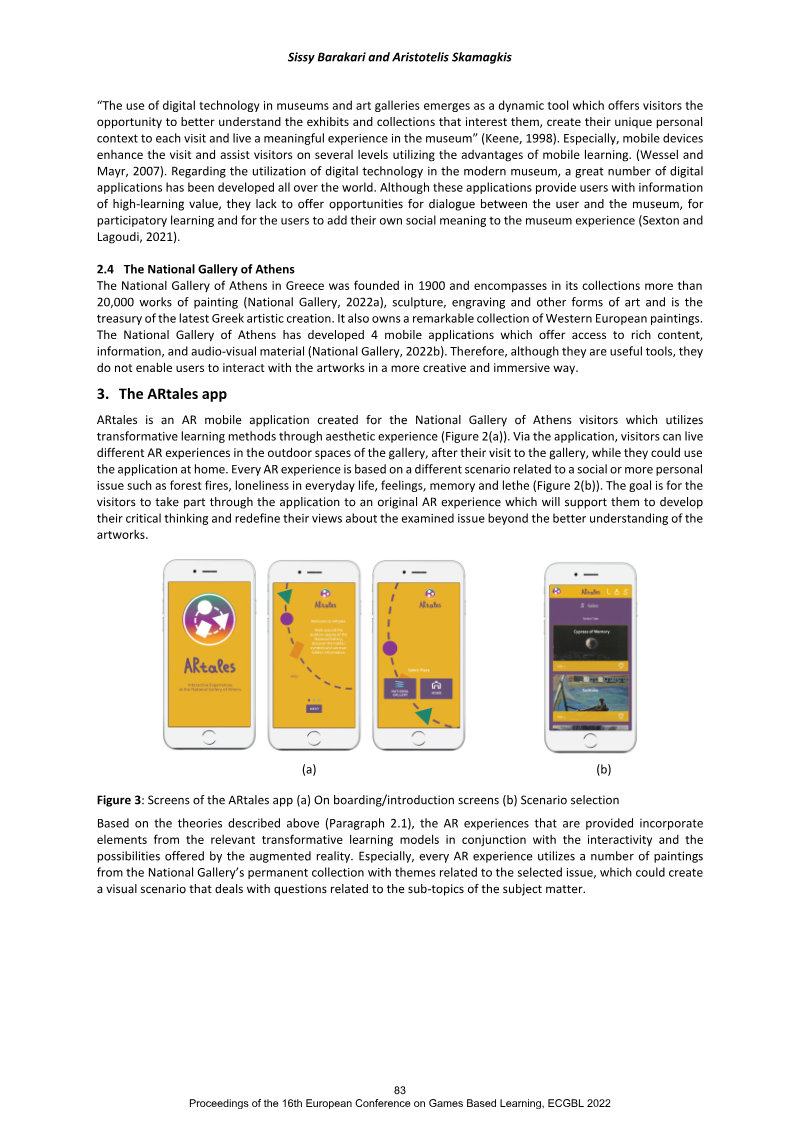
ARtales presents an augmented reality mobile application developed for the National Gallery of Athens, designed to foster transformative learning through aesthetic experience.
- ARtales is an augmented reality mobile app built for the National Gallery of Athens that pairs artwork interpretation with points-based gamified rewards to promote critical thinking about art and the social issues it addresses.
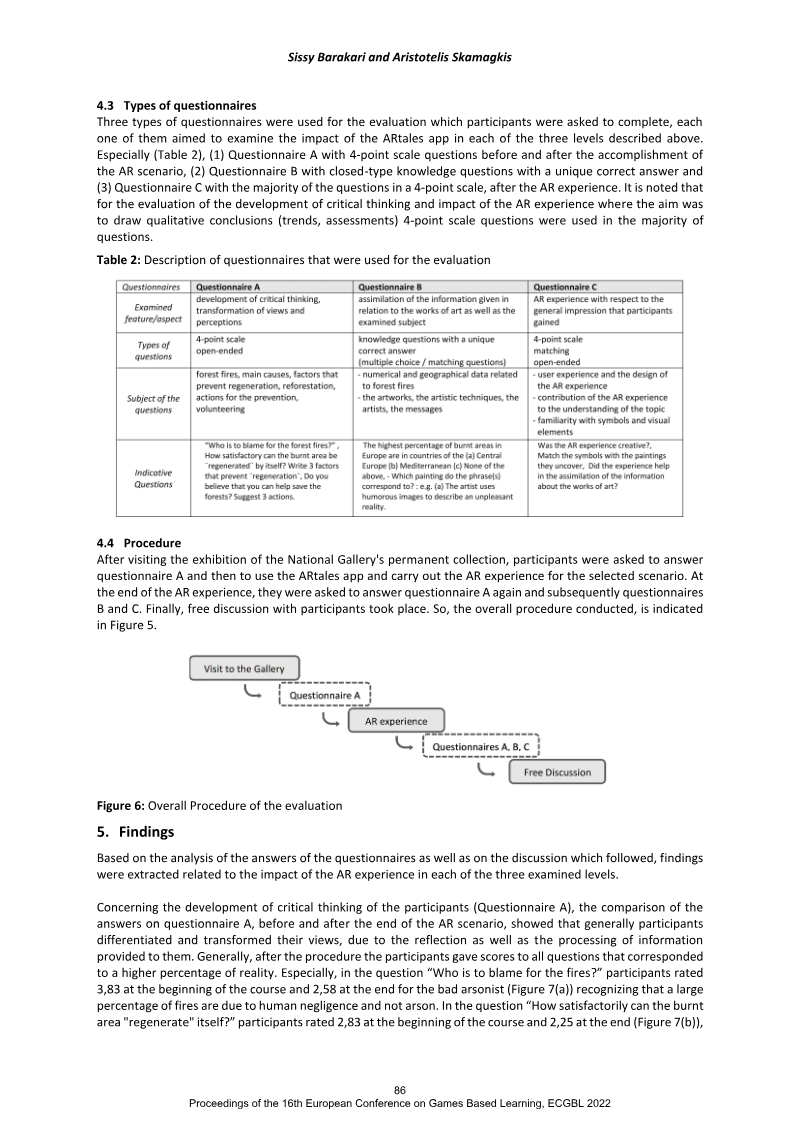
- In a preliminary evaluation with twelve postgraduate art and digital design students using the "Cypress of Memory" forest-fire scenario, the rating of the "bad arsonist" as a cause of forest fires fell from 3.83 to 2.58, suggesting greater recognition of human negligence as a major factor.
- Seventy-five percent of participants answered all forest-fire questions correctly, and 58.3% achieved a perfect score on the artwork-matching task.
A Digital Learning Game for Mathematics that Leads to Better Learning Outcomes for Female Students: Further Evidence
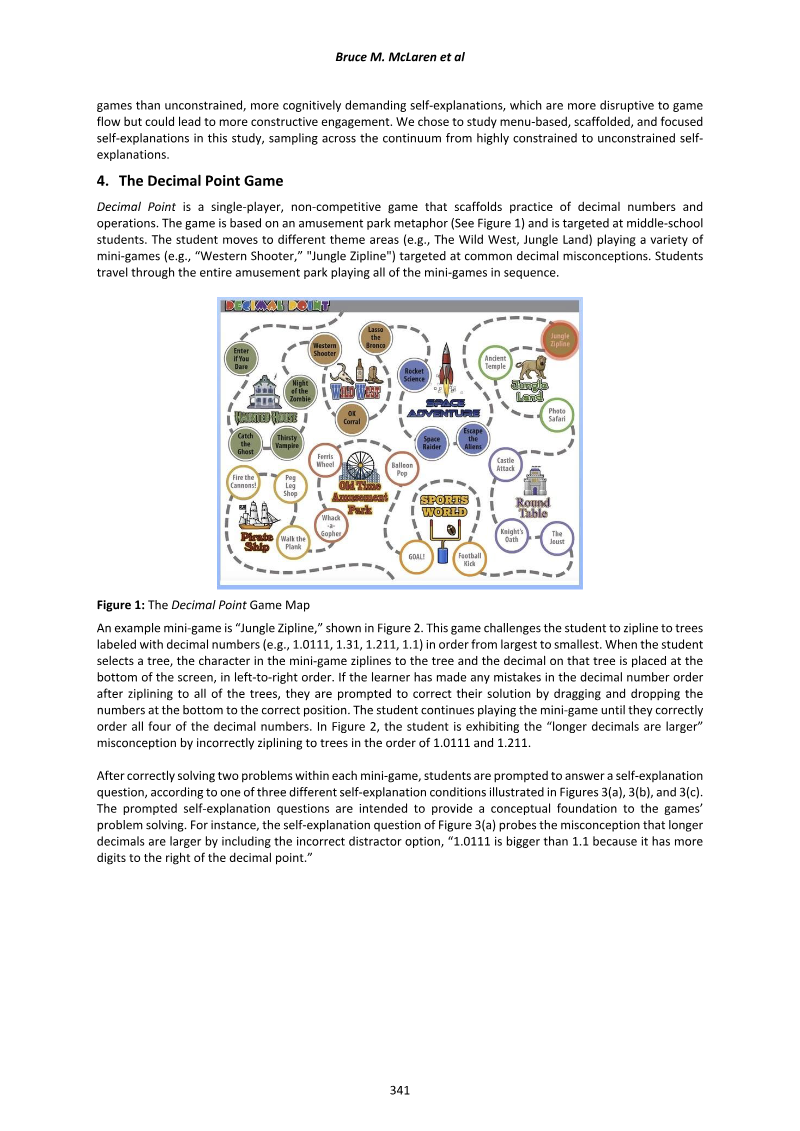
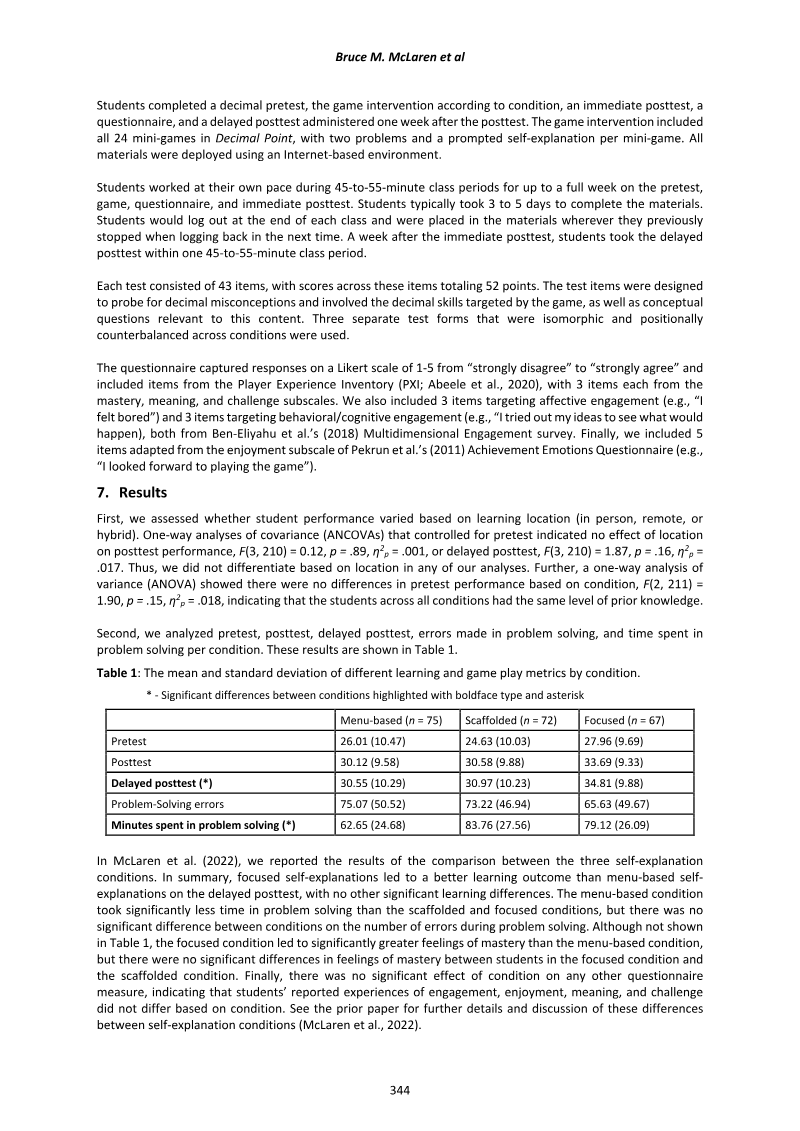
The document examines whether Decimal Point, a digital mathematics game for middle-school students, produces better learning outcomes for female students, and it builds on a body of earlier studies by the same research group involving more than 800 students.
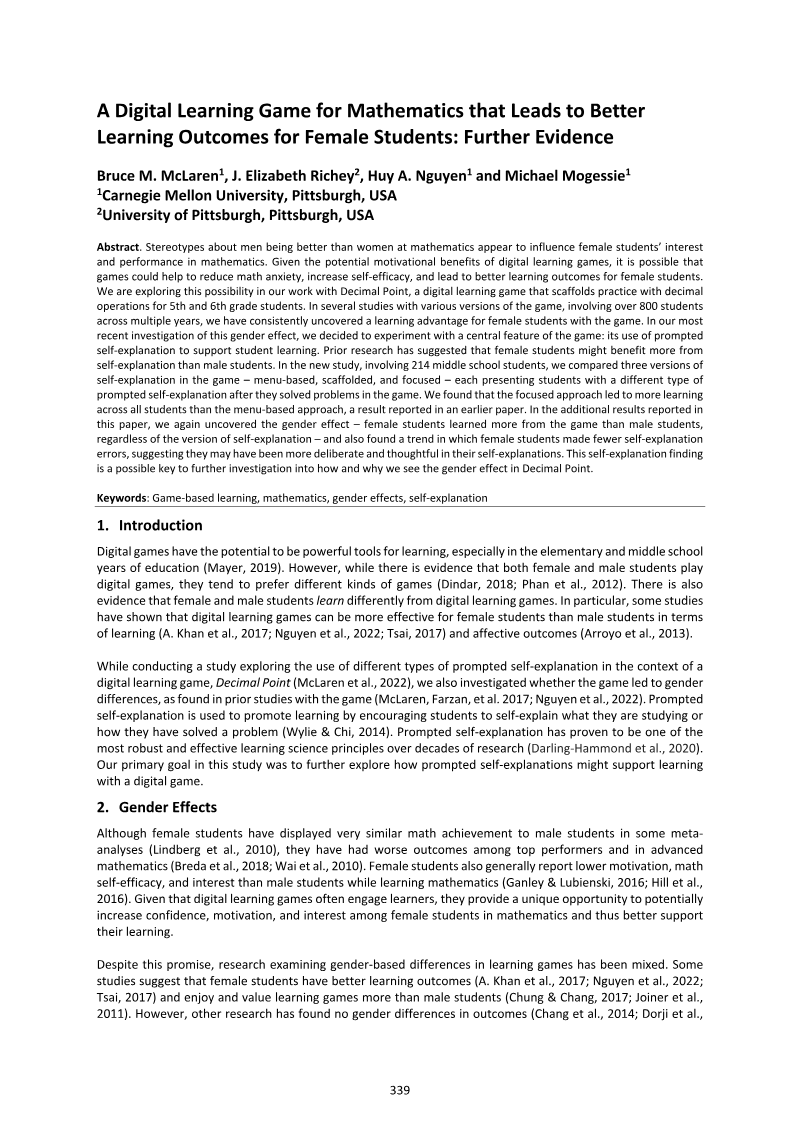
- Female students learned significantly more than male students from the Decimal Point digital math game, outperforming them on both immediate and one-week delayed posttests.
- The gender advantage is presented as robust across five studies by the same research group, which involved more than 800 students in total, making this a consistent pattern rather than a one-time result.
- The current study involved 214 fifth- and sixth-grade students comparing three self-explanation formats: menu-based, scaffolded, and focused prompted self-explanation.
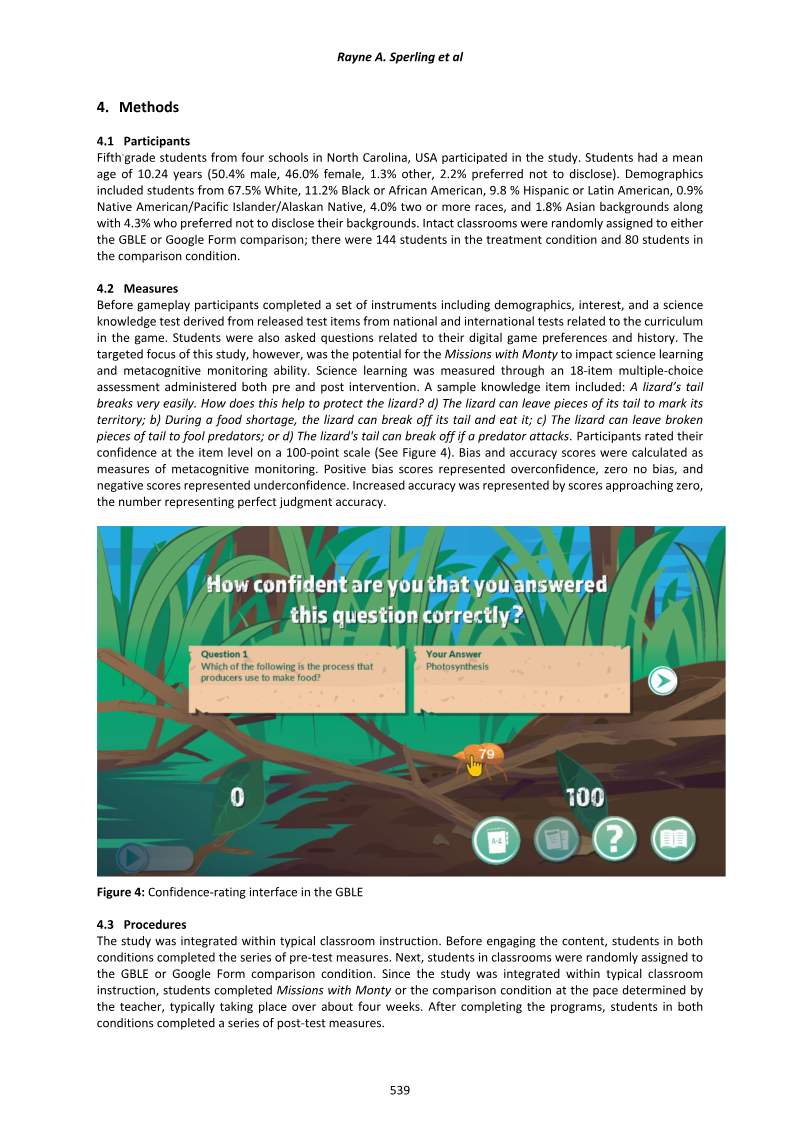
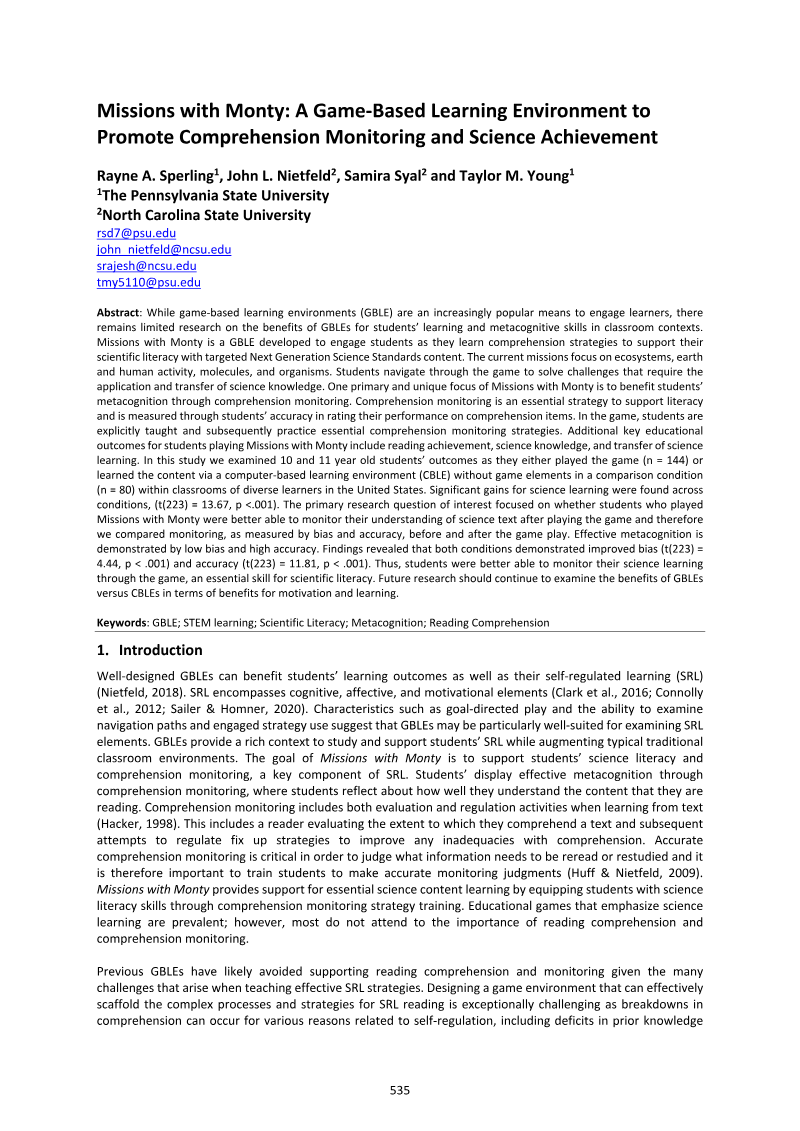
Missions with Monty: A Game-Based Learning Environment to Promote Comprehension Monitoring and Science Achievement
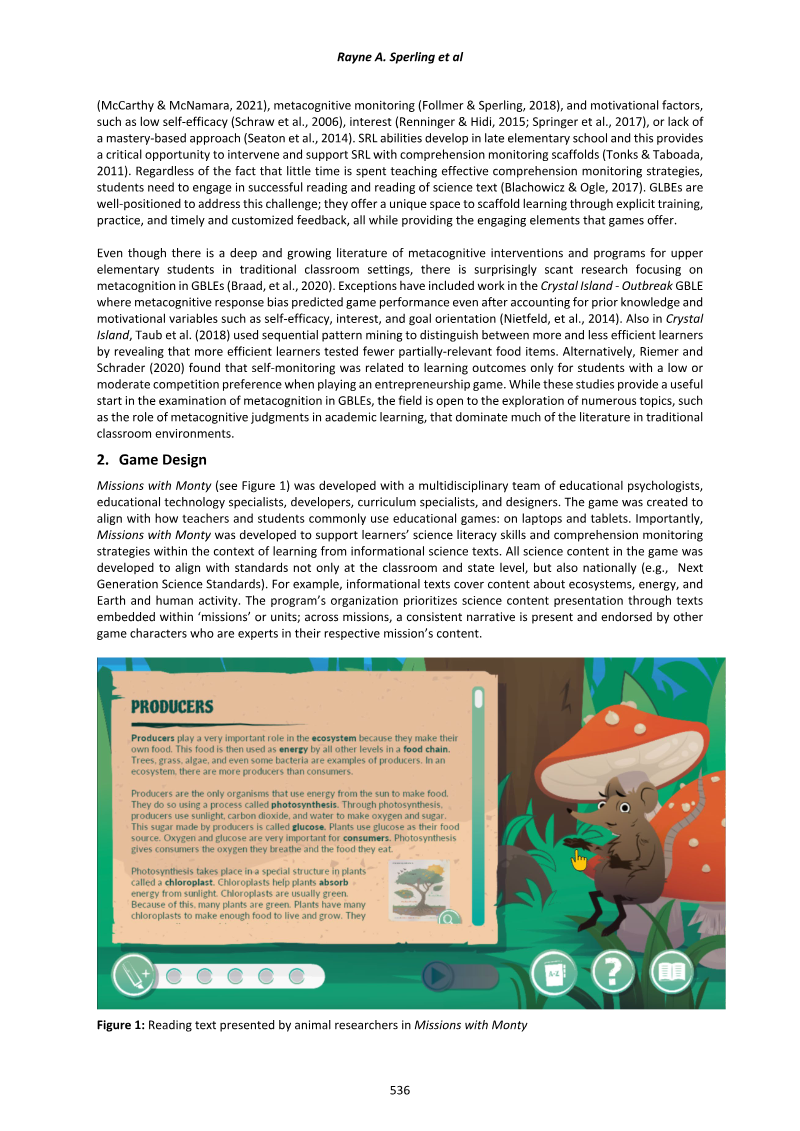
This study evaluates Missions with Monty, a game-based learning environment (GBLE) designed to teach fifth-grade students science content aligned with Next Generation Science Standards while building comprehension monitoring, a core self-regulated learning skill.
- Students who played Missions with Monty, a game-based learning environment teaching fifth-grade NGSS science content, showed a significant science knowledge gain on an 18-item pre/post test (t(143) = -13.21, p < .001), with 144 game students compared against 80 students in a non-gamified Google Forms condition.
- Both conditions improved science knowledge, but the study's core question was whether the game boosted metacognitive monitoring, and the comparison was designed around a self-regulated learning skill (comprehension monitoring) rather than content alone.
- Game-condition students became significantly less overconfident (bias) and better calibrated (accuracy) in their confidence judgments, and both monitoring gains remained significant when the two conditions were analyzed together.
Training Team Creativity with Lego Serious Play: Upside and Downside of Team Diversity
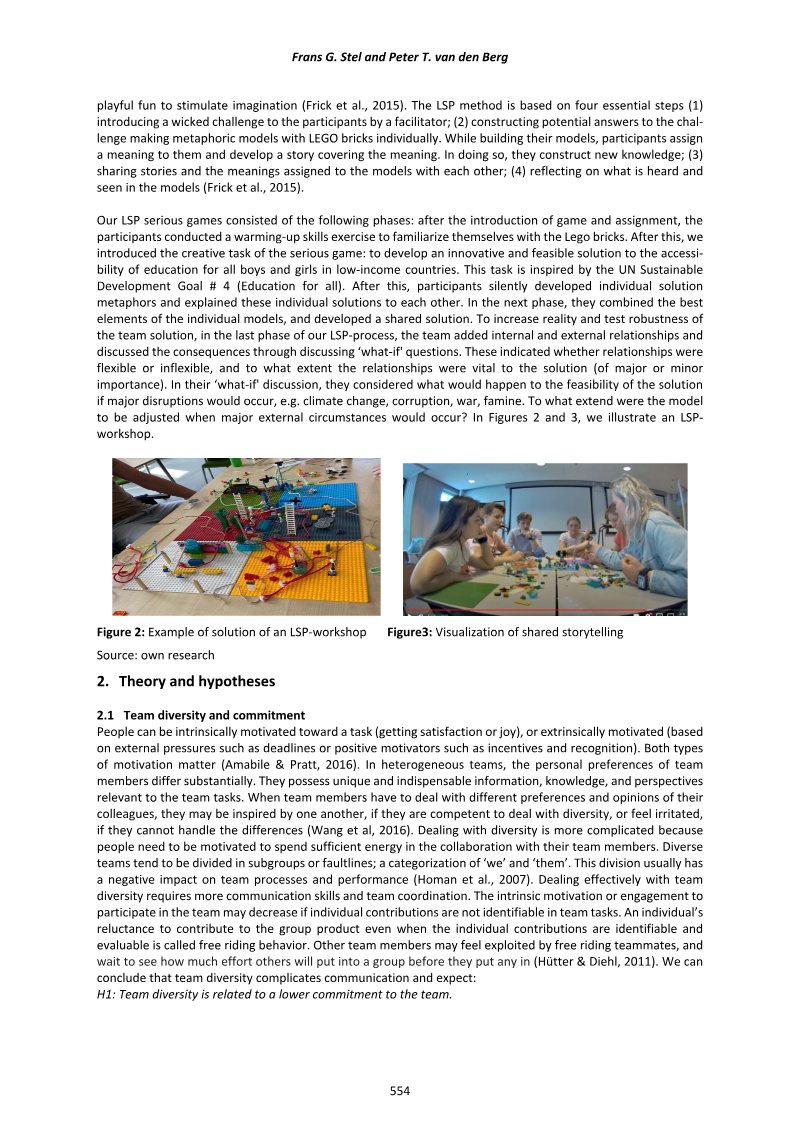
This study examines whether Lego Serious Play (LSP), a facilitated workshop method that combines visual modeling, storytelling, and hands-on building, can enhance collaborative creativity in teams, and how team diversity shapes that outcome.
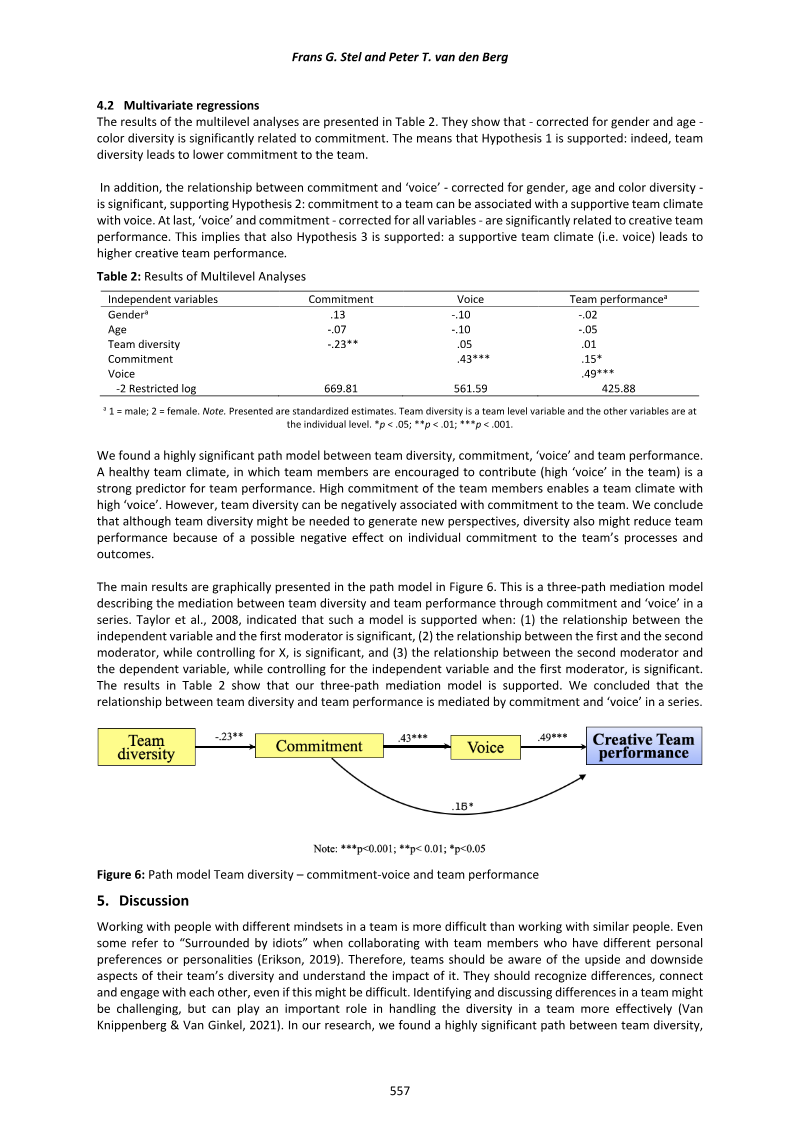
- Team diversity shows a significant negative relationship with commitment (β = -.23, p < .01), so diversity's creative benefits can be undermined by reduced commitment unless teams are actively managed.
- The authors propose a three-path mediation model in which diversity affects creative performance through commitment, while commitment and voice each positively predict creative performance and voice is supported by a team climate.
- Commitment and voice each positively predict creative team performance, supporting the proposed mediation structure linking diversity to outcomes.
Systems Mapping to Support Interdisciplinary Understanding in Serious Game Design
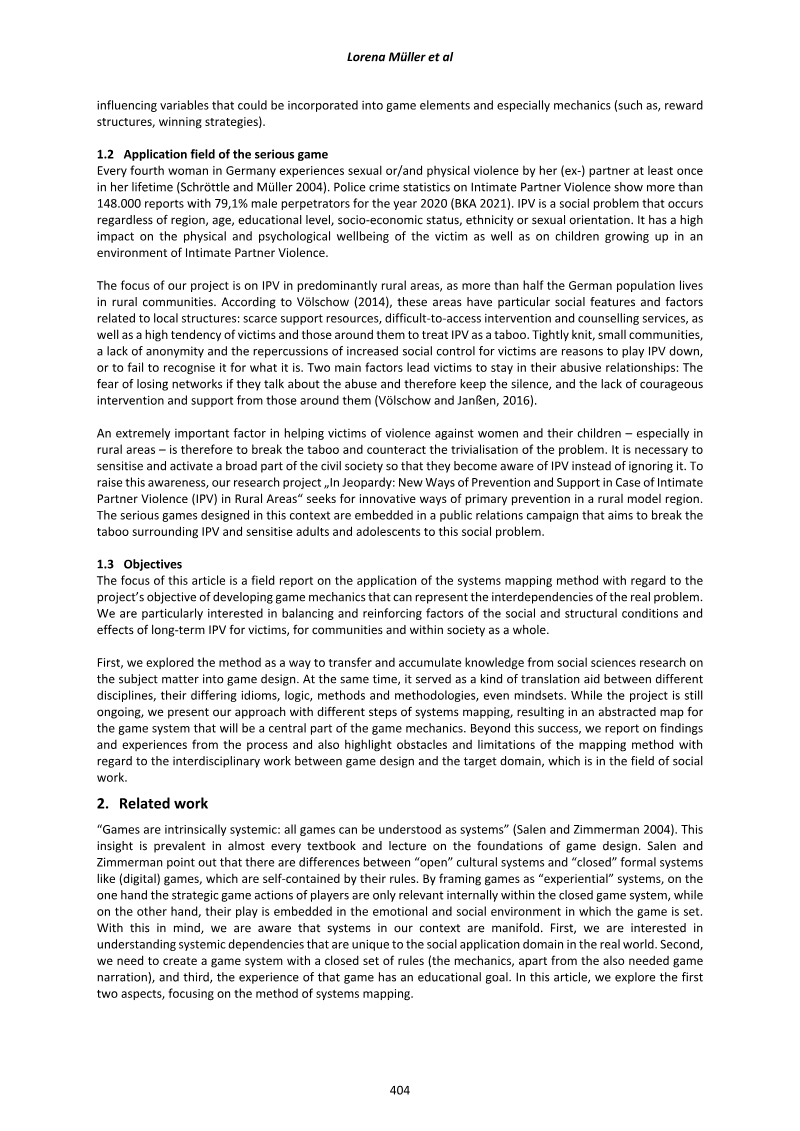
This paper examines how systems mapping can support interdisciplinary collaboration in designing serious games for the primary prevention of intimate partner violence (IPV), with a particular focus on rural communities.
- Systems mapping, implemented with the Miro whiteboard tool, gave a German team of game designers and social work experts a shared structured reference point for complex IPV knowledge before moving to game mechanics, bridging disciplines with very different vocabularies and assumptions.
- The mapping revealed reinforcing dynamics such as the taboo-isolation-silence cycle and the social control operating in rural communities, with social control identified as a leverage point for bystander-focused prevention.
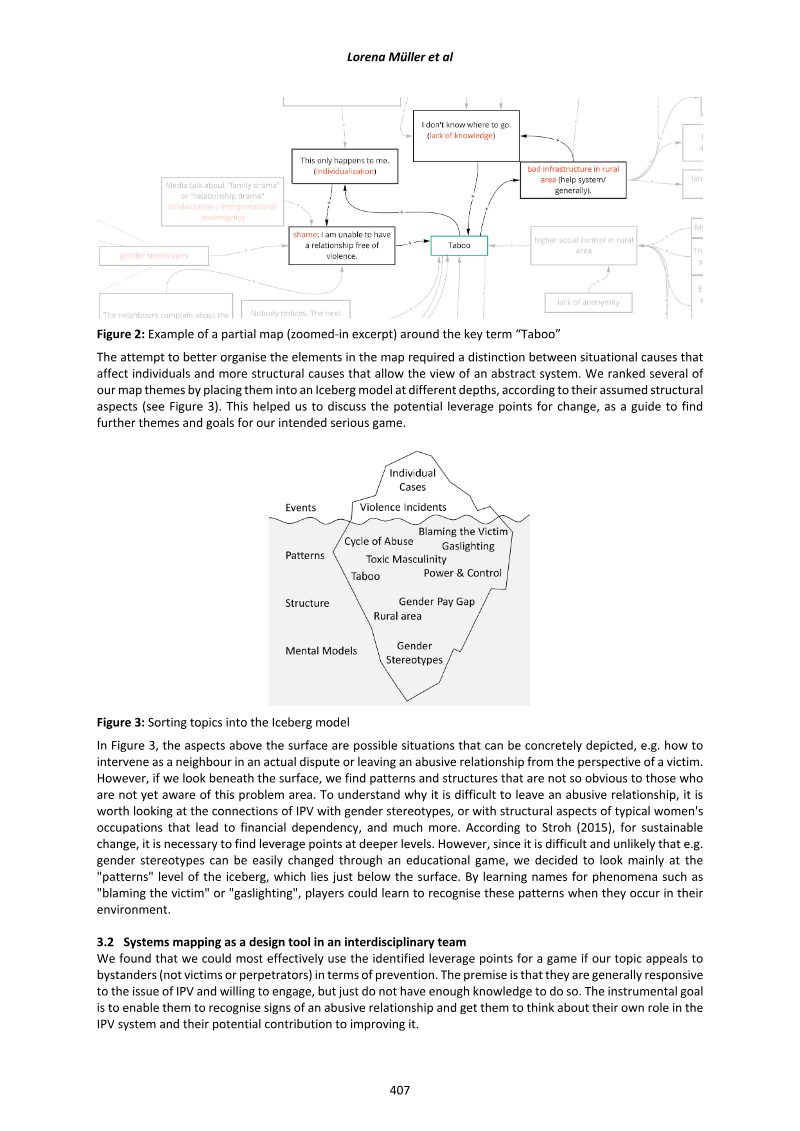
- The team used an Iceberg model to separate surface patterns (gaslighting, victim-blaming) from deeper gender stereotypes, deliberately targeting the surface patterns because they judged deeper norms unlikely to shift through a game intervention.
Serious Games as Innovative Formative Assessment Tools for Programming in Higher Education
This paper examines four serious games for programming education developed by final-year Computer Games Development students at the University of the West of Scotland as part of a Serious Games honours module.
- Students who recently completed programming courses are proposed as well-placed designers of gamified formative assessments for lower-level peers, with the authors arguing this participatory approach boosts both engagement and creativity.
- The paper frames programming as a demanding skill linked to high attrition on Computer Science courses, and argues that post-pandemic hybrid delivery calls for teaching approaches beyond traditional lectures, tutorials, and labs.
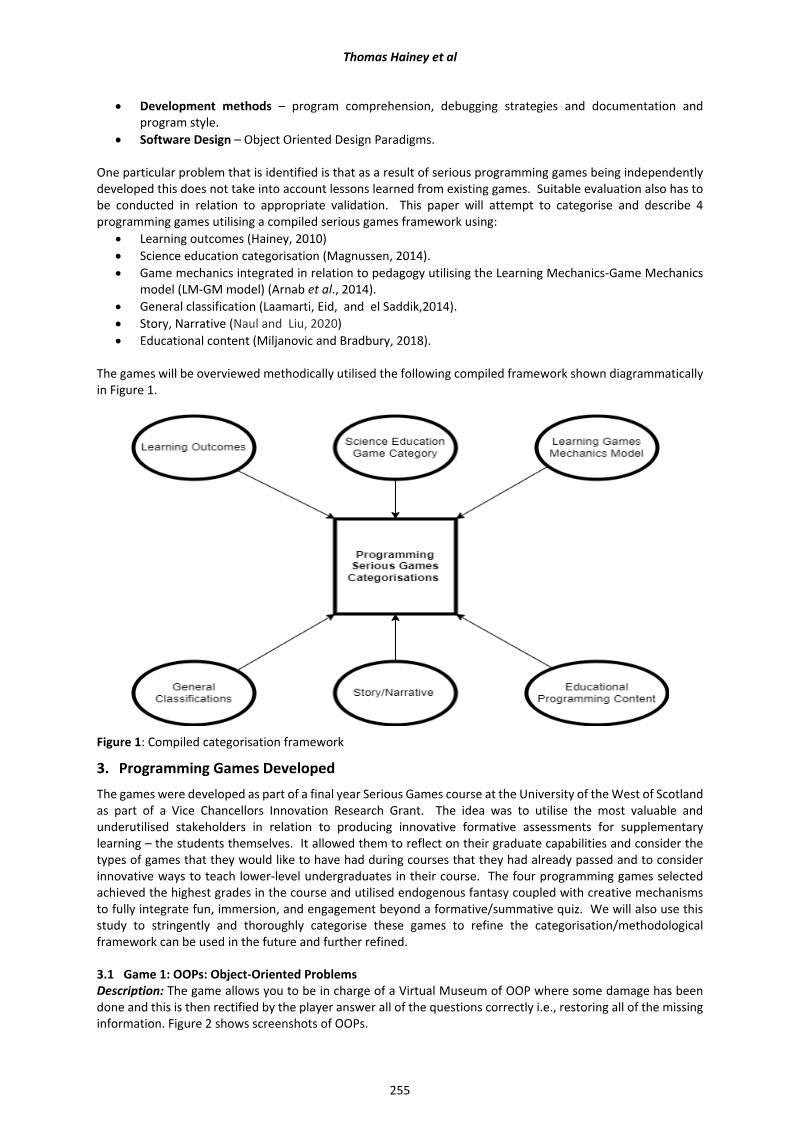
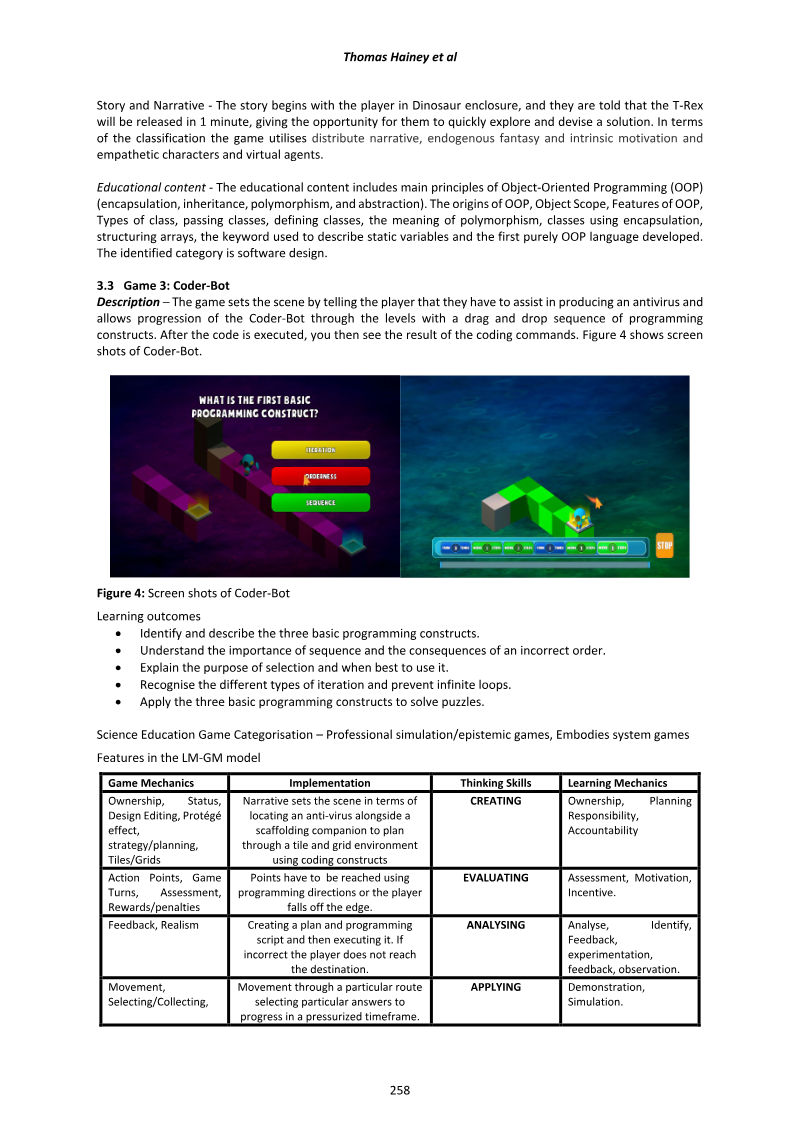
- Four games (OOPs, Planet Edolia, Coder-Bot, and LearnToCode) were built in Unity by final-year Computer Games Development students at the University of the West of Scotland and cover object-oriented programming, C# syntax, sequence, selection, iteration, variables, methods, and control statements.
A Serious Game to Teach About Career Pathways in the Games Industry
This paper argues that undergraduate games students often lack awareness of the diverse roles in the games industry and the hard and soft skills those roles demand, and proposes that career-pathway education, potentially delivered through serious games, should be embedded in game development curricula to support graduate…
- Undergraduate games students often lack awareness of the diverse roles in the games industry and the hard and soft skills those roles require, and the paper argues career-pathway education should be embedded in game development curricula to support graduate employability.
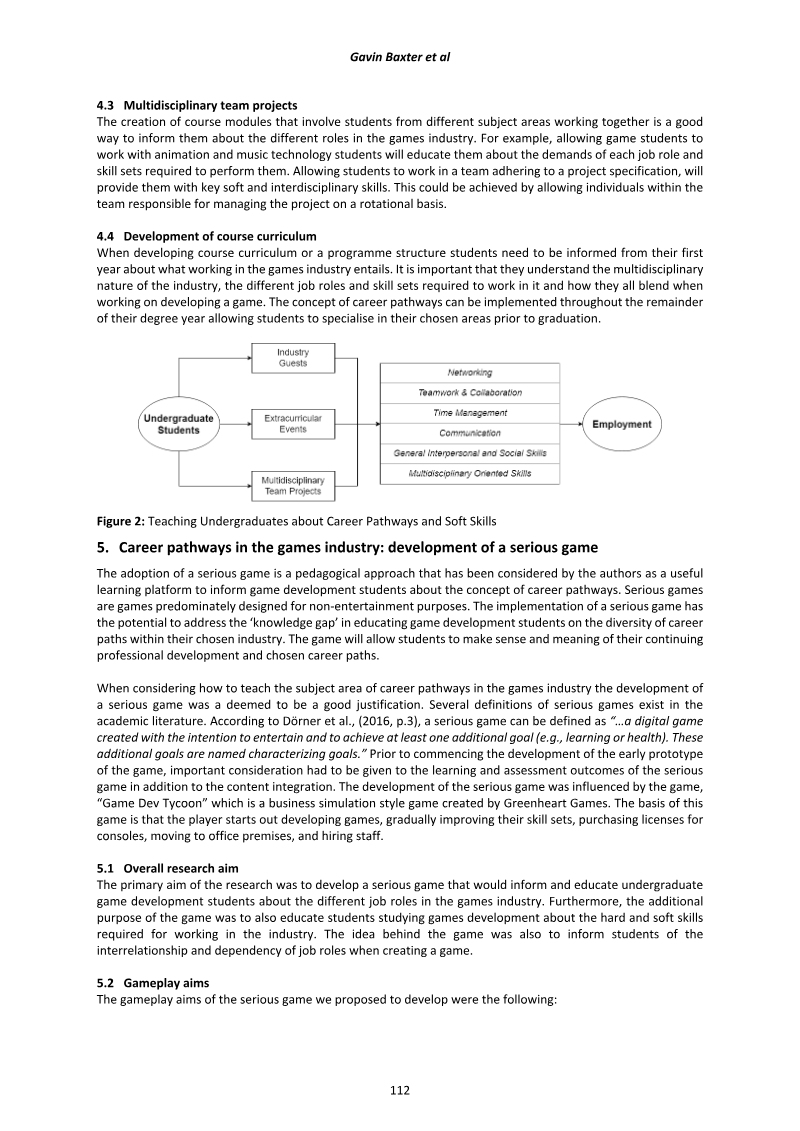
- The authors propose four complementary approaches for teaching career pathways: industry guest talks, extracurricular events such as game jams, multidisciplinary team projects, and curriculum design that introduces career content from the first year.
- The central contribution is an early-prototype Unity-based serious game simulating a games studio, where players learn about job roles, hard and soft skills, and role interdependence through NPC dialogue, puzzles, and quizzes.