1 free read left. Create a free account for unlimited reading + AI research.
Create free accountArticle European Conference on Games Based Learning (ECGBL)
1 free read left. Create a free account for unlimited reading + AI research.
Create free accountArticleEuropean Conference on Games Based Learning (ECGBL)
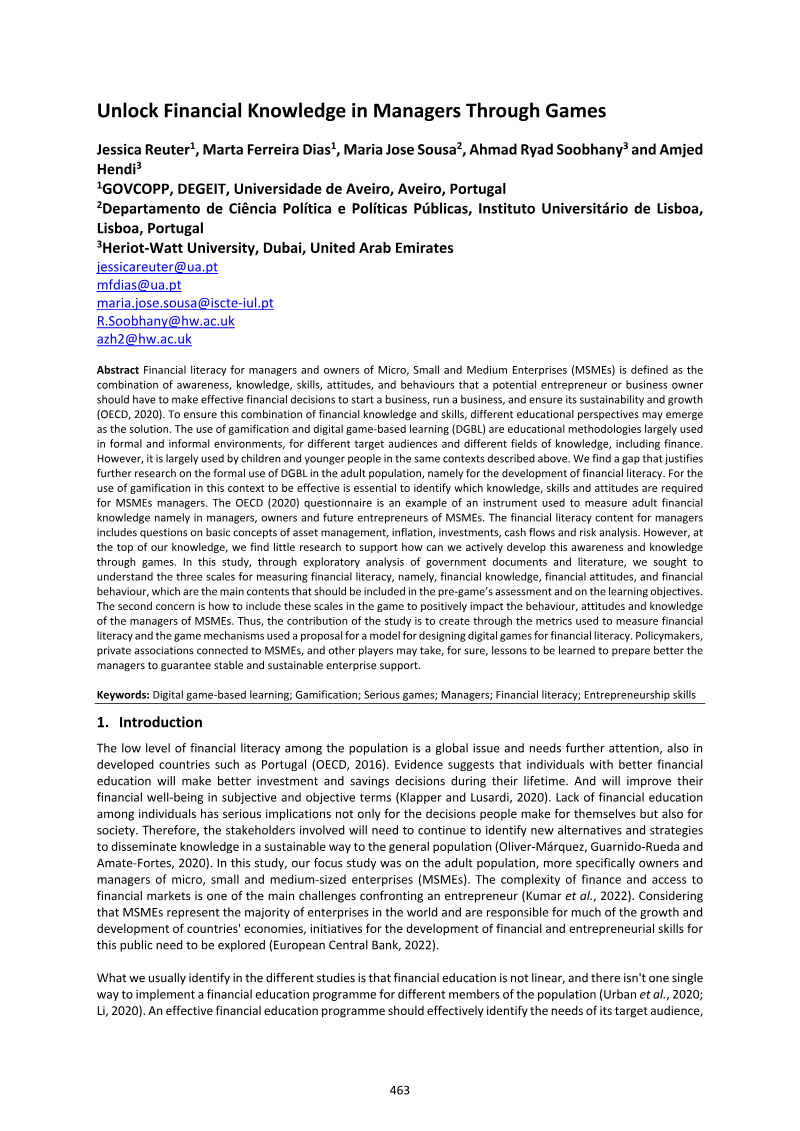
Financial literacy strongly shapes MSMEs' access to finance, risk management, and long-term sustainability. Games designed for adult managers remain underexplored.
This study examines how digital game-based learning and gamification can build financial literacy among owners and managers of micro, small, and medium enterprises (MSMEs). The authors identify a research gap: financial literacy strongly shapes MSMEs' access to finance, risk management, and long-term sustainability, yet games designed for adult managers remain underexplored. Drawing on OECD competency frameworks for adults (2016) and MSMEs (2018), which define awareness, skills, and attitudes as core elements, the authors argue that serious games can be a promising complement to traditional training, provided their design is tightly tied to specific learning objectives.
The review of existing applications covers corporate and academic serious games used for financial training, including €conomy, which teaches ECB monetary policy, and simulations such as CollectionLab, True Office, and CoCo Sim. Academic evidence specifically for finance-focused serious games is limited, though studies on e-banking gamification and the InvestNuts prototype suggest encouraging results. Building on core serious game principles of control, challenge, flow, feedback, curiosity, and fantasy, the authors apply the MDA (Mechanics, Dynamics, Aesthetics) framework to propose a design model for financial literacy games aimed at MSME managers, mapping each layer to concrete game concepts.
The central conclusion is that empirical research on digital game-based learning for MSME financial literacy is largely absent. The proposed design framework therefore offers a structured starting point for future development and evaluation rather than a tested intervention. The work situates itself within a substantial literature linking financial literacy to firm performance and credit access, and its reference base draws on figures such as Lusardi and Klapper along with OECD/INFE competency work and prior research on gamified workplace and financial education.



European Conference on Games Based Learning (ECGBL) · 2026



European Conference on Games Based Learning (ECGBL) · 2026



European Conference on Games Based Learning (ECGBL) · 2026



European Conference on Games Based Learning (ECGBL) · 2026



European Conference on Games Based Learning (ECGBL) · 2026



European Conference on Games Based Learning (ECGBL) · 2026



European Conference on Games Based Learning (ECGBL) · 2026



European Conference on Games Based Learning (ECGBL) · 2026



European Conference on Games Based Learning (ECGBL) · 2026



European Conference on Games Based Learning (ECGBL) · 2026



European Conference on Games Based Learning (ECGBL) · 2026



European Conference on Games Based Learning (ECGBL) · 2026



European Conference on Games Based Learning (ECGBL) · 2026
European Conference on Games Based Learning (ECGBL) · 2026
European Conference on Games Based Learning (ECGBL) · 2026












Comments