
European Conference on Games Based Learning (ECGBL)
Annual European conference on game-based learning and serious games; its proceedings are published open access (CC BY) by Academic Conferences International.
Documents
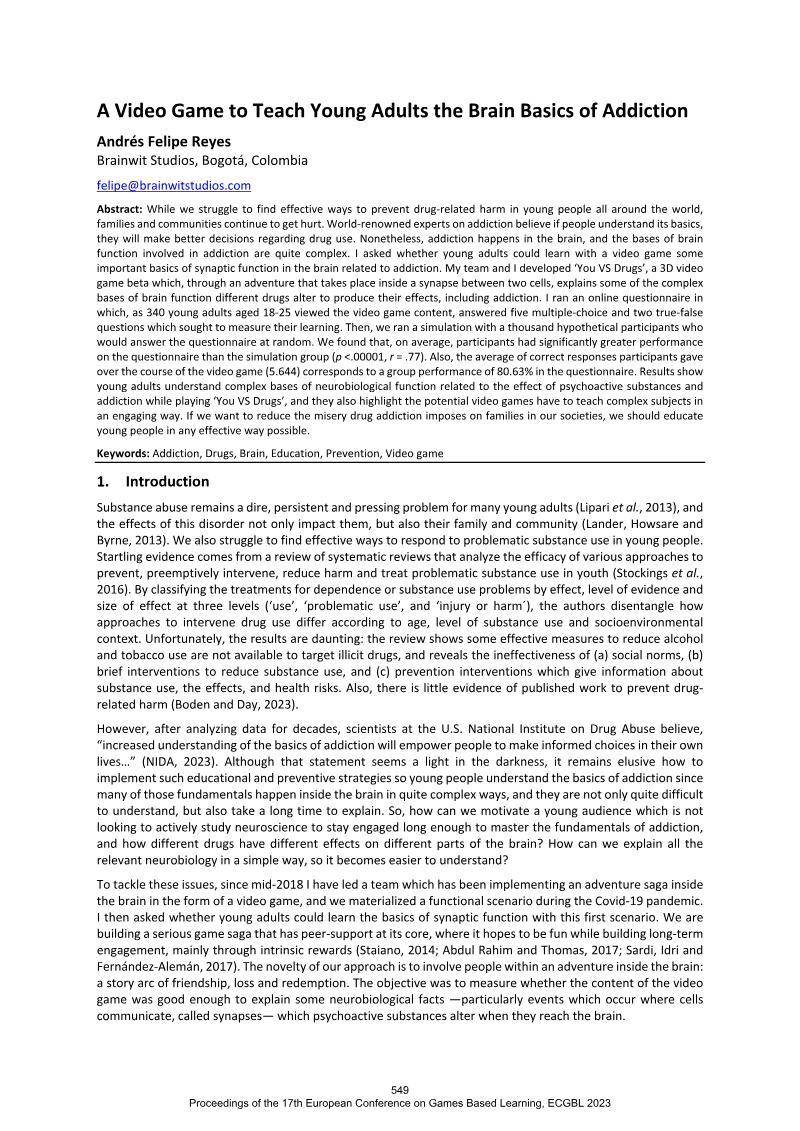
A Video Game to Teach Young Adults the Brain Basics of Addiction
This study by Andrés Felipe Reyes of Brainwit Studios in Bogotá, Colombia, asks whether a video game can teach young adults the basic synaptic neuroscience underlying drug action and addiction.
- A video game, "You VS Drugs," was developed by Andrés Felipe Reyes of Brainwit Studios in Bogotá to teach young adults the basic synaptic neuroscience of drug action and addiction, with players following neurotransmitters across a synapse and answering embedded knowledge questions.
- In an online study of 340 volunteers aged 18 to 25 tested between March 2021 and March 2022, participants answered an average of 5.644 of 7 questions correctly (about 80.6%), well above a simulated random-guessing group averaging 2.579 (about 36.8%), a large effect size.
- Quiz performance showed no significant differences across age groups or socioeconomic strata, suggesting the game's knowledge gains were broadly similar among participants.
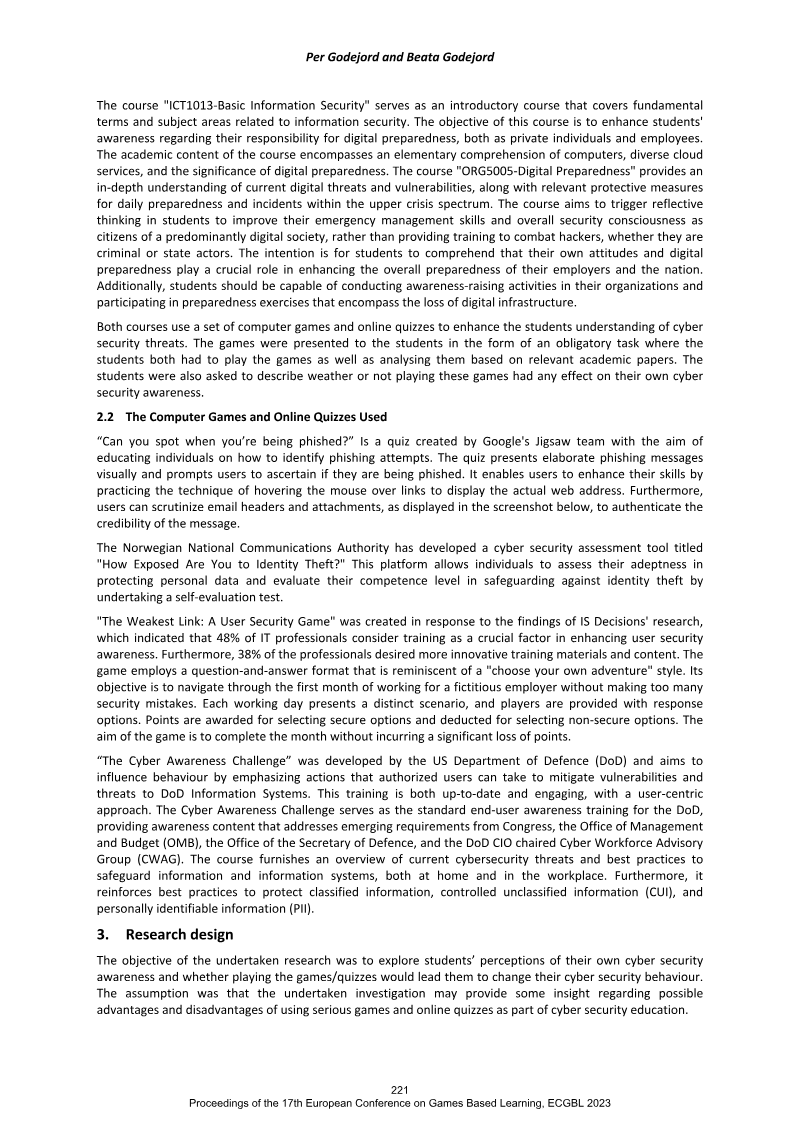
Computer Games as a Pedagogical Tool for Creating Cyber Security Awareness
This study examines whether serious games and online quizzes can raise cyber security awareness and motivate students to change their security behaviour, using Nord University in Norway as the setting.
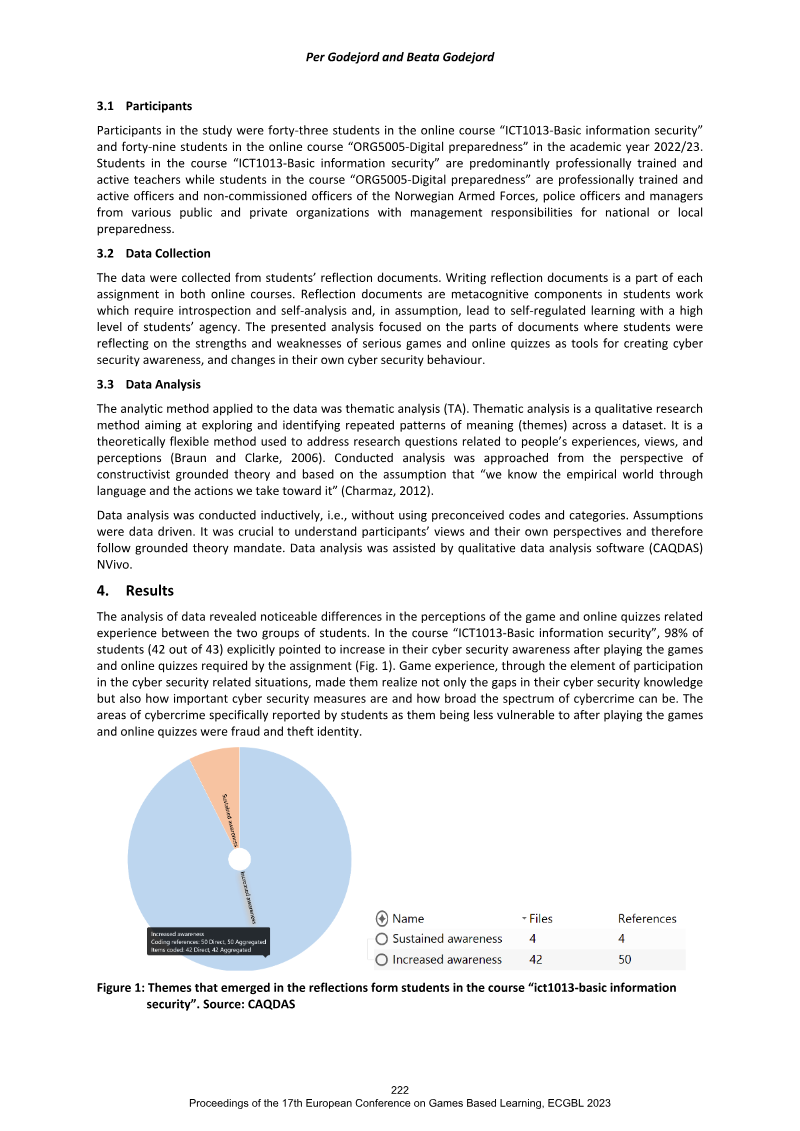
- The study, set at Nord University in Norway, analyzed reflection notes from 92 students across two courses to test whether serious games and online quizzes raise cyber security awareness and motivate behaviour change.
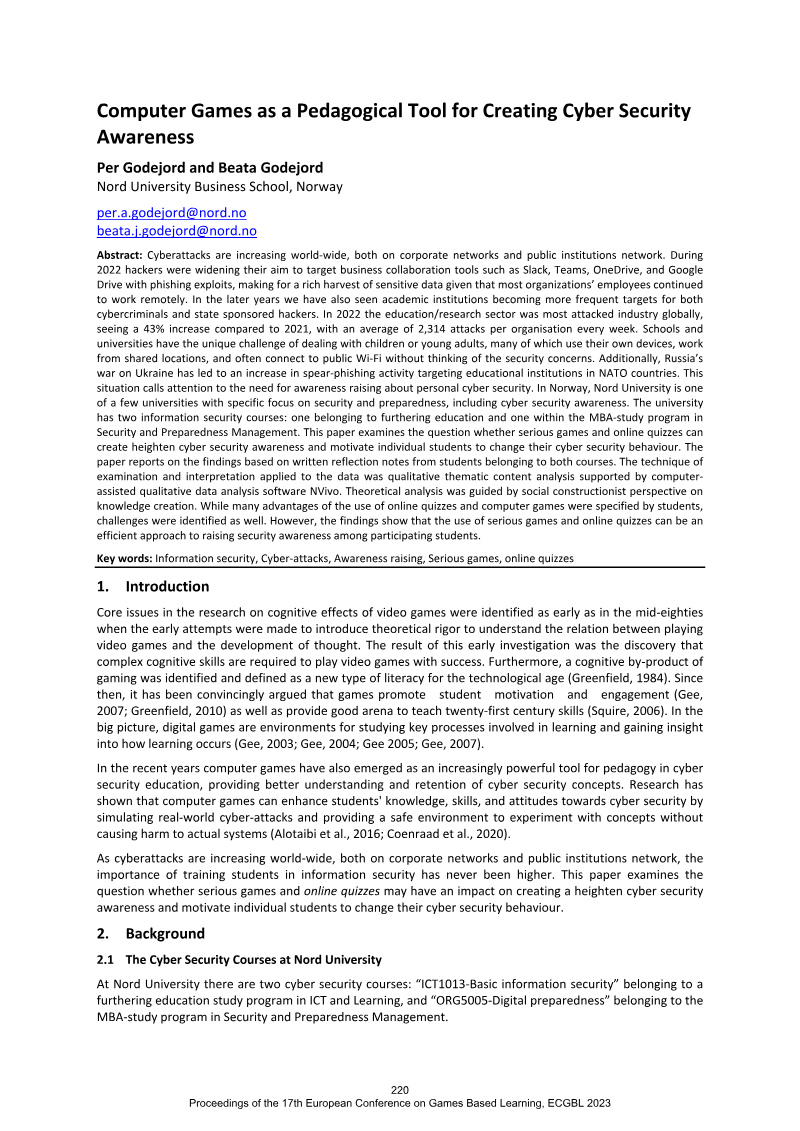
- Awareness gains differed sharply by cohort: 42 of 43 students (98%) in the basic information security course for teachers reported increased awareness, versus only 12 of 49 students (24%) in the digital preparedness course for military, police, and public and private managers.
- The authors attribute the gap partly to prior training and a stronger baseline awareness in the second cohort, rather than to the games themselves.
When Design Gets in the Way: Student Learning and Digital Escape Game
This study examines how university students experienced learning while playing Radioaktiv, a digital escape game set in a science-themed laboratory narrative, when played online over video conference.
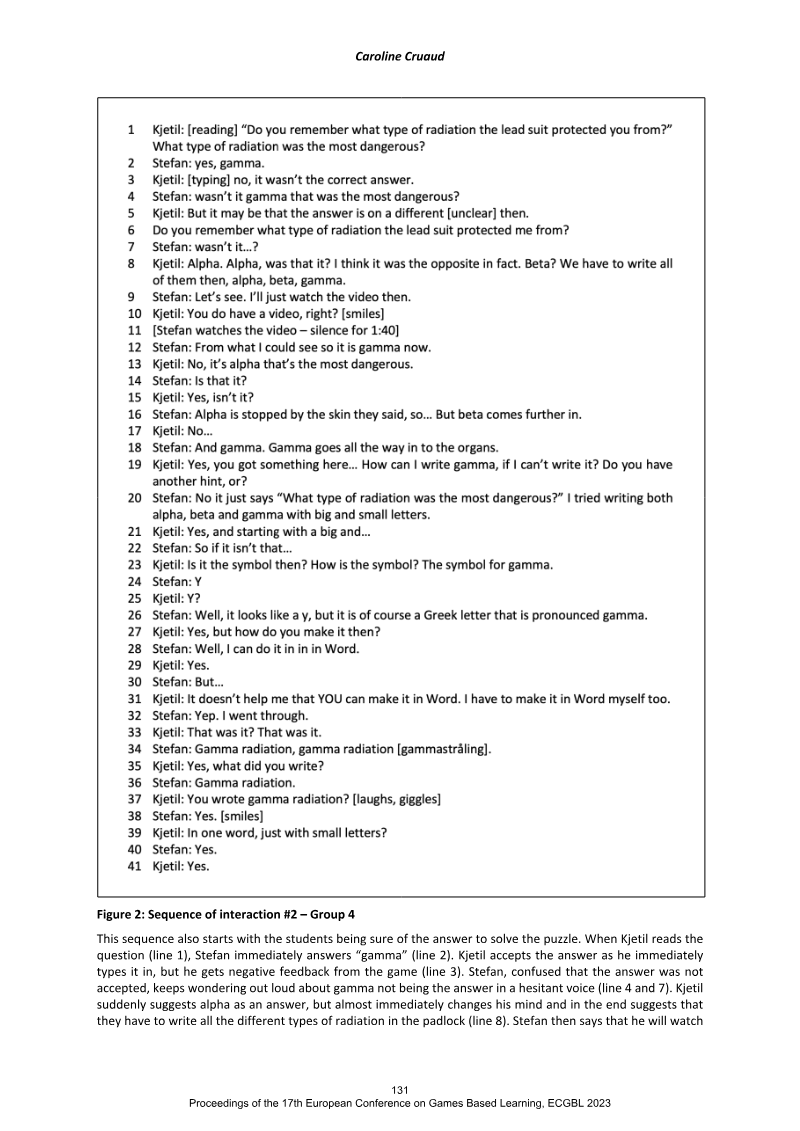
- Design choices in the digital escape game Radioaktiv sometimes obstructed learning: students who correctly identified the answer to a gamma radiation puzzle were repeatedly rejected by the game due to spelling and formatting requirements.
- The rejection pattern moved conversation from subject content to trivial mechanics, such as how to type Greek letters, and led students to mechanically try every possible answer.
- Where a supplementary video was naturally embedded in gameplay, students used it to support subject-matter discussion, suggesting embedded content can enrich dialogue when woven into the game.
Using and Facilitating Social Videogames as Warm-Ups for Embodied Design
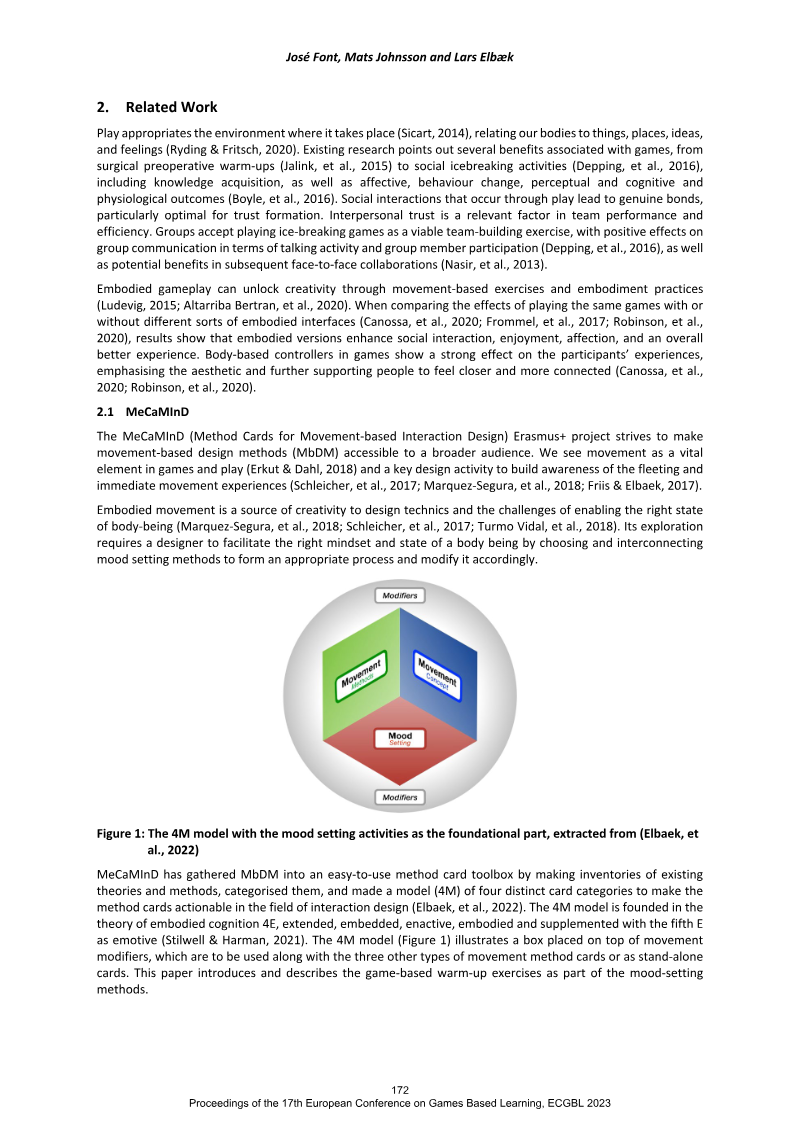
This paper examines whether off-the-shelf social videogames can serve as effective warm-ups for embodied design, a creative practice that relies on bodily movement and physical experience.
- Off-the-shelf social videogames (Just Dance, BUTTON, 1-2 Switch's Copy-Dance, and Johann Sebastian Joust) were tested as playful, group-based warm-ups for embodied design, a practice relying on bodily movement and physical experience.
- In a study of 22 participants using pre- and post-tests, domain-general creativity scores rose to an average aggregated score of 7.91, a 20.76% increase, with originality showing the largest gain at 25%.
- Post-test responses showed greater verbal elaboration, with 20.12% more words and 46.66% more sentences on a domain-specific question.
Turning Grey to Green: Engaging Gamification in Sustainability Education with Augmented Reality Technology
This paper presents an augmented reality mobile application designed to teach sustainability and carbon neutrality to students in Hong Kong through gamification.
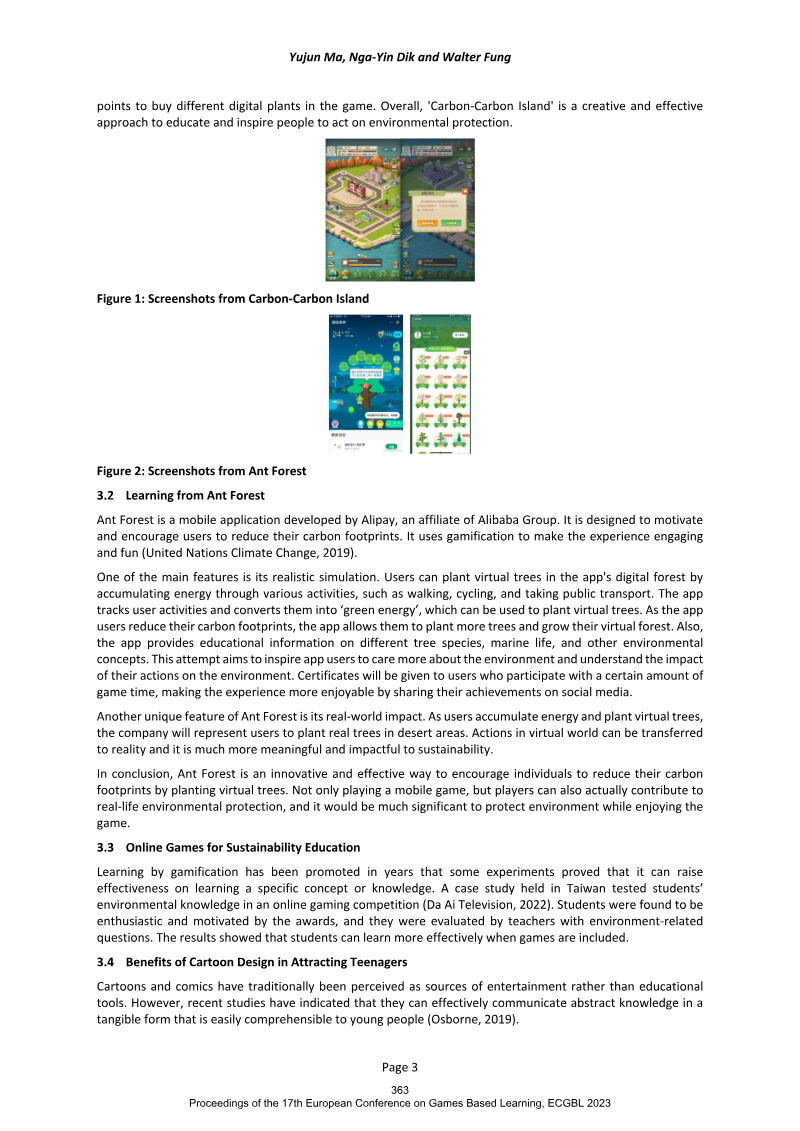
- The paper presents an AR mobile app that teaches sustainability and carbon neutrality to students in Hong Kong using gamification, combining simulation games, cartoon-style animation, achievement badges, and social sharing to boost engagement with environmental topics and low-carbon habits.
- The motivation cites a 2013 Hong Kong Baptist University survey finding that secondary students are concerned about climate change yet weakly engaged in low-carbon living, alongside rising urbanization and energy-driven emissions.
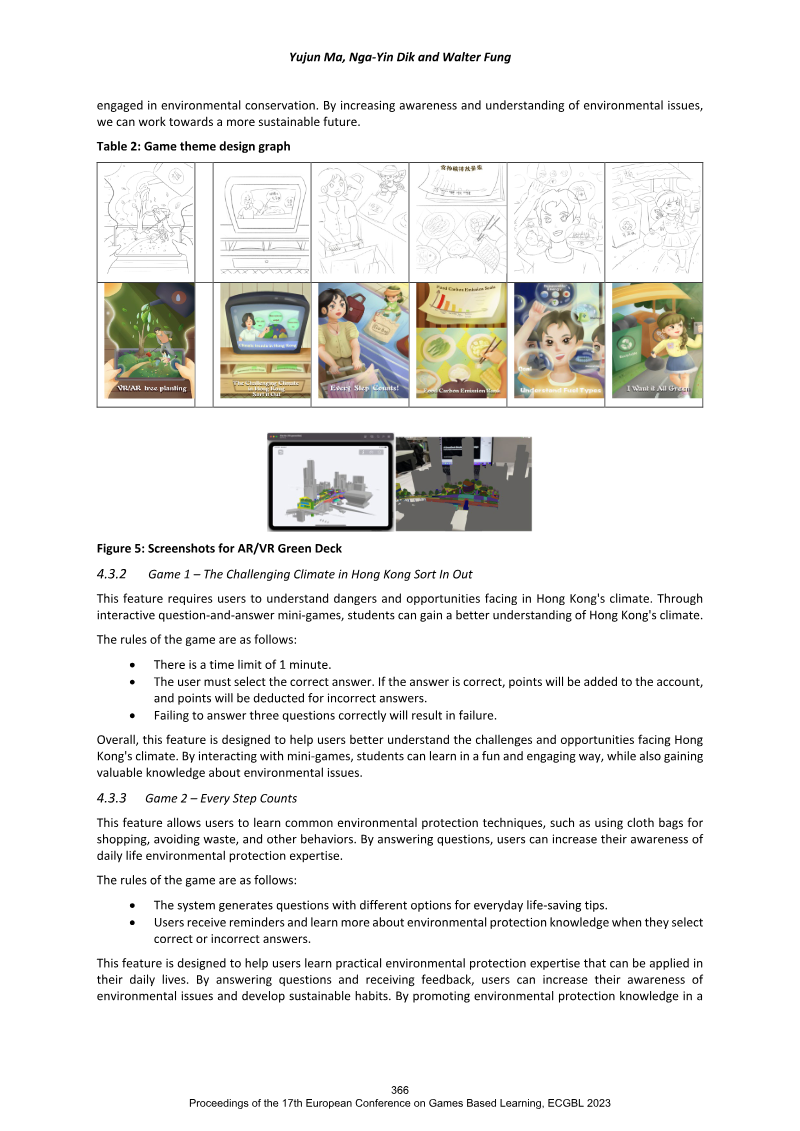
- The app has three components: simulation games on climate challenges, daily eco-friendly practices, and fuel reliability; an AR tree-planting module with gesture-based interaction via hand landmark detection; and a reward system exchanging game points for shareable digital medals.
A Conflict Management Game in Project-Based Learning
This study evaluates the "Cards of Conflict" serious game as a means of helping higher education students manage team conflicts within project-based learning.
- The "Cards of Conflict" serious game was evaluated with 19 first-year game development students in a single higher education setting, using document analysis of their reflection notes.
- Students reported increased engagement and social interaction during play, a broader understanding of the origins of conflict, recognition of multiple perspectives, and greater familiarity with the five Thomas-Kilmann conflict management modes.
- Collaborative, group-based play was found to be more valuable than solo play, because peer discussion helped students weigh different resolution styles and appreciate their peers' needs and interests.
A Slave Obeys: Capital Violence and Illusory Agency in BioShock
David Prihoda's essay "A Slave Obeys: Capital Violence and Illusory Agency in BioShock" argues that the 2007 video game BioShock offers a sustained critique of unregulated capitalism and Objectivist ideology.
- David Prihoda's essay argues that BioShock (2007) offers a sustained critique of unregulated capitalism and Ayn Rand's Objectivist ideology, reading Rapture as a zero-sum arena where systemic violence is built into the economic order.
- The analysis centers on three elements: the ADAM commodity, the exploitation of the Little Sisters, and Frank Fontaine, which together show how elite competition leaves the laboring underclass disposable.
- The essay contends that the game's apparent freedom of choice is illusory, since survival in Rapture demands violence, making agency expressed almost exclusively through force and inseparable from capitalist violence.
Maestro Martino: Designing a Historic Escape Room With Primary School Children
This paper presents a case study of a Grade 3 primary school class in the Valle di Blenio, Switzerland, that collaboratively designed and built an educational escape room themed on Maestro Martino, a fifteenth-century Renaissance cook born in the region.
- A Grade 3 primary class in Switzerland's Valle di Blenio co-designed an escape room themed on fifteenth-century Renaissance cook Maestro Martino over a full school year, shifting the usual model where teachers design games for pupils to play.
- The project ran in five phases (requirements analysis, learning content, learning to design, design for learning, and development), beginning with a pupil-made comic book on Martino's life and reverse-engineering an existing educational escape room using the "star model" framework.
- Padlocks and lock boxes served as design constraints that dictated the format of solution codes, and puzzles were tested in three tiers, including with pupils from other classes.
Literature Review for the Design Methods of Serious Games
This literature review examines design methods for serious games, which are games built to deliver learning or other non-entertainment objectives alongside enjoyment.
- The review analyzed 52 papers published between 2018 and 2023 and identified 13 design methodologies, of which 27 (roughly half) were validated through experiments or case studies.
- It organizes serious game design into a taxonomy of 41 dimensions: 10 general game features (such as endings, narrative, avatars, NPCs, and cutscenes) and 31 development factors (such as levels, feedback, challenge, flow, learning objectives, and engagement).
- Achievement and challenge, along with dilemma, are the most frequently cited development factors in the literature.
Gamification in Cybersecurity Education: The RAD-SIM Framework for Effective Learning
The RAD-SIM framework is presented as a practical design guide for gamified cybersecurity training, aiming to close a gap between inconsistent gamification research and the practical needs of workplace training designers.
- The RAD-SIM framework is a practical design guide for gamified cybersecurity training, built on behaviourist, social learning, cognitive, and social constructivist theories combined with game design components.
- The framework emphasises clearly defined learning objectives, audience-centred design, repeated practice, timely feedback, role models, and social interaction.
- It was developed from a literature review of 250 coded papers across four databases, supplemented by two interdisciplinary expert workshops.
Wargaming Simulator MASA SWORD for Training and Education of Czech Army Officers
The paper describes the University of Defence in Brno's efforts to expand its training and education of new Czech Army officers through simulation technology, with particular focus on the newly acquired MASA SWORD simulator.
- The paper argues that a comprehensive tactical simulator should be built by interconnecting several specialized tools, using a multi-simulator architecture to cover training, doctrine development, acquisition, and decision support while keeping acquisition, maintenance, and training costs low.
- MASA SWORD is presented as a component operating at company to division level, offering scenario-building and analytical tools, and runnable by a single supervisor whose integrated AI controls the behavior of aggregated units.
- The simulator's analytical functions allow scenarios to be run repeatedly and compared, which the authors highlight as particularly useful for acquisition and operational research.
Gamification of Strategic Thinking: Using a Digital Board Game on Steam
Thorsten Kodalle's report examines a three-iteration seminar, "Gamification of Strategic Thinking," that used the commercial board game Scythe to teach strategic planning and 21st-century skills.
- The seminar on strategic thinking using the commercial board game Scythe ran in three iterations, moving from an on-premise workshop in 2020 to a fully distributed format and then to a wholly digital version played on Steam as Digital Scythe between 2021 and 2022.
- As facilitator control over game execution was progressively handed to the Steam platform, participant output and engagement reportedly roughly tripled, at the cost of adaptability and facilitator control.
- Engagement was generally high and the third iteration drew strong demand, though the author notes occasional disengagement among team members that required deliberate mitigation strategies.