1 free read left. Create a free account for unlimited reading + AI research.
Create free accountWhitepaper European Conference on Games Based Learning (ECGBL)
1 free read left. Create a free account for unlimited reading + AI research.
Create free accountWhitepaperEuropean Conference on Games Based Learning (ECGBL)
The RAD-SIM framework is presented to close a gap between inconsistent gamification research and the practical needs of workplace training designers.
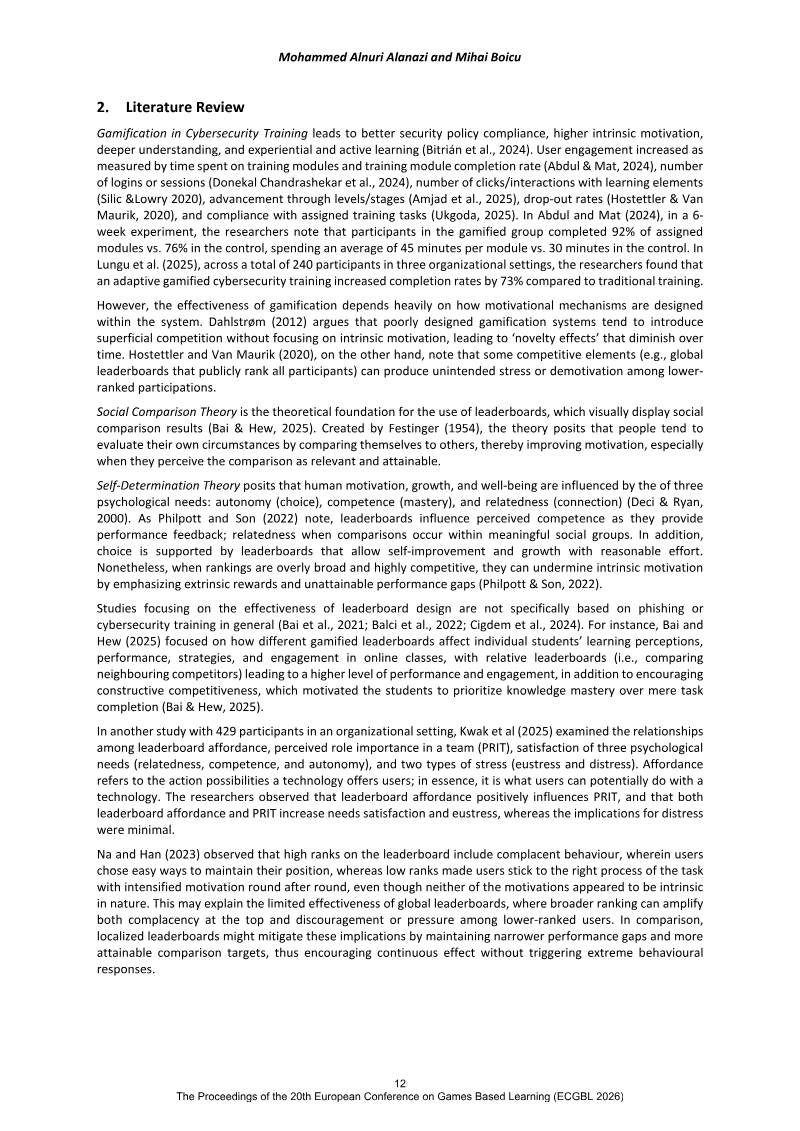
The RAD-SIM framework is presented as a practical design guide for gamified cybersecurity training, aiming to close a gap between inconsistent gamification research and the practical needs of workplace training designers. Its central proposition draws on behaviourist, social learning, cognitive, and social constructivist theories, combined with game design components. The framework emphasises clearly defined learning objectives, audience-centred design, repeated practice, timely feedback, role models, and social interaction. It was developed from a literature review of 250 coded papers across four databases, supplemented by two interdisciplinary expert workshops.
Within the broader argument, the authors maintain that game-based learning succeeds when it delivers prompt feedback, offers optional rather than mandatory incentives such as rewards and competition, and provides mentalising opportunities including role-play and reflection. Enjoyment and engagement are identified as central to sustained participation, supported by evidence that enjoyment increases time spent in gamified training and that game-based learning encourages learning beyond the intervention itself. Across the literature reviewed, gamification most reliably improves engagement, recall, and cognitive control, though results remain inconsistent across contexts.
The paper is candid about its limitations. It reports no original empirical outcome data validating the framework's claimed effects on engagement or retention, and it acknowledges that prior studies often rely on small, undergraduate, or WEIRD (Western, educated, industrialised, rich, democratic) samples, which constrains generalisability. The authors call for more flexible, customisable game designs and for quantitative meta-analyses to strengthen the evidence base. The closing reference list draws on work in game-based learning, behavioural psychology, and anti-phishing and security awareness training.



European Conference on Games Based Learning (ECGBL) · 2026



European Conference on Games Based Learning (ECGBL) · 2026



European Conference on Games Based Learning (ECGBL) · 2026



European Conference on Games Based Learning (ECGBL) · 2026



European Conference on Games Based Learning (ECGBL) · 2026



European Conference on Games Based Learning (ECGBL) · 2026



European Conference on Games Based Learning (ECGBL) · 2026



European Conference on Games Based Learning (ECGBL) · 2026



European Conference on Games Based Learning (ECGBL) · 2026



European Conference on Games Based Learning (ECGBL) · 2026



European Conference on Games Based Learning (ECGBL) · 2026



European Conference on Games Based Learning (ECGBL) · 2026



European Conference on Games Based Learning (ECGBL) · 2026



European Conference on Games Based Learning (ECGBL) · 2026