
Eludamos: Journal for Computer Game Culture
Open-access peer-reviewed journal on computer game culture, published since 2007 (now via Septentrio Academic Publishing).
Documents
Urban Games to Design the Augmented City
This 2012 Eludamos article argues that urban games can reshape how people experience cities and proposes that designers can draw on playful, behavioural methods of urban exploration to build augmented-city experiences.
- The report proposes two macro-categories for game-augmented cities: the "city as pop-up game," a limited, fully perceivable space such as an urban chess board, and the "city as big playground," a larger environment requiring navigation tools, exemplified by the Urban Iditarod.
- The central thesis is that understanding how people move through and attend to urban space can inform the design of games that integrate into the city fabric.
- The conclusions identify spatial dislocation, embodied play, and serendipitous exploration, including getting lost, as core design elements for integrating games into cities.
Teaching Serious Issues through Player Engagement in an Interactive Experiential Learning Scenario
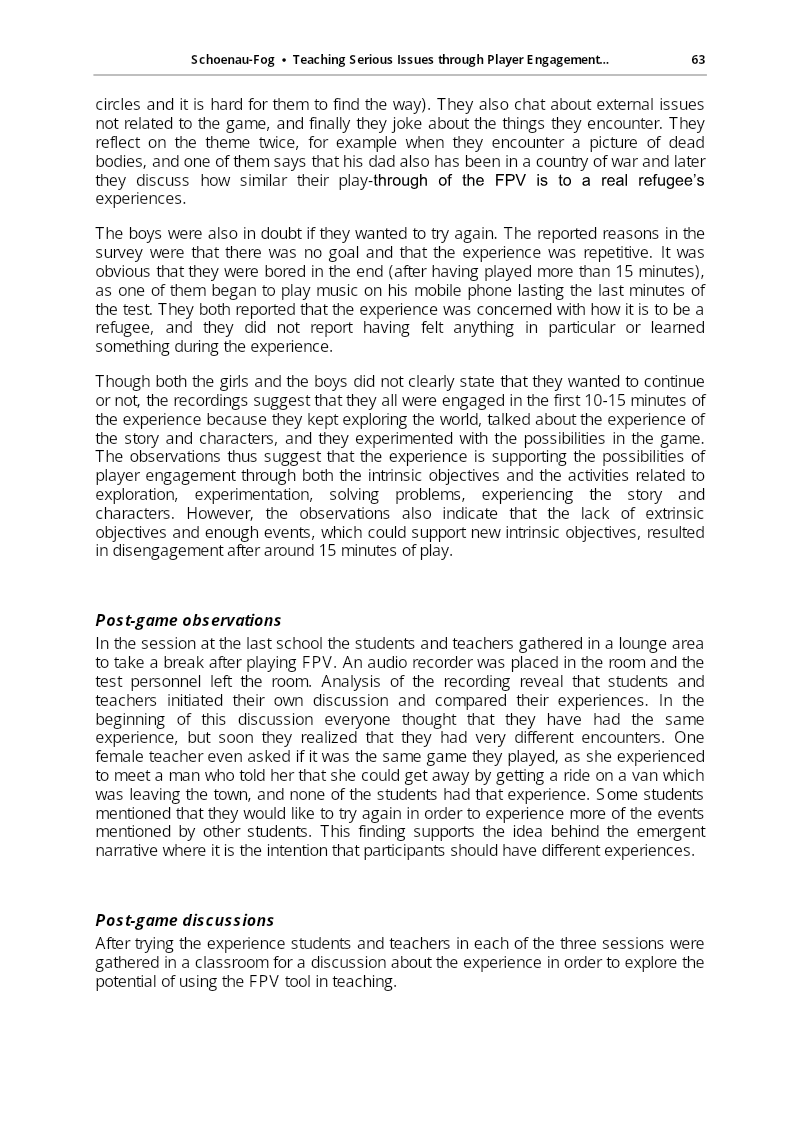
This paper argues that player engagement, rather than enjoyment, can drive learning about serious topics, and it advances this claim through the OA3 framework (Objectives, Activities, Accomplishments, Affect), which was derived from surveys of 131 respondents and aligned with Malone and Lepper's taxonomy of intrinsic motivation…
- In the prototype test of "First Person Victim" with 40 lower-secondary students (15–30 minutes of play, no explicit goals, combat, or death), 40% wanted to continue, 27.5% were undecided, and 32.5% did not.
- Students who wished to continue were drawn to the theme of victimhood and reported helplessness and shock, and 64% of them said they had learned something relevant, compared with only 8% of those who did not wish to continue.
- Common objections to the prototype centred on design gaps such as the absence of goals and direction, plus technical problems like lag on school computers.
Designing a Game for Playful Communication Within Families
The paper introduces Junomi, a location-based smartphone game designed to foster playful communication within Danish families, with a particular focus on teenagers who report loneliness and spend limited time with their parents and siblings.
- Roughly one in four Danish teenagers reports feeling lonely, and families share only a few hours of daily contact, motivating the design of Junomi, a location-based smartphone game for playful family communication.
- The authors developed the game through seventeen qualitative interviews (all eleven teenagers interviewed wanted more family time) and a 24-hour Wizard of Oz SMS prototype.
- The phone was chosen as the platform because it already fits into fragmented, busy family routines and is used daily by families.
What Makes an MMORPG Leader? A Social Cognitive Theory-Based Approach to Understanding the Formation of Leadership Capabilities in Massively Multiplayer Online Role-Playing Games
This study examines how leadership capabilities form among players of massively multiplayer online role-playing games, using World of Warcraft as its primary setting.
- The study uses Bandura's Social Cognitive Theory and the Sloan Leadership Model to examine how leadership capabilities form among World of Warcraft players, asking how the game environment, players' actions, and personal factors jointly shape leadership development.
- Interviews with Singaporean WoW players at level 30 or above (guild leaders, officers, and members) found that the game environment both enables and constrains the Sloan capabilities of relating, sensemaking, and inventing.
- Knowledge, skills, abilities, and prior experiences were consistently important across all four Sloan leadership capabilities.
Objects of Desire: A Reading of the Reward System in World of Warcraft
This article by Lasse Juel Larsen, published in the 2012 volume of the journal Eludamos, examines the reward system of World of Warcraft through a philosophical lens.
- The article argues that World of Warcraft's epic items, which are continually devalued by newer and stronger gear, harness the paradoxical nature of desire to sustain player engagement.
- Drawing on Peirce's infinite semiosis, Derrida's différance, and Freud's pleasure principle, the author contends that players are caught in an endless deferral where fulfillment is achieved but never felt as complete.
- Because epic gear loses value with each content update, the reward chain has no stable endpoint, which the author describes as a "denial of reward even as it is obtained."
Playing for Plot in the Lost and Portal Franchises
Jason Mittell's essay examines how narrative and gameplay intersect in transmedia storytelling, using the television series Lost (ABC, 2004–2010) and the game series Portal (Valve, 2007–2011) as paired case studies.
- Jason Mittell uses Lost (ABC, 2004–2010) and Portal (Valve, 2007–2011) as paired case studies to argue that the ludologist–narratologist divide obscures how modern franchises blend play and plot.
- Lost's transmedia strategy, spanning alternate reality games, novels, a console game, websites, and collectibles, invited fans to act as 'forensic' puzzle-solvers, but many of these extensions were framed as 'playing for plot' and often failed to deliver satisfying gameplay or clear revelations.
- Lost's character-centered drama relegated much of its mythology to paratexts, leaving many fans dissatisfied with the finale.
Geocaching: Interactive Communication Channels Around the Game
Geocaching, a GPS-based mixed reality game with roughly five million participants and nearly 1.8 million active caches across 220 countries, serves as the focus of this examination of the interactive communication channels players use to collaborate.
- Geocaching is a GPS-based mixed reality game with roughly five million participants and nearly 1.8 million active caches across 220 countries, making it a valuable case study for social and collaborative game design.
- The study argues that players themselves extend and develop the game, positioning geocaching as a model for interactive communication in games more broadly.
- Findings are based on a qualitative internet survey of 21 geocachers, mostly middle-aged men across eight countries, classified as "lead users" due to their high technology orientation, rather than on quantitative conclusions.
Moving Targets: The Constant Change of Mobile Game Development
This interview with James Johnson, an independent mobile game developer and former programmer at Octopi, F.U.N.
- Johnson's perspective comes from a single-source 2011 interview with one independent mobile developer, so the insights are anecdotal and reflect early-2010s conditions rather than broad industry data.
- Johnson's career spanned companies including Octopi, F.U.N. Technologies, World Winner, and Sony Online Entertainment, moving from early Nokia-based cell phone projects to iOS and Android titles.
- Small work-for-hire studios demanded adaptability, with programmers working across multiple languages such as Java, C++, and ActionScript, whereas large companies offered more specialized roles.
Ambivalence and Recursion in Castlevania: Symphony of the Night
Paul Martin's 2011 essay in Eludamos argues that Castlevania: Symphony of the Night (1997) uses recursion, both in its gameplay and its structure, to dramatize the ambivalence of its protagonist Alucard.
- Paul Martin's 2011 Eludamos essay argues that Castlevania: Symphony of the Night (1997) uses recursion in both gameplay and structure to dramatize the ambivalence of its protagonist Alucard, using the Minoan labyrinth as an analogy.
- The essay claims ordinary mechanics such as backtracking, save-and-reload after death, and repeated relic collection take on expressive meaning tied to Alucard's divided heritage as the son of a human mother and vampiric father.
- Martin reads Alucard's conflict through Freudian psychology as an unresolved oedipal struggle between Lisa, whose forgiveness he must uphold, and Dracula.
The Role of Fantasy in Videogames: A Reappraisal
Murray and Maher's "The Role of Fantasy in Videogames: A Reappraisal" (2011) contends that the games industry's creative stagnation, which they partly attribute to commercial control, stems from a deeper undervaluation of fantasy.
- Murray and Maher (2011) argue that the games industry's creative stagnation, partly attributed to commercial control, stems from an undervaluation of fantasy as a creative and psychological force.
- The authors reframe fantasy through Jungian, archetypal, and play-based lenses, drawing on Jung, Hillman, Huizinga, and Tolkien, and argue it performs simulatory and psychological functions rather than being mere escapism.
- They propose a "poetics of Fantasy" for developers and call for "meaning driven" games that draw on fantasy and play to achieve greater emotional and psychological depth.
Career Attitudes of Men and Women Working in the Computer Games Industry
Prescott and Bogg's study examines how men and women in the computer games industry perceive career barriers, work-life balance, and progression.
- Women's share of the UK games workforce fell from 12% in 2006 to 4% in 2009, a sharp decline the authors attribute to organisational culture rather than individual choice.
- Long hours, crunch time, relocation demands, and presenteeism culture are identified as barriers that have historically favoured young, unattached men in the games industry.
- Women with career gaps reported lower earnings and satisfaction than those without interruptions, highlighting the cost of interrupted careers.
The Performance of Gameplay: Developing a Ludoliteracy
Drew Davidson's essay argues that the most effective way to understand a game is to play it, and that repeated play develops "ludoliteracy," the capacity to analyze how games work by engaging with them.
- Davidson argues that the most effective way to understand a game is to play it, and that repeated play builds "ludoliteracy," the capacity to analyze how games work through engagement with them.
- Davidson frames gameplay as performance across three levels: spectatorship, theatre-inspired enactment of agency in the present, and practice (game development and player mastery).
- Games such as Guitar Hero, Rock Band, Dance Central, and Child of Eden are engaging to watch as well as to play, especially in group settings or when players' bodies form part of the control scheme.