1 free read left. Create a free account for unlimited reading + AI research.
Create free accountArticle Eludamos: Journal for Computer Game Culture
1 free read left. Create a free account for unlimited reading + AI research.
Create free accountArticleEludamos: Journal for Computer Game Culture
Paul Martin's 2011 essay argues that Symphony of the Night uses recursion in both gameplay and structure. The Minoan labyrinth serves as its analogy.
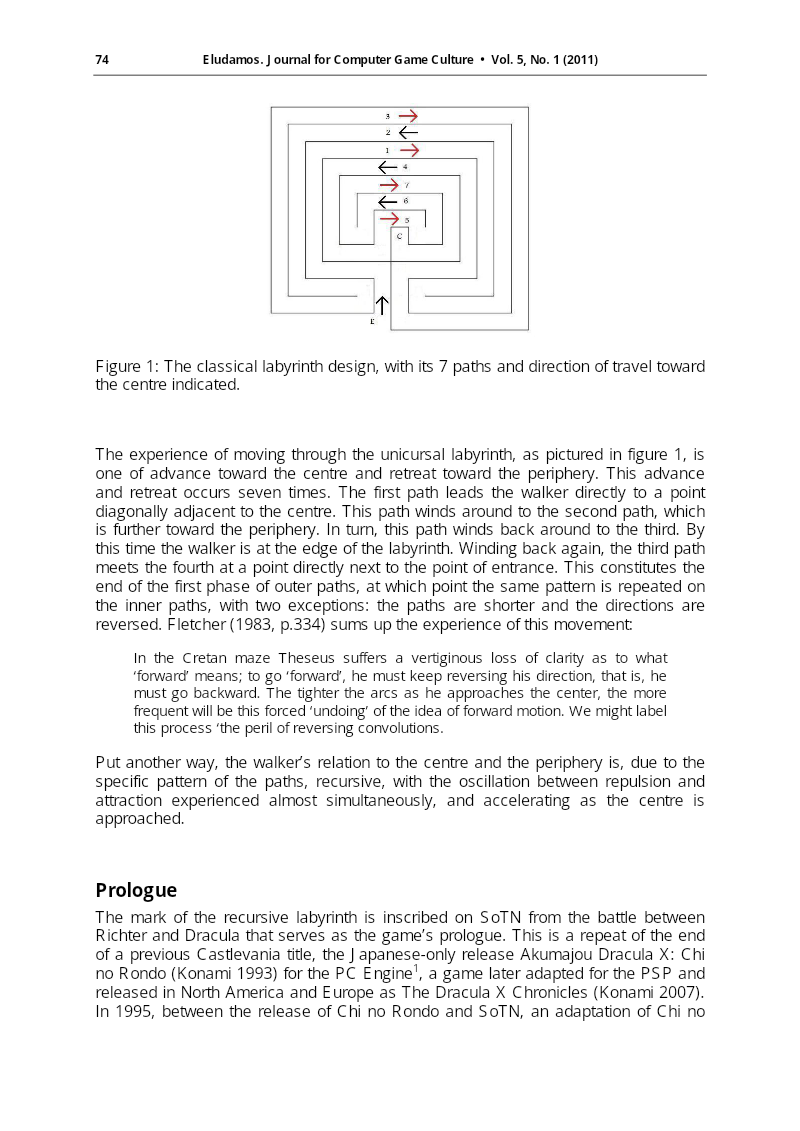
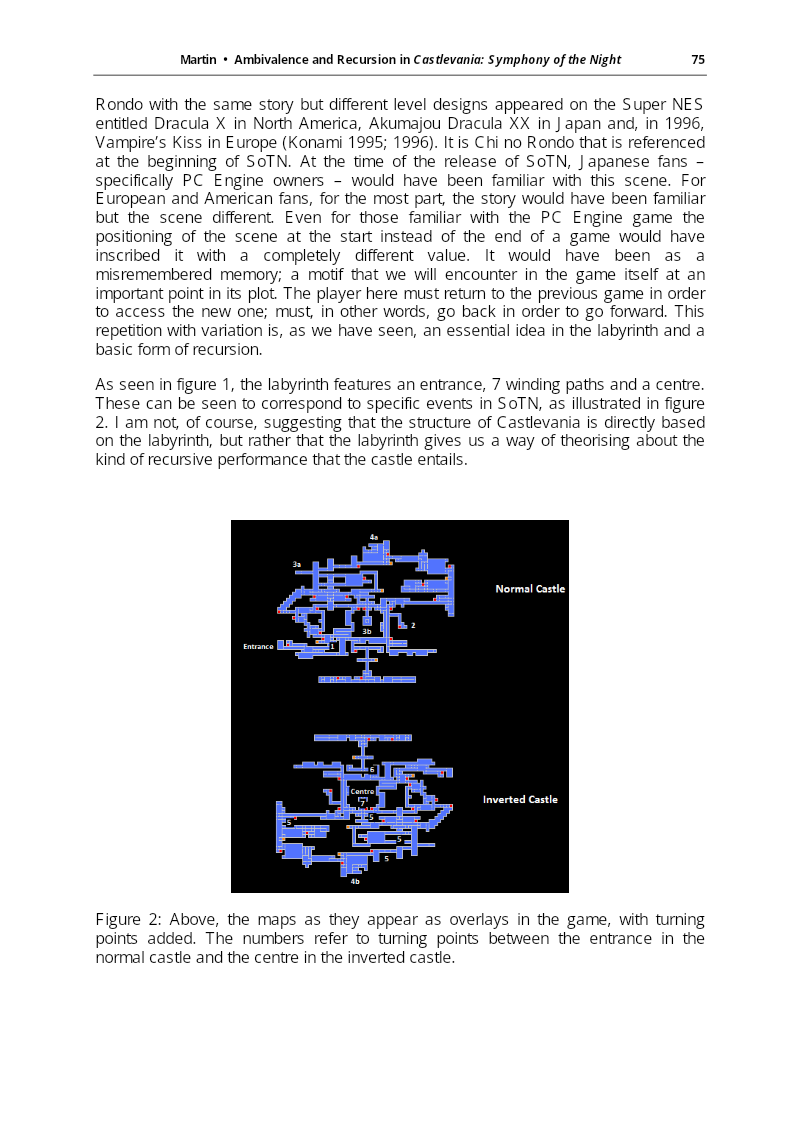
Paul Martin's 2011 essay in Eludamos argues that Castlevania: Symphony of the Night (1997) uses recursion, both in its gameplay and its structure, to dramatize the ambivalence of its protagonist Alucard. Drawing on the classical Minoan labyrinth as an analogy, the analysis reads the game as a performance of paradoxical attraction and repulsion toward its centre. The author presents this interpretation as speculative, guided by principles of interest, plausibility, and coherence, and openly acknowledges the danger of over-reading when linking narrative and mechanics.
Central to the argument is the claim that conventional videogame mechanics, such as backtracking through the castle, the save-and-reload cycle of death, and the repeated gathering of relics, acquire expressive force tied to Alucard's divided heritage as the son of a human mother and a vampiric father. The bishounen character type and brief cutscenes are identified as key carriers of this ambivalence. The analysis also turns on the Succubus/Lisa episode, which supports competing Christian and Japanese readings, and it stresses that the localized English script substantially shapes these meanings.
Martin's reading draws on Freudian psychology, framing Alucard's conflict as an unresolved oedipal struggle between Lisa, whose forgiveness he is bound to uphold, and Dracula. The English localization adds explicit Christian Trinitarian language, such as the capitalized "Father" and echoes of "In the name of the Father," absent from the Japanese original, which speaks of "the sake of your father" and "in the name of my mother." Structural features including the false ending at Richter's throne room, the inverted castle, and the parallel between Maria and Lisa reinforce this reading. The author argues that the "best ending," in which Alucard unites with Maria, offers only provisional resolution. Victories over Death, Shaft, and Dracula intensify rather than resolve his ambivalence, leaving him suspended within the labyrinth at the game's close.
Each row is a game or company this document names, each column a document, oldest first. A mark means that document names it. Select a row to see those documents.

Eludamos: Journal for Computer Game Culture · 2026

Eludamos: Journal for Computer Game Culture · 2026

Eludamos: Journal for Computer Game Culture · 2026

Eludamos: Journal for Computer Game Culture · 2026

Eludamos: Journal for Computer Game Culture · 2026

Eludamos: Journal for Computer Game Culture · 2026

Eludamos: Journal for Computer Game Culture · 2026

Eludamos: Journal for Computer Game Culture · 2025

Eludamos: Journal for Computer Game Culture · 2025

Eludamos: Journal for Computer Game Culture · 2025

Eludamos: Journal for Computer Game Culture · 2025

Eludamos: Journal for Computer Game Culture · 2025
DiGRA · 2026