
DiGRA
The Digital Games Research Association: the international association of academics and professionals who study digital games. Its Digital Library holds the proceedings of the DiGRA conferences since 2002.
Documents

The Expressions of Colours
Zammitto's paper, presented at the DiGRA 2005 conference, examines how colour communicates meaning in digital games and argues that game designers should use colour deliberately rather than intuitively.
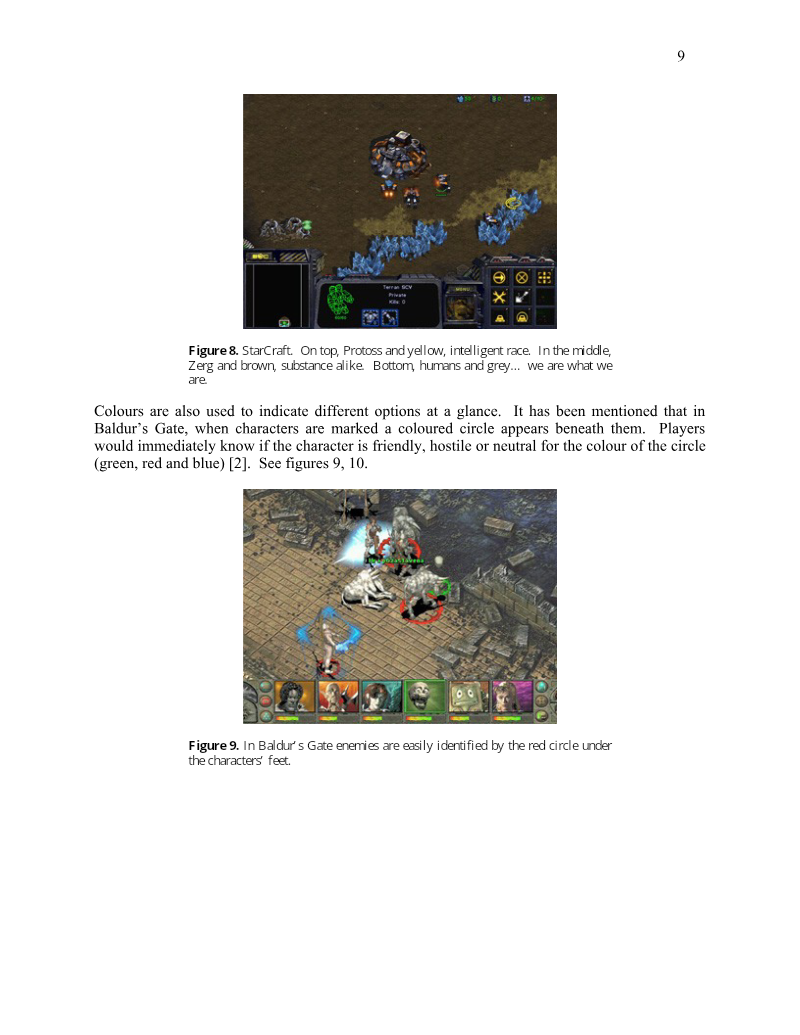
- Colour meaning in games rests on three overlapping layers, innate, personal, and cultural, so designers must account for both universal associations and regional differences such as red signifying weddings in China versus white in Western weddings.
- Colour-vision deficiency affects roughly one in twelve men, a significant concern because most players are male, making accessible palette choices important for designers.
- The paper argues that game designers should use colour deliberately rather than intuitively, applying its meanings to character costuming, interface elements, and environmental palettes.
Towards Emotionally Adapted Games Based on User Controlled Emotion Knobs
This paper proposes a conceptual framework for personalizing video games so that players can deliberately facilitate or avoid particular emotional states during play.
- The paper proposes an "emotion knob," a user-controlled mechanism that adjusts a game's emotional impact along the valence and arousal dimensions of the circumplex model of emotion, letting players deliberately facilitate or avoid particular emotional states.
- The framework is built on Psychological Customization, which tailors interface layout, modality, narrative structure, and pacing to produce transient effects such as emotion, attention, and presence.
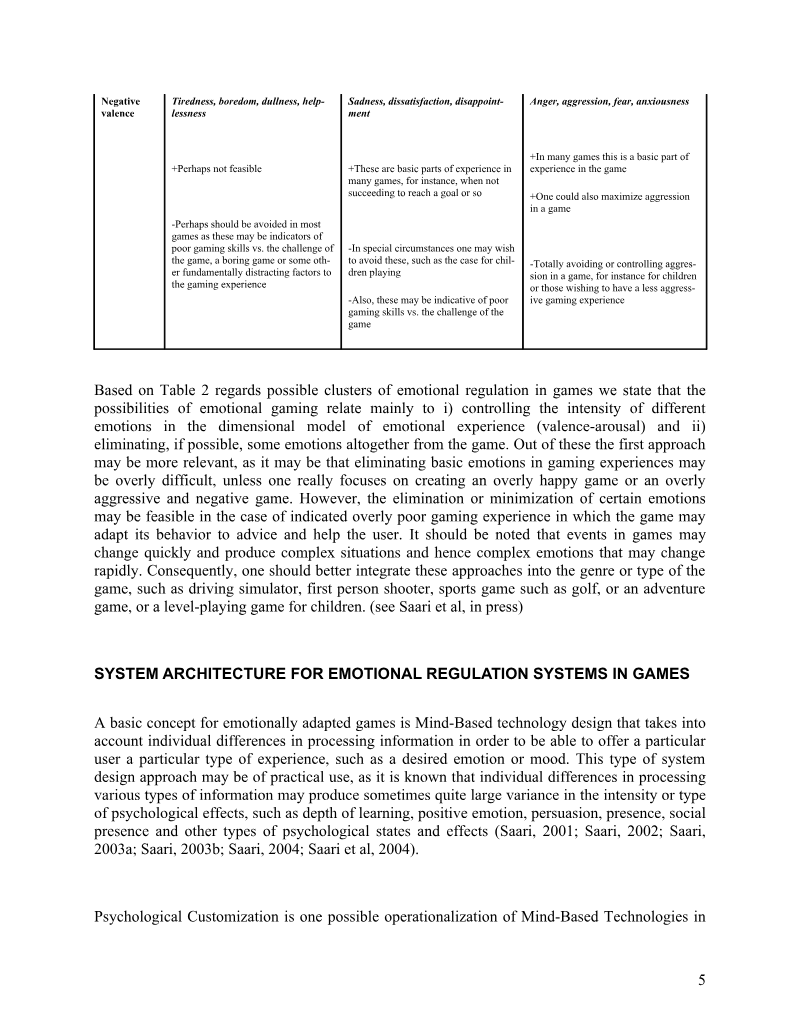
- Transient narrative emotions such as fear, satisfaction, and aggression are seen as the most natural targets for manipulation, while eliminating basic emotions is judged less feasible than controlling their intensity.
Virtually Visual: The Effects of Visual Technologies on Online Identification
Jennifer Martin's study examines how the visual design of online games shapes players' ability to identify with their avatars, using World of Warcraft as its case.
- The paper argues that visual rendering aids immersion and online selfhood in graphical games, but that pre-coded limits on appearance, movement, and interaction can undermine the identity play that visuality enables.
- Its central claim is that the fluid, boundless identity exploration found in earlier text-based world research does not transfer cleanly to graphical environments, where bodies and actions must be built in advance.
- Using World of Warcraft as its case, the study combines 15 to 20 weekly hours of participant observation across multiple races, factions, and two servers with analysis of over 1,500 player forum complaints and suggestions from December 2004 to April 2005.
Towards the Unification of Intuitive and Formal Game Concepts: Applications to Computer Chess
Arbiser's paper proposes a general technique for formalizing intuitive, human-oriented concepts in competitive board games, with computer chess as the primary testbed.
- The paper proposes formalizing intuitive concepts such as attack, defense, threat, sacrifice, and playing styles by modifying the board position before running a conventional move-selection algorithm, rather than relying only on heuristic evaluation.
- The approach generalizes the null-move technique into a family of 'modifiers' that add, delete, relocate, or change pieces, with each modification tied to a specific concept: deleting one's own piece simulates attack, adding an opponent piece simulates defense, and granting an extra move simulates threat.
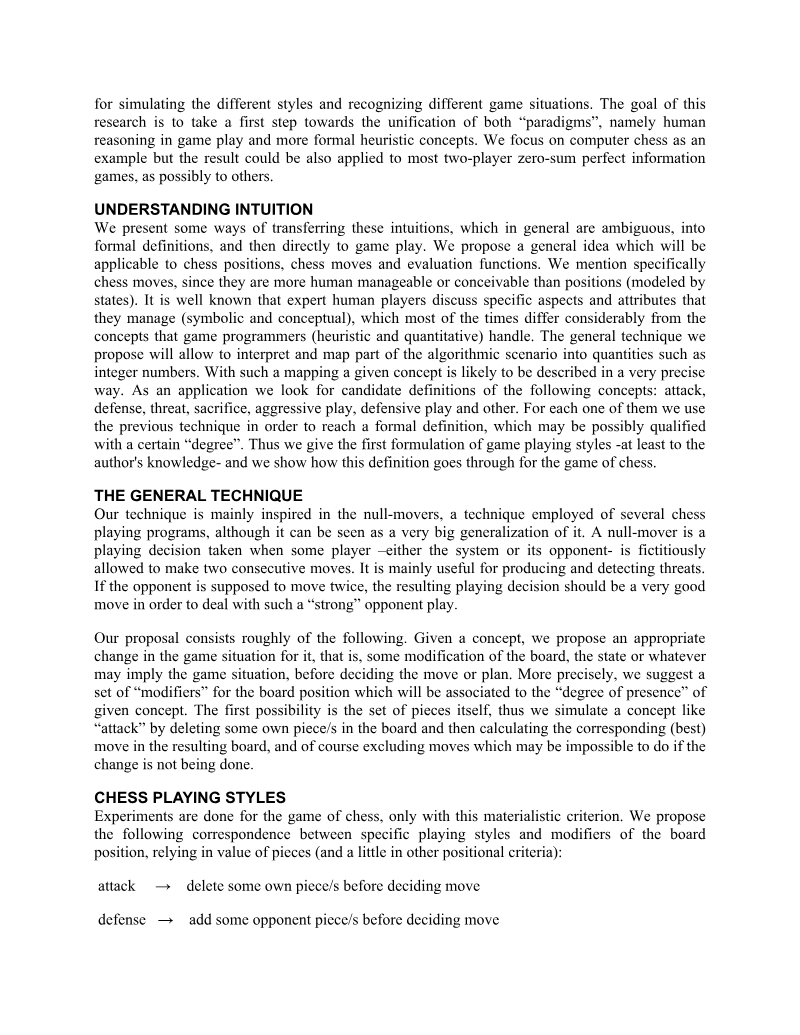
- Illustrative chess positions show a queen substituted for a pawn revealing a forced mating sequence, and a knight substitution guiding multi-move planning, though these are qualitative demonstrations only.
Game Engineering for a Multiprocessor Architecture
This paper argues that future game consoles and personal computers are likely to adopt symmetric multiprocessor architectures, and that the traditional sequential game loop must therefore be replaced with a concurrent design.
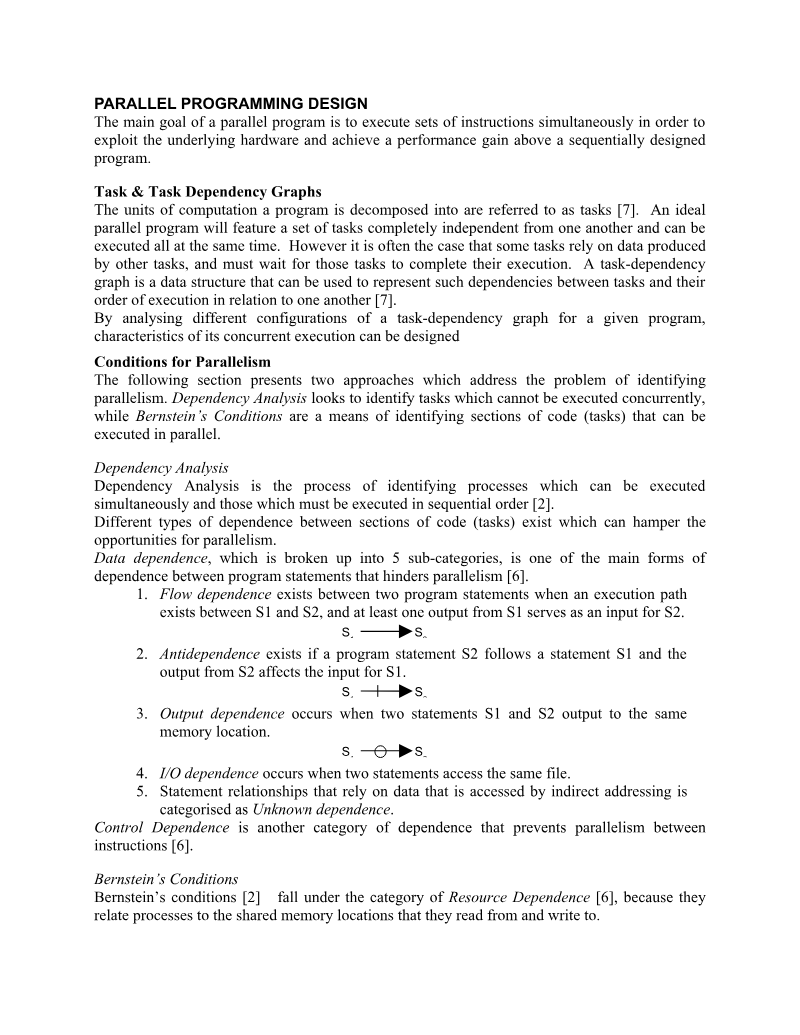
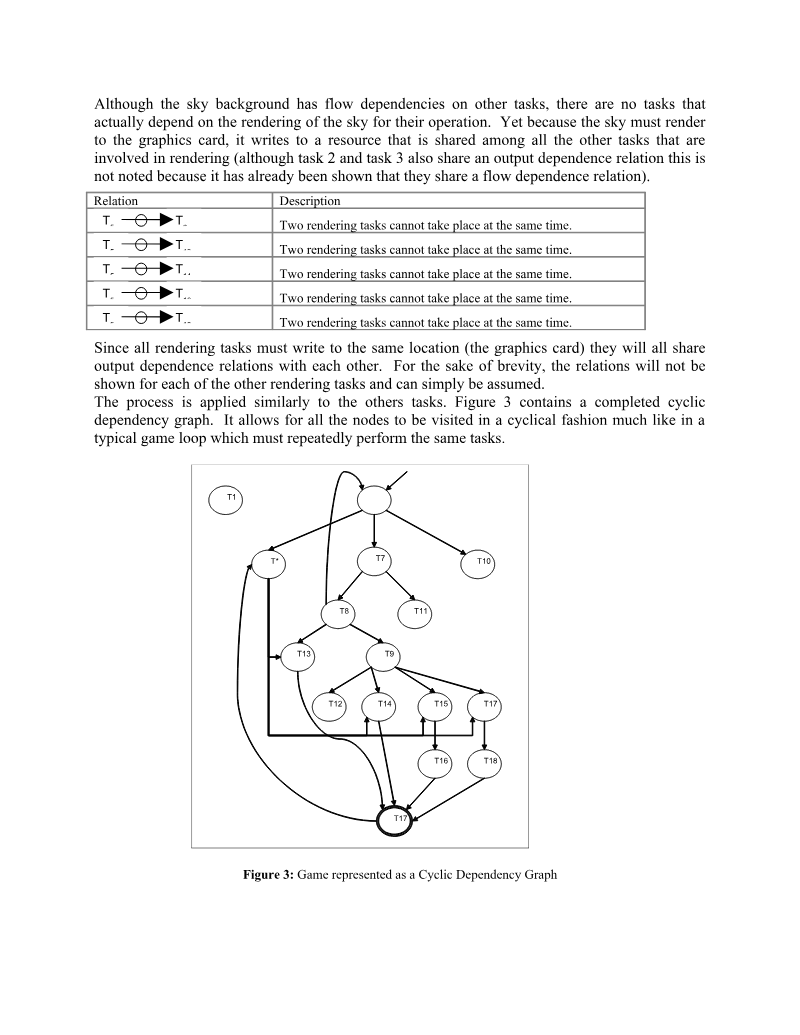
- The authors argue future consoles and PCs will likely adopt symmetric multiprocessor architectures, so the traditional sequential game loop should be replaced with a concurrent design organised as a cyclic task-dependency graph run by a scheduler across worker threads.
- The model was implemented in a Concurrent Game Programming Framework providing synchronisation primitives, thread creation objects, and a task manager, and was tested by decomposing a nineteen-task sequential loop from a 3D capture-the-flag car game.
- On a Hyper-Threaded Intel Pentium 4 at 2.80 GHz (two logical processors), the framework with one, two, or four workers produced no performance gain over the sequential loop, which the authors attribute to the model needing roughly three processors before benefits appear.
Designing Sound for a Pervasive Mobile Game
This paper examines how sound design can serve as a primary information channel in pervasive mobile games, using a working research prototype called The Songs of North as a case study.
- Sound is argued to be a primary information channel for pervasive mobile games, especially where players cannot look at a screen, such as walking through busy streets, and where small mobile displays limit visual feedback.
- The prototype The Songs of North, built for the Nokia N-Gage by the Hypermedia Laboratory at the University of Tampere, uses GSM cell positioning to track players acting as shamans, so that physical movement becomes a core game mechanic.
- Players monitor their spirits and game-world events through audio, with visual information available on demand, allowing gameplay to continue while players walk.

Tangible Interfaces for Pervasive Gaming
This paper, produced by researchers at the ISNM International School of New Media in Lübeck and presented at the DiGRA 2005 conference, proposes a low-cost framework for building tangible and pervasive games.
- The paper proposes a low-cost framework for tangible and pervasive games, arguing that embedding computing in physical environments can free players from screen-bound play, encourage face-to-face social interaction, and let them manipulate real-world objects.
- The technical core is the Phidgets USB sensor/actuator kit (motors, lamps, pressure, motion and RFID components) paired with Macromedia Flash for graphical interfaces.
- The authors built PhidgetLink, middleware that wraps Phidgets hardware in a Windows server and broadcasts sensor and switch events as XML over a local network so Flash ActionScript 2.0 applications can receive hardware input.
Gaming Mind, Gaming Body: The Mind/Body Split for a New Era
This paper, presented at the 2005 DiGRA conference, argues that playing first-person shooters (FPS) produces a double erasure of the body: the player's physical body recedes from awareness, and the virtual avatar also becomes invisible because the first-person perspective and fast pace keep attention fixed on actions rather…
- The paper argues that first-person shooter play produces a double erasure of the body: the player's physical body recedes from awareness, and the avatar also becomes invisible because attention stays fixed on actions rather than on the character performing them.
- Drawing on Drew Leder's phenomenology and Randy Martin's social theory, the author contends FPS play foregrounds only the mind, reinforcing a Cartesian mind/body split and naturalizing the body's disappearance from everyday social life.
- The argument rests on an interpretive, ethnographically informed reading of an 80-plus person overnight LAN gathering at Indiana University in November 2003, where players used Counter-Strike, Desert Combat, and Unreal Tournament, rather than on quantitative data or a survey sample.
Learning Games as a Platform for Simulated Science Practice
This paper presents early findings from a play test of "Homicide," a forensic investigation role-playing game developed at Learning Lab Denmark for cross-disciplinary science education.
- "Homicide," a forensic role-playing game developed at Learning Lab Denmark, runs over one school week, with students in investigative groups working four murder cases and concluding with written indictments.
- The game's design integrates the inquiry steps of problem definition, hypothesis formation, investigation, observation, data collection, and explanation, using forensic methods drawn from a handbook, with the teacher acting as police chief in meetings.
- Findings come from a small, qualitative, exploratory study based on video observations and a short focus-group interview with pupils from two eighth-grade classes across two schools, not a controlled experiment, so results are preliminary.
Troubling 'Games for Girls': Notes from the Edge of Game Design
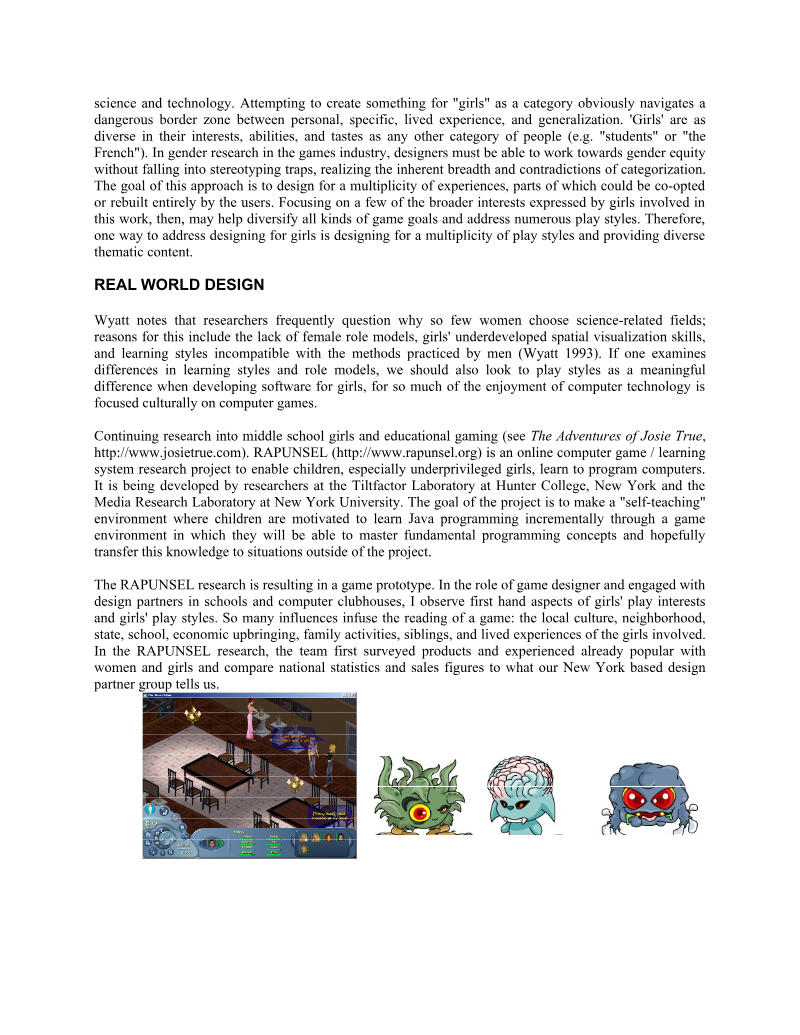
Mary Flanagan's paper, presented at the 2005 DiGRA conference, examines the challenges of designing games for girls, focusing on the RAPUNSEL project, an experimental game intended to teach middle school girls Java programming.
- Women make up only about 10 percent of US game industry workers and rarely shape design decisions, a gap the paper links to the design choices made for girls.
- Flanagan argues that 'girls' should not be treated as a uniform category with fixed preferences, since grouping them together risks reinforcing the stereotypes designers aim to challenge.
- Fieldwork with roughly 60 mostly African American girls aged 11 to 13 from New York housing projects found stated preferences leaning toward action, challenge, competition, and fear, with Grand Theft Auto and Mortal Kombat favored over traditional caregiving titles.
Research as Design-Design as Research
This paper introduces Research as Design-Design as Research (RADDAR), a methodology for investigating game design that emerged from a doctoral inquiry into designing a game to promote conceptual learning of special relativity among undergraduate physics students.
- RADDAR (Research as Design-Design as Research) is a methodology that emerged from a doctoral inquiry into designing a game to teach conceptual understanding of special relativity to undergraduate physics students.
- The paper argues that design and research share a synthesizing character and a cyclical, reflective structure, and that design can be treated as action research once emancipatory collaboration and systematic reflection are addressed.
- The author adopts Fourth Generation Evaluation, a constructivist, hermeneutic-dialectic methodology, and extends the notion of 'participant' to include design materials such as sketches, prototypes, code, and documents as collaborators alongside human respondents.
Game Graphics Beyond Realism: Then, Now, and Tomorrow
This paper, by Maic Masuch and Niklas Röber of the Otto-von-Guericke University Magdeburg, argues that game graphics should not be limited to photorealism and that developers should explore alternative, artistic rendering styles, particularly non-photorealistic rendering (NPR).
- The authors argue game graphics should not be limited to photorealism and that developers should explore non-photorealistic rendering (NPR) and other artistic styles.
- They contend that gameplay and story drive player enjoyment far more than graphical fidelity, and that as photorealism becomes costlier to achieve, graphics will lose effectiveness as a unique selling point.
- Immersion depends on believability and consistency rather than strict realism: small inconsistencies such as an incorrect shadow can break the illusion of a photorealistic game, while NPR styles tolerate such imperfections more readily.