
DiGRA
The Digital Games Research Association: the international association of academics and professionals who study digital games. Its Digital Library holds the proceedings of the DiGRA conferences since 2002.
Documents


Representation of Gender and Ethnicity in Digital Interactive Games
This document presents a content analysis of gender and ethnic representation in digital interactive games (DIGs), aiming to update previous research that largely found games dominated by stereotypical male characters and few, often submissive, female characters.
- Male characters still outnumbered females in the analyzed games, 13 of 22 characters, yet leading roles were evenly split between men and women, a shift from earlier research that found men dominating games with women in minor stereotypical roles.
- Female supporting characters were never shown in submissive positions, a notable departure from prior studies of game representation.
- Most characters were Caucasian (about 55 percent overall), and leading characters were predominantly white, indicating ethnic representation remained narrow.


Power and Control of Games: Children as the Actors of Game Cultures
"Power and Control of Games: Children as the Actors of Game Cultures" investigates the engagement and management of digital games among Finnish children.
- Children aged 10 to 12 in Finland are portrayed as active, articulate participants in game culture rather than passive or vulnerable consumers, according to a 2003 study drawing on a survey of 284 children and parents plus fifteen family interviews.
- Imaginary worlds are the most compelling draw of digital games because they make experiences possible that would otherwise be out of reach, with novelty, adventure, persistence, a balance of challenge, and humour as other major sources of engagement.
- Game appeal stems from several interacting qualities, including fun, puzzle-solving, achievement, building and controlling fictional worlds, and audiovisual quality, and interest often links to children's existing hobbies, showing games are woven into broader leisure and creative lives.

Supporting Visual Elements of Non-Verbal Communication in Computer Game Avatars
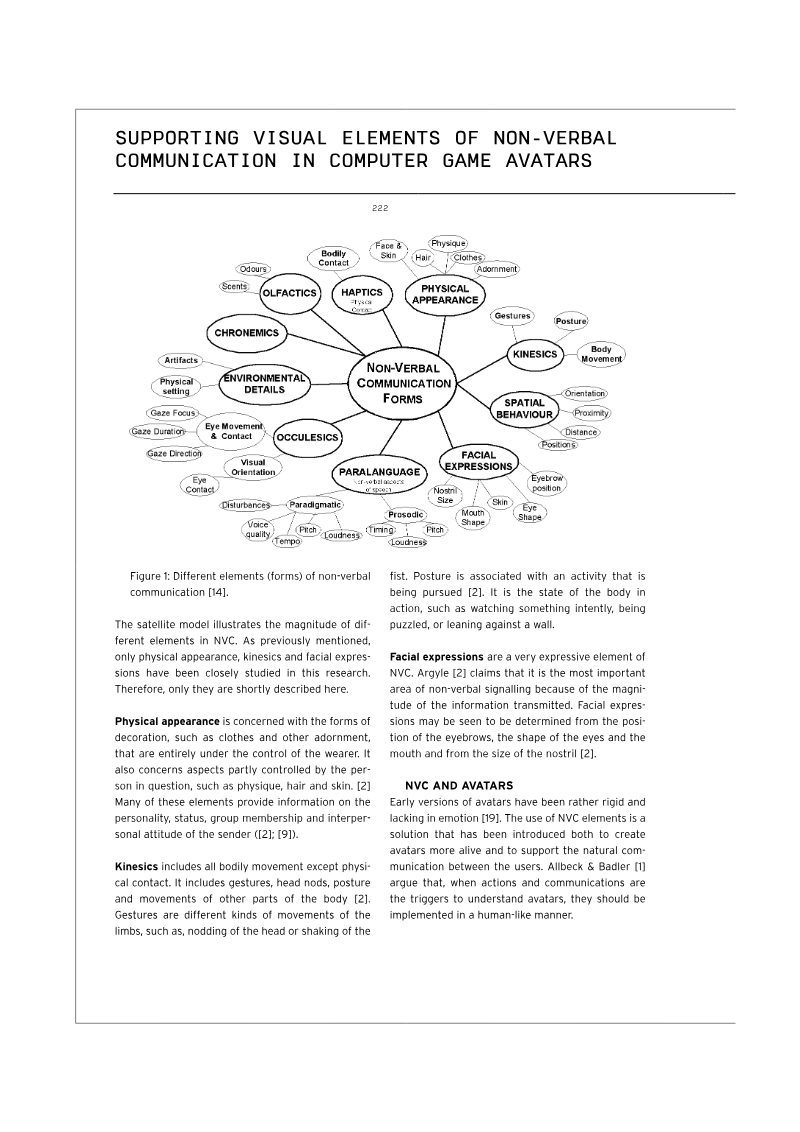
This research introduces a three-layered model for systematically designing visual non-verbal communication (NVC) elements in computer game avatars, aiming to enhance player communication in networked multi-player environments.
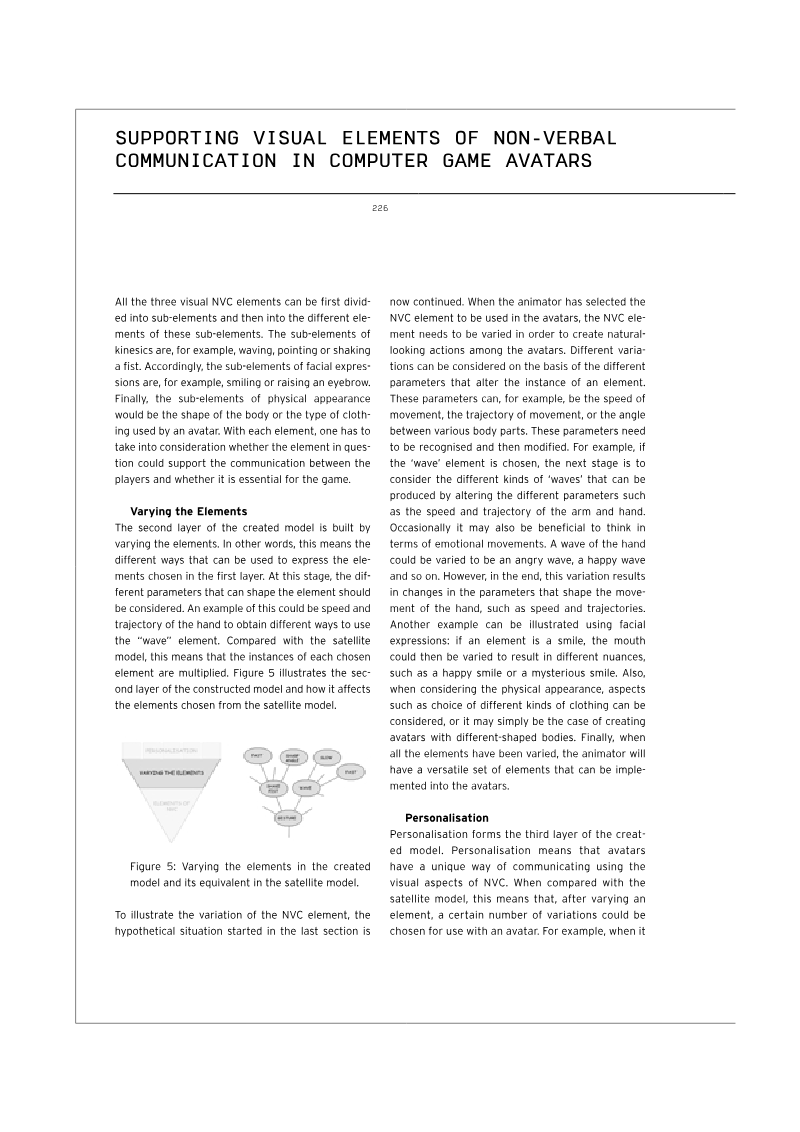
- The paper proposes a three-layer model for designing visual non-verbal communication in multiplayer game avatars, guiding designers to select NVC elements, vary them through parameters such as movement speed and trajectory, and personalise avatars so each has a distinguishable communicative identity.
- The study covers physical appearance, kinesics (bodily movement and gesture), and facial expressions, while eye movement and gaze were excluded due to limitations in the experimental technology.
- Adding NVC elements increased players' opportunities to convey and receive messages, varying them enabled richer and subtler expression, and personalisation made avatars more recognisable and prevented identical actions from appearing across different avatars.

Enhancing Gameplay: Challenges for Artificial Intelligence in Digital Games
The document, "Enhancing Gameplay: Challenges for Artificial Intelligence in Digital Games," posits that significant advancements in computing power and increased AI expertise offer an unprecedented opportunity for transformative innovation in digital game AI.
- The paper argues that rapid growth in computing power gives game designers a timely opportunity to pursue radical AI advances rather than incremental refinements, and that AI innovation is essential to avoid industry stagnation and establish games as a serious artistic medium.
- Current titles still rely largely on established techniques such as finite-state machines, A pathfinding, and scripting, with designers prioritizing the appearance of intelligence over realistic behavioral models.
- The paper identifies three priority areas for innovation: storytelling (especially player-driven narratives in MMORPGs), dynamic online learning (illustrated by the rare example of Black & White), and emotional expression, where real-time character animation lags well behind pre-rendered film.

Delightful Identification & Persuasion: Towards an Analytical and Applied Rhetoric of Digital Games
This document develops a theoretical rhetoric of digital games, arguing that gameplay constitutes a symbolic performance among designer, game, and player in which players are persuaded and come to identify with a game's design.
- Gameplay is framed as a symbolic performance among designer, game, and player, in which players are persuaded and come to identify with a game's design, drawing on Aristotle's rhetorical triad and Burke's concept of identification.
- Persuasion in games becomes visible through behavioral change: the shift from not playing to playing, and from playing to continuing.
- The model rests on three couplings between designer and player: systemic (an experiential "eigenworld" of reciprocal control, mastery, and empowerment), symbolic (performance loops grounded in identification), and structural (aligning the game's motivational offers and demands with player expectations).



A Joint Study of Super Monkey Ball: Keep the Monkey Rolling: Eye-Hand Coordination in Super Monkey Ball
This study, "Keep the Monkey Rolling: Eye-Hand Coordination in Super Monkey Ball," explores the relationship between computer game playing, specifically Super Monkey Ball, and eye-hand coordination.
- The study is an exploratory pilot from the Center for Computer Games Research at the IT University of Copenhagen, examining whether eye-hand coordination relates to computer game skill and whether avid gamers have superior coordination.
- The research found no reliable link: the data did not substantiate a connection between computer game skill and eye-hand coordination, though the author noted the claim cannot be dismissed outright.
- The empirical component was very small, involving seven boys aged 10 to 13 from an urban after-school centre in Copenhagen, tested with the Test of Visual-Motor Skills before or after a Super Monkey Ball play session.


Computer Games and Violence: Is There Really a Connection?
This study investigates the relationship between video game usage and violent behavior among Norwegian youth aged 13 to 18.
- The bivariate correlation between violent video games and violent behaviour among 9,887 Norwegian youth aged 13 to 18 (r ≈ .22–.23) drops substantially once gender is added, to about .15 for first-person shooters and .18 for action games.
- In multivariate models controlling for age and gender, the association between first-person shooters and violent behaviour largely disappears, except among 8th graders, while action games remain a significant predictor across all age groups.
- All game variables together explained only about 4 to 9 percent of the variance in violent behaviour, with the largest shares found in the oldest age groups.

Wargaming and Computer Games: Fun with the Future
This essay examines the historical trajectory of wargaming to offer new insights into contemporary computer games, particularly addressing the ludological perspective on the marginal role of narrative and "texture" in games.
- Patrick Crogan argues that modern computer games extend a relationship to the future rooted in the Enlightenment project of rational prediction and control, with the core activity being modelling and simulation.
- Narrative and cultural 'texture' are treated as marginal in games because the central pleasure lies in modelling complex systems, a claim that positions the essay within the ludological tradition while challenging its positivist tendencies.
- Wargaming is traced from Helwig's 1780 squared-board game through Reisswitz's 1824 Kriegsspiel, which impressed the Prussian military and was adopted into officer training, and on through postwar American military and research simulation.
Player Character Design Facilitating Emotional Depth in MMORPGs
The research outlines a novel approach to player character design in MMORPGs, aiming to foster profound emotional depth and dramatic interaction beyond conventional statistical progression.
- The report argues that individually authored MMORPG characters cannot scale to thousands of players, so emotional depth must come from a generative system rather than hand-crafted content.
- It proposes a "virtual mind" for player characters, replacing conventional numerical levelling with "being-values" organized around a Mind System, Story Daemons, and a Metaphysics System, developed within the Purgatory Engine and Ouroboros project at the Interactive Institute's Zero Game Studio.
- The mind model layers a two-dimensional affect framework (emotion, mood, sentiment, personality) over a Five Factor trait structure and Maslow's being-values, modeling Ekman's eleven emotions plus "pain".

Computer Games and the Complexity of Experience
The document, "Computer Games and the Complexity of Experience," argues that the prevailing sensory-motor model for studying computer games, which focuses on action-driven, Aristotelian dramaturgy, fails to capture the full complexity of player experience.
- The paper argues that computer games are typically analyzed through a sensory-motor model borrowed from classical cinema, which privileges action, causality, and an Aristotelian action-driven dramaturgy, and that this framing fails to capture the full complexity of experience both represented in games and lived by players.
- Kattenbelt and Raessens draw on Peirce's categories of firstness (feeling), secondness (action and resistance), and thirdness (reflection), and on Deleuze's movement-image, time-image, and thought-image, to build a framework for analyzing the emotional, volitional, and cognitive dimensions of play.
- The authors propose three player subject positions relative to a game's represented world: the lyric (emotional and affective), the dramatic (action-oriented and sensory-motor), and the epic (reflective and contemplative).

The Other Game Researcher: Participating in and Watching the Construction of Boundaries in Game Studies
Marinka Copier's paper argues that the emergence of game studies as an autonomous academic discipline depends on the active construction of boundaries, and that researchers themselves are participants in this boundary-work rather than detached observers.
- Marinka Copier argues that game studies' emergence as an autonomous discipline depends on active boundary-work, and that researchers are participants in drawing these boundaries rather than detached observers, drawing on Thomas Gieryn's boundary-work and Donna Haraway's situated knowledge.
- The paper traces the field's formation through early-2000s debates, including the 2001 founding editorial of the journal Gamestudies, which separated ludology from narratology and argued games deserve study on their own terms.
- Copier treats boundaries between game studies, designers, gamers, and neighboring fields as resting on both content-based and institutional arguments, and treats divides like ludology versus narratology as political constructions rather than fixed categories.

The Appeal of Cute Monkeys
Susana Pajares Tosca investigates whether the aesthetics of cuteness explain the appeal of Super Monkey Ball's four characters (MeeMee, GonGon, Baby, and AiAi).
- The monkey characters of Super Monkey Ball (MeeMee, GonGon, Baby, and AiAi) remain popular despite the game offering no story, with their appeal grounded primarily in iconic, kitsch-tinged cuteness drawn from Japanese design traditions.
- The study places the monkeys in an "iconic" category alongside Hello Kitty, arguing that such characters succeed through a combination of cuteness and caricature rather than gameplay or narrative alone.
- The monkeys' appeal depends not only on visual design but also on gameplay and on their role as a social "mask" among players, according to the study's central conclusion.