
DiGRA
The Digital Games Research Association: the international association of academics and professionals who study digital games. Its Digital Library holds the proceedings of the DiGRA conferences since 2002.
Documents
Videogame Art: Remixing, Reworking and Other Interventions
This paper examines videogame art, a form that knowingly draws on game culture and is distinguished from playable art and from commercial games, which it excludes from consideration.
- The paper frames videogame art through four practices, remixing, reference, reworking, and reaction, and deliberately excludes playable art and commercial games from its scope.
- Videogame art relies heavily on appropriation and détournement, subverting existing game material, with reworking spanning patches, skins, maps, and mods that range from enhancing a game to subverting it for artistic ends.
- Early icons such as Pacman and Space Invaders are more flexible for artistic reinterpretation than newer franchise figures like Mario because they remain widely recognized while carrying less brand baggage.
Textuality and Videogames: Interactivity, Narrative Space and Role Play
"Textuality and Videogames: Interactivity, Narrative Space and Role Play" explores the multifaceted nature of textuality within video games, focusing on how interactivity, narrative structures, and role-playing elements shape player experience and meaning-making.
- Games incorporate narrative elements players genuinely value, but the authors argue they are not inherently narrative media, since real-time play unfolds as events rather than fixed sequences.
- Player agency disrupts the linear structures that narratological theorists such as Chatman describe, challenging the application of traditional narrative theory to games.
- Based on a two-year research project (2001–2003) at the Institute of Education, University of London, the study combines textual analysis, video recordings of players in domestic settings, and interviews with players and developers.
Together We Brand: America's Army
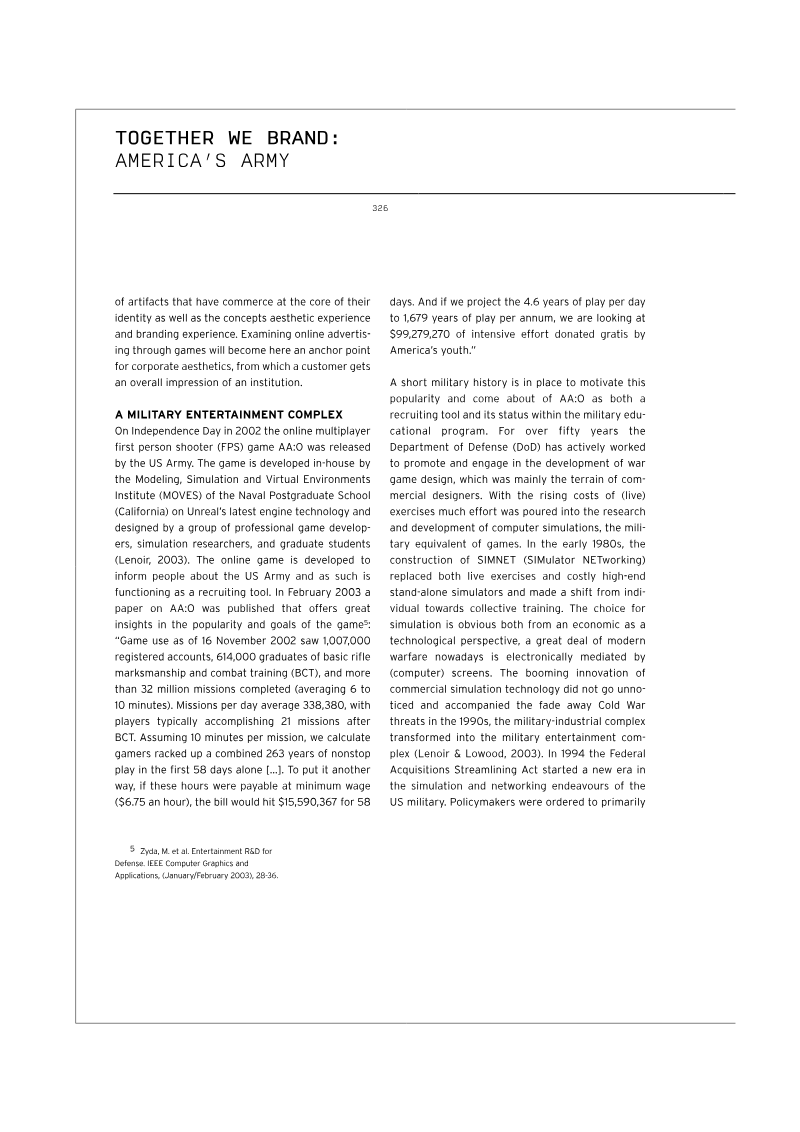
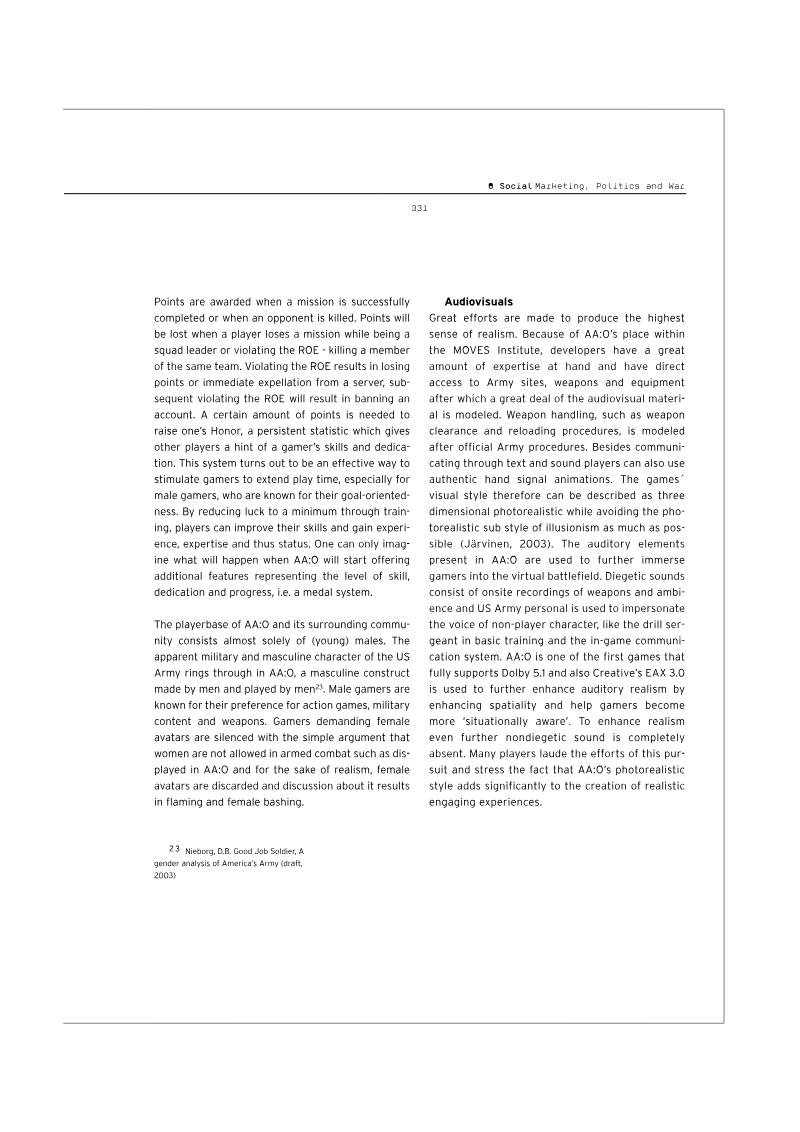
"Together We Brand: America's Army" examines the "America's Army: Operations" (AA:O) video game as a highly effective "advergame" designed to serve the US Army's recruitment and branding objectives.
- America's Army: Operations functioned simultaneously as an advergame, recruiting tool, training simulation, and branding vehicle, with the authors calling this blend "advertainment" and arguing the Army deliberately fused commercial, entertainment, and participatory online objectives into one brand experience.
- Rather than collecting explicit personal data, the game built the Army's identity through aesthetic and sensory immersion, positioning it as a central expression of the Army brand during its "Together We Stand" rebranding campaign.
- By November 2002 the free game had attracted over one million registered accounts and 32 million completed missions, and Army recruiting website traffic reportedly rose 28 percent after launch.
Enchanting Reality: A Vision of Big Experiences on Small Platforms
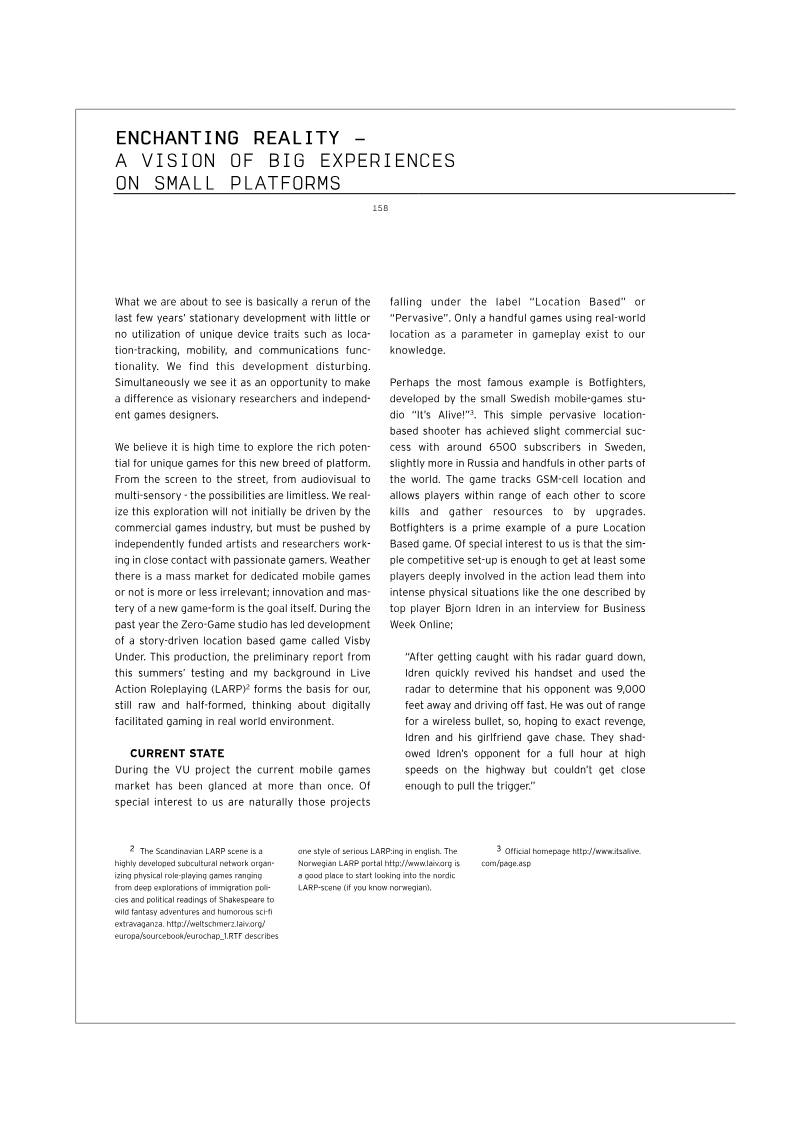
"Enchanting Reality: A Vision of Big Experiences on Small Platforms" posits that the mobile gaming industry, despite significant hardware advancements, has largely failed to innovate beyond simple ports and clones, neglecting the unique capabilities of mobile computing for pervasive, location-based gameplay.
- The paper argues mobile gaming has largely cloned or ported console and desktop titles, leaving handheld capabilities such as mobility, GPS, and communications underused.
- Its central thesis is that compelling physical-world games create immersion through "diegetic consistency," where the fictional world aligns with the player's sensory reality.
- The authors propose "enchanted reality" games, in which real-world actions meaningfully alter the virtual world rather than merely triggering isolated events.
It's No Videogame: News Commentary and the Second Gulf War
Mia Consalvo examines how U.S. news media invoked the word "videogame" during coverage of the second Gulf War, using textual analysis grounded in hegemony theory.
- Consalvo's study analysed 75 U.S. news stories from March and April 2003 to see how the term "videogame" was used in coverage of the Second Gulf War.
- The dominant usage was pejorative: critics called the war coverage fake, trivial, or unreal, arguing the conflict lacked the real human suffering that would make it serious.
- A second strand described the war as "just like a videogame" because of its hi-tech sophistication, revealing both generational unease and fascination with military technology.
From Text to Talk: Multiplayer Games and Voiceover IP
This study examines how voice-over IP, as used in systems like Roger Wilco and Xbox Live, reshapes the social experience of multiplayer gaming compared with text chat.
- Voice communication in multiplayer games shapes social dynamics differently than text chat, and the medium itself alters language functions, identity management, presence, and social protocols.
- In a Soldiers of Fortune clan, voice communication produced better coordination, higher scores, and a stronger sense of security than text, which players disliked and used sparingly.
- Strangers on Xbox Live relied on formulaic greetings and "scoping" to protect their identities, while co-located friends playing Halo produced high-energy, simultaneous talk oriented toward joshing, crowing, and strategy.
Power Gamers Just Want to Have Fun?: Instrumental Play in a MMOG
T.L. Taylor's ethnography of EverQuest argues that "power gamers" are neither isolated "lone rangers" nor cheaters, but practitioners of a legitimate, highly instrumental play style embedded in social structures.
- Power gaming in EverQuest is a rigorous, efficiency-driven style of play, marked by dynamic goal-setting, long sessions of repetitive grinding, treating failure as a learning opportunity, and transferring game knowledge across titles, and Taylor argues it deserves recognition as legitimate play rather than dismissal as a corruption of fun.
- Power gaming is profoundly social rather than solitary: players rely on practices like 2-boxing and 3-boxing, community tools such as ShowEQ and strategy websites, and friendship networks and "uber" guilds to access high-end content like epic items and difficult raid encounters.
- Reputation systems and collaboration shape what it means to be a power gamer, so efficiency is achieved through collective effort as much as individual skill.
The Playability of Texts vs. the Readability of Games: Towards a Holistic Theory of Fictionality
The document proposes a holistic theory of fictionality that integrates concepts from literary theory, particularly reader-response theory and semiotics, with game studies.
- Kücklich argues that games and literary texts are both fictional worlds requiring active playful participation, and that literary theory can contribute to game studies well beyond narratological analysis.
- Drawing on Wolfgang Iser's concept of the Textspiel, the paper frames fiction-making as a triadic process linking the real, the fictive, and the imaginary, with play as the mediating force.
- To give the concept rigor, Kücklich proposes a six-world model adapted from Marie-Laure Ryan's possible worlds theory, distinguishing the reader's actual and possible worlds, the narrator's actual world, and the textual actual and reference worlds.
Exploring Clan Culture: Social Enclaves and Cooperation in Online Games
This research explores the formation and function of clans within competitive online gaming environments, specifically focusing on Taiwanese MMORPGs like Lineage and Ragnarok Online.
- Clan membership in MMORPGs is a rational, adaptive response to competitive and interdependent game design, since progression and survival depend on group action.
- In a survey of 493 Lineage players, only 5.7% had never belonged to a clan, and interviews with 14 snowball-sampled participants indicated clans offer protection against fraud, bullying, and theft.
- Clans form most readily among off-line acquaintances, because existing social ties reduce the uncertainty of cooperating with strangers.
On the Border: Pleasure of Exploration and Colonial Mastery in Civilization III Play the World
The document, "On the Border: Pleasure of Exploration and Colonial Mastery in Civilization III Play the World," critically examines the underlying ideological frameworks of Civilization III (Civ3) and its expansion, Play the World (Civ3PtW).
- Sybille Lammes argues that Civilization III: Play the World frames exploration and expansion as a colonialist progression from "nature" toward a Western, white, male-centred "civilization," drawing on postcolonial and science studies.
- The analysis reads the game's intro cinematics (such as the Tower of Babel imagery) and setup options, including the framing of "Barbarians" as nature-bound and non-Western cultures as rivals, as naturalising links between expansionism, science, masculinity, and whiteness.
- The core claim is that the game's border expansion mirrors European colonial attitudes, with colonies serving as resource extraction zones for the homeland and "othered" peoples and territories subject to control.
Women Just Want to Have Fun: A Study of Adult Female Players of Digital Games
This study examines adult female digital game players, challenging the prevailing notion of gaming as a male-dominated activity.
- Social networks, rather than individual initiative alone, are the main force shaping how adult women first enter digital gaming and how they keep playing, with early exposure through brothers, fathers, or friends and access to shared or borrowed consoles as the principal routes in.
- Despite Sony's marketing and redesign claims of gender neutrality, female ownership of the PlayStation 2 reached only 6.7 percent of registered PAL-territory owners, compared with 11.1 percent in Japan.
- The study attributes the PlayStation 2's limited female uptake to a continued focus on hardcore male gamers, price sensitivity among women, and manufacturers' reliance on registered-user data that cannot capture people playing on borrowed hardware.
Gamescapes: Exploration and Virtual Presence in Game-Worlds
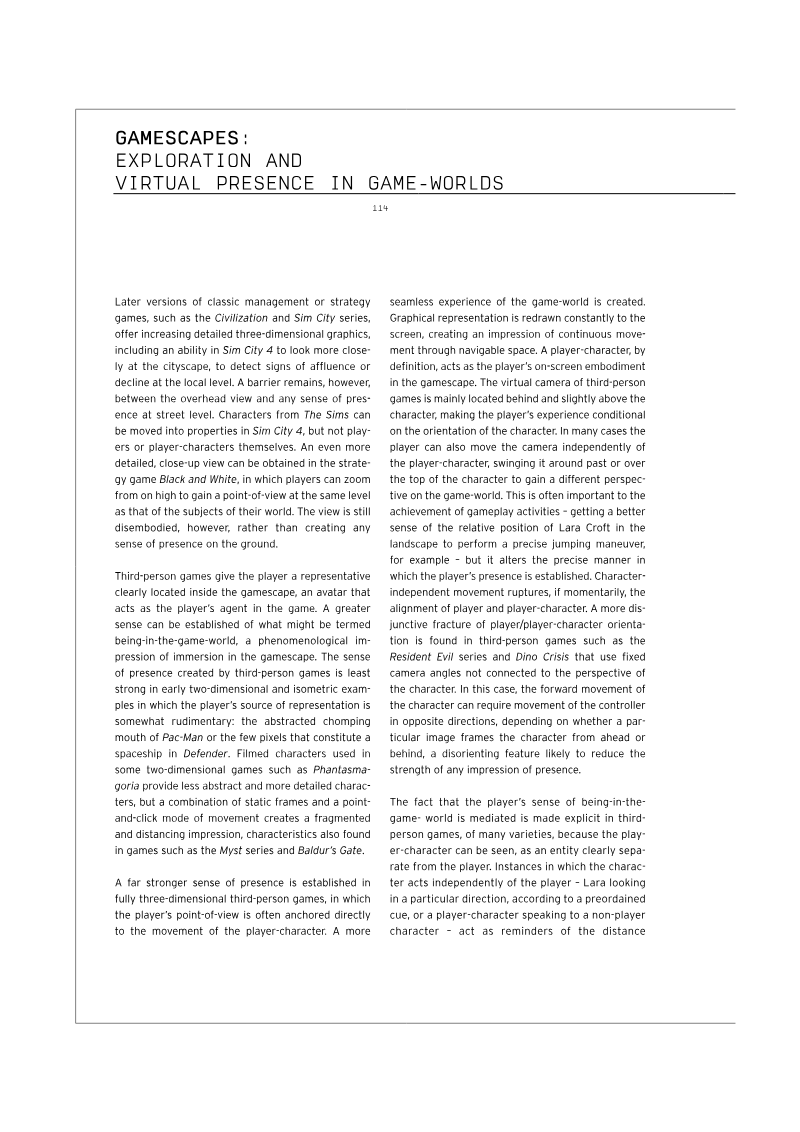
Geoff King and Tanya Krzywinska's "Gamescapes" examines how video game worlds shape players' experience of exploration and virtual presence.
- Restriction is treated as a deliberate design tool rather than mere limitation, with designers balancing 'hard' and 'soft' boundaries to govern pleasure, fear, and narrative and to manage the tension between constraint and freedom.
- Perspective is a major determinant of presence: isometric and god-view strategy games offer the most distanced experience, third-person games a mediated sense of being in the world, and first-person games the strongest illusion of presence.
- Games can generate powerful psychological immersion through gameplay alone, independent of sensory realism, though early haptics such as the dual-shock controller's crude vibration remained far from true virtual reality fidelity.