
DiGRA
The Digital Games Research Association: the international association of academics and professionals who study digital games. Its Digital Library holds the proceedings of the DiGRA conferences since 2002.
Documents
Bringing New HOPE to Networked Games: Using Optimistic Execution to Improve Quality of Service
This paper introduces New HOPE, an adaptation of the optimistic execution framework originally developed for transaction-oriented systems, aimed at mitigating latency in real-time networked multiplayer games.
- New HOPE adapts optimistic execution, a framework originally built for transaction-oriented systems, to let predictable game actions proceed without waiting for remote confirmation, hiding synchronization delay from players.
- Unlike original HOPE, which relied on full rollback when predictions failed, New HOPE substitutes controlled recovery procedures that restore a consistent state while keeping gameplay moving forward.
- New HOPE introduces padding (distracting animation that masks latency) and synchronization points (limits on how far speculative execution can proceed) as core primitives.

Frame and Metaphor in Political Games
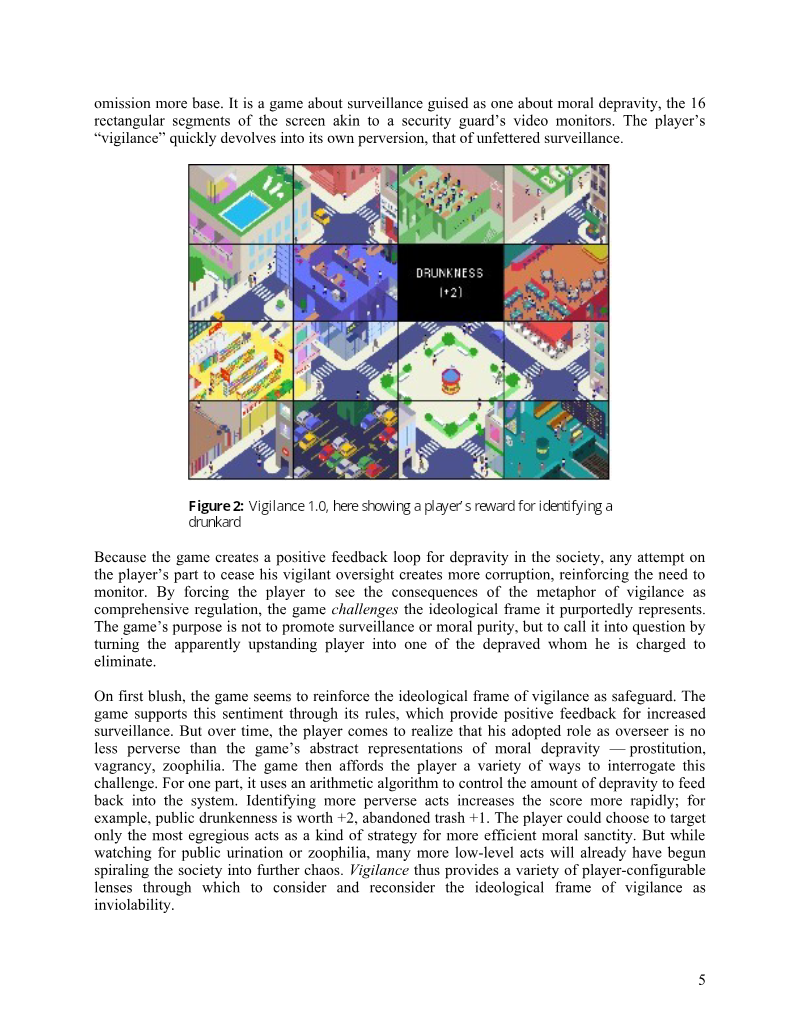
Ian Bogost's paper "Frame and Metaphor in Political Games," presented at the 2005 DiGRA conference, argues that videogames can carry ideological bias by operating through procedural rather than verbal rhetoric.
- Ian Bogost's 2005 DiGRA paper argues that videogames can carry ideological bias through procedural rhetoric, operating via rules and systems rather than verbal argument, drawing on George Lakoff's cognitive linguistics and Frank Luntz's message-development work for conservatives.
- Bogost classifies games' relation to ideological frames into three modes: reinforcing them, contesting them, or exposing them.
- The paper's reinforcement example is the Republican National Committee's Tax Invaders, a Space Invaders variant in which a Bush head fires at tax increases framed as invaders, turning the metaphor of taxation as theft into a playable form.

Interactive Story Writing in the Classroom: Using Computer Games
The document presents ScriptEase, a pattern-based authoring tool built for Neverwinter Nights that allows non-programmers to create interactive stories without writing NWScript, a low-level scripting language.
- ScriptEase is a pattern-based authoring tool for Neverwinter Nights that lets non-programmers build interactive stories without writing NWScript, using menu-driven, customizable story patterns that generate the underlying script automatically.
- The authors motivate the tool with the volume of scripting-related help requests in the game's community forums, which reached nearly 150,000 posts, arguing that manual scripting is slow, error-prone, and a barrier to wider participation.
- A pilot with 21 Grade 10 English students in Alberta produced graded interactive stories; participants were highly motivated, spontaneously collaborated in ways resembling pair programming, and lower-achieving students became notably engaged.
Digital Games: A Motivational Perspective
This literature review examines why players engage persistently with commercial digital games while educational games struggle to attract comparable interest, using motivation theory as its analytical lens.
- Commercial digital games have grown steadily while educational games remain marginal, and the review argues that understanding the motivational differences between the two can help designers combine their strengths to build more effective learning tools.
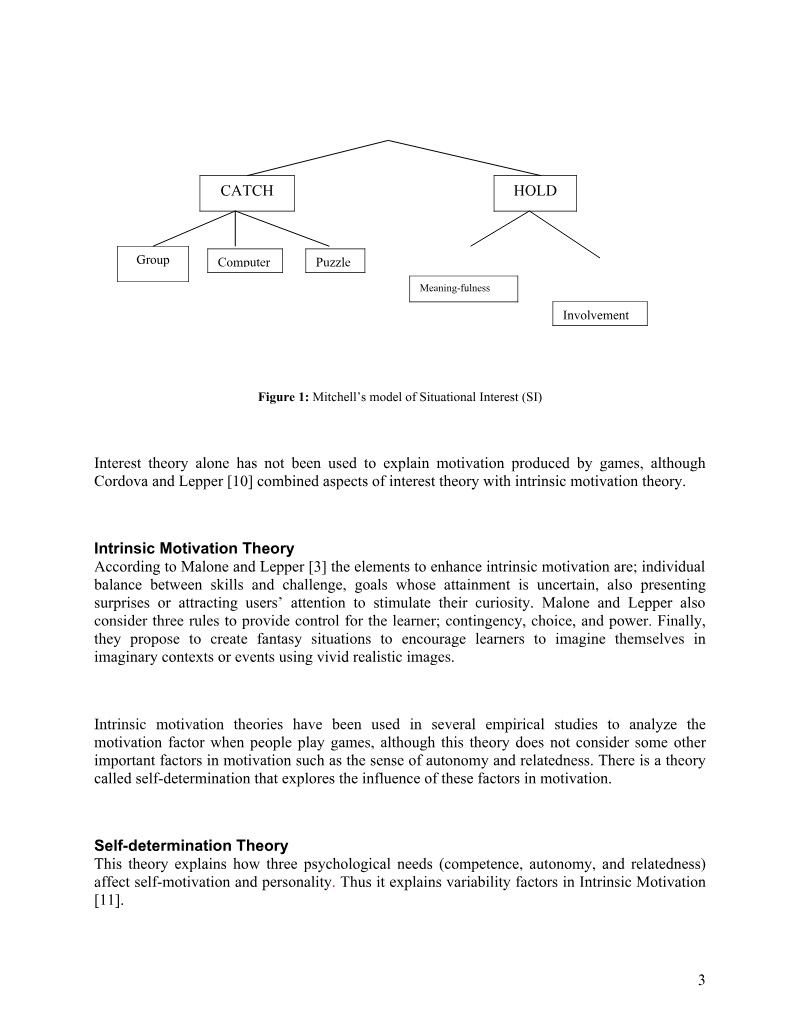
- The review grounds its analysis in three frameworks: Mitchell's situational interest model (CATCH versus HOLD), intrinsic motivation theory (challenge, fantasy, curiosity, control), and self-determination theory (competence, autonomy, relatedness).
- Lepper and Cordova's arithmetic game experiments found that personalized fantasy and player choice improved intrinsic motivation, time on task, and learning, with personalized fantasy producing the strongest results.
Consumer Driven Computer Game Design
This study, presented at the DiGRA 2005 conference, proposes a methodology for consumer-driven computer game design that uses the Critical Incident Technique (CIT) to ground game development in player experiences rather than designers' assumptions.
- The paper proposes consumer-driven game design using the Critical Incident Technique, grounding development in players' reported satisfying and dissatisfying experiences rather than designers' assumptions, with player narratives handed to creative designers as a reference for new games.
- The study drew on 61 active players (about 70% male, 30% female, roughly 70% students, ages 13 to 29, average 22), each writing one best and one worst game experience account.
- Two trained analysts coded the incidents with a third checking reliability, reaching 88% inter-judge agreement for positive incidents and 86% for negative ones.

Configuring the Player: Subversive Behavior in Project Entropia
This paper applies the Science and Technology Studies concept of the "black box" to Project Entropia, a virtual world developed by the Swedish company MindArk, examining how developers embed assumptions into the game to shape player behavior and how players work to open that black box and pursue roles the publisher did not…
- Project Entropia, developed by Swedish company MindArk, is free to download and earns revenue through a micro-payment model in which players buy its in-game currency, PED, at roughly 10 PED per US dollar, unlike most MMOs that rely on monthly subscriptions.
- The paper argues that the game's hidden rules make working as a hunter, miner, or crafter effectively costly, since tool upkeep and repairs often exceed earnings, which pushes players toward paying.
- Using the Science and Technology Studies concept of the 'black box,' the authors show how developers embed assumptions into the game to shape player behavior, and how players work to open that box and pursue roles the publisher did not intend.
Shadowplay: Simulated Illumination in Game Worlds
This paper argues that game studies lacks a vocabulary for discussing simulated illumination, and that such a vocabulary can be built by surveying existing lighting practices from three sources: computer-generated animation and film, architectural lighting, and the interactive properties of games themselves.
- Light in games is argued to be far more than decoration: illumination shapes narrative meaning, directs player attention, modulates mood and risk, and can directly drive gameplay and NPC behavior.
- Silent Hill 2 and Thief serve as the paper's primary case studies, with Silent Hill 2 examined through its pre-rendered cut scenes and low-key horror lighting, and Thief through its tuned sensory system governing AI visibility.
- The author builds a lighting vocabulary by adapting Sharon Callahan's five objectives of digital animation lighting, while noting that free navigation in games exceeds the fixed-frame assumptions of film.
Cognitive Callisthenics: Do FPS Computer Games Enhance the Player's Cognitive Abilities?
This study, a 2005 DiGRA conference paper by Paul Kearney of Unitec New Zealand, investigates whether playing the first-person shooter Counter-Strike can enhance cognitive abilities, particularly multitasking.
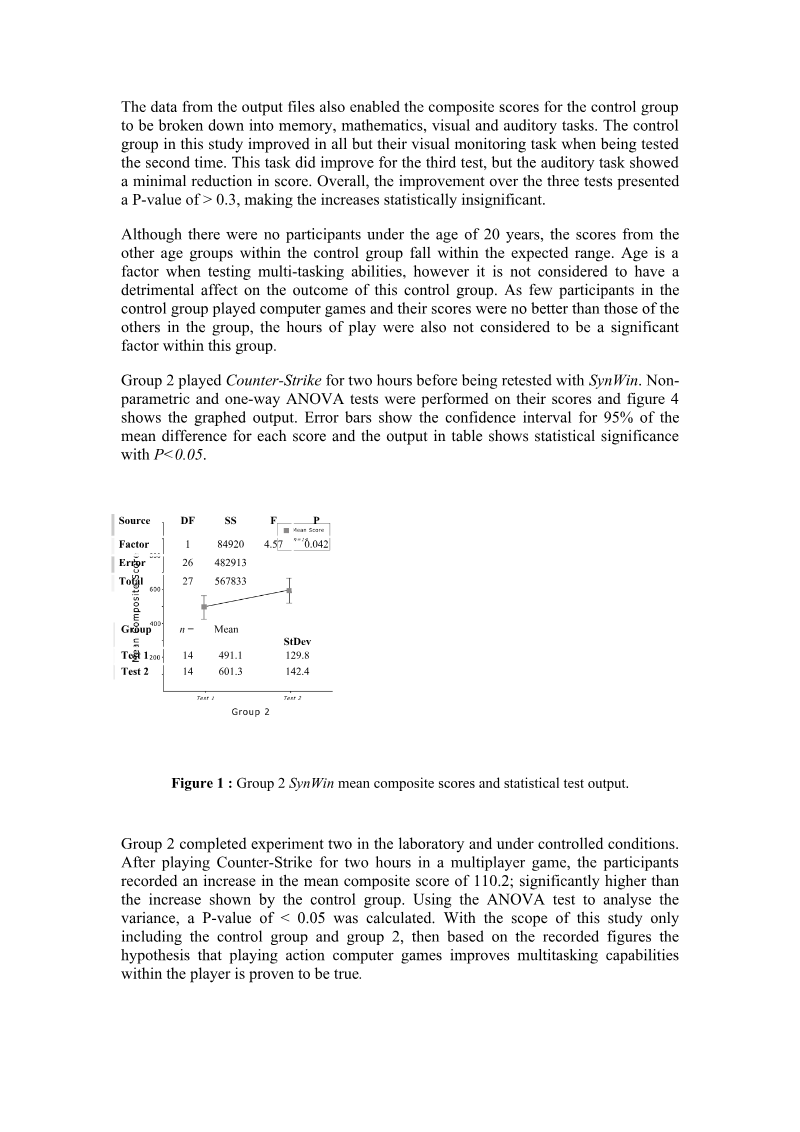
- A 2005 DiGRA study by Paul Kearney (Unitec New Zealand) found that two hours of multiplayer Counter-Strike play raised the mean composite multitasking score of 14 participants by 110.2 points, a statistically significant gain (P < 0.05) measured with the SynWin synthetic work-environment software.
- The control group of eight largely non-gaming participants, tested three times without any intervention, showed only modest gains that were not statistically significant (P > 0.3), consistent with ordinary practice effects.
- The author attributes the gains to immersion, collaborative play, and realism, but the study had no control condition in which participants played a non-game activity, so the game itself cannot be isolated as the cause.



OceanQuest: A University-Based Serious Game Project
OceanQuest is a case study of a university-developed serious game designed to teach Grade 8 science concepts about hydrothermal vent ecosystems on the ocean floor, specifically the Endeavour field west of Vancouver Island.
- OceanQuest is a university-developed serious game teaching Grade 8 science about hydrothermal vent ecosystems at the Endeavour field west of Vancouver Island, built under a small budget and a four-month schedule to deliver by February 2004.
- The authors argue that a serious game can satisfy both traditional game goals and educational goals, and treat the difficulty of combining instructional and entertainment design as the central challenge.
- Rather than direct instruction, the design aimed for players to absorb science implicitly through a submarine scavenger hunt narrative in which they search for organisms that may contain a plague cure, mirroring how commercial games teach through play.

Authentic Learning Experiences Through Play: Games, Simulations and the Construction of Knowledge
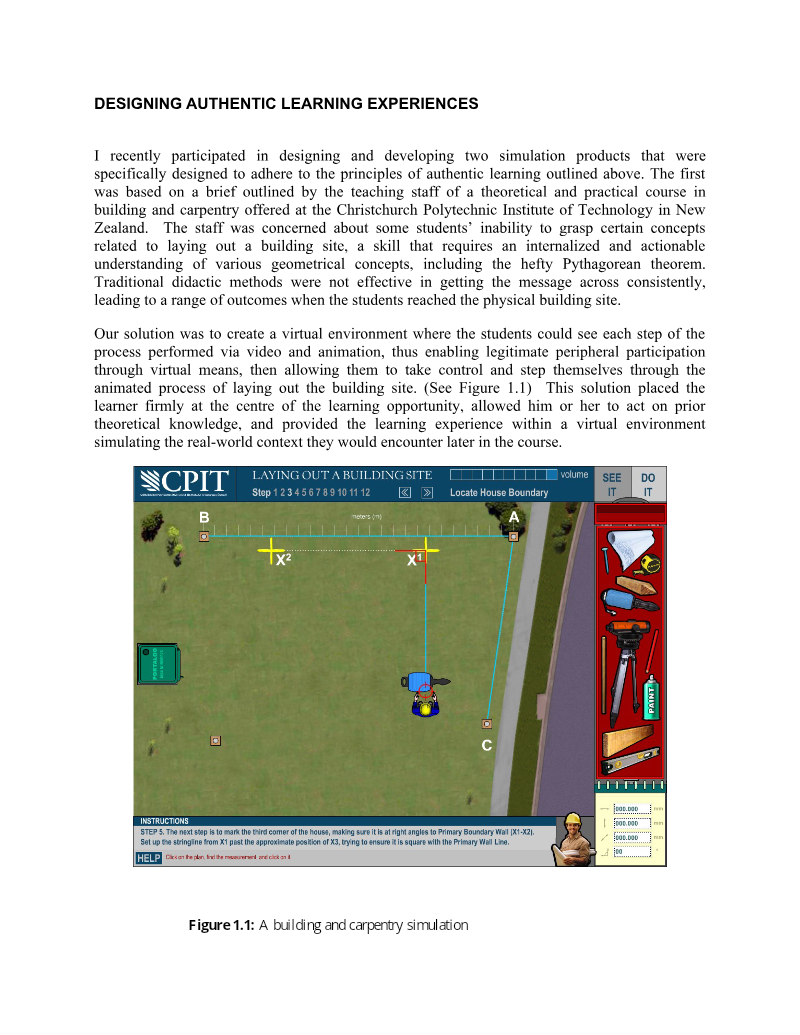
This paper, by Lisa Galarneau of the University of Waikato, argues that games and simulations are most valuable when they are designed around authentic learning experiences rather than deployed as generic motivational wrappers.
- Games and simulations are most valuable when designed around authentic learning experiences, not used as generic motivational wrappers; many 1990s 'edutainment' titles merely repackaged didactic content.
- The paper's core thesis is that learning is the formation of connections through experience, so the key design question is how to let learners experiment with knowledge in context and encounter a range of outcomes, including failure.
- The author proposes balancing three elements identified by Clark Aldrich (pedagogical structure, simulation mechanics, and game features), with the simulation element treated as central to providing realistic practice.
A Game Architecture for Emergent Story-Puzzles in a Persistent World
This paper presents a double-layer game architecture for generating short, linked story-puzzles in a persistent virtual world, using a simplified detective game set in a Victorian mansion modeled on the Cluedo characters as its test-bed.
- The paper proposes a double-layer architecture that splits a game into a narrative layer (case-based reasoning plus a narrative ontology) and an agent layer (autonomous characters running a sense-think-act cycle), aiming to reconcile tight plot control with genuine emergent behavior.
- The narrative layer generates a crime by matching a randomly generated case against a case base using ontology-based semantic distance, then adapts the retrieved world state with heuristic rules inspired by the Minstrel system's transform-recall-adapt methods.
- Character relationships are encoded as three-component emotional vectors (attraction/disgust, trust/distrust, love/hate) with values from -10 to 10, categorized as balanced, weak, moderated, or strong, and these evolve with player performance and character interaction.
The GameCreator: Self-Created Mobile Games on the Internet
The GameCreator is an Internet-based platform, introduced in a 2005 DiGRA conference paper, that lets consumers build and download their own Java mobile games without programming skills, either from scratch or by modifying preconfigured templates.
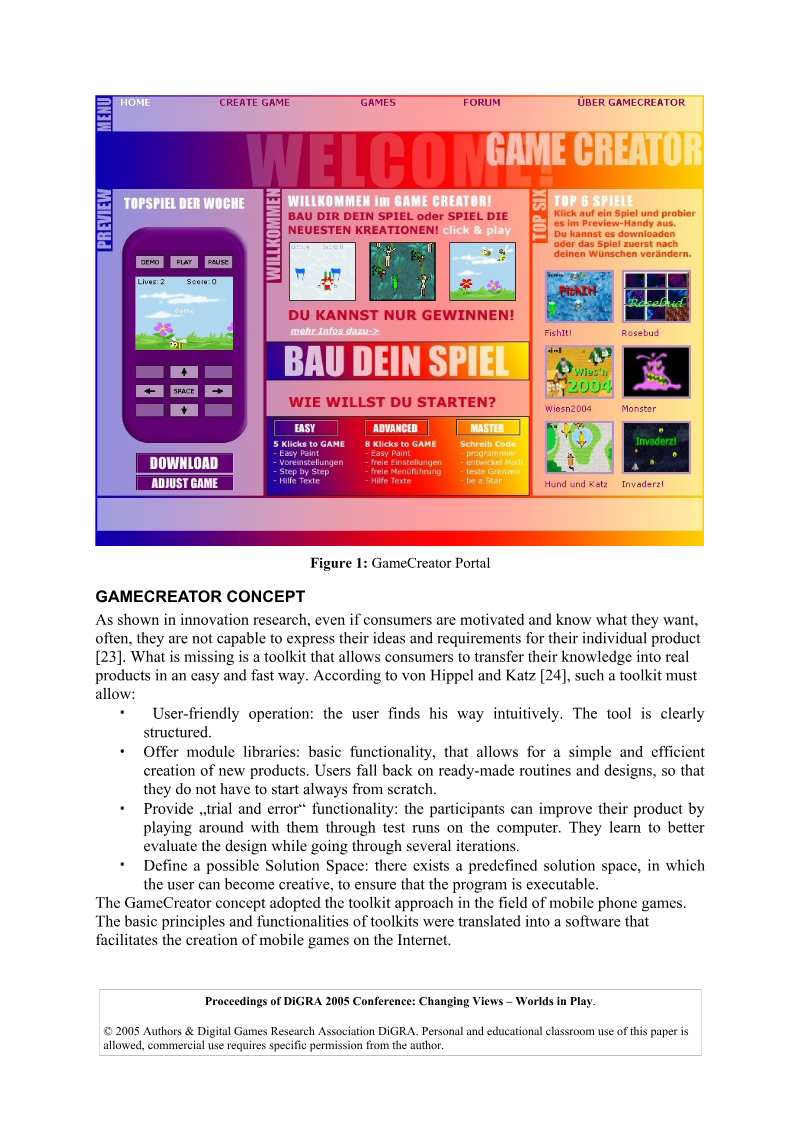
- The GameCreator is a 2005 DiGRA-presented web platform that lets users with no programming skills build and download their own Java mobile games, either from scratch or by modifying templates, using a graphical wizard, live preview, server-side compilation into JAR files, and an embedded community for sharing and co-developing games.
- The paper argues that self-created games offer value beyond ready-made titles because the effort of creation is rewarded through hedonic enjoyment, personal utility, social recognition, and symbolic meaning, such as use as personalized gifts or messages.
- The platform targets three segments through easy, advanced, and master modes: Mobile Internet crossover users who have never downloaded mobile games, regular gamers aged roughly 9 to 18, and programming-literate users seeking top-tier games.