
DiGRA
The Digital Games Research Association: the international association of academics and professionals who study digital games. Its Digital Library holds the proceedings of the DiGRA conferences since 2002.
Documents

Survey of the Adjourned Sale Rate of the Japanese Home Video Game Industry
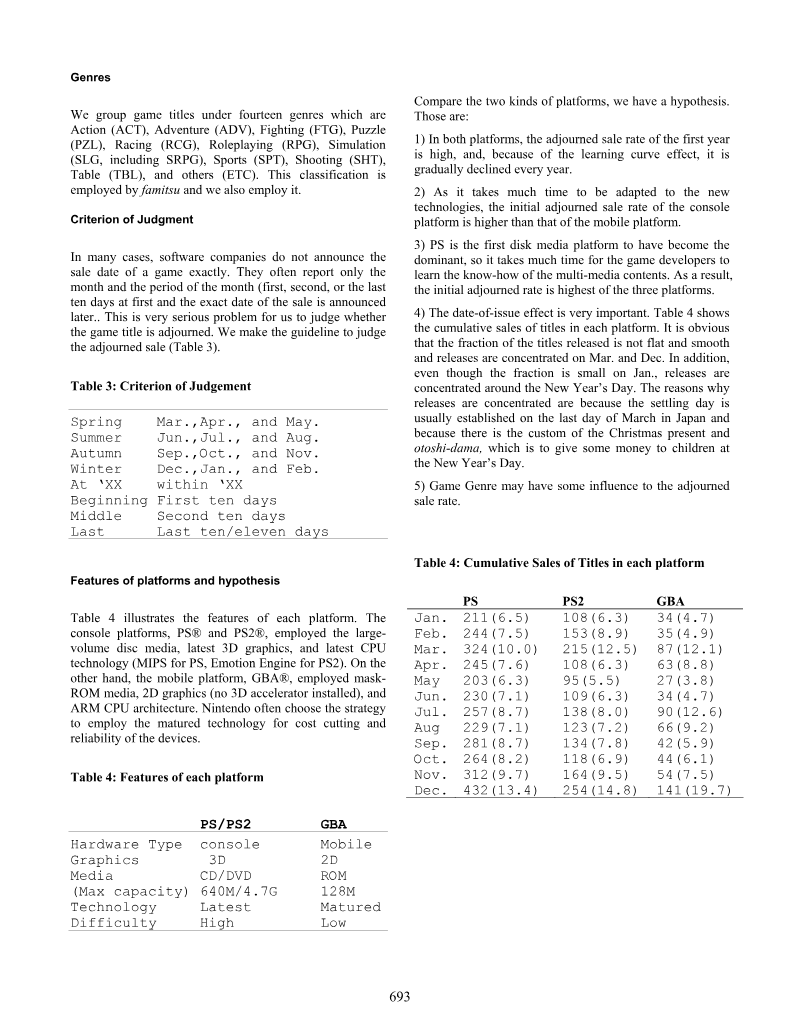
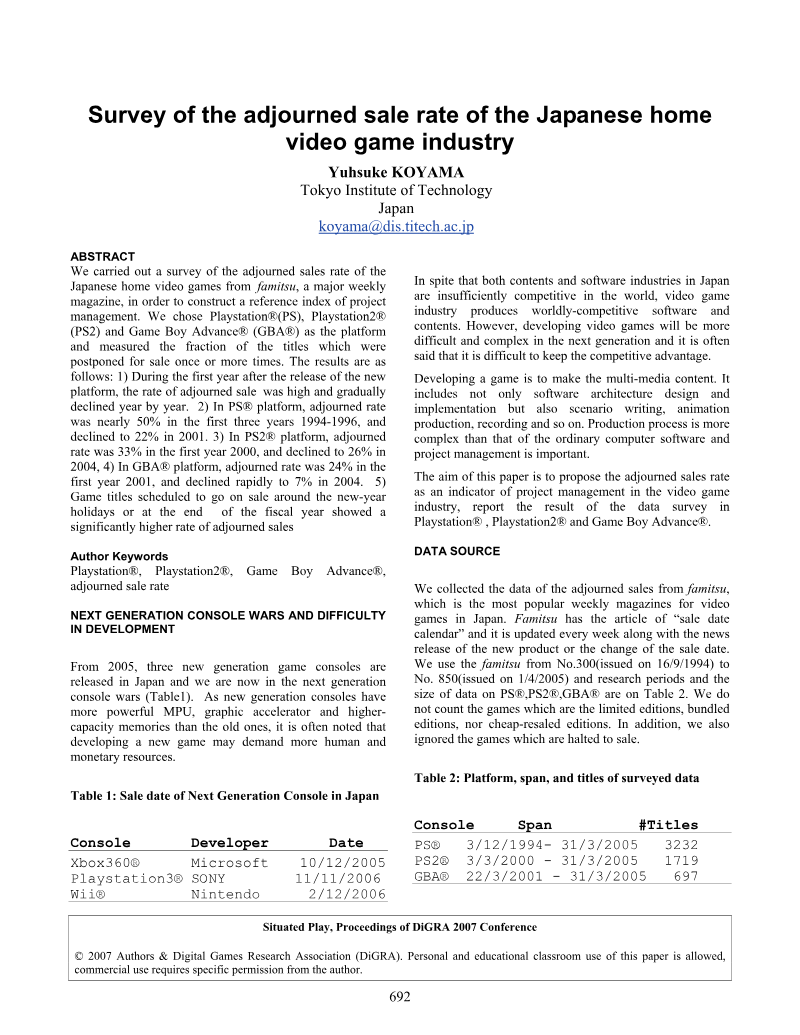
This study by Yuhsuke Koyama of the Tokyo Institute of Technology examines the adjourned sale rate of Japanese home video games, defined as the share of titles whose release was postponed at least once, with the aim of establishing it as an indicator of project management in the industry.
- Adjournment rates (titles whose release was postponed at least once) were highest in each platform's first year and declined steadily afterward, consistent with a learning-curve effect in project management.
- Sony's PlayStation started near 50% adjournment in its early years and fell to about 22% by 2001, while PlayStation 2 began at roughly 33% in 2000 and reached 26% by 2004.
- Nintendo's Game Boy Advance started at about 24% in 2001 and dropped sharply to around 7% by 2004, the steepest decline among the three platforms studied.
Blacks Deserve Bodies Too!: Design and Discussion About Diversity and Race in a Tween Online World
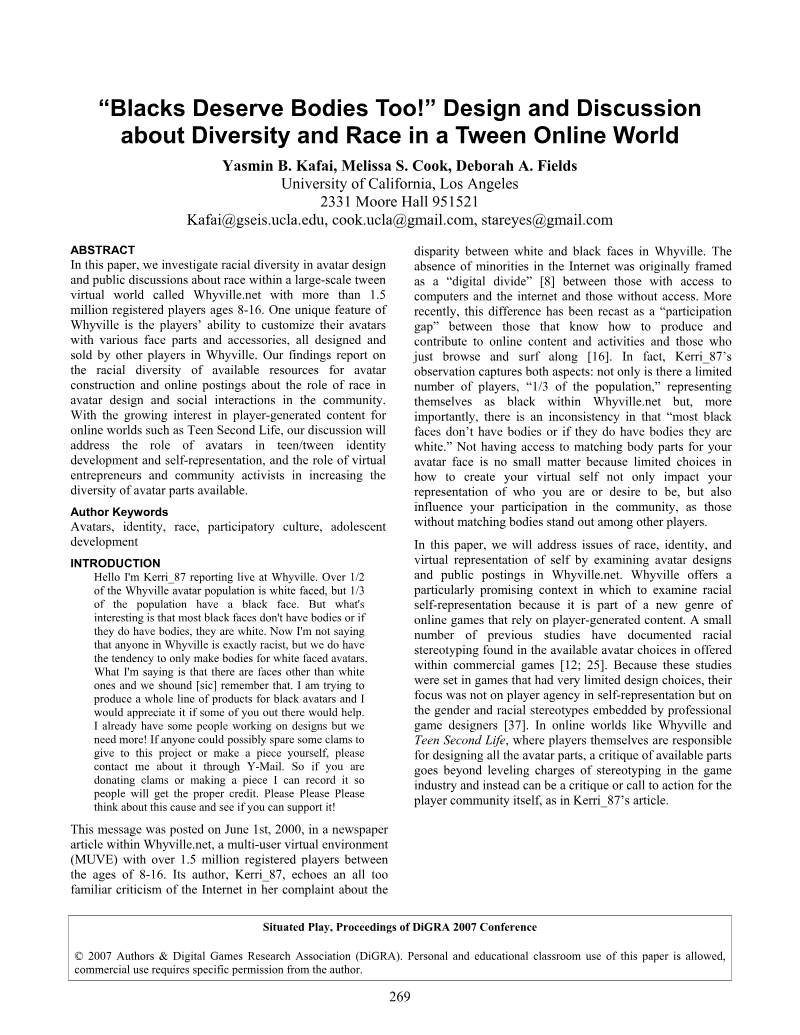
Kafai, Cook, and Fields examine how race is represented through avatar design in Whyville, a virtual world for tweens, arguing that avatars are central to identity formation and that race has been understudied in online environments relative to gender.
- Roughly one-third of Whyville's avatar faces were black-toned, but most of these faces lacked matching bodies or were paired with white bodies, revealing a persistent disparity in racial representation.
- Peach-toned parts dominated availability on the platform, with 84% of bodies for sale in 2006 in that color family, while brown, olive, and yellow options remained scarce and were largely produced by a small number of designers.
- Player discussions in Whyville's newspaper from 2000 to 2006 included recurring calls for collective action, personal accounts of racism against players using minority avatars, and growing criticism of the default peach "newbie" face.
Avatar Categorization
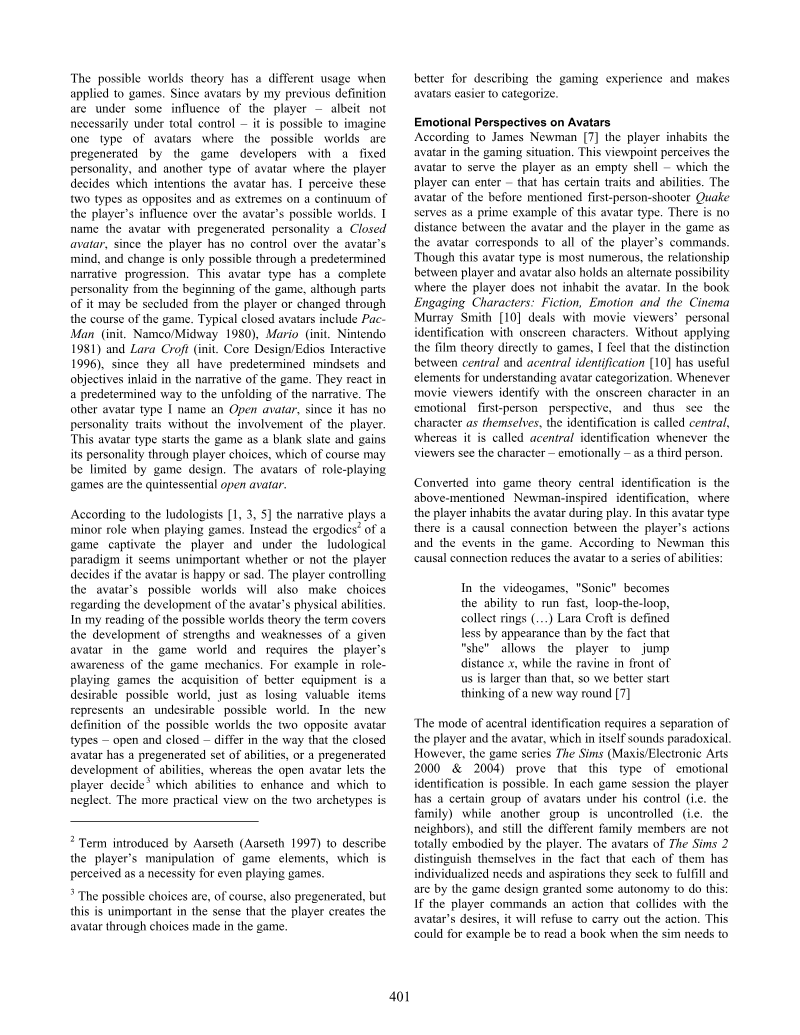
This paper by Daniel Kromand proposes a categorization system for video game avatars, aiming to establish an operational model for describing how avatars are designed.
- Kromand's paper proposes a theoretical categorization system that places video game avatars along two continua—open versus closed (how much player choices shape traits) and central versus acentral identification (whether the player inhabits the avatar or views it as a separate third person)—yielding four archetypes: central-open, central-closed, acentral-open, and acentral-closed.
- Central-closed avatars, such as Lara Croft and Mario, support strong recognizability and marketing, while central-open avatars encourage replayability and a personalized self-image for the player.
- Acentral-open avatars, exemplified by The Sims and Tamagotchi, reward organizing sequences of actions rather than isolated skill.
Video Games in Context: An Ethnographic Study of Situated Meaning-Making Practices of Asian Immigrant Adolescents in New York City
This study examines how Asian immigrant adolescents in New York City make sense of video games across multiple sites, including home, Internet cafés, and a university research lab.
- The meaning of video game play is shaped by real-world physical and social conditions around players, so researchers must attend to the player-human as well as the player-avatar, not just virtual-community dynamics.
- Existing 'situated learning' accounts of virtual communities omit the offline context in which play is constructed, which this multisite ethnography (home, Internet cafés, a university research lab) is designed to capture.
- Three Cantonese-speaking recent immigrant boys aged 15 to 18, from the same public high school ESL program, playing Super Smash Brothers Melee and Naruto: Clash of Ninjas 2, showed players applying one game's unlocking logic to another and misreading the second game's structure.
Piracy in the Caribbean: The Political Stakes of Videogame Piracy in Chávez's Venezuela
This paper examines how software piracy shapes participation in videogame culture in Caracas, Venezuela, arguing that piracy can extend access to a global economy for groups excluded by economic barriers.
- Software piracy in Caracas's Libertador district, documented through fieldwork from March to July 2005, was ubiquitous, with pirated games sold far below official prices.
- Distribution networks in Caracas were efficient enough for new North American releases to reach the streets within about 48 hours of launch.
- Apperley argues that piracy can extend access to the global videogame economy for groups excluded by economic barriers, offering a route to inclusion in a knowledge economy rather than a reproduction of poverty.
The Hegemony of Play
"The Hegemony of Play" argues that the digital game industry has been shaped by a narrow, male-dominated, largely white corporate and cultural elite that has marginalized women, non-gamers, and other minority players, even though these groups make up a large share of the population.
- The report argues the digital game industry is shaped by a narrow, male-dominated, largely white corporate elite that excludes women, non-gamers, and minority players, constricting the market and hindering commercial success.
- A 2005 IGDA survey found 88.5% of game developers are male, 83.3% are white, and 92% are heterosexual, while an ESA figure cited in the report shows 38% of gamers are women.
- The author contrasts the modern video game industry with the nineteenth- and early twentieth-century board game industry, which included women designers such as Anne Abbott (Mansion of Happiness) and Lizzie Magie (The Landlord Game) and reflected a broader range of themes and demographics.
I Fought the Law: Transgressive Play and The Implied Player
Espen Aarseth's paper, "I Fought the Law: Transgressive Play and The Implied Player," seeks to resolve a long-standing tension in game studies over what counts as "the player."
- Aarseth resolves the question of "the player" by arguing that the historical, real player cannot exist without a game, while a game can exist without any actual player, and he proposes the "implied player" as a role of expectations embedded in a game's structure, drawing on Wolfgang Iser's concept of the implied reader.
- Aarseth contends that transgressive play (defying intended rules through unexpected actions, bugs, or exploits) is central rather than marginal to understanding play, even though such behavior is statistically uncommon.
- The paper maps game studies along two axes: methodological (formal versus informal) and empirical (social sciences versus humanities), with social scientists studying the player as a historical, situated person and humanists treating the player as a construct of the text.

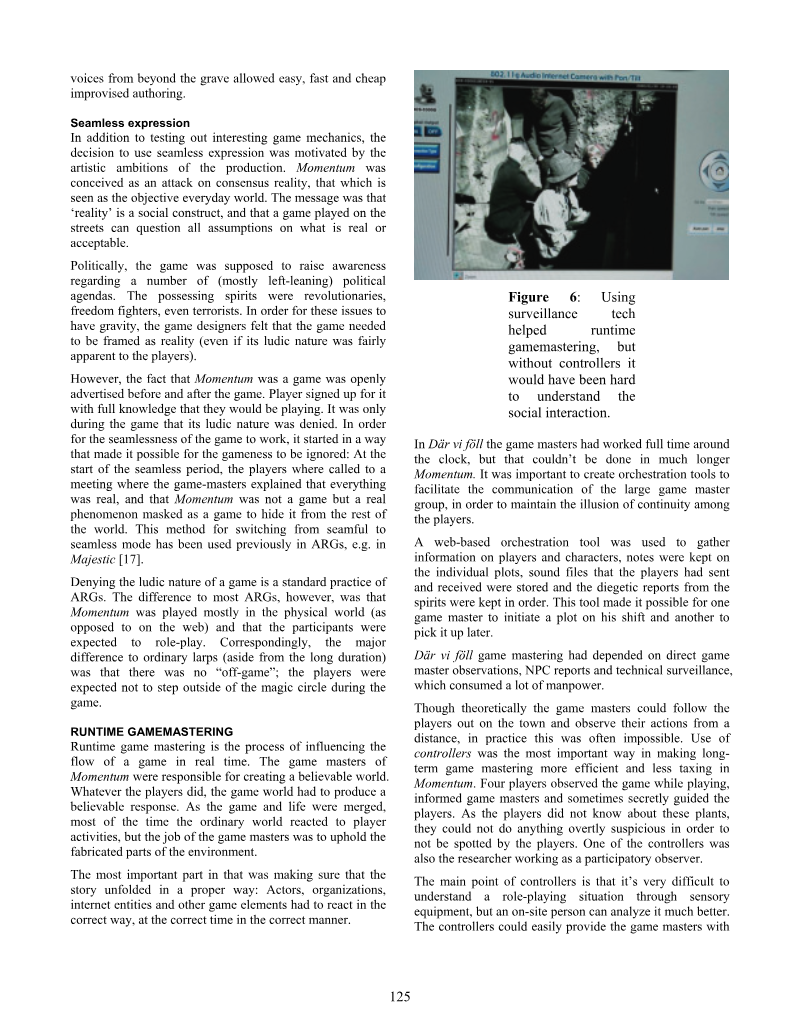
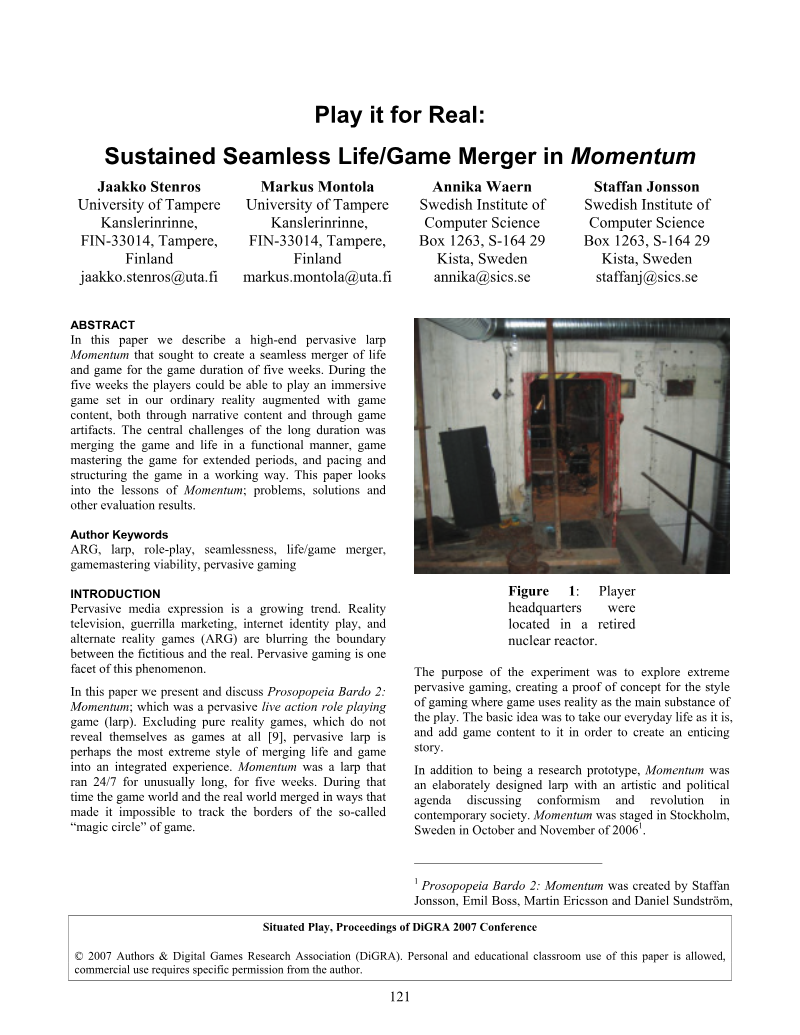
Play it for Real: Sustained Seamless Life/Game Merger in Momentum
"Play it for Real" examines Momentum, a five-week pervasive live action role-playing game staged in Stockholm in 2006, and asks what sustained, fully seamless merging of play with everyday life demands of its designers and players.
- Momentum was a five-week pervasive live action role-playing game staged in Stockholm in 2006, designed to fully merge play with everyday life and to present fictional content and fabricated clues as reality.
- The authors judged Momentum to be too seamless, largely because of its extended duration, even after seamlessness had already been moderated compared with their earlier work, "Där vi föll."
- Over 90 percent of participants reported feeling guilty about not playing enough, indicating the strong pressure the design exerted on players.
Introducing Applied Ludology: Hands-on Methods for Game Studies
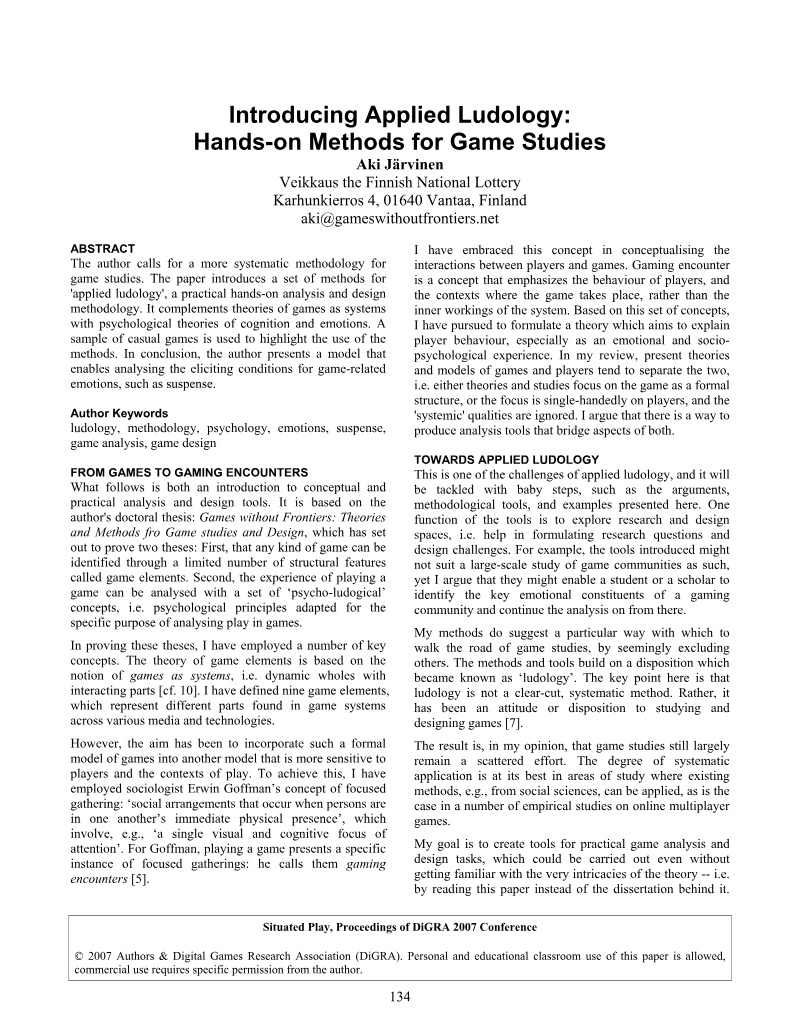
Järvinen's "Introducing Applied Ludology" argues that game studies remains fragmented, with theories tending to focus either on formal game structure or on players in isolation.
- Järvinen's applied ludology is a hands-on methodology that combines formal systems theory with psychological and player-centered perspectives to bridge the fragmentation between structural and player-focused game studies.
- The approach is operationalized through a toolbox of seven Rapid Analysis Methods covering game elements across nine categories, mechanics and goal hierarchies, and player ability sets and emotional eliciting conditions.
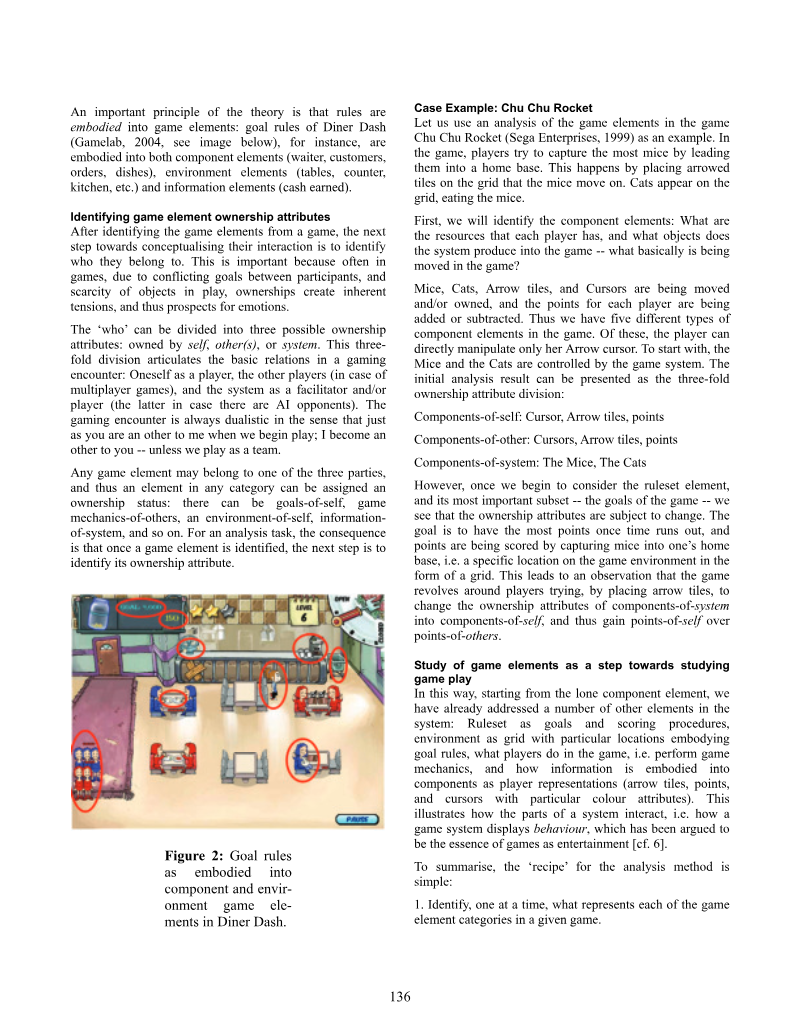
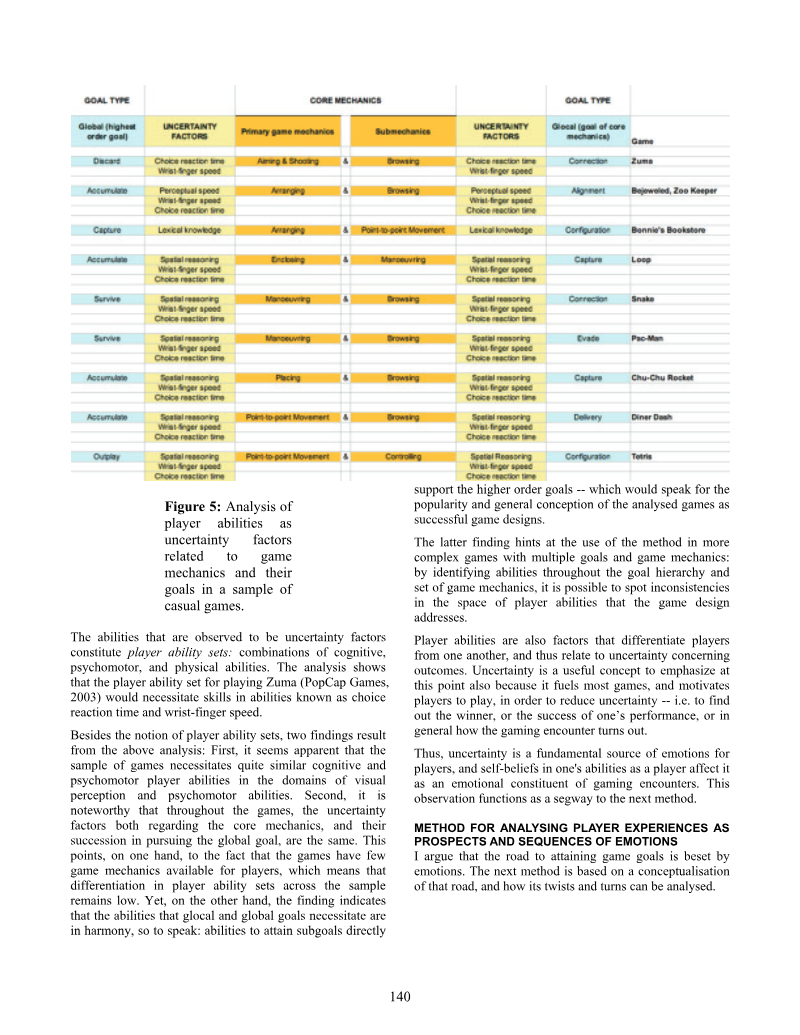
- Analysis of casual games Zuma, Tetris, and Diner Dash finds they rely on a small, recurring set of mechanics (arranging, placing, browsing, point-to-point movement) that typically aggregate into a global goal of accumulating points.
Long-Term Motivations to Play MMOGs: A Longitudinal Study on Motivations, Experience and Behavior
This longitudinal study examines the motivations, gameplay experience, and playing behavior of players of Space Merchant Realms, a text-based browser game that requires no local installation.
- The most important motivations for playing Space Merchant Realms, a text-based browser MMOG, were competition and learning, integration of reality and friendship, and escapism, with ten motivation factors explaining 67.2% of variance across 35 items.
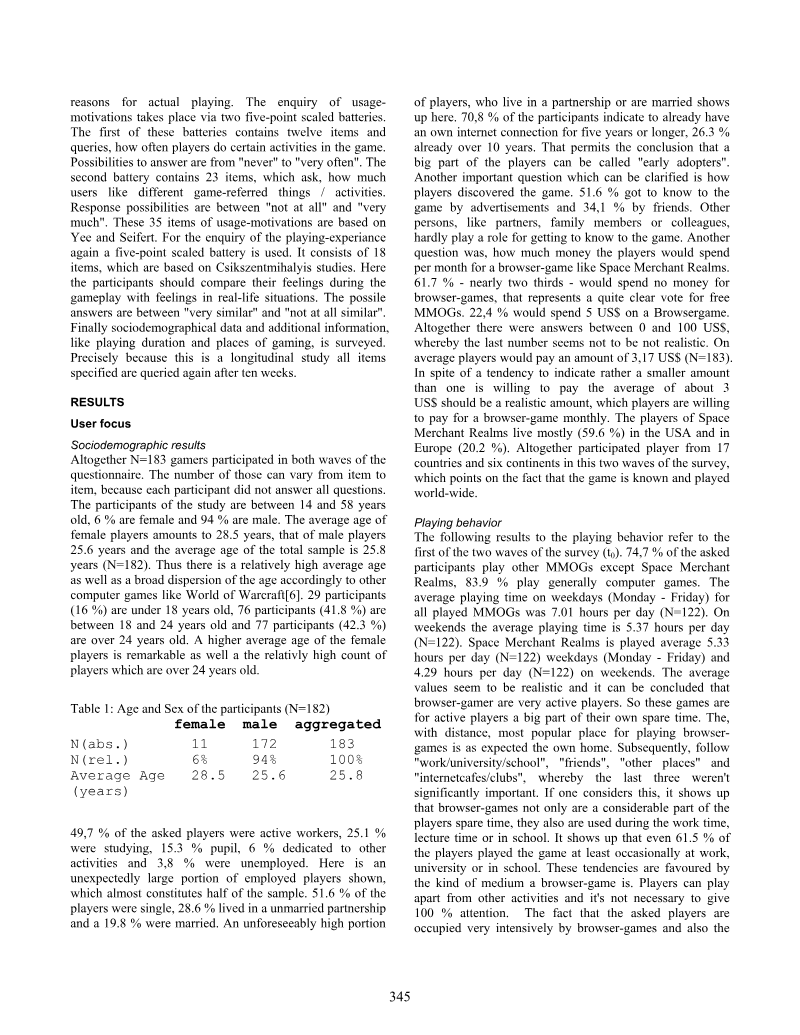
- Players were heavily engaged, averaging 5.33 hours of daily play on weekdays and 4.29 hours on weekends, with many playing during work or school hours.
- Monetary willingness to pay was low: 61.7% of players were unwilling to spend money on browser games, and the average stated monthly willingness was about US$3.17.
Stealing from Grandma or Generating Cultural Knowledge? Contestations and Effects of Cheats in a Tween Virtual World
Fields and Kafai's study examines how cheat sites function within Whyville, a non-commercial tween virtual world, drawing on a sample of 257 Google-listed cheat sites and a 2000–2005 archive of more than 100 articles from the community newspaper, The Whyville Times.
- Cheat sites in Whyville, a non-commercial tween virtual world, were studied through 257 Google-listed sites and over 100 articles from the community newspaper The Whyville Times (2000–2005), with the authors arguing that player-made cheat sites signal an active community and offer cultural and learning value rather than just shortcuts.
- Only about 15 percent of sampled cheat sites offered near-complete solutions with cultural tips, while most were partial or low quality, and the Salen and Zimmerman cheat-site typologies from commercial games applied in this setting too, ranging from solid solutions to scams and copied material.
- Newspaper coverage was largely negative toward cheating: roughly 30 percent of articles condemned cheating in salary-raising games, about 20 percent debated Smart Cars tactics, another 20 percent addressed ballot stuffing, and around 10 percent warned against scams, though some writers recognized creative or useful aspects.
What's My Game Character Worth: The Value Components of MMOG Characters
This analysis examines how massively multiplayer online game (MMOG) characters acquire value for their players, arguing that avatars function as the central focus of virtual play and identity.
- Character value in MMOGs is multidimensional, arising from the interplay of numerical competence and status, the relationships and reputation built through play, and the personal identity and meaning players invest in their avatar, rather than from any single factor.
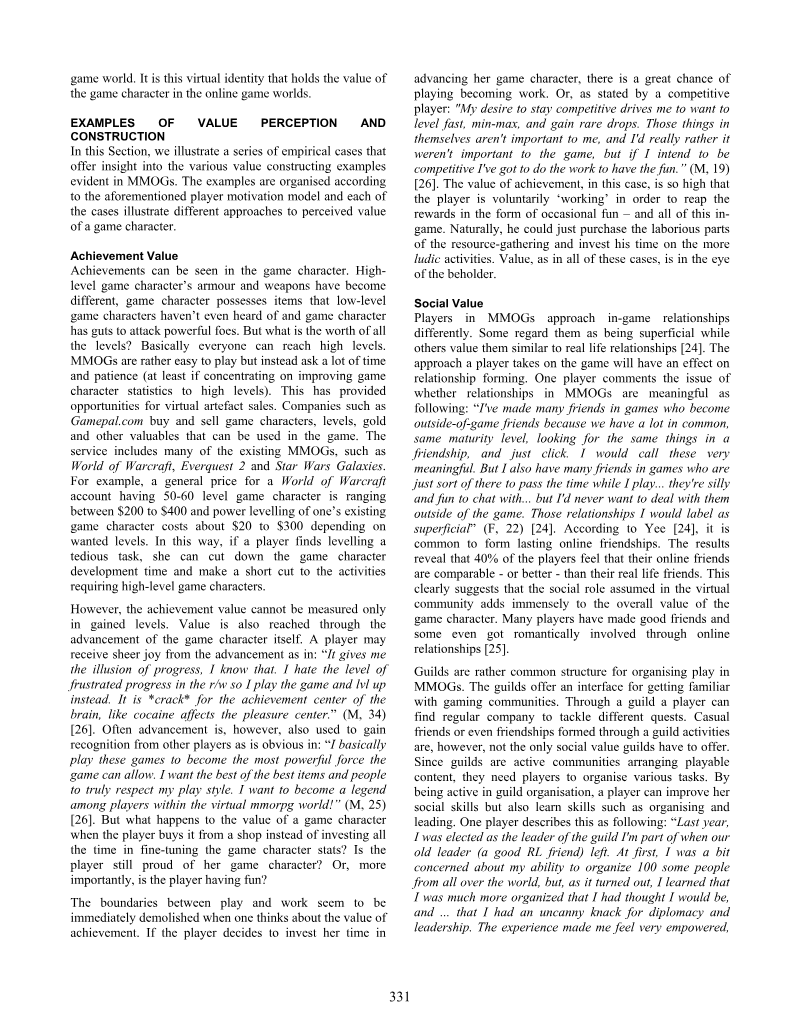
- The framework draws on Yee's motivational categories of achievement, social, and immersion components to explain why players value characters differently.
- Some players pay real money to skip progression, valuing a character's social or immersive dimensions over the effort of advancing it, while others deliberately pursue competitive standing as the core of their investment.