1 free read left. Create a free account for unlimited reading + AI research.
Create free accountWhitepaper DiGRA
1 free read left. Create a free account for unlimited reading + AI research.
Create free accountWhitepaperDiGRA
Theories tend to focus either on formal game structure or on players in isolation. Applied ludology is introduced to bridge that divide.
Järvinen's "Introducing Applied Ludology" argues that game studies remains fragmented, with theories tending to focus either on formal game structure or on players in isolation. To bridge this divide, the work introduces applied ludology, a hands-on methodology for analyzing and designing games that combines formal systems theory with psychological and player-centered perspectives. The approach is organized around a set of Rapid Analysis Methods, a toolbox of seven tools intended to help students and designers connect structural and experiential dimensions of play. The tools cover identifying game elements across nine categories, analyzing mechanics and their goal hierarchies, and mapping player ability sets and emotional eliciting conditions.
A central empirical strand applies these methods to casual games such as Zuma, Tetris, and Diner Dash. The analysis finds that these titles rely on a small and recurring set of mechanics, including arranging, placing, browsing, and point-to-point movement, which typically aggregate into a global goal of accumulating points. The player abilities they demand, such as choice reaction time, wrist-finger speed, visual perception, and spatial reasoning, are largely similar across the sample. This suggests a notable structural homogeneity within the casual segment.
The work also develops a method for analyzing player experience through the OCC emotion model. It contends that suspense, understood as a compound of hope, fear, and uncertainty, is a fundamental emotion in games because uncertainty about prospective outcomes sustains engagement. Mapping the model onto game states, including the player's proximity to goal confirmation or disconfirmation, the author applies this framework to Zuma, Diner Dash, and Bonnie's Bookstore. The resulting tentative model holds that satisfying play oscillates between hope of success and fear of failure until an outcome is resolved. The authors acknowledge that this model is theory-based rather than empirically tested, positioning it as a proposal for further validation.
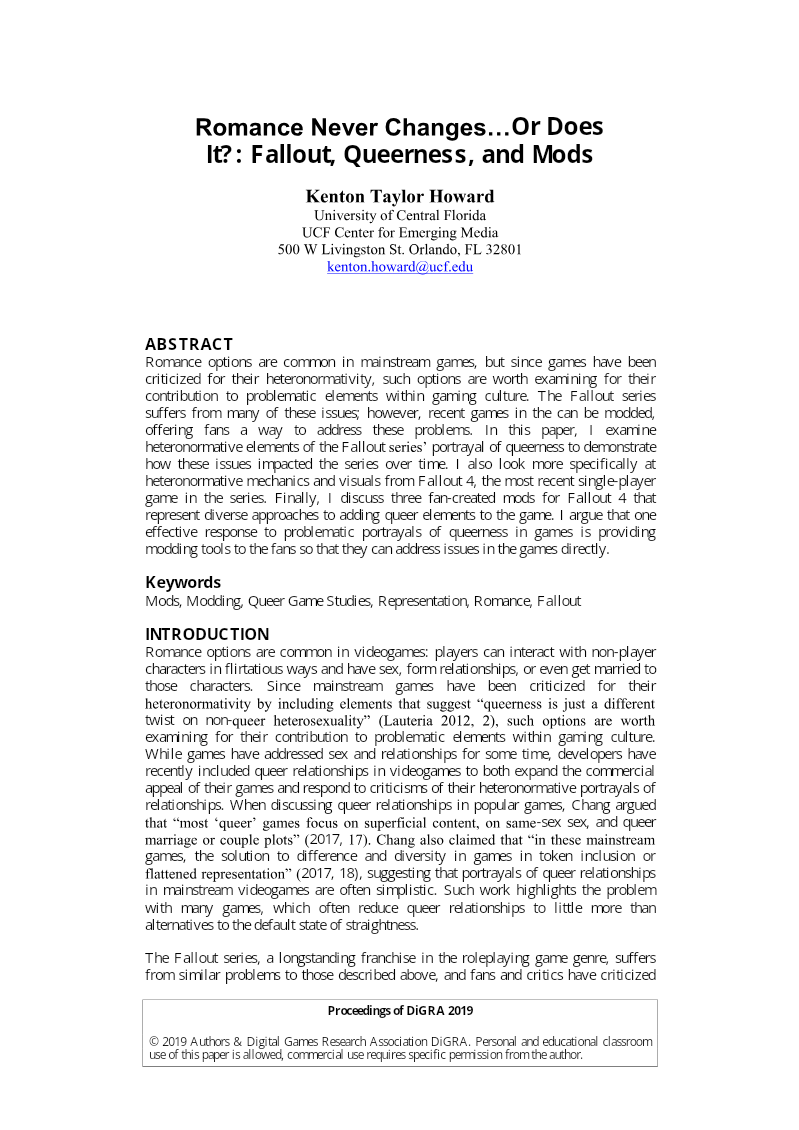
Each row is a game or company this document names, each column a document, oldest first. A mark means that document names it. Select a row to see those documents.
DiGRA · 2019
DiGRA · 2019
DiGRA · 2019
DiGRA · 2019
DiGRA · 2019
DiGRA · 2019
DiGRA · 2019
DiGRA · 2019
DiGRA · 2019
DiGRA · 2019
DiGRA · 2019
DiGRA · 2019