
DiGRA
The Digital Games Research Association: the international association of academics and professionals who study digital games. Its Digital Library holds the proceedings of the DiGRA conferences since 2002.
Documents
Subversive Game Design for Recursive Learning
The "Subversive Game Design for Recursive Learning" project, conducted at the Singapore-MIT GAMBIT Game Lab, investigates how "subversive game design" can facilitate "recursive learning."
- Video games can serve as low-risk settings for "recursive learning," in which players' mistaken expectations are challenged through failure and then readjusted, and the authors argue deliberately subverting familiar design patterns can provoke this reassessment.
- Subversions must feel unexpected yet logical rather than broken; the authors' central design principle is that surprise works for learning only when the unconventional pattern remains coherent within the game's rules.
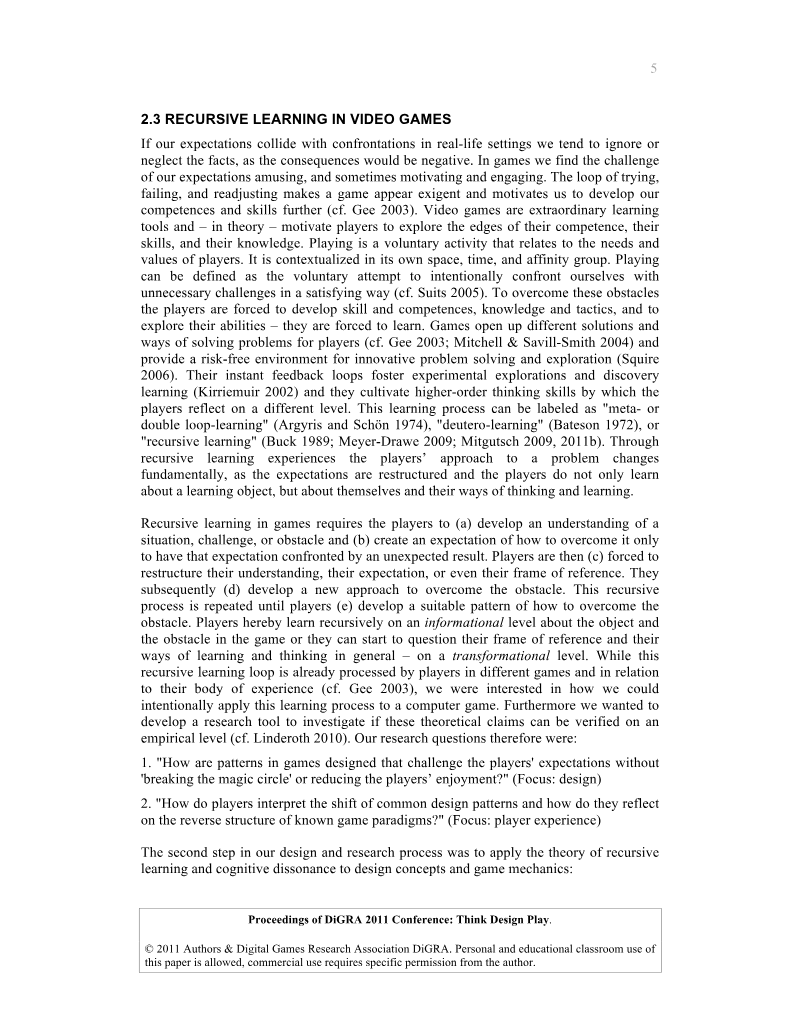
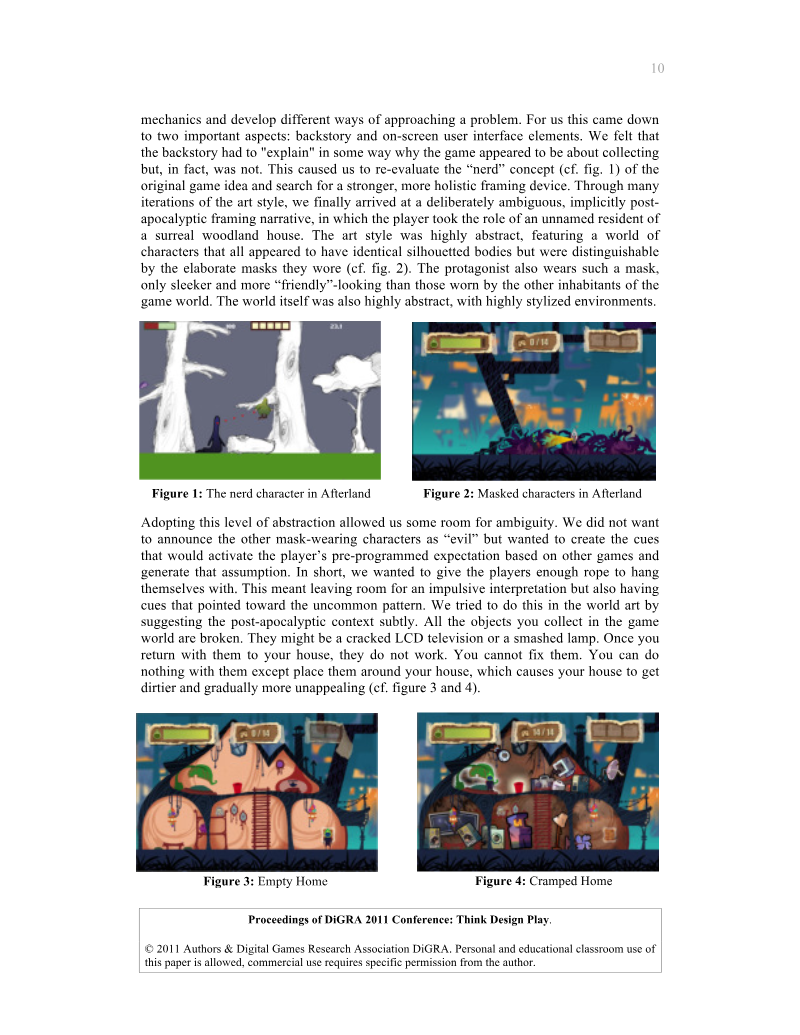
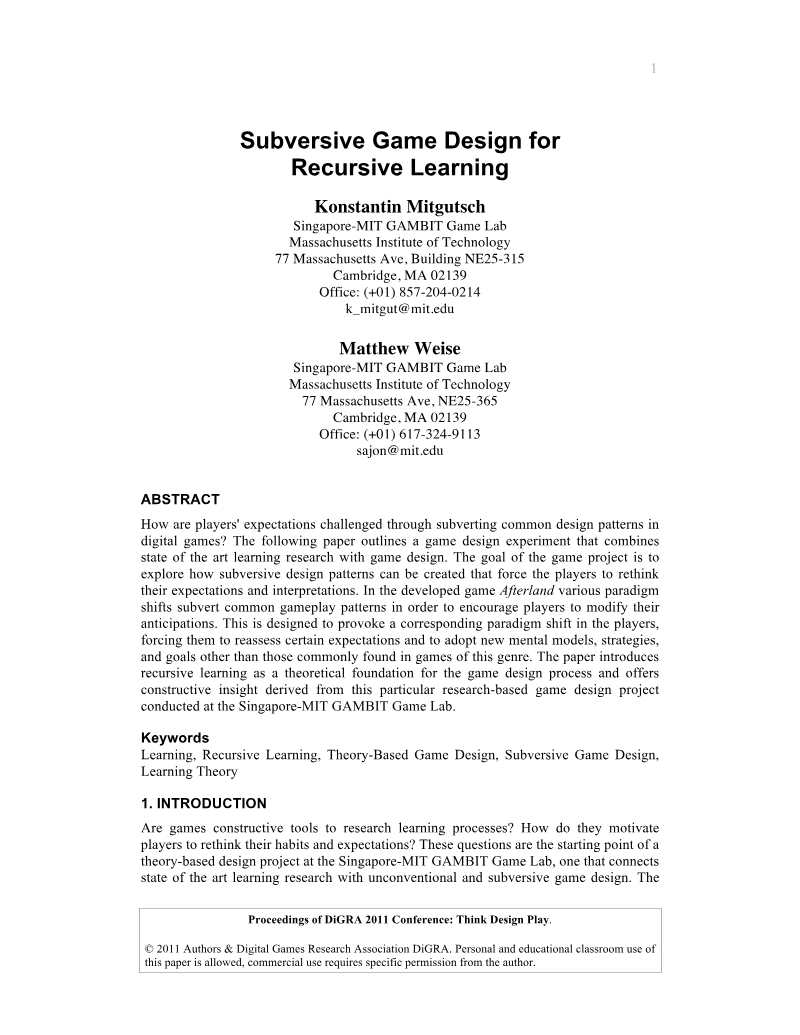
- The prototype Afterland, developed at the Singapore-MIT GAMBIT Game Lab, pairs a deceptive collecting-and-avoidance framing with an ambiguous anxiety meter and a world-based feedback system that gradually reveals the unconventional pattern.
What Keeps Designers and Players Apart? Thinking How an Online Game World Is Shared
Designers and players of an online game world are usually cast as infrastructure-makers and meaning-makers respectively, but an ethnographic study of the French MMORPG Age of Utopia shows this binary to be unrealistic.
- The boundary between designers and players in online game worlds is not a fixed binary but a continuously negotiated arrangement shaped by technical infrastructure, social mediation, and shifting roles.
- Based on about two years of participant observation at developer Stillnode (2006–2008) and roughly twenty staff interviews, the study examines the MMOG Age of Utopia, which launched in 2004, treating the game world as a sociotechnical artefact shaped by both designers and players.
- Fan forums predating the launch contributed substantially to the world's identity, with 55–60% of their threads created before release.


"He Could Be a Bunny Rabbit for All I Care": Exploring Identification in Digital Games
The document, titled ""He Could Be a Bunny Rabbit for All I Care": Exploring Identification in Digital Games," investigates the complex dynamics of player identification with in-game characters, particularly those from marginalized groups.
- Challenging the common assumption, the study finds that player-character identity-matching does not reliably drive identification: interviews with 27 players from marginalized groups (plus their partners) showed identification was inconsistent and often absent, with interviewees split roughly evenly on whether they connected with their characters.
- Interactivity tends to make players self-reflexive, directing attention toward their own actions, bodies, and social contexts rather than the perspective of the character they control.
- Identification depends on narrative depth, a game's ludic and interactive properties, game type, and the social or physical context of play; abstract avatars and weak narratives limit it, while strong storytelling can draw players into even non-humanoid characters.


Understanding Player Experience Using Sequential Analysis
This analysis introduces a novel methodology for objectively assessing video game quality by quantifying player behavior through a five-state behavioral coding scheme.
- Static measures like surveys and focus groups miss information carried by the order in which players' emotional and behavioural states unfold; sequential analysis captures that additional signal.
- The authors built a behavioural coding scheme covering frustration, boredom, curiosity, engagement, and engrossment, which showed inter-observer agreement with Cohen's Kappa between .74 and .91, indicating it can be applied reliably by different observers.
- In a repeated-measures study of ten participants playing two early iPhone games, the higher-rated title (6.6) produced significantly more engagement in both frequency and cumulative duration, while the lower-rated title (4.1) elicited more frustration and curiosity and more frustration-to-curiosity transitions.

Do Players Prefer Integrated User Interfaces? A Qualitative Study of Game UI Design Issues
The study "Do Players Prefer Integrated User Interfaces? A Qualitative Study of Game UI Design Issues" explores player preferences regarding game user interface (UI) elements and their impact on player involvement.
- Removing superimposed interface elements does not by itself increase player involvement, since involvement is a multidimensional experience that varies across individuals.
- Players generally accept overlay UI elements when they deliver clear, relevant, gameplay-useful information, though many still find integrated designs more elegant.
- Interface preferences reflect underlying player orientations (imaginative, challenge-based, and sensory immersion players) rather than dictating how people engage with a game.
Casual Mobile Gameplay: On Integrated Practices of Research, Design and Play
Casual mobile games, defined as play that turns everyday activities into game moments, emphasizes spatial movement, and permits ambient, low-commitment engagement, require research and design practices embedded in players' daily lives rather than separated from them.
- The report argues that casual mobile games like cubodo blur the line between play and everyday life, so research, design, and play should be integrated rather than kept separate.
- It proposes a "Living Lab" model, embodied in the Mobile Game Lab within Germany's "Landmarks of Mobile Entertainment" project, in which mobile games are playtested in players' everyday contexts instead of stationary laboratories.
- A December 2010 Bremen study of 12 cubodo players found play was dispersed through daily routines, with 88% of sessions consisting of brief "situation checks."


Game Spaces Speak Volumes: Indexical Storytelling
"Game Spaces Speak Volumes: Indexical Storytelling" proposes a refined framework for understanding narrative in video games, termed "indexical storytelling."
- Clara Fernández-Vara's DiGRA 2011 paper proposes "indexical storytelling," a refinement of environmental storytelling grounded in Peirce's semiotics, in which physical traces in game spaces must be interpreted by players to progress.
- Indexical traces differ from mere world-building backdrops because they are directly bound to gameplay and may record either the game world's past or the player's own actions.
- The argument is primarily conceptual, drawing on GDC 2010 industry talks by Richard Rouse and Smith and Worch and supported by illustrative examples rather than quantitative evidence.

Online Video Games in Brazilian Public Health Communication
The document explores the potential of online video games, particularly Massively Multiplayer Online Role-Playing Games (MMORPGs), as a tool for public health communication in Brazil.
- Brazil's Unified Health System (SUS) relies heavily on centralized, prescriptive, and unidirectional communication, which tends to ignore local contexts and is less effective with young audiences.
- The authors propose online video games, particularly MMORPGs, as an interactive, dialogic channel that combines entertainment with health education.
- MMORPGs suit health messaging because players progress at their own pace, allowing content to be tailored to individual interests and limitations.
Why Gamers Don't Learn More: An Ecological Approach to Games as Learning Environments
Linderoth challenges James Paul Gee's influential claim that good games are inherently good learning environments, arguing that Gee relies on anecdote rather than systematic study of what players actually learn.
- Linderoth argues that well-designed games are not inherently good learning environments: players can perform complex tasks and perceive affordances without developing the corresponding skills, challenging James Paul Gee's claim that good games teach.
- Gee's claim is found by the author to rest mainly on anecdote rather than systematic evidence, so the relationship between game design and learning is treated as an open empirical question.
- The central evidence is an interaction analysis of two players, an eight-year-old and a 36-year-old, playing LEGO Indiana Jones 2, interpreted through the ecological approach to perception and Gibson's concept of tools.
Stillborn Gamers? Writing a Birth Certificate for Corporeality and Locomotion in Game Research
Nørgaard's paper, presented at the Nordic DiGRA conference in 2010, argues that game research has largely neglected the corporeal and locomotive dimensions of play.
- Nørgaard's 2010 paper argues that game research has neglected the corporeal and locomotive dimensions of play, portraying gamers as detached cognitive observers when they are fundamentally embodied, movement-based agents.
- The author frames gaming as "thinking in movement," drawing on phenomenology (Drew Leder, Maxine Sheets-Johnstone, Edward Casey) on body memory and the primacy of movement.
- A survey of the thirteen articles in the WoW Reader found none addressing corporeality or movement, and a search of 99 papers in Game Studies found none focused on gamers' bodies, locomotion, or tool-use.

Modelling Experimental Game Design
This paper applies two design-research models, Stolterman and Löwgren's three levels of abstraction and Lawson's six-category model of designing, to analyse the iterative design process of Nokia's experimental pervasive mobile game "No One Can Stop the Hamster" (NOCSH).
- The paper applies Stolterman and Löwgren's three levels of abstraction and Lawson's six-category model of designing to analyse the iterative design of Nokia's experimental pervasive mobile game "No One Can Stop the Hamster," aiming both to test these general design models for game design research and to understand how designers actually work.
- The authors argue that existing game design literature focuses on content and gameplay mechanics, leaving the activities and thinking within the design process under-studied.
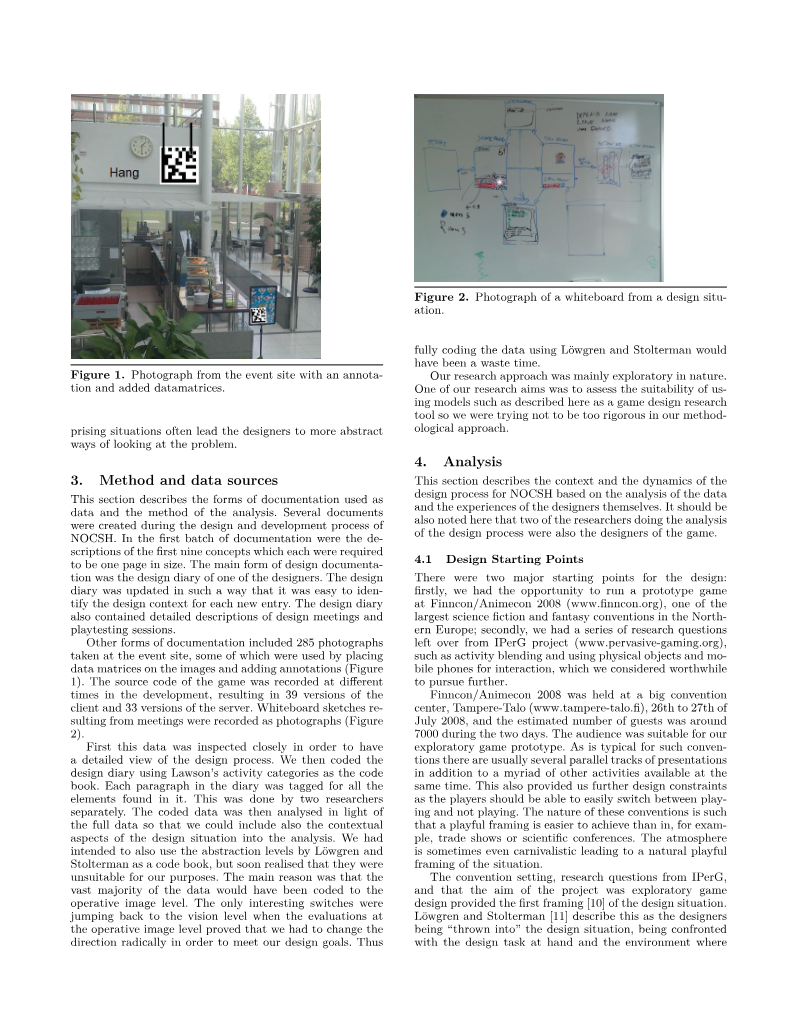
- The game was a multiplayer competition where players captured fiducial markers ("wormholes") using Nokia N95 camera phones, designed for Finncon/Animecon 2008 in Tampere, attended by an estimated 7,000 guests over two days.


Undercurrents: A Computer-Based Gameplay Tool to Support Tabletop Roleplaying
"Undercurrents" describes a novel client-server based computer tool designed to augment, rather than replace, traditional tabletop roleplaying game (TRPG) experiences.
- Undercurrents is a computer-based tool that supports tabletop roleplaying without dictating its rules, pacing, or social dynamics, based on the thesis that computers add most value when they are under player control rather than acting as game authorities.
- The tool was designed to address limitations of traditional computer role-playing games, which impose fixed rules and rhythms, and offers features such as secret player-to-GM messaging, timed audio-visual presentations, and a real-time session wiki.
- Design requirements were gathered from three focus groups of tabletop game masters, all male and aged 16 to 45.