
DiGRA
The Digital Games Research Association: the international association of academics and professionals who study digital games. Its Digital Library holds the proceedings of the DiGRA conferences since 2002.
Documents


Game Design Tools: Time to Evaluate
The game design industry currently operates without specialized tools tailored to the unique complexities of conceptualizing and balancing interactive systems.
- Game designers have historically relied on natural-language design documents and physical or simplified prototypes, both of which struggle to capture the systemic, emergent behavior of games.
- The central claim is that numerous formal frameworks and software tools for game design have been developed (including Machinations, Ludocore, and Sketch-It-Up), yet none have been meaningfully evaluated in practical settings.
- The field has lacked a common formal vocabulary and standardized notation for game mechanics, and critics have long pointed to reliance on anecdote and intuition as a barrier to rigor.

In Defence of a Magic Circle: The Social and Mental Boundaries of Play
Jaakko Stenros defends the "magic circle" as a valuable but frequently over-literalized metaphor for the boundary between play and non-play.
- The magic circle metaphor conflates three distinct phenomena: the individual playful mindset, the socially negotiated play contract, and the physical or cultural arenas recognized as places of play; separating them yields a more precise theoretical tool rather than abandoning the concept.
- Drawing on frame theory (Riezler, Bateson, Goffman, Berger and Luckmann, Csikszentmihalyi, Apter), play is characterized as a 'finite province of meaning' that is bounded yet permeable, where external elements may be transformed or may collapse the frame entirely.
- The play boundary is both social, sustained through shared metacommunication and rules, and psychological, sustained through attention and mindset.



Meta-Synthesis of Player Typologies
The "Meta-Synthesis of Player Typologies" provides a comprehensive overview of player segmentation models within game research, aiming to refine understanding of player motivations for enhanced game design and marketing strategies.
- The literature on player typologies is surprisingly uniform: Bartle's four player types, Yee's three-factor motivational model, and other schemes cluster around psychographic and behavioral bases and share recurring concepts such as achievement and sociability.
- The authors argue the widely used hardcore/casual dichotomy is too simplistic and should be understood as a continuum rather than two discrete categories.
- Psychographic and behavioral categories resist clean separation, since motivation drives behavior and the two are difficult to disentangle empirically.
The Early Micro User: Games Writing, Hardware Hacking, and the Will to Mod
Melanie Swalwell's paper argues that historical accounts of user activity have been largely absent from debates about user-generated content, and it uses the microcomputer era of the 1980s in Australia and New Zealand to recover that history.
- Games were central to early home computing, reportedly accounting for roughly 60 percent of home computer software sales, and an Australian Bureau of Statistics survey from 1994 found games were used in 62.1 percent of frequently used home computer households.
- Early home computer users commonly learned BASIC by typing in and modifying game code, and many became 'bedroom coders' or built and sold their own kit computers and software, which the author frames as a longer lineage of user tinkering and a 'will to mod'.
- Hands-on tinkering extended beyond programming into electronics: MicroBee owners and other hobbyists built, repaired, and hacked their machines, supported by magazines, kits, and how-to books, with repair treated as the norm for hobbyists of the period.

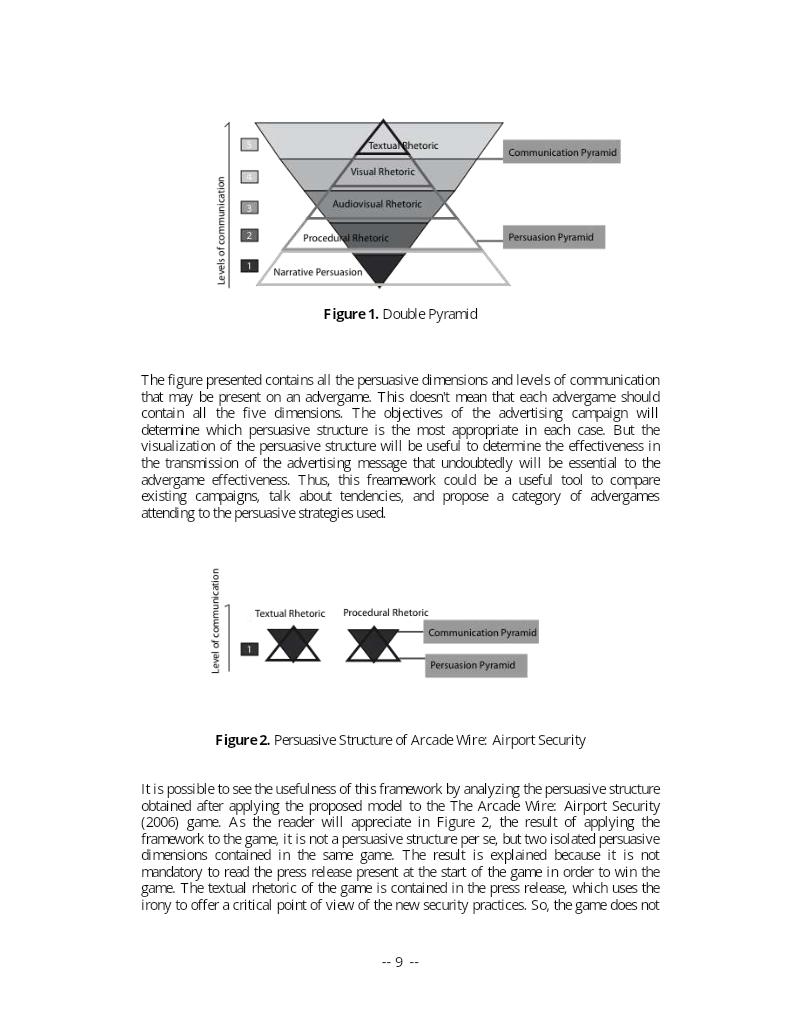

Visualizing Persuasive Structures in Advergames
The document, "Visualizing Persuasive Structures in Advergames," posits that effective advergame design necessitates a comprehensive approach beyond mere procedural rhetoric, advocating for the integration of diverse persuasive dimensions, notably narrative persuasion.
- Procedural rhetoric alone is insufficient for advergames; the authors argue they should combine narrative, visual, audiovisual, and textual persuasion across five communication levels, forming a "double pyramid" structure.
- In the double pyramid model, one persuasive dimension is dominant and guides players through the others, ensuring the intended message is received rather than left to optional content players may ignore.
- Arcade Wire: Airport Security was found to lack full autonomy and to have a misalignment between learning and game goals, since players could succeed without absorbing the persuasive message.
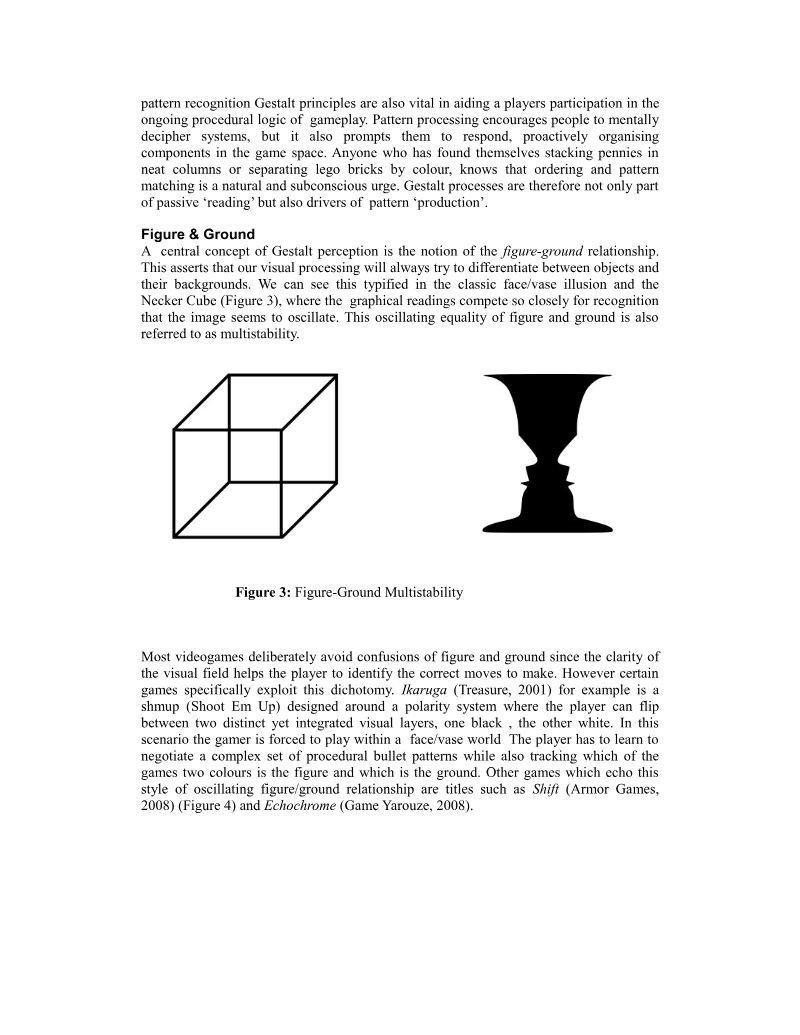

Pattern Recognition: Gameplay as Negotiating Procedural Form
"Pattern Recognition: Gameplay as Negotiating Procedural Form" posits that gameplay fundamentally involves a player's negotiation of procedural form through pattern recognition, deeply rooted in Gestalt principles.
- The paper argues that pattern recognition, grounded in Gestalt psychology, is central to player engagement and that players actively produce patterns (not just perceive them), citing Metzger's claim that Gestalt principles govern both perception and production.
- Its most distinctive contribution is the concept of "pattern immersion," a sub-linguistic, Gestalt-based engagement developed through direct play that aligns with Csikszentmihalyi's notion of Flow, set against "narrative immersion," which relies on authored story and cultural convention.
- The author contends that designers often apply Gestalt principles as a top-down layer over predefined structures, underutilizing their capacity to generate emergent gameplay.
Collaboration and Team Composition in Applied Game Creation Processes
This explorative study examines collaboration and team composition within the applied game creation process, drawing insights from ten Dutch applied game designers.
- Team composition and collaboration, rather than any single design method, are the main determinants of whether applied games can balance entertainment with their out-of-game objectives.
- A subject matter expert is involved from the start in nearly all projects, usually as the client or someone working for the client, yet only half of SME-involved companies treated the expert as a full team member, reflecting unclear authority over content.
- None of the eight projects included a pedagogical or transfer expert, despite theoretical frameworks treating such expertise as central to achieving learning outcomes.

Game Prototyping: The Negotiation of an Idea
Game prototyping serves as a critical communication and negotiation tool within the game development process, facilitating the exploration and resolution of design ideas.
- Prototyping in game design is framed as a communicative and negotiative process, in which prototypes act as a "language of experience" that helps design teams resolve contested problems and build pistis (trust and consensus) among collaborators.
- The study draws on qualitative interviews with 27 respondents (16 game designers, 10 students, and one teacher) in Sweden and Poland.
- Prototypes typically isolate a single mechanic or experience to stand in for the whole game, acting as reality checks that turn vague ideas into playable form.
Game Reviews as Tools in the Construction of Game Historical Awareness in Finland, 1984-2010: Case MikroBitti Magazine
Game reviews in Finland's MikroBitti magazine functioned as tools for constructing historical awareness of digital gaming between 1984 and 2010.
- The study is a qualitative content analysis of 640 reviews from MikroBitti, a Finnish computer and gaming magazine, sampled from two issues per year between 1984 and 2010.
- Its central argument is that game criticism served as a means for the Finnish gaming community to construct an understanding of its own past, tracing how this developed over more than two decades.
- Review writing grew more detailed and historically aware after Niko Nirvi joined the magazine in 1986, and his lively style and historical framing became a lasting influence on Finnish game journalism.

Guidelines to Design Interactive Open-Ended Play Installations for Children Placed in a Free Play Environment
This study establishes design guidelines for interactive open-ended play installations intended for children in free-play environments.
- The study of open-ended play centred on SmartGoals, a sensor-equipped, light-responsive mobile play installation of six goals, tested with 50 primary school children aged 9 to 12 across five gym sessions alongside Nintendo Wii, Swinx, and CosmicCatch installations.
- Goal placement and presentation strongly shaped creativity: football-framed introductions produced football-only games, and aggression-prone objects had to be replaced with smaller, lighter ones.
- Analysis of twelve observations yielded seven design guidelines, emphasising clearly communicated action possibilities (mobile and fixed modes), feedback and feed-forward on interaction, rewards for coordinated multi-player actions, object-to-object influence, and ambiguous abstract design.

Do We Need Real-Time Hermeneutics? Structures of Meaning in Games
"Do We Need Real-Time Hermeneutics? Structures of Meaning in Games" explores the unique challenges and processes involved in interpreting video games as a distinct medium.
- Games are procedural, interactive, and temporally complex objects, so interpreting them must account for their internal logic and the player's participation, unlike film or literature.
- Players' interpretations directly shape their actions and outcomes, producing a 'real-time hermeneutics' with no real equivalent in other media.
- The paper argues that the real-time versus turn-based binary is too simple, since 'real-time' covers a wide range of speeds and structures, drawing on Aarseth, Zagal and Mateas's four temporal frames, and Juul's distinction between play time and event time.


Game Reward Systems: Gaming Experiences and Social Meanings
The document, "Game Reward Systems: Gaming Experiences and Social Meanings," comprehensively analyzes the design, function, and impact of reward mechanisms within digital games and their broader applications.
- Rewards in video games are treated as enjoyable in their own right and as carriers of social meaning, operating through motivation, status, and interpersonal use rather than serving only as progress markers.
- The authors classify eight reward forms (scores, experience points, items, resources, achievements, feedback messages, plot animations, and unlocking mechanisms) and assess them against four attributes: social value, effect on gameplay, suitability for collection and review, and timing.
- A dual-axis model maps reward usage across advancement, review, sociality, and cooperation versus competition, offering a structured way to analyse how players use rewards.