1 free read left. Create a free account for unlimited reading + AI research.
Create free accountArticle DiGRA
1 free read left. Create a free account for unlimited reading + AI research.
Create free accountArticleDiGRA
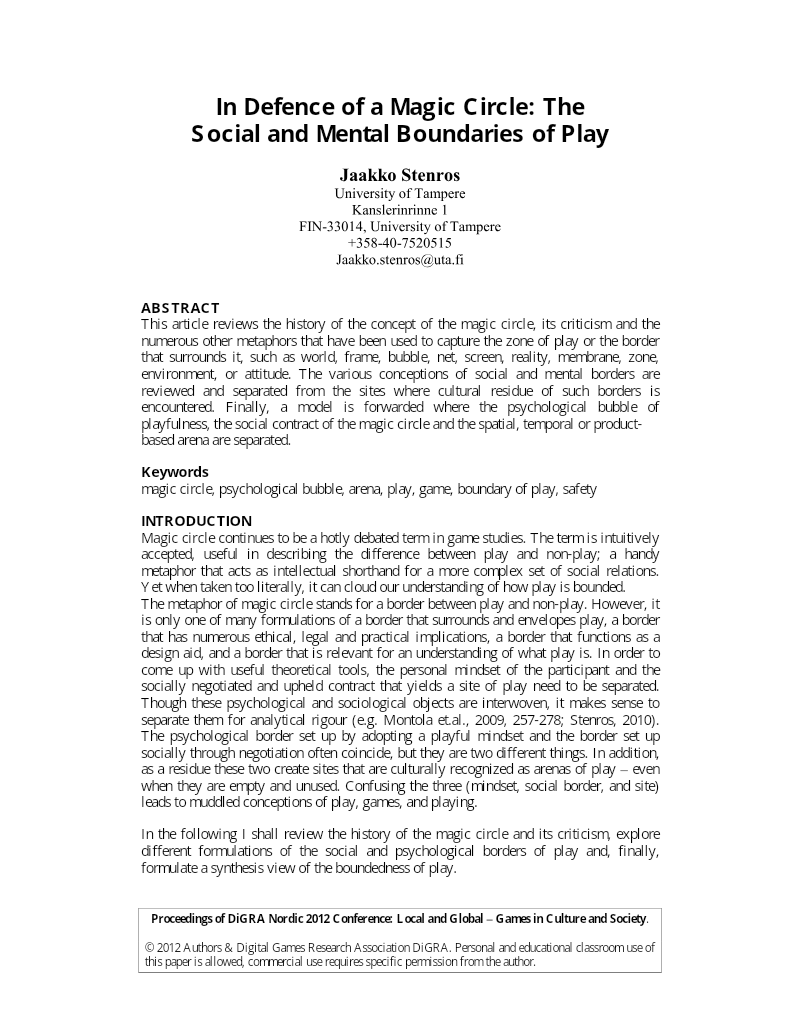
Stenros's "In Defence of a Magic Circle" revisits one of game studies' most debated concepts, the idea that play is set apart from ordinary life by a boundary. Tracing the notion from Huizinga through Salen and Zimmerman, the paper acknowledges the substantial criticism directed at the magic circle, particularly the argument that play and everyday life are not cleanly separable. Rather than abandoning the concept, the author contends that the single metaphor conflates three distinct phenomena: the individual playful mindset, the socially negotiated play contract, and the physical or cultural arenas recognized as places of play. Separating these elements, he argues, yields a more precise theoretical instrument.
The paper's defense rests on a survey of frame theory drawing on Riezler, Bateson, Goffman, Berger and Luckmann, Csikszentmihalyi, and Apter, among others. These theorists characterize play as a "finite province of meaning," bounded yet permeable, in which external elements may be transformed or may collapse the frame entirely. Importantly, the boundary is understood as both social, sustained through shared metacommunication and rules, and psychological, sustained through attention and mindset. Games, on this account, are not exceptional but one among several frame-based activities alongside art, ritual, and dreams.
The author further distinguishes personal psychological "bubbles," socially negotiated magic circles, and culturally recognized arenas, and examines transgressive forms such as dark play, brink games, and pervasive games that deliberately blur or interrogate these borders. Legal systems, the paper notes, often treat such activities as separate jurisdictions, underscoring that play boundaries have institutional as well as experiential reality. The overall conclusion is that play boundaries are real but layered, contractual, and socially constructed rather than fixed. Events within the circle remain genuine but are re-signified, and the boundary's porousness allows motivations to flow in and out. The paper suggests that this multi-frame model of social encounters may extend well beyond games.

DiGRA · 2012
DiGRA · 2012

DiGRA · 2012
DiGRA · 2012
DiGRA · 2011
DiGRA · 2011
DiGRA · 2011
DiGRA · 2011
DiGRA · 2011
DiGRA · 2011
DiGRA · 2011
DiGRA · 2011












Comments