
DiGRA
The Digital Games Research Association: the international association of academics and professionals who study digital games. Its Digital Library holds the proceedings of the DiGRA conferences since 2002.
Documents

Understanding Videogame Cities
"Understanding Videogame Cities" proposes a comprehensive framework for analyzing virtual urban environments, exemplified by Steelport in Saints Row: The Third.
- The report argues that fictional videogame cities can be analyzed with the same rigor as physical cities, using a three-part framework of constitutional, representational, and experiential orders that blends Lefebvre's spatial triad with Douglas Allen's criteria.
- Its central thesis is that a city's character emerges from the interplay between its built structure, its visual and symbolic representation, and the embodied experience of moving through it.
- Using Saints Row: The Third's Steelport (2011) as the central case, the analysis finds that territory control and monuments, such as the Magarac Island statue destroyed late in the game, visibly express the city's power dynamics.

A Study of Team Cohesion and Player Satisfaction in Two Face-to-Face Games
This study examines the impact of game rules on team cohesion and player satisfaction within face-to-face, team-based games, specifically through the lens of Social Identity Theory.
- The Green Revolution Game produced significantly higher ratings than Africulture for team cohesion, communication, and fairness (each at p<.05), in a between-subjects study of 36 participants (16 vs. 20).
- The study grounded its hypothesis in Social Identity Theory, predicting that fixed team membership and collective judgment would foster stronger cohesion than individualized roles and changeable teams.
- Mixed-motive conflict was somewhat lower in the Green Revolution Game, but this difference did not reach statistical significance.



Fusing Quantitative and Qualitative Methods in Virtual Worlds Behavioral Research
The research outlines a novel mixed-methods approach developed by SAIC and Georgia Institute of Technology to predict real-world player characteristics from avatar behavior within Massively Multiplayer Online Role-Playing Games (MMORPGs).
- Gender was predicted from virtual-world observation with 84% overall accuracy, the strongest result in the study of 80 Guild Wars and Aion participants, followed by extraversion (73%), aggressive ideology (73%), submissive ideology (71%), and approximate age (66%).
- The study fused standardized avatar ratings with 'thick description' field notes converted into quantitative predictors via automated text analysis, then analyzed them with discriminant analysis and leave-one-out cross-validation.
- Key predictors included male avatar appearance, movement patterns, and avatar class; aggressive ideology was associated with non-strategic play, melee combat, and frequent quest log checking, though its 53% precision indicates many false positives.

Teaching Serious Game App Design Through Client-Based Projects
George Mason University's 2012-2013 mobile game development courses explored the efficacy of client-based projects in teaching serious game app design.
- The authors argue that client-based, studio-style projects are an effective way to teach serious game design, and that course structure significantly affects outcomes.
- A spring offering that began with tightly defined project goals and a half-semester project window produced faster progress toward complete prototypes than a fall offering that used an immersive, learn-by-building approach.
- Students with more formal game design study, delivered through parallel lectures and play sessions, analyzed client problems better and built systemic mechanics rather than emulating popular apps.
Nostalgia in Retro Game Design
Retro game design is best understood through Svetlana Boym's distinction between restorative and reflective nostalgia.
- Retro game design is not a uniform category: Maria Garda's distinction between restorative nostalgia (faithful preservation via emulation, re-releases, and retrogaming) and reflective nostalgia (creative recombination of the medium's historical styles) implies very different design goals.
- The report argues that perfect historical accuracy in restorative nostalgia is inherently unattainable, whereas reflective nostalgia openly embraces the gap between past and present.
- Hotline Miami is cited as reflective nostalgia that remediates the look of 1980s neo-noir cinema rather than specific gaming practices, producing a deliberately unfaithful analog feel.
Understanding the Videogame Medium: Perspectives of Participation
The document, "Understanding the Videogame Medium: Perspectives of Participation," presents a conceptual model for analyzing and designing videogame experiences, asserting that videogames fundamentally aim to promote an experience rather than serve utilitarian functions.
- The report proposes a theoretical framework that analyzes videogames through six perspectives of participation (Playfulness, Challenge, Embodiment, Sociability, Sensemaking, and Sensoriality) rather than abstract experiential concepts like fun, flow, or immersion, which the authors view as hard to operationalize for design.
- The framework draws on Activity Theory's notion of multi-mediation and examines each perspective through three focuses: Intention, Artifact, and Participation, with mediators such as avatars, rules, resources, and social structures shaping player experience.
- The model is primarily theoretical rather than empirical, and each perspective is grounded in established play theory and player-motivation research.

DESIGN(er) META Game
The document outlines the development and implementation of "DESIGN(er) META Game," a serious game designed to enhance concept generation, visual composition, and technical material use in design education.
- The META game was created by design educators at the University of Tennessee to close a gap where students could analyze design history in essays but failed to transfer that analysis into their own conceptual reasoning and visual work.
- The game uses directed, open-ended questioning to foster divergent thinking about concept, composition, materials, and technology, and aims to channel students' gaming curiosity into design education.
- Students read decade-based material drawn from a 1989 Print magazine issue covering design from the 1940s through the 1980s, then produce at least five question cards with visual examples and compete in team bouts where judges and opponents argue from question prompts.
It's All Fun and Games: A History of Ideas Concerning Gamification
Raczkowski's history of ideas argues that gamification, the application of game mechanics to non-game contexts, is not a novel invention but a descendant of 1960s behaviorist token economies.
- Gamification is argued to be a revival of 1960s behaviorist methods rather than a recent innovation, with its core assumptions traced back to the token economies of that era.
- The paper identifies three recurring assumptions in popular gamification guidebooks: that games offer safe experimental environments, that they reliably induce the flow state, and that point-based systems motivate behavior.
- The key precedent is Ayllon and Azrin's 1961 token economy experiment at Anna State Hospital, which used tangible rewards to shape psychiatric patients' conduct.


Big Huggin': A Case Study in Affection Gaming
"Big Huggin': A Case Study in Affection Gaming" details the design, development, and evaluation of "Big Huggin'," an experimental game utilizing a custom teddy bear controller.
- Big Huggin' is a design case study by Lindsay D. Grace of American University, describing a game played with a custom 30-inch teddy bear controller that senses hug pressure and duration, and it is the ninth title in the Critical Gameplay collection of small projects built by one developer in five days or less.
- The central argument is that affection is largely absent from digital play and that physical interfaces have become hard and sterile, and that affection-based game verbs can be fun when tightly coupled to player goals.
- The game rewards well-timed, moderate hugs that help the bear rise over obstacles while penalizing excessive squeezing, and it deliberately omits competitive elements such as non-player characters.
Affection Games in Digital Play: A Content Analysis of Web Playable Games
This analysis investigates "affection games" available on web-based clearinghouses, defining them as digital games centered on expressing liking.
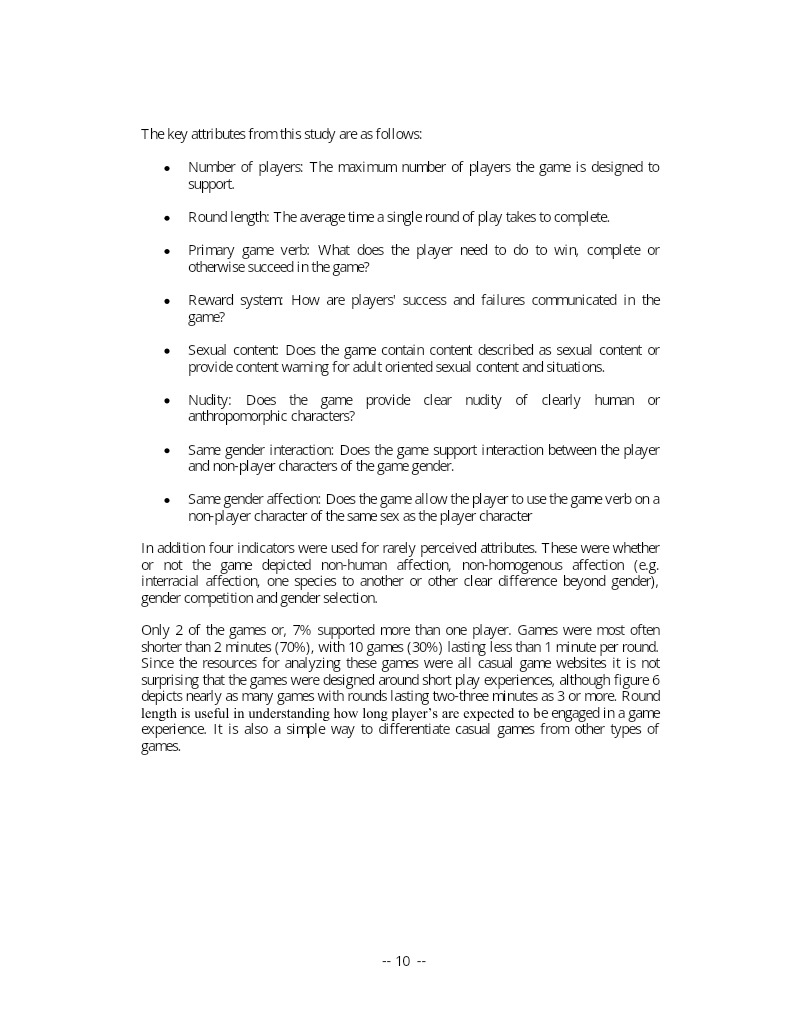
- Kissing is the dominant mechanic across the sampled affection games, while flirting is comparatively rare and hugging is nearly absent.
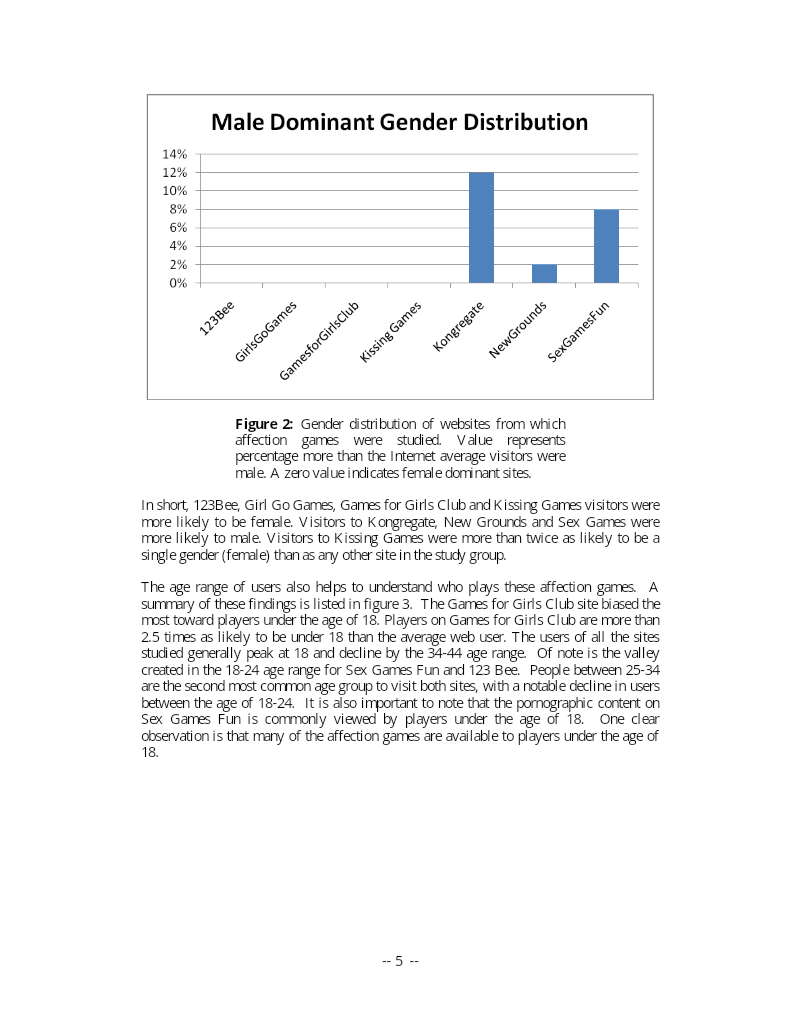
- Affection games make up a large share of niche sites such as KissingGames.com and SexGamesFun.com but are a negligible portion of major general-audience platforms.
- In a random sample of 30 games, sexual content appears in only three titles, and same-gender, interracial, and cross-species romance are essentially absent.

eSport and the Human Body: Foundations for a Popular Aesthetics
The document, "eSport and the Human Body: Foundations for a Popular Aesthetics," fundamentally argues for the re-evaluation of esports within the broader definition of "sport," challenging traditional philosophical exclusions based on physical exertion.
- The author argues that Steven Connor's definition of sport, which centers on physical exertion and direct bodily confrontation, is philosophically inconsistent with embodiment theory and sociologically inadequate, citing Olympic Tug of War and Cold War Chess as evidence that sport has never been defined by exertion alone.
- Competitive videogaming, the document contends, already meets most practical markers of sport, including training regimens, expert hierarchies, spectatorship, sponsorship, and professional labor infrastructures, and videogame play is itself corporeal under embodied and distributed cognition.
- eSport's aesthetic appeal differs from traditional athletics: spectators tend to fixate on the screen rather than athletic bodies, which are often concealed and not subject to the same cultural sanctity or doping scrutiny, so eSport aesthetics should be understood on their own terms.

Good Fences Make Good Neighbors: Values of Digital Objects in FarmVille 2
The analysis examines the values attributed to digital objects within the free-to-play social game FarmVille 2 (FV2), asserting that a robust community is essential for players to assign symbolic value to virtual goods.
- The study proposes that a strong pre-existing community may be necessary for virtual goods to acquire symbolic value, with FarmVille 2 played outside a friend network serving as a negative case to test this claim.
- Findings come from a single researcher's two-month solo play period (October to December 2012), so the author explicitly states the conclusions cannot be generalized.
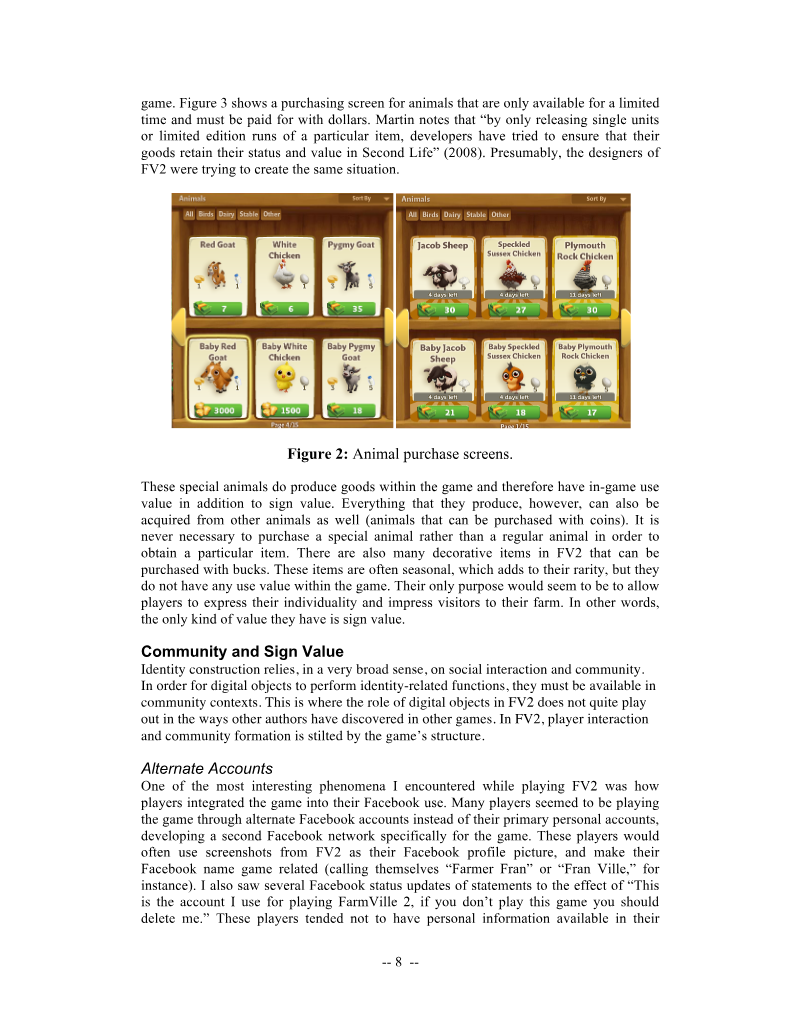
- FarmVille 2's design, with purchasable or friend-requested progression and no direct player-to-player communication, turns neighbors into instrumental resources rather than social ties.