
DiGRA
The Digital Games Research Association: the international association of academics and professionals who study digital games. Its Digital Library holds the proceedings of the DiGRA conferences since 2002.
Documents

(Re)Mark(s) of the Ninja: Replaying the Remnants
The analysis of "Mark of the Ninja" (Klei, 2012) posits that the game serves as a significant cultural artifact, primarily through its sophisticated engagement with temporality, intertextuality, and critical reflexivity.
- The essay reads Klei's Mark of the Ninja (2012) through media archaeology, arguing the game folds the past onto the present through its 2D interface, tattoo and scroll "marks," and haiku-like scrolls, which act as remnants evoking 3D stealth classics and 1980s ninja iconography.
- Its central thesis is that intertextual references, memento mori motifs, and ambiguous moral framing create productive tension between legitimate reflection on violence and the pleasures of play.
- The game's slow, unsatisfying killing of the hallucinated guide, and its framing of tradition versus modernity as a shared paradox of mediation rather than opposed worldviews, pushes players toward self-conscious reflection.


An Introduction to EEG Analysis Techniques and Brain-Computer Interfaces for Games User Researchers
The document provides an introduction to Electroencephalography (EEG) analysis techniques and Brain-Computer Interfaces (BCIs) specifically for Games User Researchers (GURs).
- EEG offers a real-time alternative to post-play questionnaires, which are prone to recall bias and interrupt gameplay, and its superior temporal resolution, lower cost, and suitability for live feedback make it a valuable evaluation method for games user research.
- EEG's limited spatial resolution and susceptibility to artefacts mean study design must be handled carefully, with electrode configuration, preprocessing (artefact removal and filtering), and analysis technique chosen to follow directly from the research question.
- The guide surveys frequency-based methods (FFT band analysis, mu rhythm measures, neurofeedback, frontal alpha asymmetry), event-related synchronization, event-related potentials such as P300 and ERN, the Berlin BCI protocol, and connectivity and coherence measures, each illustrated with examples from research on sleep, violence in games, player engagement, and EEG-based authentication.
Exploring the Cause of Game (Derived) Arousal: What Biometric Accounts of Player Experience Revealed
This research explores the drivers of game-derived arousal, challenging conventional assumptions about the relationship between "violent" game content and player response.
- The study by Schott, Marczak, and Neshausen (University of Waikato, DiGRA 2014) tested whether violent video games cause arousal mainly through violent content, as regulation assumes, using galvanic skin response (GSR) measurements of play sessions of Battlefield 3 and Dead Island.
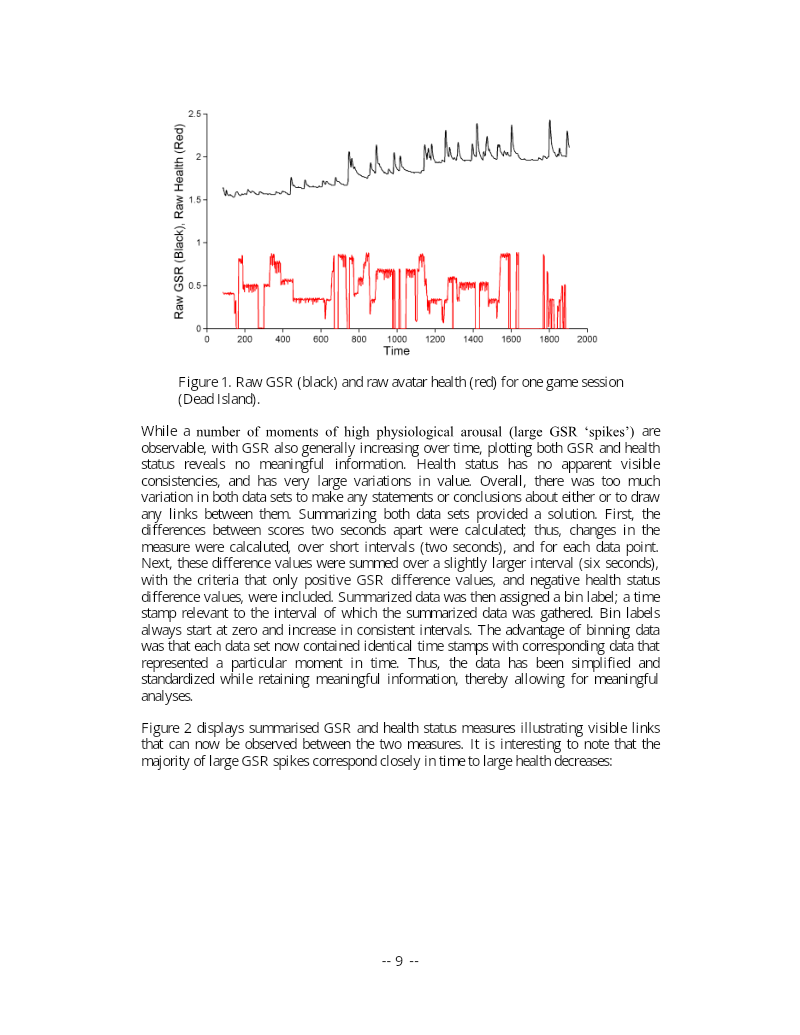
- The largest GSR arousal spikes frequently coincided with health loss or player death, with most large spikes aligning closely in time with sharp drops in player health after data was aggregated into two- and six-second bins.
- A substantial share of arousal spikes could not be linked to health loss or death, and in Battlefield 3 these unexplained spikes were most often tied to anticipatory moments, unseen enemy attacks, and surprise scenarios rather than active combat.

Game Design Patterns for Collaborative Player Interactions
The document presents a framework of game design patterns aimed at enhancing meaningful collaborative player interactions, particularly within serious games where resources may be constrained.
- The report targets 'tacked-on' co-op modes, where additional players add little to the experience, and aims to make collaborative player interactions meaningful rather than superficial.
- Collaborative player interactions are defined as synchronous, coordinated actions directed toward shared goals, and the patterns were derived from comparative analysis of well-received cooperative games across shooter, puzzle, strategy, MOBA, sandbox, and MMORPG genres.
- Interactions in titles such as League of Legends, Dota 2, Minecraft, and World of Warcraft are classified along spatial, temporal, player, and functional dimensions, then abstracted into nine patterns grouped as General (Concurrency and Parallelization), Gate (Separation and Gathering), and Support (Strengthening, Resupply, Protector, and Savior).


Modeling the Semiotic Structure of Game Characters
The document, "Modeling the Semiotic Structure of Game Characters," proposes a semiotic-structural model to analyze how player-characters are constructed as both "possible individuals" and "semiotic constructions" within video games.
- Daniel Vella argues that game studies has overlooked the ontology of the character itself, focusing instead on the player-avatar relationship, and proposes understanding the player-character as both a possible individual and a semiotic construction, adapting Uri Margolin's narratological model.
- Vella identifies three groups of elements through which player-characters acquire traits: static mimetic elements (name, appearance, costume, voice, animation), contextual elements (possessions, environment, role), and ludic elements (capabilities and limitations, operating through games' specific mediality).
- Vella contends that characters can remain static in these elements while still developing, challenging Frasca's claim that most videogame characters are flat.


Contextualising Flow in Games
The document, "Contextualising Flow in Games," critically re-evaluates the application of Csikszentmihalyi's Flow theory to digital games, arguing that current interpretations are often oversimplified and fail to account for the potential negative aspects of game engagement.
- The paper argues that Flow theory, as commonly applied to digital games, is reduced to a checklist of nine mechanistic conditions, overlooking Csikszentmihalyi's own warnings about 'entropy' in video games and his distinction between 'good' and 'bad' Flow.
- The central thesis is that Flow analysis must be extended to account for value, since absorption alone cannot explain why activities like chess and video games are judged so differently.
- The authors locate the missing element in an unstated evaluative 'wrapper' that Csikszentmihalyi implicitly relies on, which they propose is supplied by cultural capital and socially legitimated worth drawn from Bourdieu's habitus and Mead's socially internalised values.

Disrupting the Player's Schematised Knowledge of Game Components
The document proposes a framework for "disruptive game design" intended to elevate player cognitive engagement beyond mere achievement and mastery towards higher-level self-actualization.
- The paper argues that player-centric design, which challenges players only within an implied model of their abilities and learns through incremental accretion, caps the fulfilment of high-level cognitive needs such as self-actualisation.
- It proposes disruptive game design: deliberately altering how players construct, store, and recall knowledge of game components to deepen cognitive engagement without producing mere confusion.
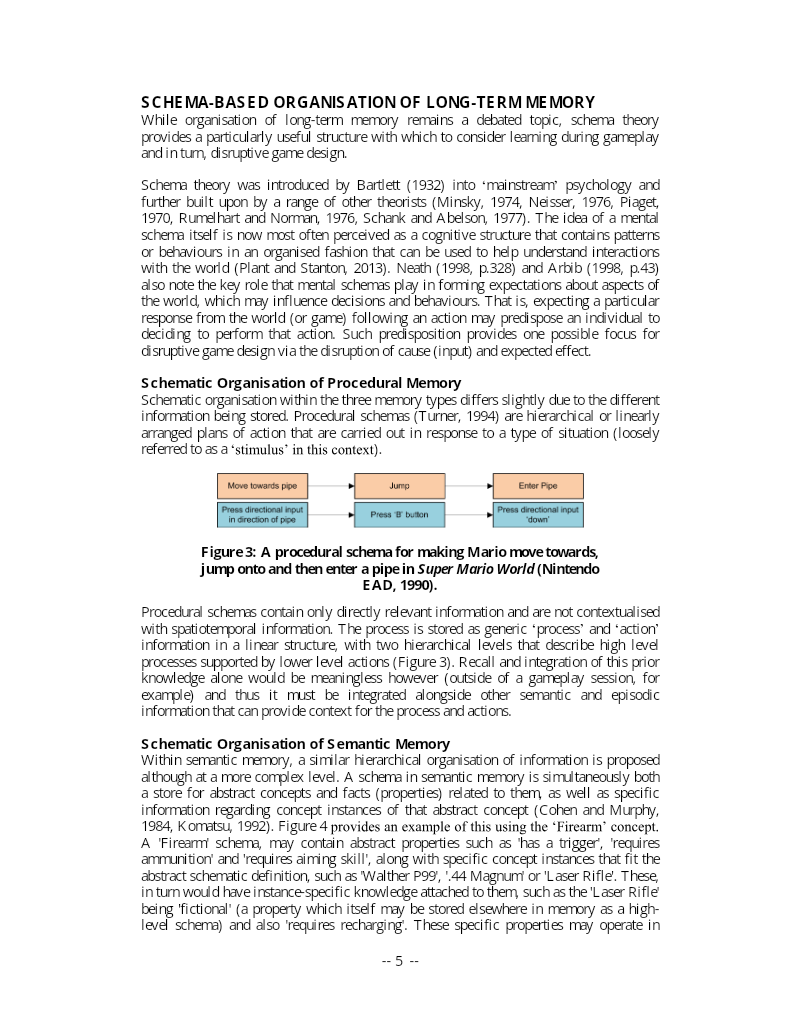
- The framework is grounded in Mayer's multimedia learning model, Tulving's taxonomy of procedural, semantic, and episodic memory, and schema theory as its organising principle.


Isomorphic Game Interaction Technique Patterns for Single Button: Definition and Evaluation
This document defines and evaluates isomorphic interaction technique patterns for single-button controls, specifically within third-person games featuring humanoid avatars.
- The paper proposes a pattern language of eight isomorphic single-button interaction techniques for third-person humanoid-avatar games, derived by crossing three action characteristics: Effort, Duration, and Context.
- In a user study comparing nine candidate patterns across the GCO and MWV prototypes, eight of the nine patterns were confirmed, with the Quick Time Event pattern as the exception, showing a 26% miss rate and a significance level of 0.130.
- Participants tended to choose lower-effort alternatives such as Pump or Time Limited Hold over the intended patterns, and regression analysis explained only about 41% of the variance in misses (adjusted R² = 0.4122), so other factors also influenced performance.
Thanatogaming: Death, Videogames, and the Biopolitical State
"Thanatogaming: Death, Videogames, and the Biopolitical State" posits that while videogames often function as instruments of biopolitical control, their inherent mechanics of virtual death can be appropriated by players as a form of "thanatopolitical" resistance.
- The report argues that death can function as a form of resistance to biopower, and that videogames, though instruments of biopolitical governance, can become spaces where this resistance is performed.
- The industry has built networked legal, technical, and economic control over its products, from Nintendo's 10NES lockout chip and the Tengen lawsuit to developers' quasi-sovereign "virtual biopower" over player economies in World of Warcraft, including the gold-farming case.
- Death is framed as a core procedural concept in games, with titles such as September 12 and Limbo showing that failure mechanics can carry social critique and shape players' understanding of mortality and consequence.
Presence and Heuristic Cues: Cognitive Approaches to Persuasion in Games
The document proposes a novel approach to persuasive game design, arguing that leveraging specific technological affordances to trigger heuristic cues can foster long-term attitude change in players.
- Persuasion in games depends less on surface messaging than on how design features trigger heuristic cues that evoke presence and shape how players process a message.
- Procedural rhetoric, where a game's rules and systems make arguments, can produce lasting attitude change when it engages players systematically.
- Heuristic cues can heighten presence and cognitive engagement, but presence alone does not guarantee persuasion; messages must also generate relevant favorable thoughts in the player.
Dots, Fruit, Speed and Pills: The Happy Consciousness of Pac-Man
"Dots, Fruit, Speed and Pills: The Happy Consciousness of Pac-Man" examines the enduring cultural phenomenon of Pac-Man, arguing that its classic iterations offer a complex reflection of cultural, ethical, and political shifts, particularly through the lens of Marcuse's "Happy Consciousness."
- The essay reads Pac-Man's endless levels, culminating in the unplayable level 256, as a Borgesian maze with no exit, using Herbert Marcuse's concept of 'Happy Consciousness' and Jorge Luis Borges' labyrinths as its interpretive frame.
- Pac-Man is positioned within a transmedial reach spanning more than forty games and multiple media, and its design is highlighted for a nonviolent theme, broad accessibility across genders, and an emphasis on speed and consumption.
- The author links Pac-Man's sound and aesthetics to late-1980s acid house and rave culture, along with the psychological and drug-culture associations of that scene.
Testing the Power of Game Lessons: The Effects of Art and Narrative on Reducing Cognitive Biases
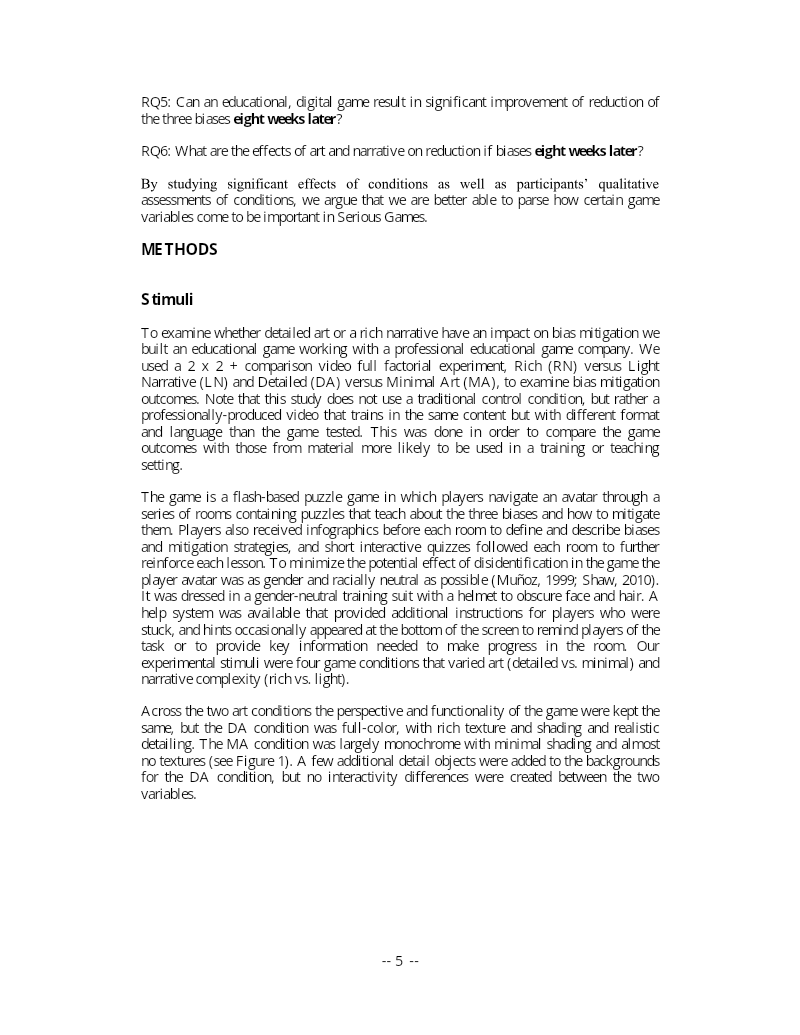
This study explores the efficacy of an educational game in teaching about cognitive biases—specifically Fundamental Attribution Error, Confirmation Bias, and Bias Blind Spot—compared to a traditional training video.
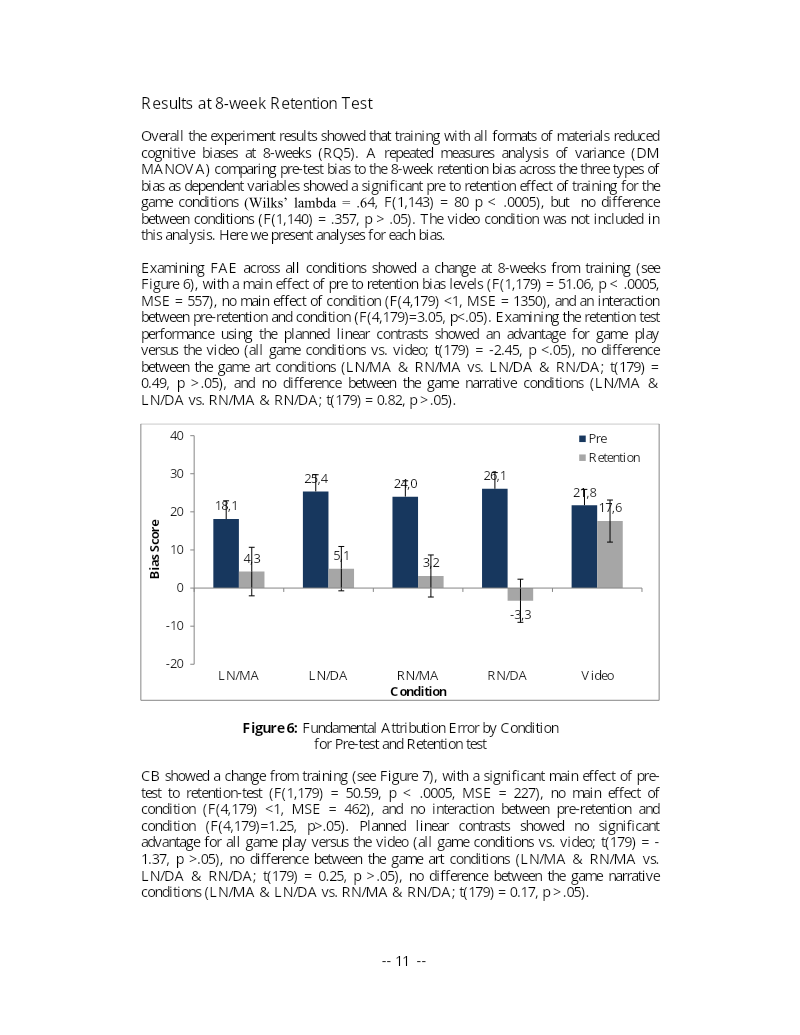
- The educational game outperformed a professionally produced training video immediately after play for reducing fundamental attribution error and confirmation bias, with these gains partially persisting at an eight-week retention test.
- Bias blind spot proved far more resistant to reduction than the other two biases, showing little improvement except in one game condition.
- Minimal art was the only design variable significantly associated with learning, and only for bias blind spot at immediate post-test; this advantage disappeared by the retention measurement.