1 free read left. Create a free account for unlimited reading + AI research.
Create free accountArticle DiGRA
1 free read left. Create a free account for unlimited reading + AI research.
Create free accountArticleDiGRA
The paper argues that gamification is not a recent innovation.
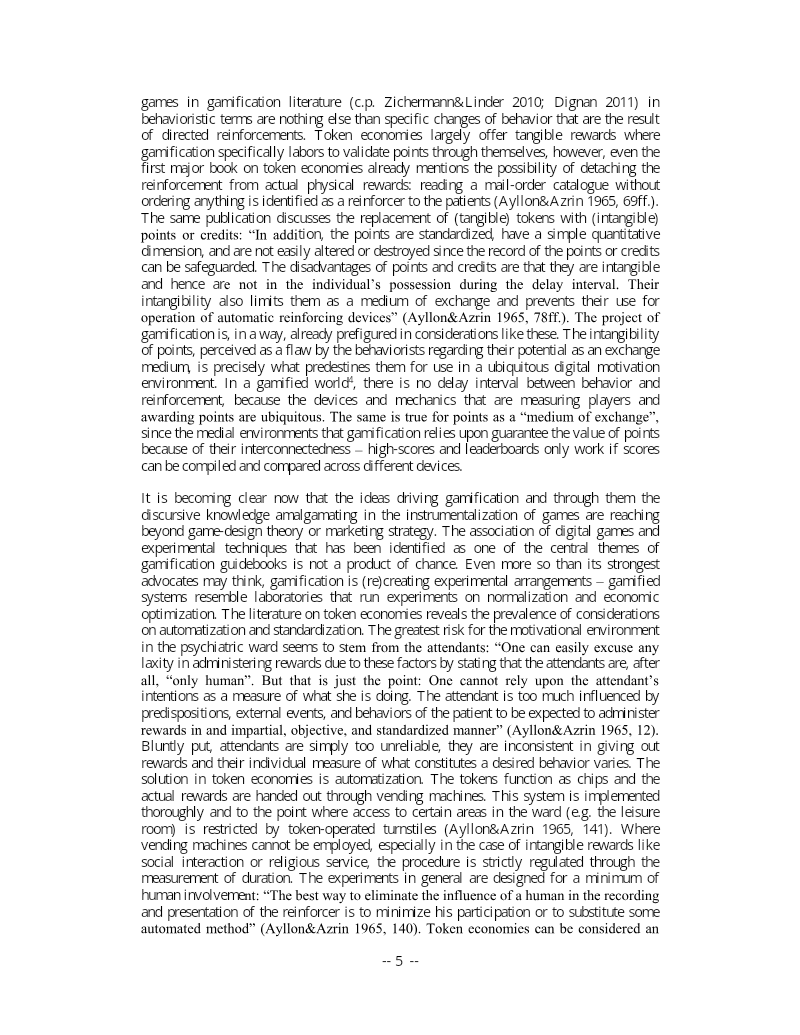
Raczkowski's history of ideas argues that gamification, the application of game mechanics to non-game contexts, is not a novel invention but a descendant of 1960s behaviorist token economies. Examining popular gamification guidebooks by authors such as Chatfield, Zichermann and Linder, and Edery and Mollick, the analysis finds a consistent portrait of digital games: experimental environments where consequences are negotiable, sources of Csikszentmihalyi's "flow," and systems governed by points and high scores that measure and reward players.
The central claim traces these point-based reward structures to token economies like Ayllon and Azrin's six-year experiment at Anna State Hospital, begun in 1961, in which patients earned tokens for desired behavior and exchanged them for privileges. Gamification extends this logic by automating reward delivery, which eliminates unreliable human attendants, and by using ubiquitous digital media to collapse the delay between behavior and reinforcement. It also adds flow as a tool of optimization and conceals work behind the appearance of play, much as token economies restructured hospital wards and restricted everyday commodities so they could be earned. Both approaches offer multi-purpose applicability and tiered progression, and gamified systems thus resemble laboratories for behavioral normalization and economic optimization.
Both also share a core vulnerability: cheating, power-gaming, and playing with the rules threaten their deterministic, experimental design, as illustrated by patients using a nail file to hack a television reward. Foursquare's tolerance of false check-ins and the difficulty of actually attaining flow, which popular literature often overlooks, point to similar limits today, and token economies themselves persist.
The analysis concludes that gamification's treatment of games conflicts with the creative, unpredictable nature of play described by Consalvo and Sicart, since classical games can be played with while gamified systems cannot. It calls for critique centered on the player's role and further study of the games gamification guidebooks cite. The controversy over instrumentalizing games is expected to continue, offering a chance to broaden game studies into a transdisciplinary field that also examines how digital games are perceived and the utopian hopes attached to them.

DiGRA · 2026

DiGRA · 2026



DiGRA · 2026



DiGRA · 2026



DiGRA · 2026



DiGRA · 2026



DiGRA · 2026



DiGRA · 2026



DiGRA · 2026

DiGRA · 2026



DiGRA · 2026



DiGRA · 2026
DiGRA · 2025