
DiGRA
The Digital Games Research Association: the international association of academics and professionals who study digital games. Its Digital Library holds the proceedings of the DiGRA conferences since 2002.
Documents

Digitising Diplomacy: Grand Strategy Video Games as an Introductory Tool for Learning Diplomacy and International Relations
Grand Strategy video games present a significant, yet largely unutilized, opportunity as an introductory educational tool for diplomacy and international relations.
- Only about 27 percent of IR educators report using digital games in teaching, compared with 56 percent who use non-digital resources, revealing a notable gap in higher education.
- Rhett Loban argues that grand strategy games such as Europa Universalis IV, Stellaris, and Hearts of Iron IV can serve as accessible introductory tools for teaching diplomacy and International Relations.
- These games model IR concepts both explicitly, through diplomatic action interfaces, opinion modifiers, and war declarations, and in more complex ways, through balance-of-power coalitions, alliance systems, and democratic peace dynamics reflected in AI behaviour.
Virtual Reality Is 'Finally Here': A Qualitative Exploration of Formal Determinants of Player Experience in VR
This qualitative study investigates how the formal features of virtual reality (VR) systems shape player experience, particularly focusing on stressors that arise when players perceive their avatar as a vulnerable, "lifesized" entity.
- The paper argues VR is a renaissance of immersive technology whose capacity to affect beliefs, emotions, and behaviour merits serious scholarly attention from game studies.
- Its central thesis is that VR uniquely elicits self-directed "I emotions", whereas screen-based games typically elicit threats concerning story (F emotions) or gameplay (G emotions).
- Based on a qualitative content analysis of 124 immersive environments drawn from clinical and experimental VR research, the authors identify recurring threat stimuli: looming threats, heights, hostile agents, and enclosed spaces.
Are You Out of Your Mind? Focalization in Digital Games
Digital games function as sophisticated engines for subjective experience, utilizing the narratological framework of focalization to align player perception with the mental states and worldviews of in-game avatars.
- Digital games utilize focalization—the alignment of player perception with an avatar's mental state—as a primary mechanism to bridge the gap between mechanical interaction and narrative immersion.
- Developers embed character expertise and psychological states directly into game code, using heads-up displays, selective rendering, and visual cues to simulate an avatar's private knowledge.
- Control schemes and movement constraints, as seen in titles like Grand Theft Auto V, Mirror’s Edge, and QWOP, force players to adopt the specific worldview and limitations of their in-game avatar.
What is Strafe Jumping? idTech3 and the Game Engine as Software Platform
Strafe jumping represents a critical case study in how emergent, community-driven gameplay mechanics can fundamentally redefine the trajectory of software development.
- Strafe jumping is a physics engine bug in idTech3 that allows players to bypass movement speed limits, effectively doubling their velocity and transforming Quake III Arena into a high-speed twitch shooter.
- The persistence of the strafe jumping glitch was driven by the player community, which successfully advocated for its retention despite id Software's ability to fix it during the engine's development.
- Game engines function as 'software platforms' that impose specific operational logics, which constrain and define the gameplay possibilities for any title built upon them.

A Structural Model for Player-Characters as Semiotic Constructs
The player-character functions as a complex semiotic construct that simultaneously operates as a narrative entity, a ludic component, and a vehicle for player expression.
- Player-characters function as complex semiotic constructs that integrate narrative entities, ludic components, and vehicles for player expression into a single, coherent identity.
- Character identity is formed through a hierarchical process that merges static mimetic elements, such as appearance and voice, with dynamic ludic affordances like systemic capabilities and limitations.
- Systemic constraints, including vulnerabilities and statistical attributes, act as essential vehicles for personality development by forcing players to project their intentions onto the protagonist.

Reconciling Csikszentmihalyi’s Broader Flow Theory: Meaning and Value in Digital Games
Current game design discourse frequently misapplies Mihaly Csikszentmihalyi’s Flow theory by reducing it to a narrow calibration of challenge and skill.
- Game design currently misapplies Flow theory by reducing it to a narrow, mechanistic calibration of challenge versus skill.
- The industry’s focus on technical difficulty curves ignores the essential role of personal and cultural context in determining whether an experience is meaningful.
- A new 'tenth condition' of Flow is proposed, requiring that activities provide a clear, participant-defined pathway for meaningful self-growth.
We Are All Fishes Now: DiGRA, Feminism, and GamerGate
The 2014 Digital Games Research Association (DiGRA) conference Fishbowl event, titled "The Playful is Political," serves as a focal point for analyzing the intersection of feminist game scholarship and the GamerGate movement.
- The 2014 DiGRA conference 'The Playful is Political' Fishbowl event became a catalyst for the GamerGate movement, which targeted feminist scholars through organized harassment campaigns like 'Operation Digging DiGRA.'
- GamerGate participants weaponized the event's collaborative notes to construct conspiracy theories, alleging that DiGRA functioned as a hub for feminist behavioral control.
- The harassment campaigns targeted specific researchers based on their academic focus on gender, race, and sexuality within the gaming industry.

On Chairing a Games Research Conference
This analysis explores the multifaceted responsibilities and strategic considerations involved in chairing an academic games research conference, specifically drawing on experiences from the Digital Games Research Association (DiGRA) and the Foundations of Digital Games (FDG) conferences.
- To maintain academic integrity and prevent conflicts of interest, the roles of Conference Chair (logistics and finance) and Program Chair (peer-review and acceptance standards) must be strictly separated.
- Academic conferences in this sector are not profit-driven, as evidenced by the 2014 DiGRA event where registration fees covered only 73% of the total budget, requiring external sponsorship to bridge the gap.
- Venue costs represent the primary financial burden for organizers, accounting for 70% of total conference expenses.
Global Influences on Regional Industries: Game Development in Nordic Countries, China, and India
The document examines how cultural and regional contexts influence the structure of local game development industries and, to some extent, game content.
- The global games industry has been dominated by a few historically influential actors, principally Japan and the United States, whose practices serve as benchmarks that other regions tend to follow.
- The authors find that regional content still largely follows globally established standards, possibly because development tools and distribution platforms are concentrated among a small number of companies that pressure developers to adopt existing mechanics while varying aesthetics.
- Nordic game industries took different shapes according to their origins: Sweden and Finland grew out of software engineering and the demoscene with an emphasis on programming, while Norway and Denmark drew on film, animation, and visual storytelling traditions.
Games as Travel Guides: A Look at Meaningful Downloadable Content and Its Connection to Locational Context
This paper examines the growing trend of video games incorporating locational context and collaborating with local businesses to create meaningful downloadable content (DLC).
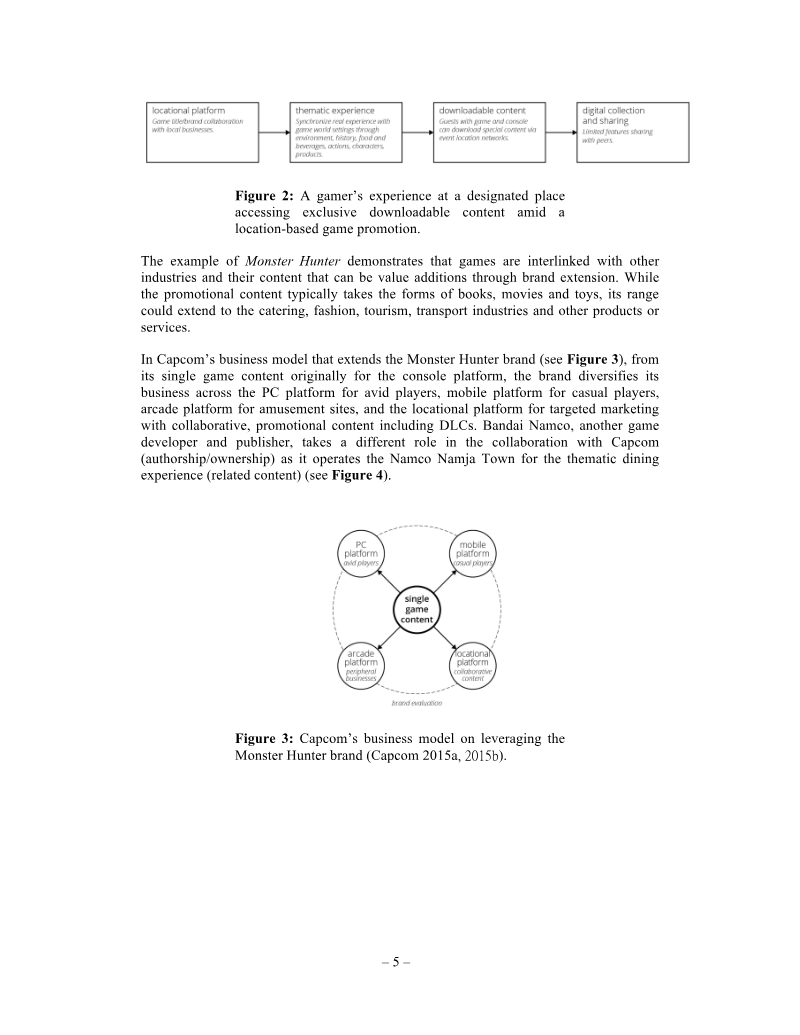
- The paper argues that location-based game content can simultaneously benefit the gaming industry, tourism, and local economies, and proposes two design approaches: tying the game environment to a specific real place, or tying game content to a real-world culture that local businesses elsewhere can reinterpret.
- The Monster Hunter Festival at Shibu Onsen drew more than 10,000 visitors during a low season, illustrating how game-linked events can drive tourism outside peak periods.
- Collaborations extended the Monster Hunter brand across businesses, including the "Monster Hunter the Real" attraction at Universal Studios Japan and DLC distributed through 7-Eleven stores.
Review of Serious Games Development in Hong Kong (2006-2016)
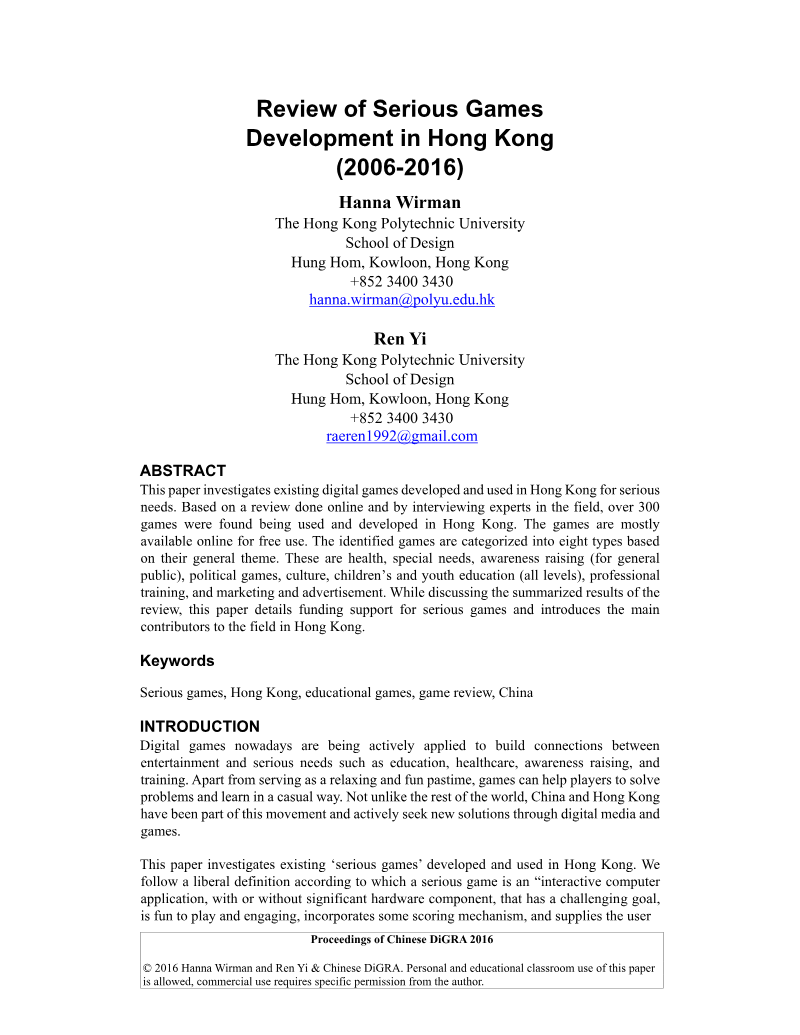
This document provides a comprehensive review of serious games developed and utilized in Hong Kong between 2006 and 2016.
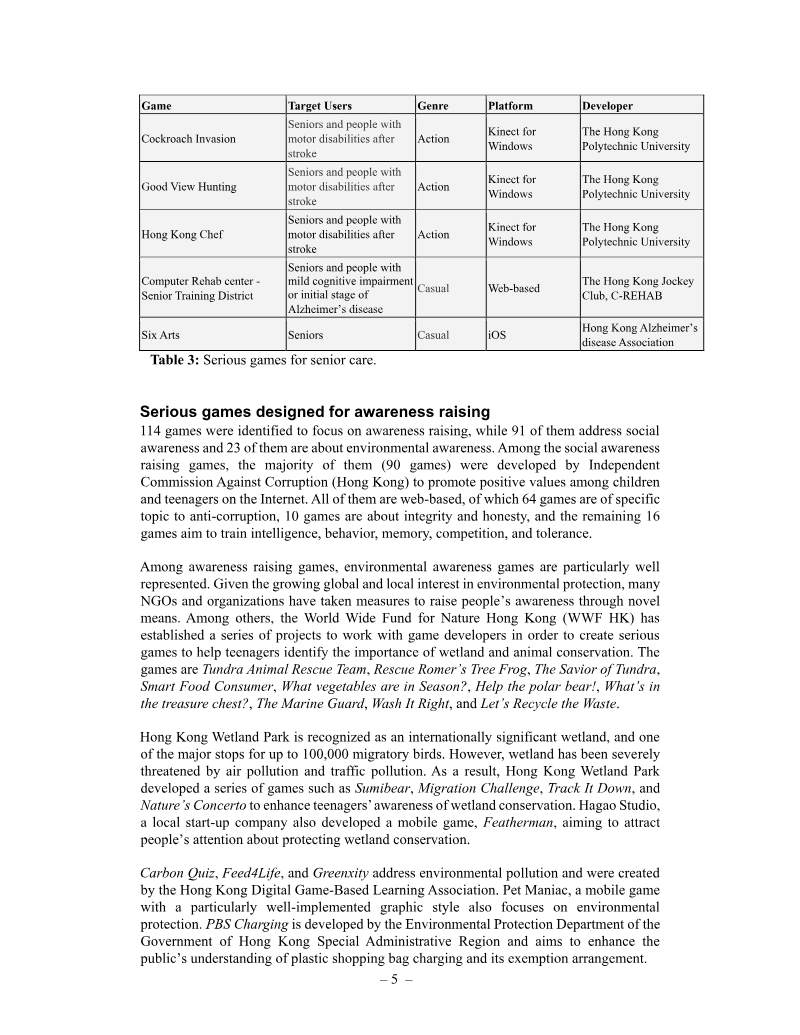
- Over 300 serious games developed or used in Hong Kong between 2006 and 2016 were identified, most freely available online and mainly designed for mobile platforms, with web, PC, and Mac titles also forming a substantial share.
- Awareness raising is the largest category with 114 titles, mostly addressing social values such as anti-corruption and integrity, followed by environmental games developed with organizations like WWF Hong Kong and the Hong Kong Wetland Park.
- Marketing and advertisement accounts for 80 games, most of them interactive installations in shopping venues rather than standalone software, and the authors suspect this category undercounts short-term installations.
The Divide Between E-Sport and Playing Games in China
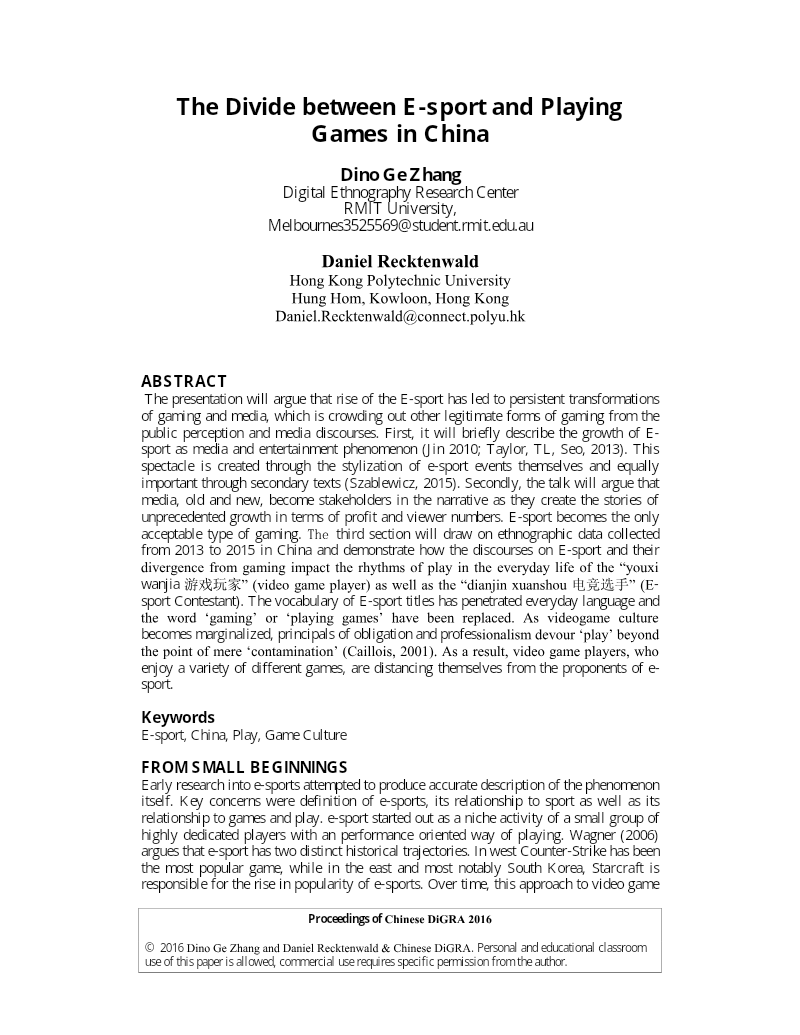
The document examines the growing divide between esports and general video game play in China, arguing that the rise of esports has transformed gaming and media landscapes, marginalizing other forms of gaming in public perception and discourse.
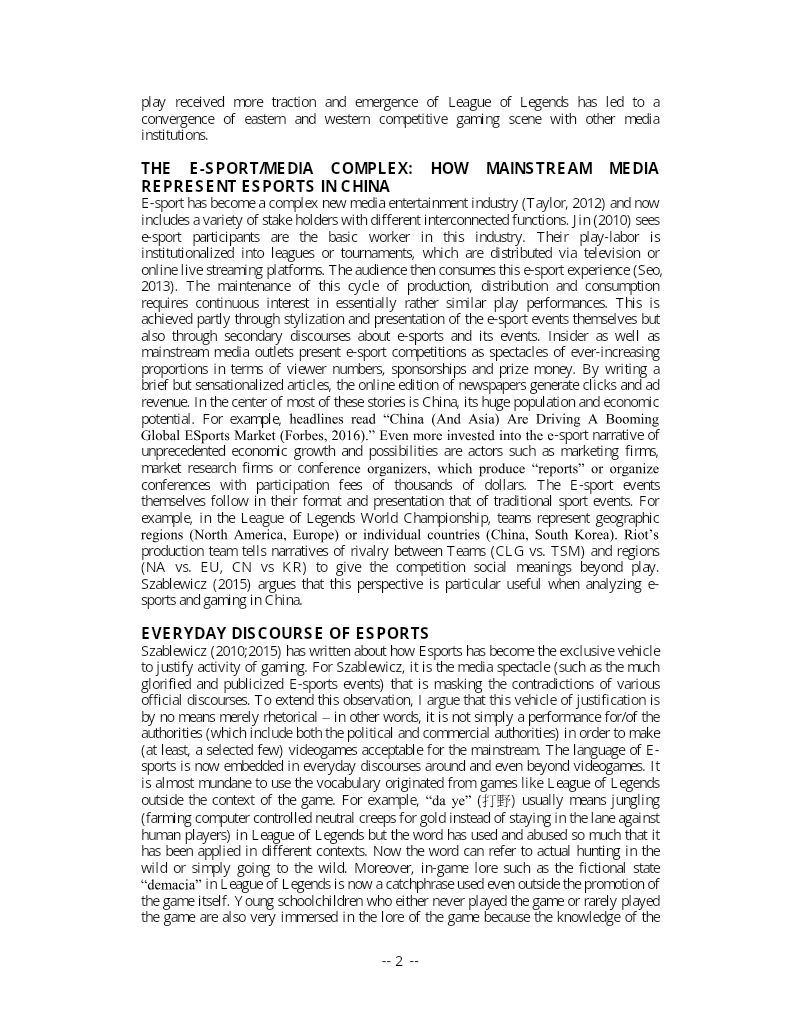
- The paper argues that media coverage of competitive e-sports, driven by record viewership, sponsorship, and prize-money narratives with China as the centerpiece of a global market, has made e-sports the only socially acceptable form of gaming in China and cast other play as less legitimate.
- The authors' evidence comes from ethnographic fieldwork in China conducted between 2013 and 2015, combining informal interviews with online forum observation.
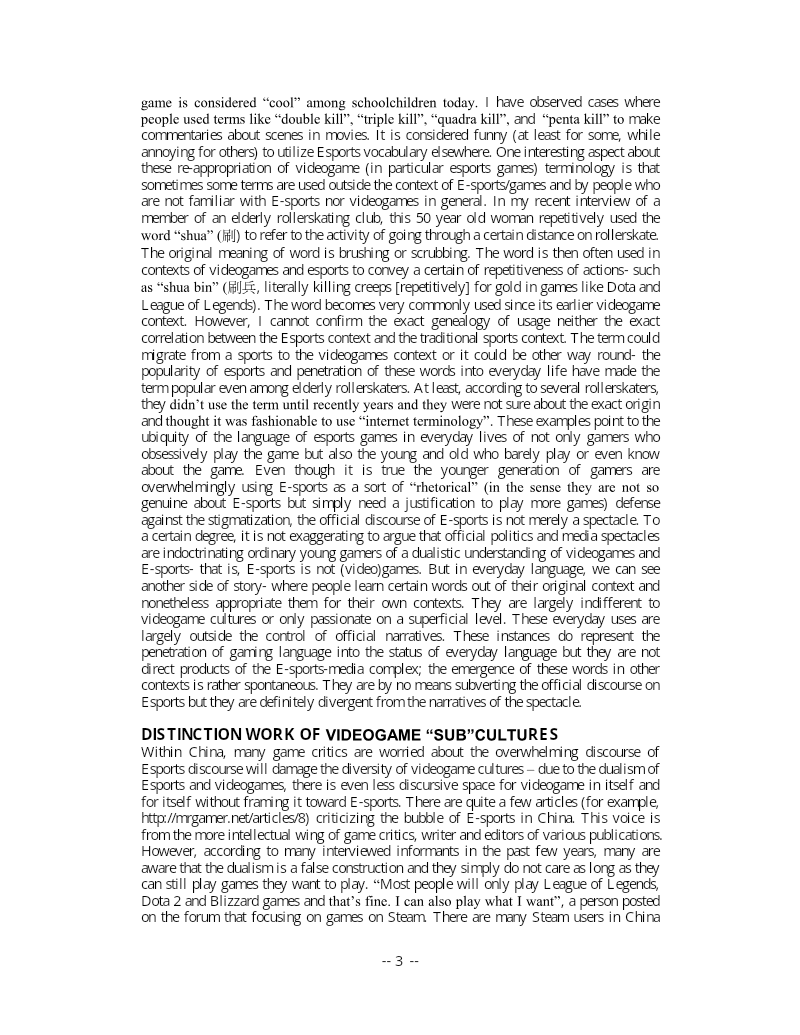
- Terms from League of Legends and similar titles, such as "da ye" (jungling), "shua bin," and "penta kill," have spread into everyday Chinese speech, including among people who rarely or never play games.
Do you work at DiGRA? Get a free report of how these documents are read and cited here.