1 free read left. Create a free account for unlimited reading + AI research.
Create free accountWhitepaper DiGRA
1 free read left. Create a free account for unlimited reading + AI research.
Create free accountWhitepaperDiGRA
About 27 percent of IR educators report using digital games, compared with 56 percent who use non-digital resources.
Rhett Loban's paper argues that grand strategy video games, particularly titles such as Europa Universalis IV, Stellaris, and Hearts of Iron IV, can serve as accessible introductory tools for teaching diplomacy and International Relations (IR). The work situates this claim against a notable gap in higher education, where digital games are used far less than non-digital materials in IR teaching, with only about 27 percent of educators reporting use of digital games compared with 56 percent for non-digital resources. The paper traces diplomacy back roughly 5,000 years and the IR discipline to 1919, and reviews prior research on game-based learning and wargaming, including positive findings for games such as Diplomacy and SimCity in political science courses.
The central argument is that these games model diplomacy and IR both explicitly, through diplomatic action interfaces, opinion modifiers, and war declarations, and in more complex ways, through balance-of-power coalitions, alliance and federation systems, and democratic peace dynamics reflected in AI behaviour. A survey of 331 Europa Universalis IV forum players, with a 100 percent completion rate, found that many respondents believed the game clarified how diplomacy, alliances, and realpolitik shape historical conflict, and that multiplayer intensified these lessons. Respondents who engaged more with diplomacy tended to perceive the game as emphasising material interests over ideology, and multiplayer was seen as adding a human, Machiavellian dimension.
The author frames these layered "digitised diplomacy" forms along a spectrum from conceptual to explicit representation, presenting them as a complement to books and documentaries. The conclusions are qualified: the survey sample is self-selected, and the claimed educational value rests on player perception rather than measured learning outcomes. The paper's evidence therefore supports the games' potential as an imperfect but promising introduction to IR theory and practice, rather than a demonstrated teaching method.
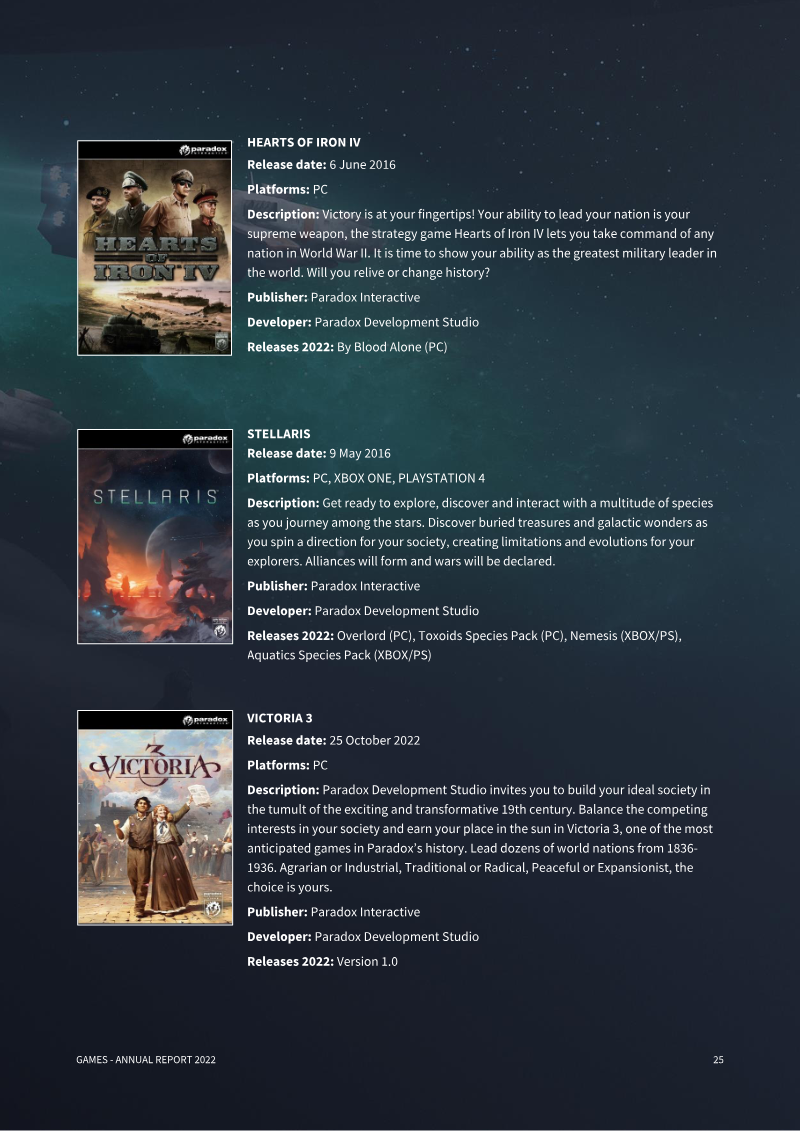
 StellarisGame · Paradox Development Studio · 2016 · 43 documents
 Hearts of Iron IVGame · Paradox Development Studio · 2016 · 30 documents
 Hearts of IronGame · Paradox Development Studio · 2002 · 28 documents
Each row is a game or company this document names, each column a document, oldest first. A mark means that document names it. Select a row to see those documents.
DiGRA · 2022
Paradox Interactive · 2024