
American Journal of Play
The American Journal of Play is a peer-reviewed scholarly journal published by The Strong National Museum of Play. It publishes articles on the history, science, and culture of play, including video games and learning.
Documents
The Rise of Massive Multiplayer Online Games, Esports, and Game Live Streaming: An Interview with T. L. Taylor
This interview with T. L. Taylor, a professor of Comparative Media Studies at MIT and co-founder of the esports organization AnyKey, traces her scholarly path from early childhood play and graduate-school interest in text-based virtual worlds to a sustained career studying online games, esports, and live streaming.
- Game play is best understood as an assemblage of technological structures, social processes, and personal meaning-making that routinely exceeds designers' intentions, with players co-constructing their experience through raid calendars, guild structures, and user-interface modifications.
- Taylor's research on the MMO EverQuest found online play to be deeply social rather than isolating, and that women were among the most dedicated players despite barriers to entry and retention.
- Professional esports depends on institutions, broadcasters, sponsorship, and infrastructure beyond individual players, and it varies substantially by region, such as South Korea's PC bang culture and China's integration of mobile titles.
Play in a Digital World: How Interactive Digital Games Shape the Lives of Children
Interactive digital games now occupy a substantial place in young children's lives, and this analysis examines how that medium shapes their learning, physical health, and social-emotional development.
- Nearly all American children under eight live in homes with tablets or smartphones, making digital games a substantial part of early childhood play.
- Children aged two to four play digital games about 20 minutes daily (mostly on mobile devices), while children aged five to eight average roughly 42 minutes per day.
- The evidence on cognitive outcomes is mixed: many educational apps have never been formally tested and few offer adaptive challenges or responsive feedback, though some meta-analyses report learning benefits from touchscreen use, especially in STEM.
Praxis Games: A Design Philosophy for Mobilizing Knowledge through Play
Steve Wilcox's "Praxis Games: A Design Philosophy for Mobilizing Knowledge through Play" argues that serious games should move beyond the "edutainment" model, in which fun serves merely as a delivery mechanism for content, toward games whose mechanics themselves embody domain-specific knowledge.
- Steve Wilcox argues serious games should move beyond "edutainment," where fun merely delivers content, toward games whose mechanics embody domain-specific knowledge through meaningful action-outcome relationships.
- The author proposes five design heuristics, including evidence-based rules, guided discovery, and decision optimization, illustrated mainly through design examples such as Allergory, Depression Quest, science.net, and ZombiePox.
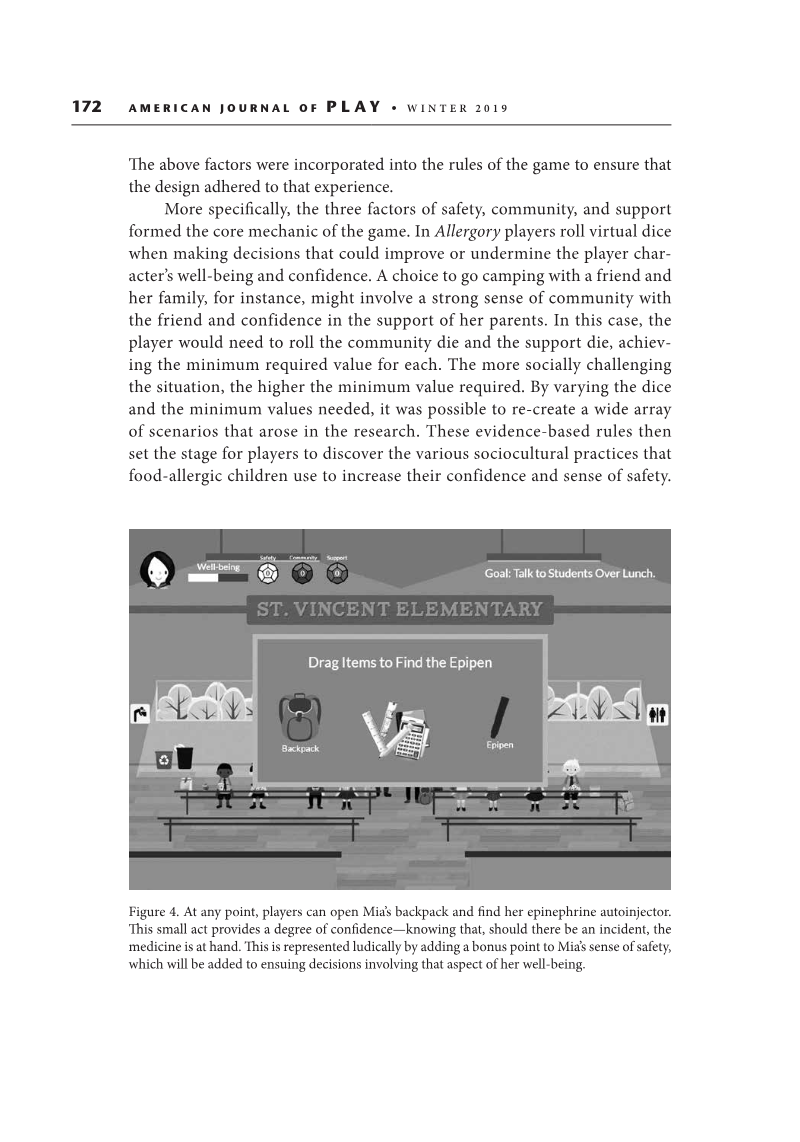
- Allergory recreates food-allergy social situations drawn from interviews with food-allergic children, serving as the report's central illustration of praxis games.
Twitch and the Work of Play
T. L. Taylor's "Twitch and the Work of Play" examines live streaming as a hybrid practice that fuses play with professional media production and labor.
- Live streaming turns private play into public entertainment and a new form of work that is typically home-based, economically precarious, and dependent on social, emotional, and technical labor.
- Taylor's ethnography of a popular streamer running a one-person production studio shows streamers juggling setup, chat interaction, subscriptions, donations, and raids alongside gameplay, blending set design, performance, critique, and sociality into one enterprise.
- Live streaming is best understood as an assemblage of human and nonhuman components, including hardware, software, platform infrastructure, and monetization systems, which together make both play and labor possible.
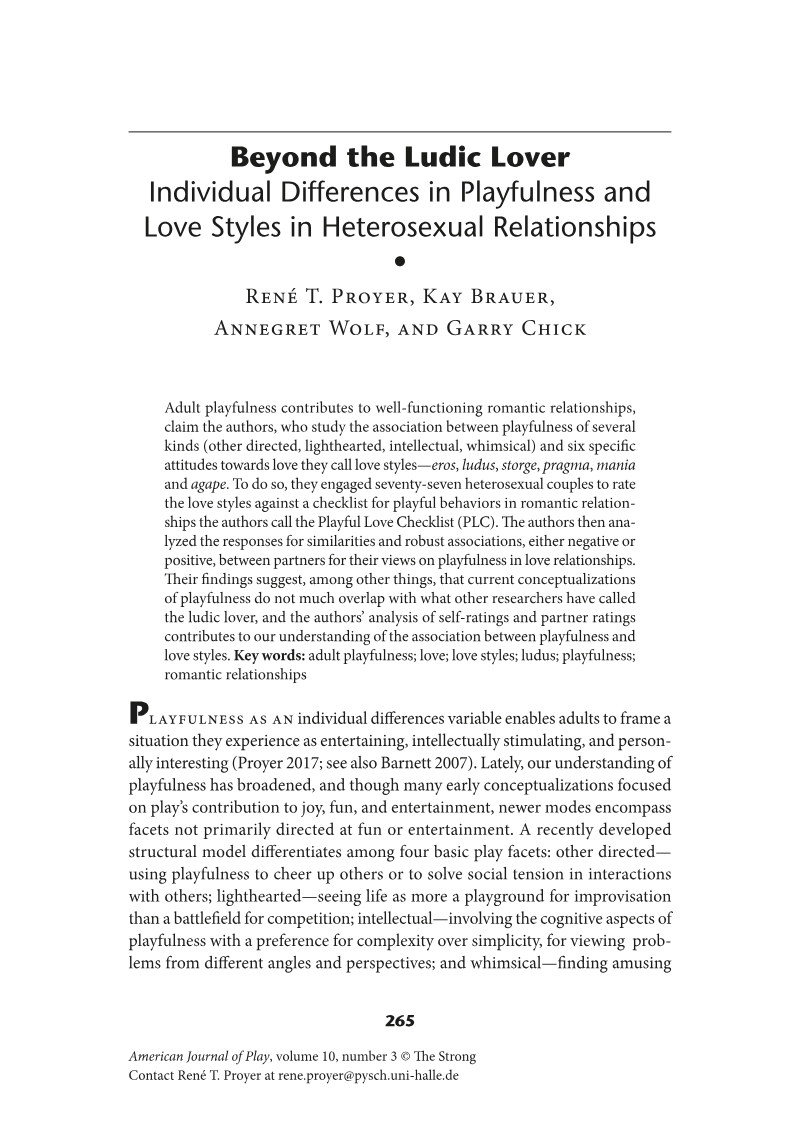
Beyond the Ludic Lover: Individual Differences in Playfulness and Love Styles in Heterosexual Relationships
This study examines how adult playfulness relates to love styles among heterosexual couples, challenging the classic view of the "ludic lover" from Lee's love-styles typology as a noncommittal, deceptive, pleasure-seeking partner.
- Playfulness is positively associated with the eros love style, sharing roughly 21% of variance in men and 17% in women.
- Ludus, the closest match to Lee's original 'ludic lover,' shared only 5 to 7% of variance with playfulness, supporting the authors' argument that the ludic lover and playful lover are distinct constructs.
- The authors conclude the ludic lover should be conceptually separated from the playful lover, with playful partners using play to actively strengthen relationships.
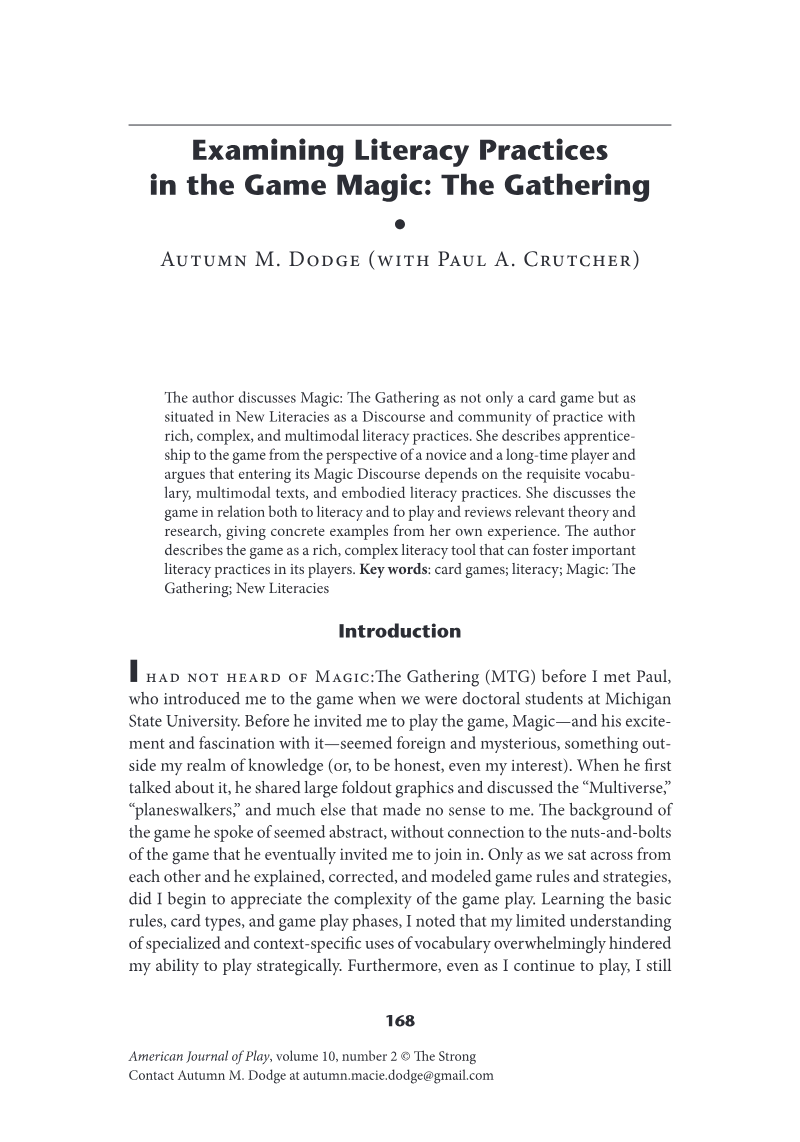
Examining Literacy Practices in the Game Magic: The Gathering
Magic: The Gathering is examined here as a multimodal literacy environment, one that demands specialized vocabulary, the interpretation of interrelated card texts, symbolic and mathematical reasoning, and embodied physical play.
- Magic: The Gathering is analyzed as a multimodal literacy environment requiring specialized vocabulary, interrelated card-text interpretation, symbolic and mathematical reasoning, and embodied play, with entry into its community framed as situated, socially mediated literacy development.
- Newcomers learn through just-in-time, challenging-but-achievable demands, such as researching unfamiliar terms like "leviathan" or "Simic" in card texts, symbols, and flavor text, supported by guided participation with experienced players that moves them from peripheral to fuller community membership.
- Using the card Nimbus Swimmer as an example, the analysis shows that comprehension of game texts combines linguistic, mathematical, and strategic reading.
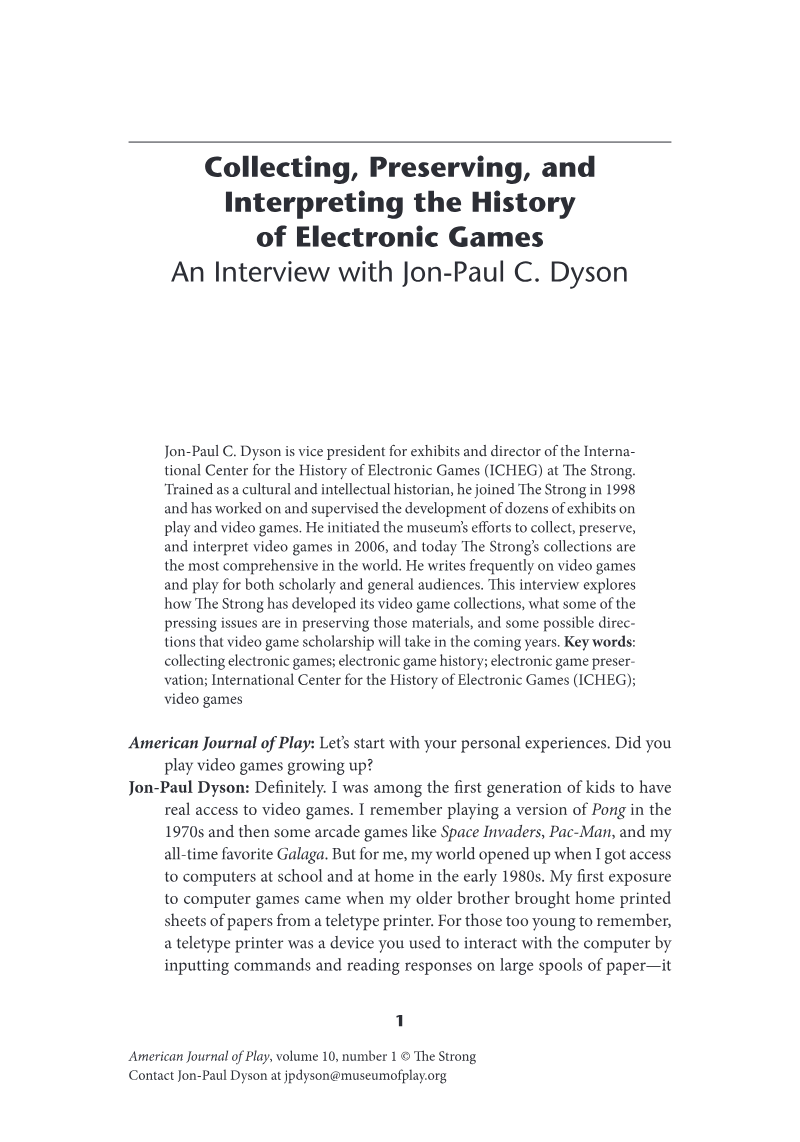
Collecting, Preserving, and Interpreting the History of Electronic Games: An Interview with Jon-Paul C. Dyson
The International Center for the History of Electronic Games at The Strong, a museum in Rochester, New York, has grown from fewer than 100 items in 2006 to a collection exceeding 60,000 games and related artifacts.
- The International Center for the History of Electronic Games at The Strong in Rochester, New York, has grown from fewer than 100 items in 2006 to a collection exceeding 60,000 games and related artifacts, and draws more than 550,000 visitors annually.
- Director Jon-Paul C. Dyson argues that electronic games are uniquely hard to preserve because they depend on obsolete hardware, fragile storage media, and social play contexts that are easily lost.
- The museum's five-part preservation strategy covers original hardware and software, published materials and archival records from industry figures, gameplay recorded on original equipment, and source code preservation with file migration, with digitization occurring only after items are stabilized and cataloged.
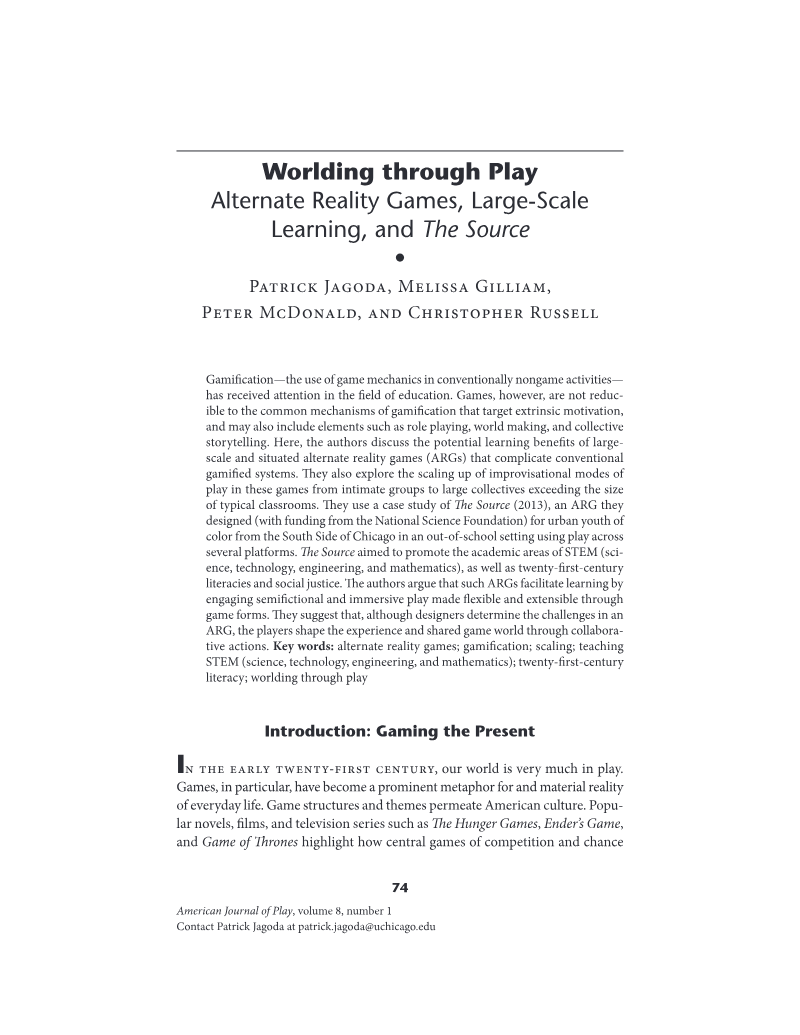
Worlding Through Play: Alternate Reality Games, Large-Scale Learning, and The Source
"Worlding Through Play" argues that alternate reality games can support learning by inviting players to collaboratively shape a shared game world, a process the authors call "worlding through play," rather than merely completing gamified tasks driven by extrinsic rewards.
- The core argument is that alternate reality games can support learning through "worlding through play," where players collaboratively shape a shared game world, rather than simply completing gamified tasks driven by extrinsic rewards.
- The study centers on The Source, a five-week transmedia ARG run from July 8 to August 16, 2013, on Chicago's South and West Sides, designed to teach STEM, twenty-first-century literacies, and social-justice awareness.
- Of 144 mostly African American and Latino youth aged 13 to 18 who took part, 133 were included in the evaluation, which drew on focus groups, surveys, interviews, and an external evaluation by the University of Chicago's Outlier Research and Evaluation team.
Deep Fun and the Theater of Games: An Interview with Bernie DeKoven
Bernie DeKoven, a play theorist and game designer, argues in this interview that playfulness is a central and undervalued dimension of human life, particularly for adults, who he contends are more play-deprived than children.
- Playfulness, more than play itself, is presented as the foundation of meaningful engagement, and Bernie DeKoven frames it as a survival skill that supports adaptation and community.
- DeKoven argues that adults are more play-deprived than children, and that fear and competitiveness erode playfulness in adult life.
- Trust, freedom of choice, and shared rule-making are identified as the conditions under which play becomes genuinely enjoyable and equitable.
Strategy and Sociability: The Mind, the Body, and the Soul of Chess
Gary Alan Fine's "Strategy and Sociability: The Mind, the Body, and the Soul of Chess" argues that chess, though often regarded as a solitary intellectual pursuit, is fundamentally a social activity in which cognition, physical experience, and emotion are shaped by interpersonal relations, competition, and audience.
- Expertise in chess is largely experiential and relational rather than innate, and a move's quality can only be judged through the interplay of two players' plans.
- Elite players reconstructed 93 percent of chess positions accurately versus 51 percent for average players, an advantage Fine attributes to pattern recognition and relational "chunking" built through context.
- Strong players often rely on intuition resting on tacit calculation, and strategic play requires envisioning a shared future, with games averaging around sixty moves per side allowing tactics to be embedded in extended plans.
The Why, How, and What of a Museum of Play: An Interview with George Rollie Adams
The Strong, formerly the Margaret Woodbury Strong Museum in Rochester, New York, reoriented itself around play after its original collections-based, industrial-era focus failed to sustain attendance.
- The Strong pivoted to an exclusively play-centered mission after attendance fell from roughly 150,000 in 1983 to under 70,000 by 1986, with interactive exhibits driving sustained growth in visitors and membership.
- Marketing research showed about 70 percent of visitors were families with children twelve and under, and the museum's toy and doll collections were recognized as its most significant but underused holdings.
- The museum now has over 400,000 collection items, welcomes roughly 600,000 onsite visitors annually, and serves more than 17,000 member households.
Active Gaming: The Future of Play?
Active Gaming: The Future of Play? examines whether video games that require physical movement can help address childhood inactivity and obesity without abandoning children's enthusiasm for technology.
- Children spend roughly six to eight and a half hours daily on technology, and about one in three children is overweight or obese, with inactivity identified as a leading contributor.
- The authors argue that play is developmentally essential for cognitive, social-emotional, physical, and creative growth, and that physical play has declined as sedentary screen use has expanded.
- Active video games have been shown to roughly double energy expenditure compared with sedentary digital play and can meet moderate-to-vigorous physical activity guidelines.