
American Journal of Play
The American Journal of Play is a peer-reviewed scholarly journal published by The Strong National Museum of Play. It publishes articles on the history, science, and culture of play, including video games and learning.
Documents
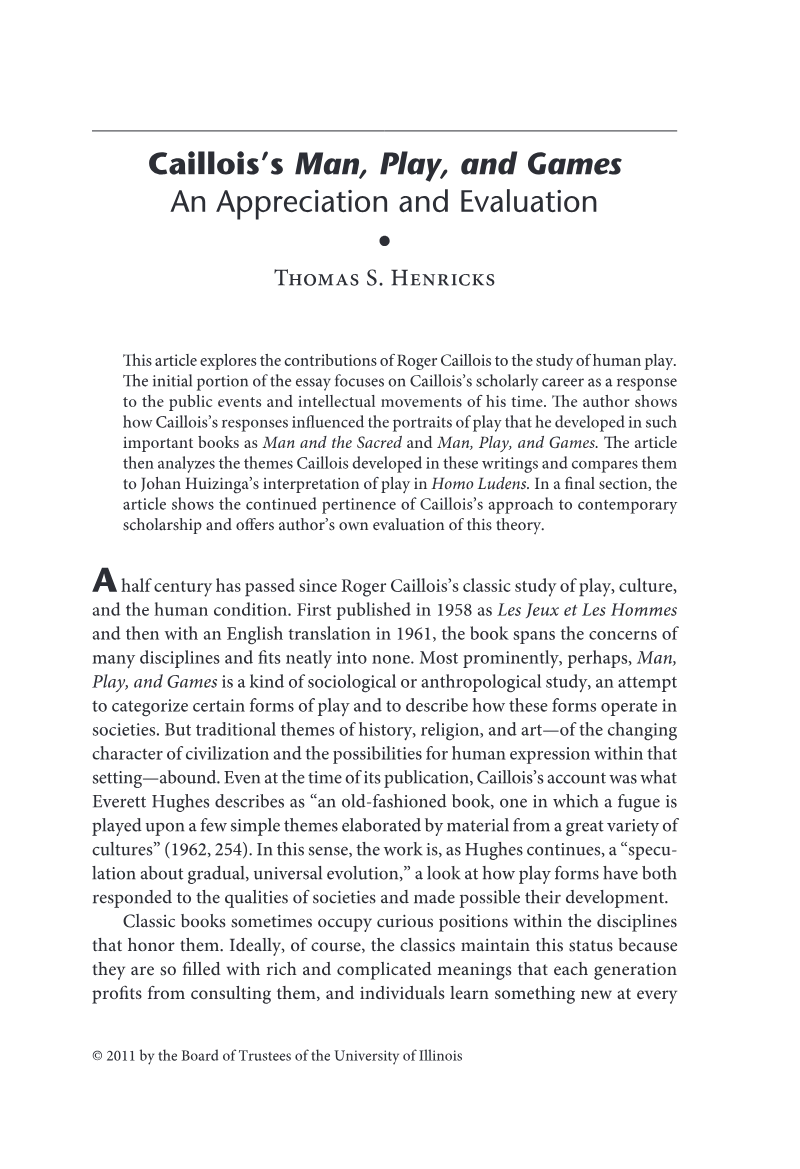
Caillois's Man, Play, and Games: An Appreciation and Evaluation
Thomas Henricks's appreciation of Roger Caillois's Man, Play, and Games (1958) revisits a book best known for its typology of play and its response to Johan Huizinga's Homo Ludens, while drawing attention to its less examined concern with the corruption of play in modern society.
- Caillois argues that Huizinga wrongly equated play with the sacred: play is defined by free, self-controlled engagement, whereas ritual imposes obligation and submission to a higher force.
- Caillois proposes a fourfold typology of play, agôn (competition), alea (chance), mimicry (simulation), and ilinx (vertigo), arranged on a continuum between improvisational paidia and rule-bound ludus, a distinction that remains foundational in game studies.
- Caillois contends that unchecked play impulses can degenerate into obsession, greed, or self-delusion, and treats the decline of fair play in a profit-driven, cynical society as a central concern.
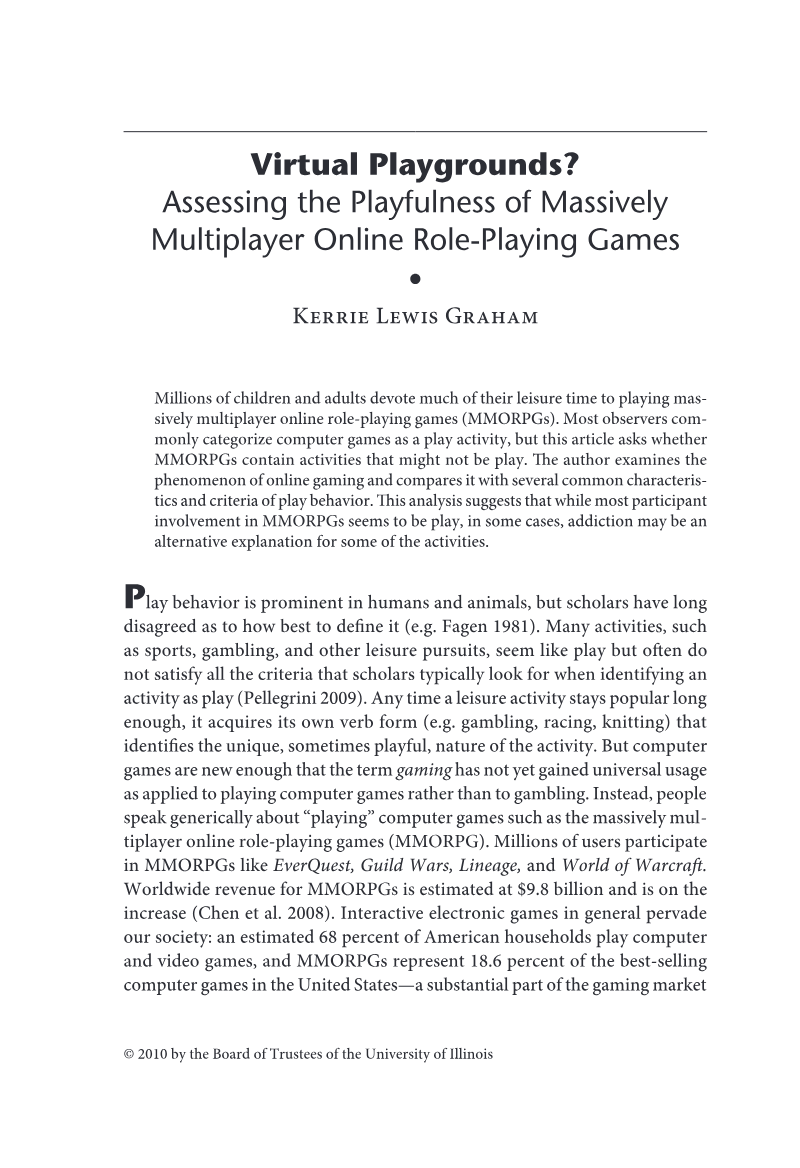
Virtual Playgrounds?: Assessing the Playfulness of Massively Multiplayer Online Role-Playing Games
Virtual Playgrounds? examines whether participation in massively multiplayer online role-playing games (MMORPGs) qualifies as play, testing the activity against established criteria such as rules, make-believe, fun, and voluntariness.
- The central thesis is that MMORPG engagement is playful for most participants, though the line between play and compulsive overuse is real and depends on the individual and context.
- The paper argues that play and addiction sit at opposite ends of a continuum rather than forming a clear binary, and it applies R. I. F. Brown's six facets of addiction (salience, euphoria or relief, tolerance, withdrawal, conflict, relapse) to assess overuse risk.
- Supporting figures cited include 79 percent of gamers forming guilds, an average player age of 26, and roughly 22 hours of play per week.
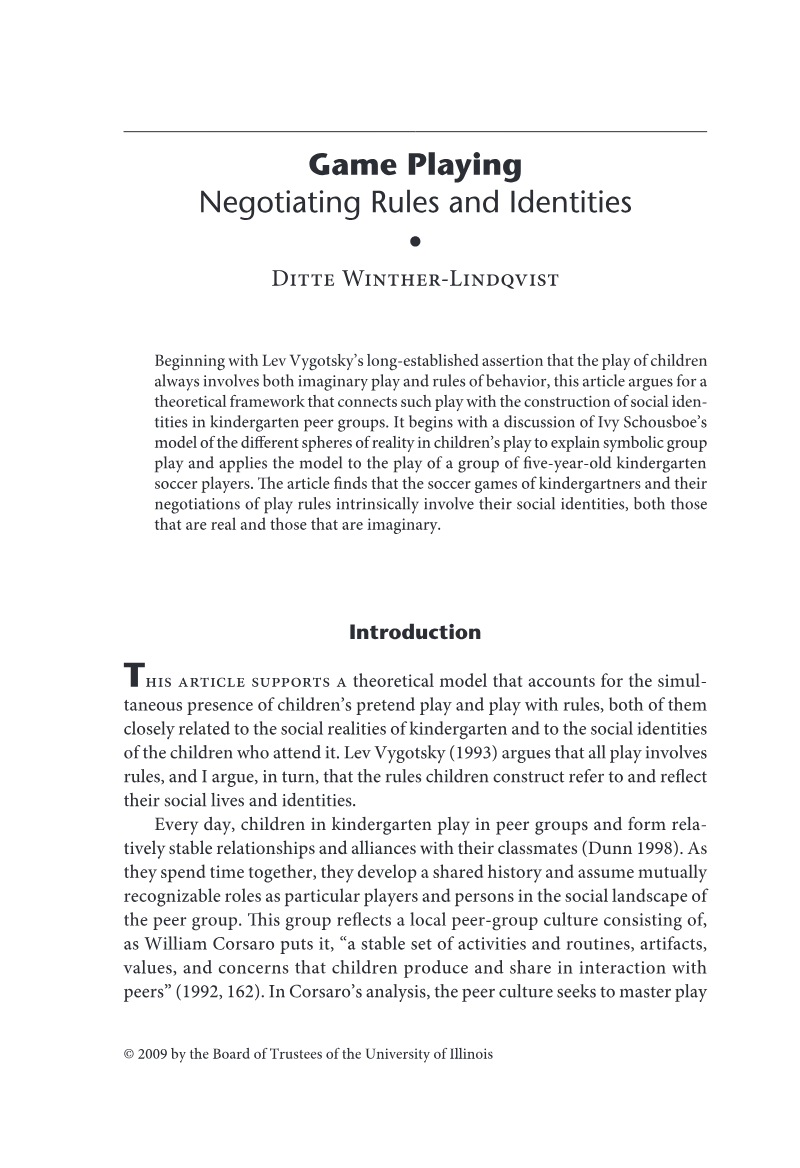
Game Playing: Negotiating Rules and Identities
Winther-Lindqvist's study, published in the American Journal of Play in 2009, examines how five-year-old boys in a Danish kindergarten use soccer play to negotiate rules and social identities.
- Children's rule-based games and pretend play are argued to be different expressions of the same underlying process: subjunctive 'as-if' and 'what-if' reasoning combined with ongoing work on social belonging, rather than separate activities.
- Based on fifteen unsupervised soccer matches among ten five-year-old boys in a Danish kindergarten, the children continually created and revised their own rules, often diverging from conventional soccer rules.
- Rulings in these games were shaped more by status and alliances than by abstract fairness or quality of argument; for example, whether a goal counted often depended on who had scored it.
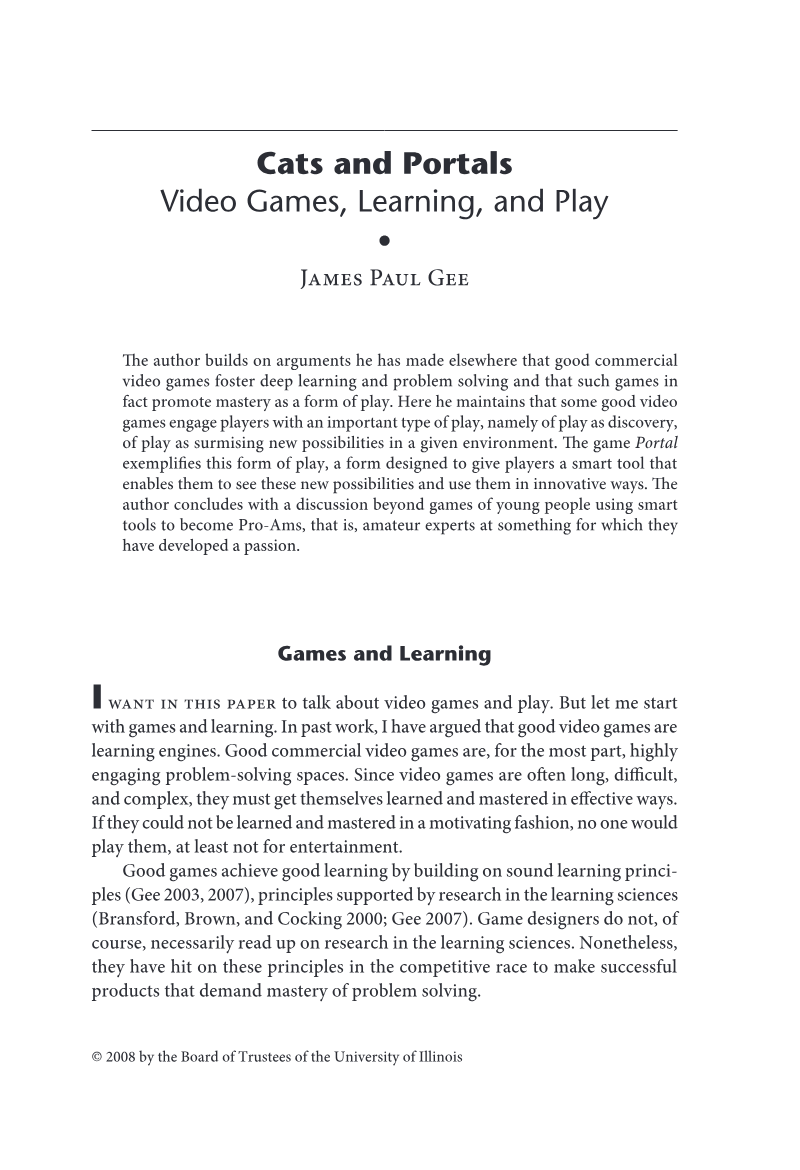
Cats and Portals: Video Games, Learning, and Play
James Paul Gee's "Cats and Portals" argues that video games are powerful learning engines, and that the discovery-driven play found in titles like Portal mirrors how people build knowledge with tools in everyday life.
- Play-driven learning, such as discovering mechanics through trial and hypothesis-testing in Portal, is presented as serious and increasingly consequential for the modern economy, deserving recognition alongside formal education.
- Gee's central example is a working-class young woman who taught herself Photoshop through The Sims and became a "Pro-Am" whose expertise exceeded much of what her schooling offered.
- Entertainment games like World of Warcraft and Yu-Gi-Oh! demand teamwork, specialized vocabulary, and sustained problem-solving, skills that parallel those required in school and workplaces.