1 free read left. Create a free account for unlimited reading + AI research.
Create free accountArticle American Journal of Play
1 free read left. Create a free account for unlimited reading + AI research.
Create free accountArticleAmerican Journal of Play
Marketing research identified this audience, and the museum's toy and doll collections were recognized as its most significant but underused holdings.
The Strong, formerly the Margaret Woodbury Strong Museum in Rochester, New York, reoriented itself around play after its original collections-based, industrial-era focus failed to sustain attendance. Attendance fell from roughly 150,000 in its opening year in 1983 to under 70,000 by 1986, while marketing research showed that about 70 percent of visitors were families with children twelve and under. Recognizing that its toy and doll collections were its most significant and underused holdings, the museum found that interactive exhibits drove sustained growth in visitors and membership. Its board unanimously adopted an exclusively play-centered mission after reviewing scholarly definitions of play, framing play's role broadly across learning, human development, and cultural history.
The institution's scope has expanded accordingly. Its holdings include over 400,000 collection items, and it now welcomes roughly 600,000 onsite visitors annually and more than 17,000 member households. Through its acquisition of the National Toy Hall of Fame in 2002 and the founding of the International Center for the History of Electronic Games in 2009, which holds over 40,000 items, the museum has extended its reach into toys and video games. Its 2012 Toy Hall of Fame inductions of dominos and Star Wars action figures generated nearly 1,700 online articles reaching an audience exceeding one billion, illustrating the public visibility its scholarship and exhibits can achieve.
The museum also positions its scholarly and archival work as central to its public role. It publishes the American Journal of Play, maintains the Brian Sutton-Smith Library and Archives, and operates interactive exhibits intended to make play research accessible. Adams argues that research does not support claims that video games cause real-world violence, reflecting the museum's stance that evidence should guide public discussion of play.
Community engagement forms another pillar, including free admission for foster families and therapists' clients, pediatric resident observation, and partnerships with social-service organizations. The museum advocates for play primarily through collections-based research, exhibits, and media presence rather than policy lobbying. Near-term plans include completing the America at Play exhibit, renovating the National Toy Hall of Fame, and adding water play, while long-term goals emphasize expanding digital access to its collections.
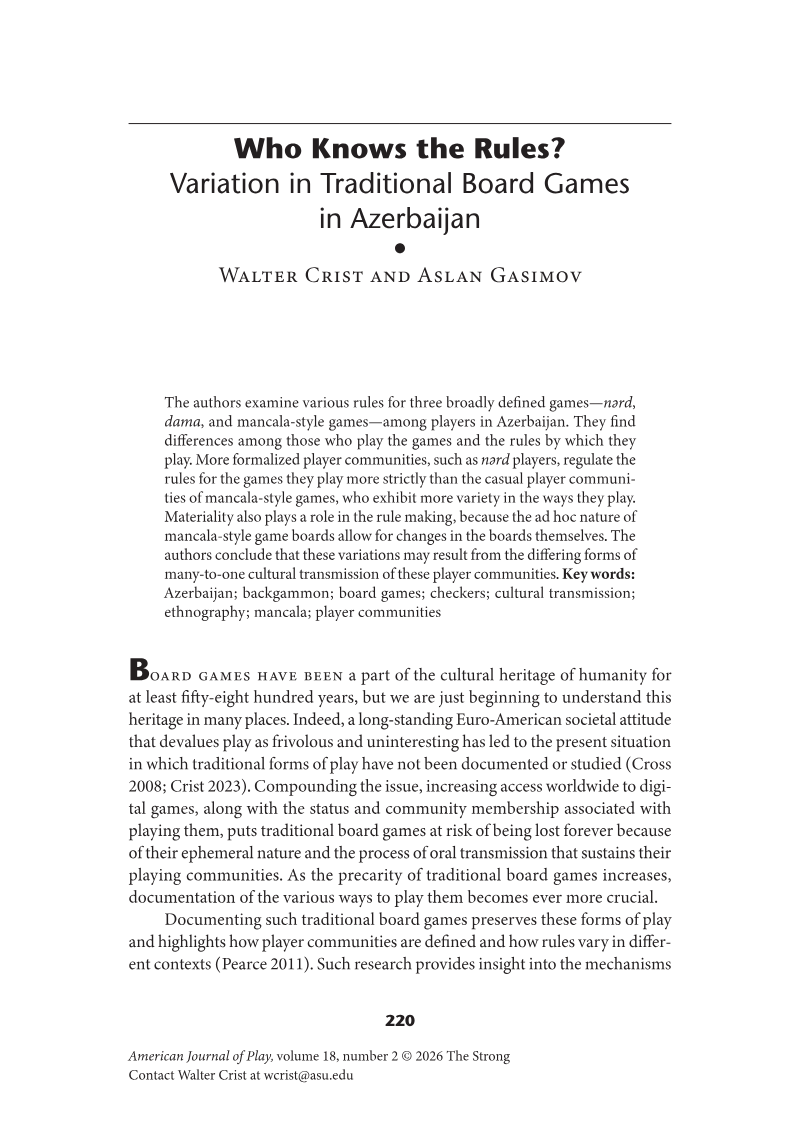
Each row is a game or company this document names, each column a document, oldest first. A mark means that document names it. Select a row to see those documents.
American Journal of Play · 2025
American Journal of Play · 2025
American Journal of Play · 2024
American Journal of Play · 2024
American Journal of Play · 2024
American Journal of Play · 2023
American Journal of Play · 2022
American Journal of Play · 2022
American Journal of Play · 2021
American Journal of Play · 2020
American Journal of Play · 2020
American Journal of Play · 2019