1 free read left. Create a free account for unlimited reading + AI research.
Create free accountArticle American Journal of Play
1 free read left. Create a free account for unlimited reading + AI research.
Create free accountArticleAmerican Journal of Play
Taylor describes play as an assemblage of technological structures, social processes, and personal meaning-making. Players co-construct their experience.
This interview with T. L. Taylor, a professor of Comparative Media Studies at MIT and co-founder of the esports organization AnyKey, traces her scholarly path from early childhood play and graduate-school interest in text-based virtual worlds to a sustained career studying online games, esports, and live streaming. Drawing on qualitative sociology and science and technology studies, Taylor argues that game play is an assemblage of technological structures, social processes, and personal meaning-making that routinely exceeds designers' intentions. Her work on the massively multiplayer online game EverQuest documented how players coconstruct their experience through raid calendars, guild structures, and user-interface modifications, and she frames this as a cocreative model of cultural production.
Several substantive findings recur throughout the discussion. Taylor's research on EverQuest found that online play is deeply social rather than isolating, that women are among the most dedicated players despite barriers to entry and retention, and that "power gamers" approach the same artifact in markedly different ways. Her later work on esports traces how the professional scene depends on institutions, broadcasters, sponsorship, and infrastructure beyond individual players, and she notes substantial regional variation, from South Korea's PC bang culture to China's integration of mobile titles. On live streaming, she identifies intellectual property law as a central constraint, since developers largely retain ownership of game content, and she describes how streamers and audiences blur the boundary between work and play.
The interview covers both the scope and the methods of this research. Taylor's approach combines interviews, participant observation, and archival work, and it draws on the empirical experiences of players, streamers, and tournament participants across North America, Europe, Asia, and India. She also addresses gender inclusion, the legitimacy of esports as a sport, and the viewing motivations of Twitch audiences, which range from education to entertainment to "ambient sociality." The conversation closes with her current shift toward studying everyday play in theme parks and with the work of AnyKey, which aims to pursue diversity and inclusion in competitive gaming through research-based programs.
Each row is a game or company this document names, each column a document, oldest first. A mark means that document names it. Select a row to see those documents.
American Journal of Play · 2025
American Journal of Play · 2025
American Journal of Play · 2024
American Journal of Play · 2024
American Journal of Play · 2024
American Journal of Play · 2023
American Journal of Play · 2022
American Journal of Play · 2022
American Journal of Play · 2021
American Journal of Play · 2020
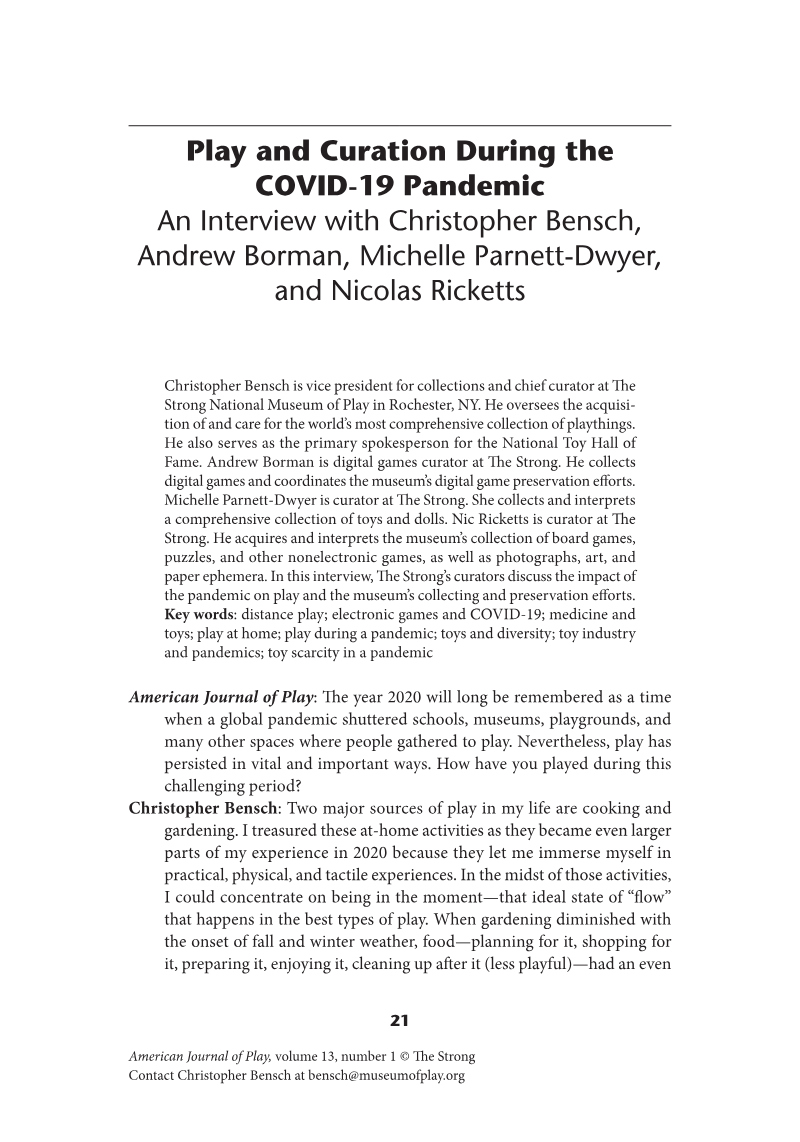
American Journal of Play · 2020
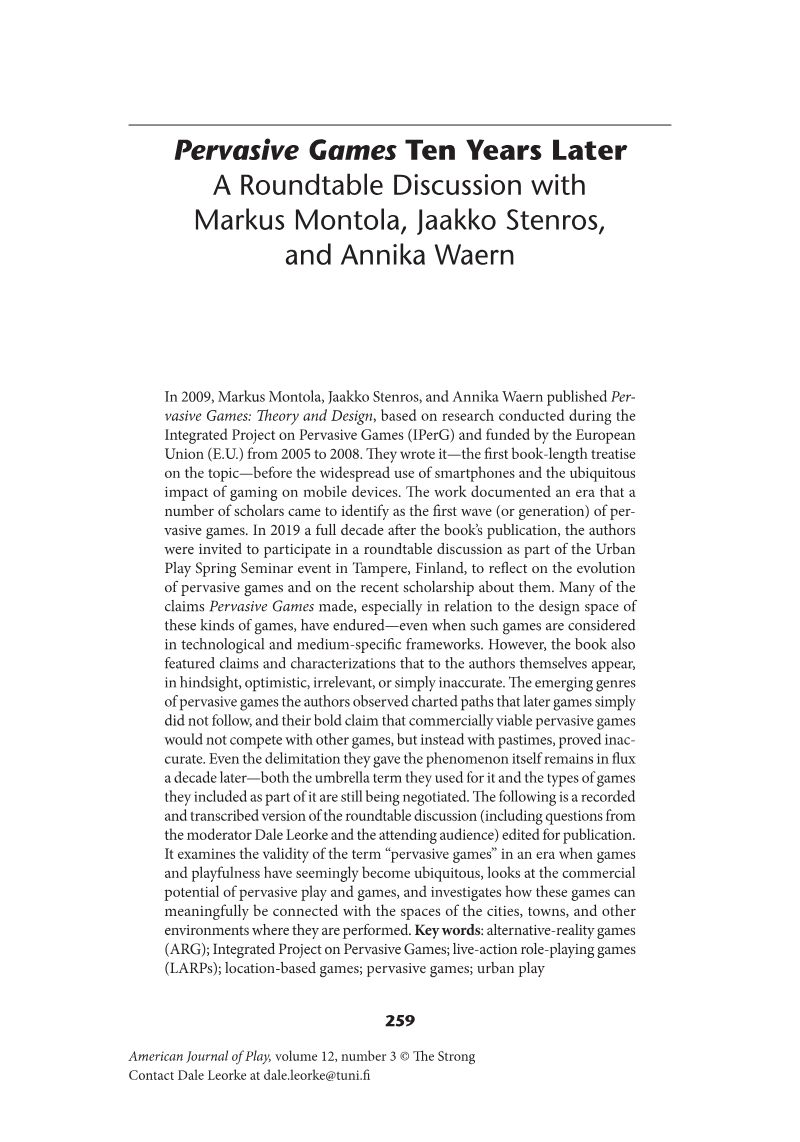
American Journal of Play · 2019
DiGRA · 2026