Player Behavior

169 documents·85 publishers

Documents

Page 1
Report31 pages

Les Français et le jeu vidéo: 2025

The French video game market has reached a historic peak in engagement, with 40.2 million individuals—representing 66% of the national population—identifying as players. The demographic profile of the average gamer has stabilized at 40 years old, characterized by near gender parity. Notably, women now constitute a 55% majority within the 16-30 age bracket, while the senior segment has expanded to 5.4 million participants. This broad adoption is accompanied by an increase in weekly playtime to nearly eight hours, driven largely by a preference for social and multiplayer experiences. Approximately 86% of players utilize multiplayer modes, and 60% report forming direct friendships through gaming, illustrating the medium's role as a primary driver of social cohesion across generations.

Professional interest in the sector is also rising, particularly among young adults, over a third of whom have considered industry careers. This cultural integration is supported by a robust regulatory and educational framework. Parental involvement is high, with 67% of parents actively monitoring their children’s gaming habits and 95% expressing awareness of parental control systems. The PEGI classification system remains the cornerstone of consumer protection, utilizing independent verification bodies to ensure content appropriateness across more than 35,000 titles. This system facilitates informed purchasing decisions and maintains safety standards for the nation's "digital native" demographics.

The industry’s operational landscape is anchored by the Syndicat des Éditeurs de Logiciels de Loisirs (SELL), which represents major publishers and manages significant cultural milestones such as Paris Games Week. Beyond market intelligence and event organization, the sector emphasizes social responsibility through initiatives like PédagoJeux and various inclusion-focused partnerships. These efforts ensure that the French gaming ecosystem remains both economically vibrant and socially responsible, balancing rapid growth with a commitment to player safety and diversity.

  • The French video game market has reached 40.2 million players, representing 66% of the national population with an average player age of 40.
  • Social and multiplayer gaming are primary engagement drivers, with 86% of players using multiplayer modes and 60% reporting the formation of direct friendships through gaming.
  • Gender parity is a defining characteristic of the market, with women now comprising a 55% majority of players in the 16–30 age demographic.
  • Parental engagement is high, as 67% of parents actively monitor gaming habits and 95% are aware of parental control systems.
  • The PEGI classification system serves as the primary consumer protection framework, covering more than 35,000 titles to ensure content appropriateness.
+1
SELL – Syndicat des Éditeurs de Logiciels de LoisirsJul 2025
Page 1
Report38 pages

From Data to Personas: The 2025 Guide to US Gaming Audiences

The modern gaming landscape in the United States has evolved into a diverse, cross-generational ecosystem that fundamentally challenges outdated stereotypes of the solitary, young male player. Current data indicates that today’s gaming population is characterized by middle-to-high-income individuals who prioritize quality, convenience, and social connectivity. Far from being sedentary, these consumers frequently integrate digital play with active, outdoor lifestyles, sports participation, and family-oriented activities. This shift reflects a broader demographic reality where gaming serves as a primary form of entertainment across all age groups and socioeconomic backgrounds.

Consumer behavior within this segment extends well beyond the digital realm, as gamers demonstrate significant purchasing power and a strong affinity for premium brands, casual dining, and higher education. Analysis reveals a consistent tendency for these audiences to over-index on online shopping and delivery services, favoring mainstream, value-oriented brands across the retail and fitness sectors. These habits suggest that gaming is not an isolated hobby but a central component of a lifestyle defined by convenience and digital-physical integration.

Segmentation reveals distinct behavioral patterns that allow for more nuanced marketing strategies. For instance, sports-oriented gamers gravitate toward fast-food and convenience-driven brands, whereas those who favor board, puzzle, and trivia games tend to be older, more education-focused, and financially prudent. By moving past monolithic industry tropes, advertisers can leverage these granular insights to execute more precise, data-driven campaigns. Ultimately, the gaming audience represents a highly active, diverse, and economically influential consumer base that requires sophisticated engagement strategies tailored to specific lifestyle personas rather than generalized assumptions.

  • The US gaming population is characterized by middle-to-high-income individuals who integrate digital play into active, outdoor, and family-oriented lifestyles rather than operating as a sedentary, isolated demographic.
  • Gamers demonstrate significant purchasing power with a strong affinity for premium brands, higher education, and convenience-based services like online shopping and delivery.
  • Gaming has evolved into a cross-generational, mainstream form of entertainment that transcends traditional age and socioeconomic stereotypes.
  • Consumer behavior within the gaming segment is highly segmented, with sports-oriented gamers favoring fast-food and convenience brands, while puzzle and trivia gamers skew older and more financially prudent.
  • Effective marketing in 2025 requires moving away from monolithic industry tropes in favor of granular, data-driven strategies tailored to specific lifestyle personas.
+2
AnzuJan 2025
Page 1
Whitepaper11 pages

Gaming's Cheating Crisis: The Impact on Players and Profit

The gaming industry is currently facing a widespread crisis regarding online cheating, which significantly undermines player retention, community trust, and developer revenue. This analysis, based on a survey of 2,013 gamers across the United Kingdom and the United States, reveals that cheating is no longer a fringe issue but a pervasive challenge affecting the majority of the gaming population. The findings underscore a critical need for industry-wide accountability measures to restore fair play and protect the financial health of game studios.

Data indicates that 80% of gamers have encountered cheating in online environments, with over half experiencing it at least monthly. This prevalence has direct consequences for business performance: 42% of players have considered quitting games entirely due to the presence of cheaters, and 55% have either reduced or ceased in-game spending. The impact is particularly acute among high-value players who spend between $11 and $50 monthly, a segment that represents the revenue backbone for many developers.

Despite these challenges, the gaming community remains highly receptive to robust solutions. A significant 83% of respondents expressed a greater likelihood to play games marketed as cheat-free, and 73% are willing to undergo identity verification to ensure a fair environment. Furthermore, there is strong support for systemic accountability, with 79% of gamers advocating for penalties that apply across multiple titles to prevent ban evasion.

The research concludes that while traditional anti-cheat measures are necessary, they are insufficient without mechanisms that enforce persistent, cross-game consequences. By adopting identity-based verification and unified accountability systems, developers have a clear opportunity to mitigate the negative financial impacts of cheating, improve player retention, and foster more sustainable, trustworthy gaming communities.

  • Cheating is a pervasive issue, with 80% of gamers encountering it and over 50% experiencing it at least monthly.
  • The presence of cheaters directly impacts revenue, as 55% of players have reduced or stopped in-game spending, particularly among high-value spenders.
  • Cheating is a significant churn driver, with 42% of players reporting they have considered quitting games entirely due to unfair play.
  • There is strong consumer demand for stricter security, with 83% of players more likely to play games marketed as cheat-free and 73% willing to undergo identity verification.
  • 79% of gamers support systemic, cross-title penalties to prevent ban evasion and ensure persistent accountability.
+2
PlaySafe IDJan 2025
Page 1
Report23 pages

2025 Mobile Gaming Benchmarks

The mobile gaming landscape in 2024 faced significant challenges regarding player loyalty, as 75 percent of titles failed to maintain a 3 percent retention rate by the 28th day. This decline underscores a critical industry shift where long-term viability is increasingly tethered to sophisticated content pacing, refined progression systems, and seamless onboarding experiences. Because retention serves as the primary engine for both user acquisition return on investment and sustainable monetization, developers must prioritize data-backed strategies to mitigate rising churn rates across the global market.

Engagement metrics reveal a nuanced performance gap between platforms and regions. While iOS continues to demonstrate superior early-stage engagement compared to Android, regional behaviors vary significantly; the Middle East currently leads in retention, whereas Africa and Oceania report the highest average playtime and session lengths, respectively. Genre-specific performance further complicates these trends, as Board and Card games exhibit robust long-term retention, contrasting sharply with Multiplayer titles that struggle to retain users despite commanding the longest average session durations of 8 to 9 minutes.

These insights, derived from an expansive dataset of over 100,000 active games, highlight the necessity of granular performance benchmarking. By comparing individual game metrics—including monetization, engagement, and retention—against global standards filtered by genre and player spending habits, studios can effectively optimize their development cycles. Ultimately, the industry is moving toward a model where success is no longer defined by broad acquisition, but by the precise, data-driven calibration of the player experience to ensure longevity in an increasingly competitive mobile ecosystem.

  • 75 percent of mobile games failed to achieve a 3 percent retention rate by day 28 in 2024, highlighting a widespread struggle to maintain long-term player loyalty.
  • Retention is the primary driver for both user acquisition ROI and sustainable monetization, making it the most critical metric for long-term viability.
  • Multiplayer titles command the longest average session durations of 8 to 9 minutes but struggle significantly with long-term user retention.
  • Board and Card games currently demonstrate the most robust long-term retention performance compared to other genres.
  • Regional engagement varies significantly, with the Middle East leading in retention, while Africa and Oceania lead in average playtime and session length, respectively.
+2
GameAnalyticsJan 2025
Page 1
Report26 pages

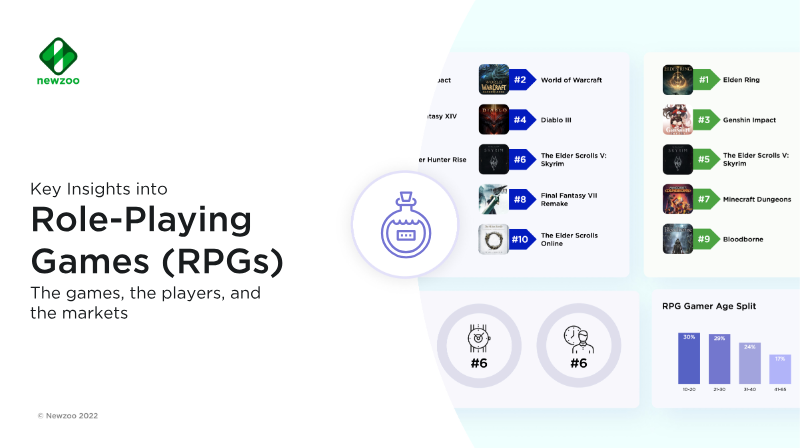
Key Insights into Role-Playing Games (RPGs)

Role-Playing Games (RPGs) represent the highest-revenue genre in the global gaming market as of 2022. The genre is characterized by deep character development, party-based mechanics, and progression systems centered on quests and combat. While RPGs are played across all platforms, they maintain a strong presence on PC and console, where they consistently rank among the top genres for monthly active users.

The demographic profile of the RPG audience is predominantly male, accounting for 58% of players, and skews toward younger age groups, with 59% of the player base falling between the ages of 10 and 30. Engagement patterns reveal that RPG players are highly active, averaging 18.8 sessions per month. The genre also demonstrates significant cross-genre appeal, with high player overlap in the adventure, shooter, and battle royale categories. High magical fantasy remains the most popular thematic element, utilized by 63% of the player base, while skill and talent trees serve as the most prevalent gameplay mechanic.

Monetization within the RPG space is dominated by pay-to-play models, which reach 97% of the player base, followed closely by in-app purchases at 90%. Geographically, the United States and Japan lead in monthly active users on PC and console. The genre also maintains a robust live-streaming presence, generating 205 million hours watched across platforms like Twitch and Facebook Gaming in June 2022. These insights are derived from data covering 37 markets, excluding China and India, and utilize proprietary gamer segmentation to analyze player motivations, viewing habits, and engagement metrics across the broader gaming ecosystem.

  • As of 2022, Role-Playing Games (RPGs) rank as the highest-revenue genre in the global gaming market.
  • The player base is predominantly male (58%) and young, with 59% of users falling between the ages of 10 and 30.
  • Monetization is heavily driven by pay-to-play models used by 97% of the player base, supplemented by in-app purchases at 90%.
  • High magical fantasy is the dominant theme, appearing in 63% of RPGs, while skill and talent trees remain the most prevalent gameplay mechanics.
  • RPG players exhibit high engagement, averaging 18.8 sessions per month, with significant audience overlap in the adventure, shooter, and battle royale genres.
+2
NewzooJan 2025
Page 1
Report94 pages

PC & Console Gaming Report 2025

Global PC and console revenues are expected to grow modestly through 2027, with consoles driving the majority of expansion at an estimated +13 % CAGR while PC revenue rises only in single digits. 2024 saw a plateau for PCs, dominated by free‑to‑play and in‑game monetisation, whereas console sales are set to rebound from 2025 thanks to strong releases such as GTA VI and the launch of Nintendo Switch 2. Player growth remains incremental, with PC players increasing at +2.3 % annually and console players at +3.5 %, driven largely by established franchises rather than breakthrough innovation.

Playtime data confirm that 2024 experienced a 6 % YoY increase, with Pay‑to‑Play titles (e.g., Call of Duty) and free‑to‑play hits (Fortnite, Roblox) accounting for most of the lift. New releases captured only about 9 % of total playtime, underscoring that long‑running series dominate the market. Console audiences remain heavily slate‑dependent: 67 % of new‑release hours come from annual franchises, while PC players show a higher share of non‑annual titles. In the US and Western Europe, non‑annual franchise games contribute a smaller slice of console revenue (≈8–22 %) compared to annual franchises, which drive the bulk of earnings.

Engagement patterns reveal a sharp decline in title diversity on PC and Xbox, with the average number of titles played per player falling 27 % on Steam in the US and up to 34 % in Russia and Brazil. PlayStation, by contrast, shows modest growth in title engagement. Genre preferences are shifting away from Battle Royale toward Adventure and Role‑Playing, reflecting a broader industry trend toward narrative‑rich, long‑form gameplay. Nostalgia and free‑to‑play models continue to sustain short‑term spikes, but long‑term retention hinges on continuous content updates and robust live‑service strategies. New IPs must prioritize originality, polished gameplay loops, and community‑first discovery to overcome the legacy brand advantage and achieve lasting commercial success.

  • Console revenue is projected to grow at a 13% CAGR through 2027, significantly outpacing single-digit growth for PC, with major catalysts including the release of GTA VI and the Nintendo Switch 2.
  • Market dominance is heavily concentrated in established franchises, as new releases captured only 9% of total playtime in 2024, with annual franchises accounting for 67% of new-release hours on consoles.
  • Title diversity is shrinking, evidenced by a 27% decline in the average number of titles played per user on Steam in the US, with drops as high as 34% in markets like Russia and Brazil.
  • Player growth remains incremental, with annual increases of 3.5% for console and 2.3% for PC, driven primarily by legacy brands rather than breakthrough innovation.
  • Genre preferences are shifting away from Battle Royale toward Adventure and Role-Playing titles, signaling a market trend toward narrative-rich, long-form gameplay.
+1
NewzooJan 2025
Page 1
Report37 pages

UK Interactive Entertainment Japan Market Report 2025

The report examines Japan’s interactive entertainment market for 2025, aiming to guide UK game developers and publishers in entering or expanding within a culturally distinct yet lucrative region. Japan accounts for only 2.2 % of the global player base but generates 9.1 % of worldwide game revenue, underscoring high per‑player spend—$223 in Japan versus $145 in the UK. The PC and console segment, excluding mobile and Nintendo platforms, represents a $2.5–3.0 billion opportunity.

Key market dynamics include an older player demographic than the US and Europe, a strong preference for single‑player role‑playing games with deep narratives, and a dominance of domestic publishers—70 % of console hardware sales are controlled by Japanese firms. Nintendo’s presence is particularly pronounced, while sports titles remain marginal. Revenue growth has been robust, with PC revenue rising 16.2 % YoY in 2024 versus a global 4.4 % increase, though the pace is expected to decelerate as the Japanese yen weakens against the dollar.

Methodologically, insights derive from Newzoo’s flagship global gamer study and proprietary market intelligence tools, sampling 73 000 gamers across PC and console platforms. The analysis covers player overlap, retention, and engagement metrics (DAU/MAU), and includes forecasted growth through 2027. The report concludes that strategic localization—emphasizing narrative depth, fantasy and science‑fiction themes, and solo play experiences—will be critical for success in Japan’s competitive landscape.

  • Japan generates 9.1% of global game revenue from only 2.2% of the global player base, with an average per-player spend of $223 compared to $145 in the UK.
  • The PC and console segment, excluding mobile and Nintendo platforms, represents a $2.5–3.0 billion market opportunity for developers.
  • PC gaming revenue in Japan grew 16.2% year-over-year in 2024, significantly outpacing the 4.4% global growth rate, though this momentum faces headwinds from a weakening yen.
  • Domestic firms dominate the market, controlling 70% of console hardware sales, with Nintendo maintaining a particularly strong presence.
  • Successful market entry requires prioritizing single-player role-playing games featuring deep narratives, fantasy, or science-fiction themes.
+1
UK Interactive EntertainmentJan 2025
Page 1
Report10 pages

Hyper-Casual Games – Industry Snapshot 2020

The snapshot presents a quantitative overview of the hyper‑casual mobile game sector for 2020, drawing on data from over 140 000 titles and more than 2 billion monthly sessions. The analysis disaggregates key performance indicators—day‑one and day‑seven retention, average playtime, ARPPU, ARPDAU, and conversion rates—across four dominant sub‑genres: timing, traversal, physics, and shooting. Timing games achieve the highest day‑one retention (≈44 %) but lower playtime, while traversal titles show slightly higher day‑seven retention (≈41 %). Average revenue per paying user ranges from $18 for physics games to $42 for timing titles, with conversion rates consistently below 1 % across all sub‑genres.

Geographically, France and Germany dominate early retention metrics (≈49 % day‑one), whereas Japan leads in average daily playtime (63 minutes). The United States, China, and South Korea exhibit moderate retention but lower playtime. In 2020, the most successful titles—such as “High Heels!” (traversal) and “Slap Kings” (timing)—combined high download volumes with strong engagement scores, reflecting the importance of low production effort and rapid iteration.

Methodologically, the report aggregates network data from GameIntel’s Explorer platform, employing a cross‑title average approach to benchmark performance. The findings underscore that hyper‑casual games thrive on brevity, simplicity, and forgiving mechanics; developers are advised to monitor day‑one retention thresholds (≈40 %) early in development and prioritize high‑impact, low‑effort optimizations to maximize user acquisition and monetization.

  • Hyper-casual developers should target a day-one retention threshold of approximately 40% early in the development cycle to ensure viability.
  • Timing games lead the sector in day-one retention at roughly 44%, while traversal titles demonstrate superior long-term engagement with day-seven retention near 41%.
  • Monetization performance varies significantly by sub-genre, with ARPPU ranging from $18 for physics-based games to $42 for timing titles, despite conversion rates remaining consistently below 1%.
  • Geographic performance metrics show France and Germany leading in day-one retention at 49%, while Japan records the highest average daily playtime at 63 minutes.
  • Successful 2020 titles like 'High Heels!' and 'Slap Kings' validate a development strategy centered on low production effort, rapid iteration, and simple, forgiving mechanics.
+2
GameIntelJan 2025
Page 1
Report88 pages

Genre and Great Games: Understanding Audiences and Designing Better Mobile Games

The study demonstrates that genre is the primary factor influencing mobile game adoption, with puzzle and matching titles dominating in North America and East Asia, while card‑casino games lead elsewhere. Within these markets, strategy players—comprising 12–26 % of the player base—exhibit high retention when titles incorporate live events, achievements, and daily rewards. Their spending patterns favor direct purchases over random loot boxes, especially in Japan, and they tolerate rewarded ads only when infrequent and longer. Strategy games also deliver the highest lifetime value, largely through aggressive use of battle passes (present in 92 % of top titles) and character or gear upgrades.

Role‑playing games attract players motivated by accomplishment, collection, and social interaction; churn is driven by repetitive gameplay and aggressive monetization. Successful RPGs mitigate this through frequent live events, multiple leveling paths, robust guild systems, and a balanced mix of loot boxes and bulk‑discount options. Monetization sensitivity varies regionally: U.S. players accept rewarded videos when they provide tangible benefits, whereas Korean and Japanese audiences are more tolerant of longer, character‑centric ads.

Puzzle players skew female (≈70 %) and older (≈60 % aged 35+), favoring short solo sessions for stress relief. Retention gaps stem from boredom and slow progress; top performers address this with live events, diverse level goals, and event currencies. While community engagement is low overall, a majority welcome developer communication and leaderboard features. Hyper‑casual audiences similarly value frequent updates, social cues, and ad‑friendly monetization that avoids pay‑to‑win perceptions.

Across all genres, the analysis identifies key mechanics—battle passes, VIP tiers, guilds, live‑event currencies, and ladder systems—that create recurring revenue streams and community retention. Combining season‑based progression with social collaboration and limited‑time rewards maximizes player lifetime value and monetization potential.

  • Strategy games deliver the highest lifetime value in mobile gaming, driven by battle passes—which are present in 92% of top-performing titles—and character or gear upgrades.
  • Strategy players, who make up 12–26% of the mobile base, prefer direct purchases over loot boxes and exhibit high retention when games feature live events, achievements, and daily rewards.
  • Puzzle games, which dominate North American and East Asian markets, attract a demographic that is approximately 70% female and 60% aged 35 or older, favoring short sessions for stress relief.
  • RPG player churn is primarily driven by repetitive gameplay and aggressive monetization, which successful titles mitigate through multiple leveling paths, guild systems, and a mix of loot boxes and bulk-discount options.
  • Monetization sensitivity varies by region: U.S. players prefer rewarded videos with tangible benefits, while Japanese and Korean audiences show higher tolerance for longer, character-centric advertisements.
+1
Facebook GamingJan 2025
Page 1
Report21 pages

Newzoo's Generations Report: How Different Generations Engage with Games

The report examines how gaming engagement varies across generational cohorts, drawing on a representative online sample of 72,068 respondents from 33 global markets (North America, EMEA, APAC). Data were collected via Computer Assisted Web Interviewing between January and April 2021. Findings show that younger generations devote a larger share of leisure time to gaming, with Gen Z and Millennials spending 11–12% of their free time on games versus 18% for Baby Boomers. Weekly playtime averages 7 hours and 20 minutes for Gen Z, 6 hours and 30 minutes for Millennials, dropping to just over 2 hours for Baby Boomers. Gaming remains the dominant entertainment medium across all ages, though motivations shift: younger players cite competition, socializing and achievement, while older players prioritize relaxation.

Platform preferences differ markedly; Gen Z spends 77% of gaming spend on mobile, whereas Baby Boomers allocate 73% to PC. Younger gamers also engage more with game‑related content, with 71–67% of Gen Z and Millennials both playing and watching games, compared to 44–51% for older cohorts. Persona segmentation reveals that “Ultimate Gamers” and “Community Gamers” dominate among Gen Z, whereas older groups are more likely to be “Time‑Fillers” or “Bargain Buyers.”

The report highlights the metaverse as a growing trend, with 70% of Gen Z and 63% of Millennials expecting to spend more time in virtual worlds. Overall, the study underscores a generational shift toward immersive, social gaming experiences and signals expanding opportunities for brands to reach diverse gamer audiences.

  • Gen Z and Millennials spend significantly more time gaming weekly, averaging 7 hours 20 minutes and 6 hours 30 minutes respectively, compared to just over 2 hours for Baby Boomers.
  • Platform spending habits are polarized by generation, with Gen Z allocating 77% of their gaming budget to mobile while Baby Boomers direct 73% of their spend toward PC.
  • Engagement with game-related content is higher among younger cohorts, as 67–71% of Gen Z and Millennials both play and watch games, compared to 44–51% for older generations.
  • Motivations for gaming diverge by age, with younger players prioritizing competition, socializing, and achievement, while older players primarily seek relaxation.
  • The metaverse is a significant growth area, with 70% of Gen Z and 63% of Millennials anticipating increased time spent in virtual worlds.
+1
NewzooJan 2025
Page 1
Report74 pages

Japan’s World of Gaming & Influencer Marketing 2025

Japan represents the world’s third-largest gaming market, valued at $26.3 billion in 2024 with projections to exceed $60 billion by 2033. This growth is underpinned by a mature player base of 55.5 million, characterized by the highest average revenue per user globally at approximately $580. While mobile gaming currently commands 75% of consumer spending, the market is undergoing a structural transition. Digital distribution and subscription models are increasingly replacing physical media, while the PC sector exhibits a robust 8.8% annual growth rate. Domestic giants Sony and Nintendo maintain market leadership by leveraging iconic intellectual properties and a cultural preference for narrative-heavy genres such as RPGs and adventure titles.

The ecosystem is increasingly defined by the convergence of gaming, live streaming, and broader entertainment. Esports revenue is expected to reach ¥21.8 billion by 2025, supported by a shift in viewership toward platforms like YouTube and Twitch. A unique cultural phenomenon in this space is the dominance of VTubers and virtual influencers, who drive significant engagement among Gen Z and Millennial demographics. Marketing strategies have pivoted toward these creators and nano-influencers to achieve authenticity, particularly as major publishers aim to quadruple the international market for Japanese content by integrating anime aesthetics into global entertainment ecosystems.

Technological advancements in 5G, cloud streaming, and augmented reality are further diversifying the landscape, though traditional social dynamics remain influential. While YouTube and X serve as the primary digital hubs for the gaming community, professional networking continues to favor established platforms like Facebook over LinkedIn due to local cultural barriers. As the mobile sector prepares for a projected rebound to $21 billion by 2025, the industry focus remains on cross-platform accessibility and the expansion of "evergreen" franchises within an increasingly digital and interconnected global market.

  • Japan’s gaming market is valued at $26.3 billion in 2024 and is projected to exceed $60 billion by 2033, supported by 55.5 million players and the world's highest average revenue per user at approximately $580.
  • Mobile gaming currently accounts for 75% of consumer spending, with a projected rebound to $21 billion by 2025, while the PC sector maintains a robust 8.8% annual growth rate.
  • Domestic leaders Sony and Nintendo maintain market dominance by leveraging iconic intellectual properties and a strong cultural preference for narrative-heavy RPGs and adventure titles.
  • Esports revenue in Japan is expected to reach ¥21.8 billion by 2025, driven by a shift in viewership toward YouTube and Twitch.
  • VTubers and virtual influencers are the primary drivers of engagement for Gen Z and Millennial demographics, leading publishers to prioritize these creators for authentic marketing.
+1
NintendoJan 2025
Page 1
Report87 pages

Understanding Audiences and Designing Better Mobile Games

The analysis establishes that genre is the primary driver of mobile‑game discovery, influencing 49 % of players across nine major markets and outweighing recommendations and advertising. Within this framework, strategy titles deliver the highest lifetime value and revenue per install, a result of dense monetisation layers such as consumable boosts, speed‑ups, loot‑box bundles and limited‑time offers. Player motivations and churn factors differ markedly by genre and region: Japanese action‑RPG/MMORPG users play chiefly for stress relief (47 %) and item collection (37 %), while boredom, repetitiveness and aggressive monetisation trigger attrition, mirroring the experience of over a third of Korean RPG players who abandon games due to pushy in‑app purchases.

Puzzle gamers are predominantly female (≈ 70 %) and older (≈ 60 % aged 35 +), favor short solo sessions, and seek stress relief and time‑killing. A pronounced mismatch exists between their expectations—learning, accomplishment and unique experiences—and current offerings, with only 17‑32 % feeling satisfied, leading to churn driven by boredom, slow progress and intrusive ads. Successful titles mitigate this through frequent live events, special‑event currencies and diverse level‑goal designs, while modest social engagement (20‑30 %) still influences retention. Notably, more than 80 % of U.S. puzzle players and roughly 68 % of Japanese players would return after a 30‑day hiatus if informed of new content, and 30‑36 % cite such updates as a decisive factor. Hyper‑casual audiences in the United States, United Kingdom and South Korea also demonstrate high receptivity to developer communication, exceeding 80 %.

A comprehensive catalogue of core gameplay and monetisation mechanics—battle‑passes, consumable boosts, crafting, limited‑time bundles, VIP tiers, loot‑boxes

  • Genre is the primary driver of mobile-game discovery for 49% of players across nine major markets, outweighing both advertising and recommendations.
  • Strategy games generate the highest lifetime value and revenue per install due to dense monetization layers including loot-box bundles, consumable boosts, and limited-time offers.
  • Puzzle games, which attract a demographic that is approximately 70% female and 60% aged 35+, suffer from high churn because only 17–32% of players feel satisfied with current offerings.
  • Aggressive monetization is a primary driver of attrition, causing over one-third of Korean RPG players to abandon games due to pushy in-app purchases.
  • Over 80% of U.S. puzzle and hyper-casual players, as well as 68% of Japanese puzzle players, are willing to return to a game after a 30-day hiatus if notified of new content.
+1
NewzooJan 2025

Publishers

Related Topics