North America

31 documents·11 publishers

Documents

Page 1
Report15 pages

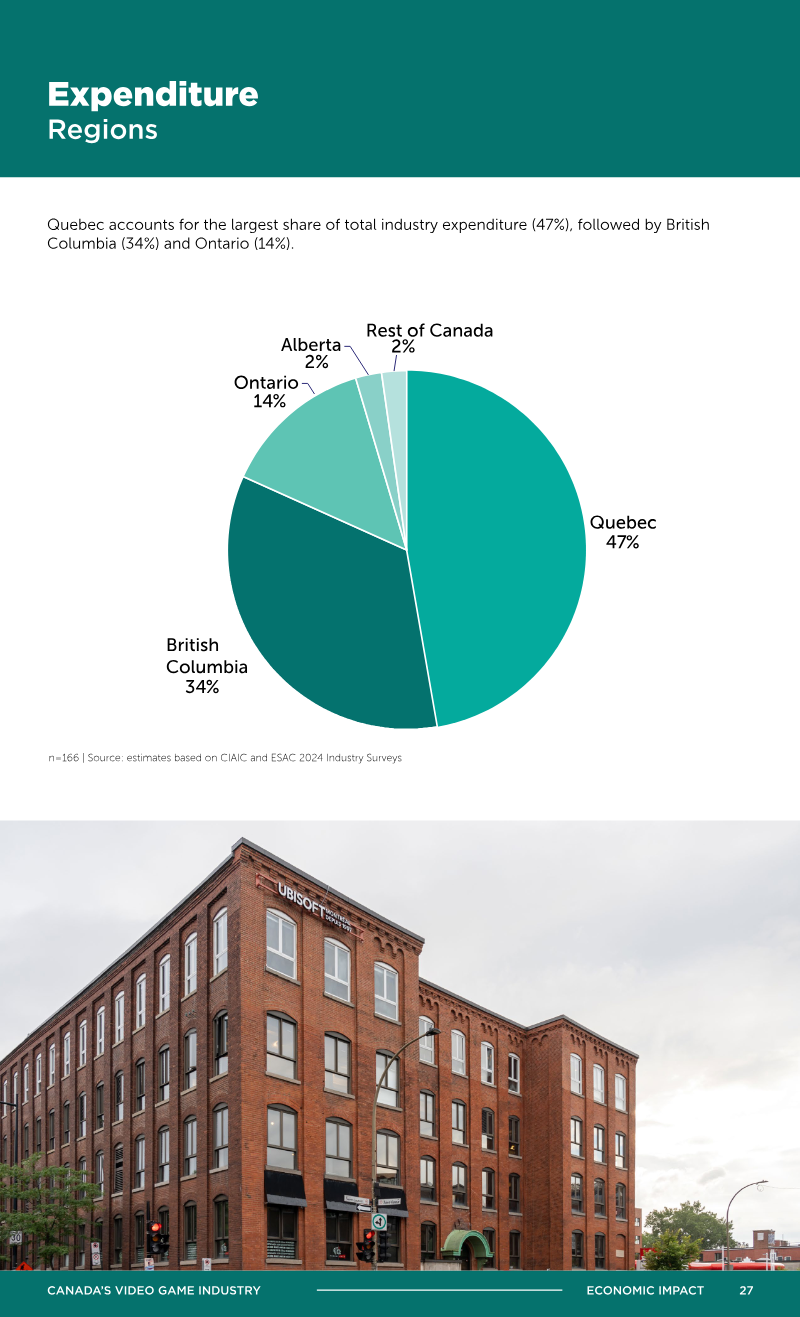
Annual Report 2023: Canada

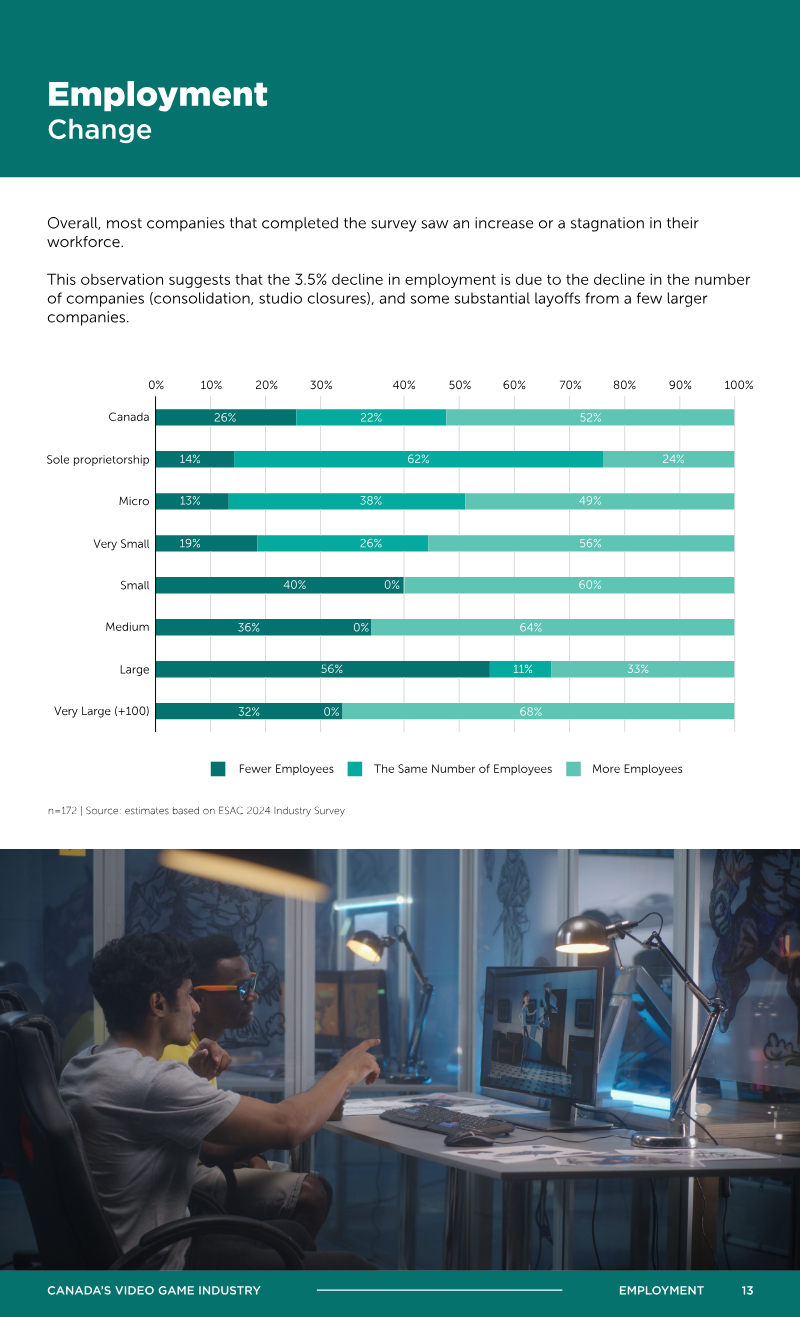
The 2023 annual review underscores a year of extraordinary expansion for Canada’s video‑game industry, positioning the nation as a pre‑eminent global hub for development talent and creative output. Canadian studios not only captured a record share of international awards and critical praise, but also deepened export revenues, reinforcing the sector’s contribution to the broader digital economy. Concurrently, the industry association intensified its advocacy agenda, securing more favourable regulatory frameworks and advancing diversity, equity and inclusion initiatives that aim to broaden participation across the workforce.

Financial analysis reveals that the Canadian Entertainment Software Association (ALD) concluded the fiscal year with a substantial surplus, reflecting both robust membership growth and effective cost management. The surplus enabled the organization to maintain flat membership fees for existing constituents while expanding its full‑time staff, thereby enhancing service delivery and policy‑making capacity. This fiscal stability signals confidence among stakeholders and provides a solid foundation for future strategic investments.

Geographically, the findings pertain to the Canadian market, encompassing all provinces and territories, and cover the calendar year 2023. The scope spans development studios, publishing entities, and ancillary service providers within the interactive entertainment ecosystem, as well as the association’s governance and advocacy functions.

Overall, the data illustrate a thriving, financially sound industry that is both internationally competitive and increasingly inclusive, supported by an association that leverages its surplus to reinforce member value and influence public policy.

  • Canada’s video game industry experienced extraordinary expansion in 2023, solidifying its status as a global hub for development talent and creative output.
  • Canadian studios achieved record-breaking international award recognition and critical acclaim throughout the 2023 calendar year.
  • The sector deepened its export revenues in 2023, significantly increasing its contribution to the national digital economy.
  • The Canadian Entertainment Software Association (ALD) ended the 2023 fiscal year with a substantial financial surplus resulting from robust membership growth and cost management.
  • The ALD utilized its fiscal surplus to increase full-time staffing and enhance policy-making capacity while maintaining flat membership fees for existing constituents.
+1
ESAC – Entertainment Software Association of CanadaJan 2023
Page 1
Report25 pages

The Rise of Midcore Mobile Games Snapshot Report

The midcore mobile gaming sector is experiencing a significant shift as AAA developers successfully port major PC and console franchises to mobile devices. Between Q1 2021 and Q1 2022, midcore games represented the only category to see market share growth, accounting for nearly 37% of US iOS mobile game revenue. This trend is further evidenced by the fact that nine midcore titles released in the past year remain in the top-200 grossing charts in the US, compared to only three casual titles.

The success of these high-performing midcore games is attributed to three essential design pillars: sophisticated control systems, diversified monetization, and high content cadence. Leading titles like Diablo Immortal and Genshin Impact have moved away from traditional mobile autoplay mechanics, instead favoring precision-based manual controls and immersive storytelling that mirror premium console experiences. These games effectively cater to player motivations centered on mastery and the adrenaline rush of reaction-based skills.

Monetization strategies in the midcore space have become increasingly complex. Top-performing games are significantly more likely to utilize Battle Passes, with 75% of the top 20% grossing midcore games employing the feature compared to just 25% of lower-ranking titles. Furthermore, gacha systems remain a dominant revenue driver; over 65% of top midcore games feature more than five different gachas. To maximize margins, a emerging trend shows publishers establishing external web stores to bypass standard app store commission fees.

Finally, maintaining a massive content cadence is critical for retention. Approximately 80% of top midcore games utilize special live event currencies to create temporary economic sinks and drive daily engagement. By combining frequent limited-time events with a steady stream of cosmetic updates and new gameplay modes, successful developers ensure long-term player interest in an increasingly competitive AAA mobile landscape.

  • Midcore games were the only mobile category to see market share growth between Q1 2021 and Q1 2022, capturing nearly 37% of US iOS mobile game revenue.
  • Successful midcore titles are increasingly adopting high-cadence content strategies, with 80% of top-performing games using special live event currencies to drive daily engagement.
  • Battle Passes are a primary monetization driver for top-tier midcore games, utilized by 75% of the top 20% grossing titles compared to only 25% of lower-ranking games.
  • Leading titles like Genshin Impact and Diablo Immortal are shifting away from mobile autoplay mechanics in favor of precision-based manual controls and immersive storytelling to mirror console experiences.
  • Gacha systems remain a dominant revenue source, with over 65% of top midcore games featuring more than five distinct gacha mechanics.
+1
GameRefineryJul 2022
Page 1
Report33 pages

Casual Gaming Trends Snapshot Report March 2022

This analysis examines the evolving landscape of the casual mobile gaming market as of March 2022, focusing primarily on the United States iOS market. The central thesis posits that the casual sector has become increasingly competitive, forcing developers to move beyond simple core gameplay by integrating sophisticated meta-elements, hybrid mechanics, and social features to maintain chart positions and drive player retention.

Key findings indicate a massive shift in the Match3 genre, where the presence of meta-elements in top-100 grossing games rose from under 10% six years ago to 70% by early 2022. Renovation and construction mechanics have emerged as the dominant trend; notably, every top-100 grossing casual game released in the two years preceding the report utilizes renovation elements. Construction features specifically appeared in 49% of top Match3 games, a significant increase from 7% in 2016. These elements are prized for providing visual progression and satisfying psychological "completionist" motivations without disrupting core game balance.

The scope of the research covers the casual genre hierarchy—including subgenres like Match3, Solitaire, and Time Management—with a specific focus on top-grossing titles on the US iOS platform. Data points highlight the stability of the top three casual games between Q4 2020 and Q4 2021, while noting that newer titles like Royal Match and Project Makeover successfully captured market share by leveraging episodic design and deep customization.

Methodologically, the insights are derived from the GameRefinery SaaS platform, utilizing a proprietary three-layered taxonomy (Category, Genre, Subgenre) developed with industry experts. The analysis concludes that successful casual games are increasingly adopting midcore-inspired features, such as social hangouts, competitive tournaments, and diverse minigames, to broaden their motivational appeal and create new monetization sinks in a post-IDFA marketing environment.

  • By early 2022, 70% of top-100 grossing Match3 games incorporated meta-elements, a massive increase from less than 10% six years prior.
  • Renovation and construction mechanics have become industry standard, appearing in every top-100 grossing casual game released between 2020 and 2022.
  • The integration of construction features in top Match3 games surged to 49% in 2022, up from just 7% in 2016.
  • Newer titles like Royal Match and Project Makeover successfully disrupted the market by utilizing episodic design and deep customization to challenge established top-grossing games.
  • Casual games are increasingly adopting midcore features—such as social hangouts, competitive tournaments, and minigames—to drive retention and monetization in a post-IDFA environment.
+2
GameRefineryMar 2022
Page 1
Report11 pages

Rapport Annuel 2022 de l'ALD: Canada

The Association canadienne du logiciel de divertissement (ALD) presents an overview of its 2022 activities, emphasizing the organization’s mandate to champion the Canadian video‑game sector through policy advocacy, industry research and public‑relations initiatives. Central to the narrative is the 2021 economic study conducted with Nordicity, which quantifies the sector’s contribution to the national economy and underscores its resilience amid pandemic‑induced disruptions.

The study reveals that the industry expanded from fewer than 700 active studios in 2019 to nearly 1 000 in 2021, employing more than 32 000 full‑time workers and supporting an additional 23 000 indirect jobs. Direct output now adds $5.5 billion to Canada’s gross domestic product, the highest level recorded to date. Survey participation reached a record 160‑plus responses, representing over 150 studios that supplied employment and financial data. Diversity and inclusion policies are in place at more than 80 % of studios with 100 or more employees, indicating a sector‑wide commitment to balanced talent pipelines.

Complementary efforts include a bilingual “#MyWhy” vaccination campaign that mobilized seven influencers to produce eight videos, and a newly funded guide outlining electronic‑waste recycling obligations for members. Media outreach, coordinated with Hill & Knowlton Strategies, generated roughly 39 million impressions, 66 000 Twitter impressions, 11 000 Instagram impressions and 42 000 YouTube views, translating into over 1 200 hours of video consumption. Virtual engagements with federal officials covered economic impact, immigration, skills development and cultural funding, while plans are under way for an in‑person “Games on the Hill” event in November 2022.

Overall, the report demonstrates that despite pandemic constraints, the Canadian video‑game industry has continued to grow, diversify and increase its cultural and economic influence, positioning Canada as

  • The Canadian video-game industry contributed $5.5 billion to the national GDP in 2021, marking the highest economic output recorded to date.
  • The sector experienced significant growth between 2019 and 2021, with the number of active studios increasing from fewer than 700 to nearly 1,000.
  • The industry currently supports 32,000 full-time direct employees and an additional 23,000 indirect jobs.
  • Over 80% of studios with 100 or more employees have implemented formal diversity and inclusion policies to support talent development.
  • Media outreach initiatives generated approximately 39 million impressions across various platforms, including 42,000 YouTube views totaling over 1,200 hours of consumption.
+1
ESAC – Entertainment Software Association of CanadaJan 2022
Page 1
Report20 pages

Match3 Genre Snapshot: US iOS (May 2021)

The Match3 subgenre represents the largest individual segment of the US iOS mobile gaming market, accounting for approximately 16% of total market revenue as of May 2021. While the category has long been dominated by established titles that have maintained chart positions for years, recent market shifts indicate a move away from traditional swapping mechanics. Notably, none of the new Match3 titles entering the top 500 grossing rankings over the last 18 months utilize standard swapping gameplay, signaling a diversification in core mechanics and the rising importance of meta-layers.

Meta-elements, particularly those focused on decoration and customization, have become essential components for modern success in the genre. Successful megahits like Royal Match and Project Makeover demonstrate the effectiveness of combining core puzzle gameplay with deep progression systems and sophisticated monetization strategies. Data indicates that recurring live events, special event rewards, and limited-time in-app purchase offers have the highest impact on revenue. Furthermore, social features such as guild mechanics and "send/ask help" systems are increasingly vital for driving engagement and retention.

Player motivation analysis, based on a survey of over 7,000 mobile gamers across English-speaking Western markets, reveals distinct psychological drivers within the genre. While "Thinking and Solving" remains the primary driver for traditional titles like Candy Crush Saga, newer successful entries increasingly lean into "Customization and Decoration" and "Role-playing and Emotions." This shift reflects a broader industry trend where loss aversion mechanics and social competition are leveraged to enhance the player experience and maximize lifetime value in a highly competitive landscape.

  • As of May 2021, the Match3 subgenre accounts for approximately 16% of total US iOS mobile gaming revenue.
  • No new Match3 titles entering the top 500 grossing rankings over the last 18 months utilize standard swapping mechanics, indicating a shift toward gameplay diversification.
  • Modern Match3 success is increasingly driven by meta-layers, specifically decoration and customization features seen in titles like Royal Match and Project Makeover.
  • Revenue performance in the genre is most heavily influenced by recurring live events, special event rewards, and limited-time in-app purchase offers.
  • Social features, including guild mechanics and help-request systems, are now essential for maintaining player engagement and retention.
+5
GameRefineryMay 2021
Page 1
Report30 pages

The State of Mobile Game Advertising 2021

The report examines U.S. mobile game advertising in 2021, focusing on ad network share of voice (SOV), creative formats, genre‑specific trends, and demographic alignment. Five gaming‑centric networks—Chartboost, Unity, Adcolony, ironSource, and Vungle—dominated game advertising, each maintaining over 90 % SOV from games on iOS and Android. In contrast, mainstream social platforms (Facebook, Instagram, TikTok, YouTube) displayed a more balanced mix of gaming and non‑gaming ads, with SOV from games ranging 40–60 %. AppLovin and MoPub shifted toward gaming in late‑2018, investing heavily in hypercasual publishers; this pivot increased their game SOV to roughly 90 % on iOS and 80 % on Android by early‑2021. AdMob’s focus on Google Play titles grew, with its game SOV rising from 60 % to 80 % by Q2 2021.

Creative analysis shows video ads remain the dominant format across networks, accounting for >50 % of game ad spend on iOS and Android. Playable ads gained traction among hypercasual publishers (e.g., AppLovin) and, more recently, mid‑core titles such as Call of Duty: Mobile and State of Survival. Full‑screen ads were more common on Android, especially for Google Play games.

Genre‑level insights reveal puzzle and hypercasual games rely heavily on gaming‑focused networks (Chartboost, Unity), while mid‑core and strategy titles favor broader platforms like Facebook and YouTube. Casino games concentrated on Adcolony, which also hosts many real‑money reward creatives.

The study concludes that despite IDFA changes, game advertising volumes remained stable into 2021. Publishers can optimize spend by matching network demographics to target audiences—YouTube for younger, male strategy players; Adcolony for older, female casino gamers—and by adopting emerging creative trends such as simple playable ads and background music to differentiate in a crowded market.

  • Gaming-centric networks including Chartboost, Unity, Adcolony, ironSource, and Vungle maintained over 90% share of voice (SOV) for mobile game advertising on iOS and Android throughout 2021.
  • AppLovin and MoPub aggressively pivoted toward hypercasual publishers, increasing their game SOV to approximately 90% on iOS and 80% on Android by early 2021.
  • AdMob increased its focus on Google Play titles, raising its game SOV from 60% to 80% by Q2 2021.
  • Video ads remain the primary creative format, accounting for over 50% of total game ad spend across both iOS and Android platforms.
  • Mainstream social platforms like Facebook, Instagram, TikTok, and YouTube maintain a more balanced advertising mix, with gaming-related content representing only 40–60% of their total SOV.
+1
Sensor TowerJan 2021
Page 1
Report78 pages

The State of Mobile Gaming: An Analysis of Mobile Gaming Market Trends and Top Titles in the U.S., Europe, and Asia

The analysis demonstrates that the mobile‑gaming market expanded dramatically during the COVID‑19 pandemic, with global quarterly revenue reaching $33 billion in Q2 2020 and downloads climbing 39 % to 16 billion. The United States remains the dominant spend market, contributing 28 % of worldwide revenue in 2020 and generating $7 billion in Q1 2021, while emerging regions such as India (12 % of global installs) and Brazil drive download growth but lag in monetization. Hyper‑casual and shooter titles—PUBG Mobile, Garena Free Fire, Subway Surfers—consistently occupy top download positions worldwide.

In 2020 and early 2021, revenue concentration persisted in mature markets (U.S., Japan, China), yet fast‑growing regions like Europe and Southeast Asia presented expanding opportunities. European revenue was led by Playrix ($700 M) and Supercell ($600 M), with Israeli publishers also in the top‑10, while installs remained near pandemic highs at roughly 4 billion in Q1 2021. In Asia, India’s explosive download growth (nearly 3 billion installs in Q3 2020) and Indonesia’s 26 % YoY rise positioned the region as the dominant market, with PUBG Mobile and Honor of Kings topping download charts. Despite a 44 % YoY decline in Chinese installs, mobile‑game spend there continued to rise, contributing to Asian revenue of $12 billion in Q1 2021.

Genre‑level insights reveal hyper‑casual games as the fastest‑growing segment, expanding from 757 million installs in Q1 2018 to over 3.4 billion by Q1 2021 and accounting for more than 30 % of all mobile downloads that quarter. Freemium models dominate monetization, with 99 % of App Store revenue derived from free titles; subscription adoption remains a minority (≈29 %) among top U.S. games. Advertising revenue is heavily concentrated in puzzle and hyper‑casual titles, which captured over 30 % of ad spend across major networks in 2020. Playrix led overall ad spending, especially for its puzzle franchises, while Zynga’s acquisition of Rollic Games spurred a sharp increase in hyper‑casual ad spend on AdMob and Facebook.

Overall, the data underscore a mobile‑gaming ecosystem where mature markets generate the bulk of revenue, emerging regions drive download growth, hyper‑casual and battle‑royale titles dominate user acquisition, and freemium monetization models—supported by advertising—remain the primary revenue engine.

  • The mobile gaming market is bifurcated between mature markets like the U.S., Japan, and China, which generate the bulk of global revenue, and emerging regions like India and Brazil, which drive the majority of download volume.
  • Hyper-casual games are the fastest-growing segment, surging from 757 million installs in Q1 2018 to over 3.4 billion in Q1 2021, representing more than 30% of all mobile downloads.
  • Freemium models are the industry standard, accounting for 99% of App Store revenue, while subscription models remain a minority, utilized by only 29% of top U.S. games.
  • Asia remains a massive revenue engine, generating $12 billion in Q1 2021, even as China experienced a 44% year-over-year decline in installs alongside rising per-user spend.
  • Advertising revenue is heavily concentrated in puzzle and hyper-casual genres, which captured over 30% of total ad spend across major networks in 2020.
+2
Sensor TowerJan 2021
Page 1
Report14 pages

Rapport Annuel 2021

The 2021 annual review underscores the emergence of video‑games as a pivotal social and economic force within Canada, where roughly 61 % of the population—about 23 million people—engage in regular play. Pandemic‑era surveys reveal that 58 % of adult gamers and 80 % of adolescents increased their gaming time, while disposable income previously allocated to cinema and travel was redirected toward interactive entertainment, positioning gaming as the dominant medium in the national leisure landscape.

Advocacy and industry support intensified throughout the year. The association shifted to virtual engagement with parliamentarians, deployed a paid Globe and Mail advertisement, and produced a targeted video message to maintain policy visibility during COVID‑19. A new content‑manager bolstered digital capacity, and coordinated outreach—including bi‑weekly provincial briefings, a monthly liaison call with provincial bodies, and a legally vetted return‑to‑work guide—facilitated the successful exclusion of video‑game developers and console manufacturers from the revised Canadian Broadcasting Act, averting potential royalties amounting to tens of millions of dollars and avoiding additional regulatory burdens.

Operational resilience was demonstrated as approximately 30 000 industry employees transitioned to remote work without disrupting the majority of scheduled releases. Financial stewardship met all set objectives, remaining within budget while expanding strategic initiatives. The sixth‑year student competition attracted 20 entries, awarding a $6,000 prize, reflecting ongoing investment in talent development and community engagement across the Canadian gaming sector.

  • The Canadian video game industry successfully lobbied to be excluded from the revised Canadian Broadcasting Act, avoiding tens of millions of dollars in potential royalties and regulatory burdens.
  • Approximately 23 million Canadians—61% of the population—are regular gamers, with 58% of adults and 80% of adolescents increasing their playtime during the pandemic.
  • The industry maintained operational continuity during 2021 as 30,000 employees transitioned to remote work without disrupting the majority of scheduled game releases.
  • Consumer spending shifted during the pandemic, with disposable income previously allocated to cinema and travel redirected toward interactive entertainment.
  • Industry advocacy efforts in 2021 included virtual parliamentary engagement, targeted media campaigns in The Globe and Mail, and the implementation of a legally vetted return-to-work guide.
Association canadienne du logiciel de divertissementJan 2021
Page 1
Report19 pages

The Modern Mobile Gamer: 2021 Gen Z Edition

This analysis examines the mobile behaviors, gaming habits, and advertising preferences of Generation Z, defined as individuals born in 1997 or later. Based on a February 2021 survey of 7,103 U.S. consumers aged 18–24 on the Tapjoy network, the findings characterize this demographic as "digital natives" who view the smartphone as their primary device for entertainment, social connection, and commerce. The study utilizes opt-in participation and rewarded survey methodology to gather data on a generation that currently represents $140 billion in buying power.

Key findings indicate that Gen Z is heavily invested in the mobile ecosystem, with 86% using mobile as a gaming platform—significantly higher than the 42% who use consoles. The COVID-19 pandemic accelerated these trends, as 71% of respondents reported playing more mobile games in 2020. Beyond gaming, the demographic is highly active in mobile commerce; 68% shop via mobile one to four times per week, frequently purchasing to-go food, retail items, and subscription services. Socially, Gen Z favors Instagram and TikTok over Facebook and increasingly rejects traditional gender stereotypes in marketing.

The research concludes that Gen Z has a unique, high-standard relationship with advertising. They largely reject intrusive, non-skippable, or inauthentic content, preferring ads that offer a value exchange. Consequently, 54% of respondents prefer rewarded ads over other formats, and 53% engage with rewarded mobile game ads—outperforming engagement rates on Instagram (38%) and TikTok (23%). To successfully reach this audience, brands must prioritize humor, social and environmental awareness, and opt-in experiences that respect the user's digital autonomy.

  • Mobile is the dominant gaming platform for Gen Z, with 86% of the demographic using smartphones for gaming compared to only 42% who use consoles.
  • Rewarded advertising is the most effective engagement strategy for this group, with 54% preferring rewarded ads and 53% engaging with them, significantly outperforming Instagram (38%) and TikTok (23%).
  • The COVID-19 pandemic significantly accelerated mobile gaming adoption, with 71% of Gen Z respondents reporting increased mobile gameplay during 2020.
  • Gen Z is highly active in mobile commerce, with 68% of the demographic shopping via mobile devices one to four times per week for food, retail, and subscriptions.
  • This demographic, representing $140 billion in buying power, rejects intrusive or inauthentic advertising in favor of content that respects digital autonomy and incorporates humor or social awareness.
+2
TapjoyJan 2021
Page 1
Report16 pages

Rapport Annuel 2020 de l’ALD

Canada’s video‑game sector continued to function as a high‑growth engine in 2020, supporting roughly 48 000 full‑time‑equivalent positions, of which 27 700 are direct industry jobs, and generating about C$4.5 billion in GDP. The number of development studios expanded by 16 percent to approximately 700, and sales increased despite the disruptions of the COVID‑19 pandemic. A remote‑work guide and a targeted outreach campaign helped maintain employment levels, while an economic‑impact study of 185 respondents confirmed a favourable policy and investment climate for the industry.

Leadership within the sector is exemplified by senior figures such as Tania, a veteran with more than 15 years of experience and a champion of diversity through the EA Women’s Employee Resource Group, and Éric Martel, director of AI and machine‑learning at Eidos‑Montréal, who oversees research for flagship franchises. Their profiles underscore the growing technical sophistication and inclusive culture emerging across Canadian studios.

Strategic initiatives in 2020 focused on talent development and cultural recognition. Partnerships with the Conseil des technologies de l’information et des communications launched the Integrated Work‑Based Learning program to place students in industry roles, while the inaugural Canadian Game Awards moved to a digital format. Support for the Canadian Screen Awards introduced three new video‑game categories, signalling the medium’s expanding cultural relevance despite modest submission volumes. Financially, the association reported a solid position, reinforcing its capacity to sustain growth‑oriented programs and diversity‑focused pipelines throughout the Canadian gaming ecosystem.

  • Canada’s video game sector generated approximately C$4.5 billion in GDP and supported 48,000 full-time-equivalent positions in 2020.
  • The number of development studios in Canada grew by 16 percent in 2020, reaching a total of approximately 700 studios.
  • The industry maintained employment levels throughout the COVID-19 pandemic by implementing remote-work guides and targeted outreach campaigns.
  • Strategic talent development was bolstered by a partnership with the Conseil des technologies de l’information et des communications to launch an Integrated Work-Based Learning program for students.
  • The Canadian Screen Awards increased the cultural recognition of the sector by introducing three new video-game categories.
+1
ESAC – Entertainment Software Association of CanadaJan 2020
Page 1
Report14 pages

Rapport Annuel 2019 Entertainment

The 2019 annual report of the Canadian Entertainment Software Association (ALD) outlines the organization’s role as the principal advocate for Canada’s video‑game sector, emphasizing a strategic focus on member‑first principles, regulatory advocacy, and public perception. Central to its thesis is the conviction that a coordinated, policy‑friendly environment and heightened visibility of the industry’s economic contribution will sustain long‑term growth.

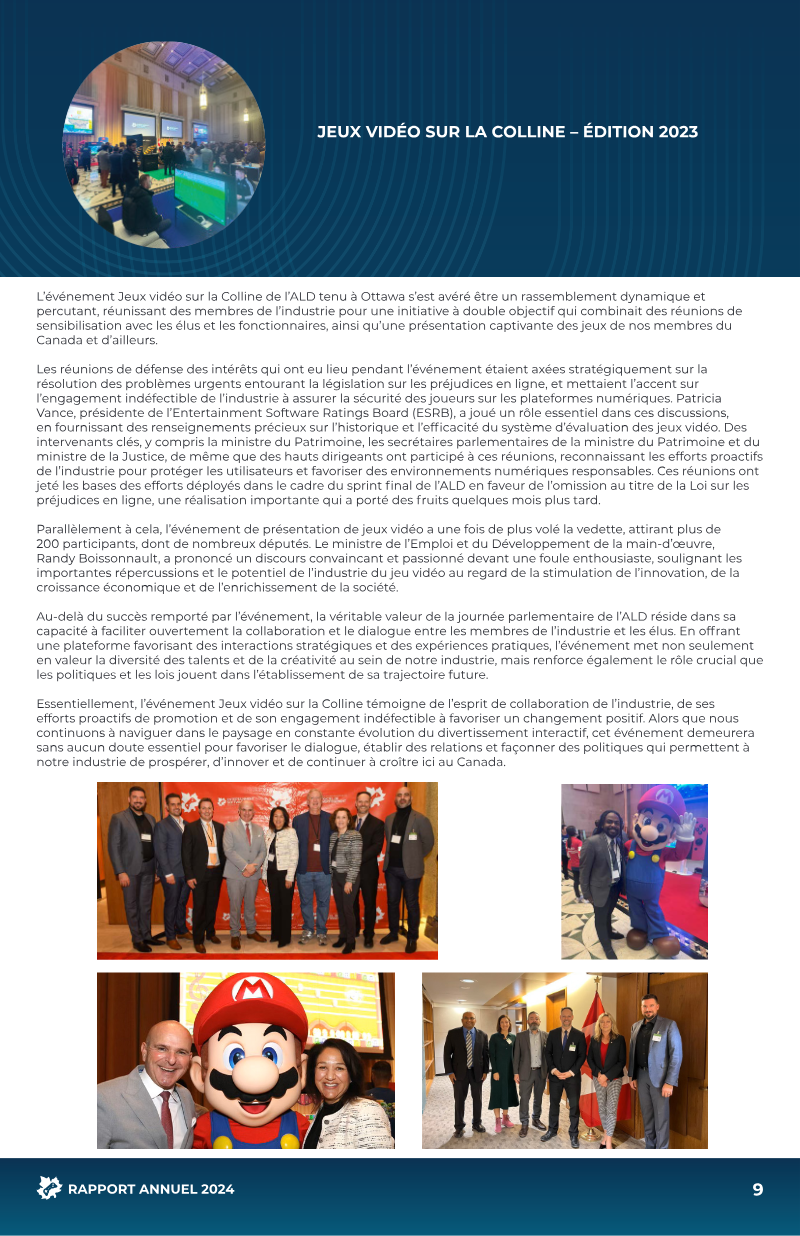
Key findings highlight a robust domestic market, with more than 23 million Canadians identified as regular gamers through a 2018 NPD Group survey that captured demographic, console usage and purchasing patterns. The “Jeux vidéo sur la Colline” event drew a record 250 participants, including 25 federal legislators, and featured leading publishers such as Ubisoft, Nintendo, EA and Xbox, underscoring the sector’s political engagement. ALD’s lobbying efforts included testimonies before multiple parliamentary committees and direct dialogue with Minister Navdeep Bains, reinforcing support for tax‑credit frameworks and innovation policies. Internationally, the association participated in the Global Video Game Associations Summit in Santa Monica, addressing issues like loot‑box regulation and the WHO’s inclusion of gaming disorder in ICD‑11.

Operational highlights for 2019 include the appointment of a new director of policy and a director of communications, a targeted media campaign that secured coverage in four major Canadian newspapers, and the launch of bilingual parental‑control tutorials in partnership with console manufacturers. Membership remained stable while two prominent publishers, Codename Entertainment and Kabam, joined the association, reflecting continued expansion of the member base. Overall, the report demonstrates ALD’s comprehensive advocacy, research, and outreach activities aimed at strengthening Canada’s video‑game ecosystem during the fiscal year.

  • The Canadian video-game market remains robust, with a 2018 NPD Group survey identifying over 23 million regular gamers in Canada.
  • The Entertainment Software Association (ALD) successfully engaged 25 federal legislators and major industry players including Ubisoft, Nintendo, EA, and Xbox during the 'Jeux vidéo sur la Colline' event.
  • Lobbying efforts focused on securing tax-credit frameworks and innovation policies through direct dialogue with Minister Navdeep Bains and testimonies before parliamentary committees.
  • The association expanded its membership base in 2019 by adding publishers Codename Entertainment and Kabam.
  • ALD addressed international regulatory challenges, specifically loot-box legislation and the WHO’s classification of gaming disorder in the ICD-11, at the Global Video Game Associations Summit.
ESAC – Entertainment Software Association of CanadaJan 2019
Page 1
Report16 pages

Essential Facts 2014: Canada

The 2014 overview of Canada’s video‑game sector presents a comprehensive picture of an industry that ranks among the world’s largest by per‑capita employment and is a cornerstone of the nation’s digital economy. Drawing on custom research commissioned by the Entertainment Software Association of Canada (ESAC)—including NPD surveys of 3,359 adults and 526 teens in 2014, a 2012 survey of 2,969 adults, 527 teens and 687 children, and quantitative data from 90 Canadian companies—the analysis covers national trends, regional breakdowns, workforce characteristics, public perception and consumer behaviour.

Employment figures reveal 16,500 individuals directly working in game development, equivalent to 27,000 full‑time jobs, with a 5 % increase in staff between 2011 and 2013 and two‑fifths of firms forecasting a 25 % expansion within two years. The sector generated $2.3 billion in GDP contribution and $1.6 billion in direct spending, a 12.5 % rise from 2011. More than half of Canadian companies identify as independent developers, and 53 % of the 329 firms operate as such. Salaries average $72,500 annually, with a median employee age of 31,

  • Canada’s video game sector directly employs 16,500 people, representing 27,000 full-time equivalent jobs.
  • The industry contributed $2.3 billion to Canada’s GDP and generated $1.6 billion in direct spending, marking a 12.5% increase since 2011.
  • Employment in the sector grew by 5% between 2011 and 2013, with 40% of firms projecting a 25% staff expansion within two years.
  • Independent developers comprise 53% of the 329 identified Canadian game companies.
  • The average annual salary for industry employees is $72,500, and the median age of the workforce is 31.
+1
ESAC – Entertainment Software Association of CanadaJan 2014

Publishers

Related Topics