Market Analysis reports and market data
Documents

Is Gaming in an AI Bubble? What the Deal Data Says
The gaming industry is currently undergoing a structural transition characterized by a shift from speculative content creation toward infrastructure, hardware, and artificial intelligence.
- Gaming financing reached a 12-month high in Q2 2026 with over $2.5 billion raised, despite the total volume of deals dropping from roughly 200 per quarter in 2021-2022 to below 100.
- Capital allocation has shifted away from general content and studio funding toward AI, ad-tech, and hardware, with AR glasses emerging as a significant platform bet.
- The current funding landscape for game studios is bifurcated; while AI-native gaming companies are attracting massive capital, studios that raised small rounds in 2021-2022 are struggling to secure follow-on financing.
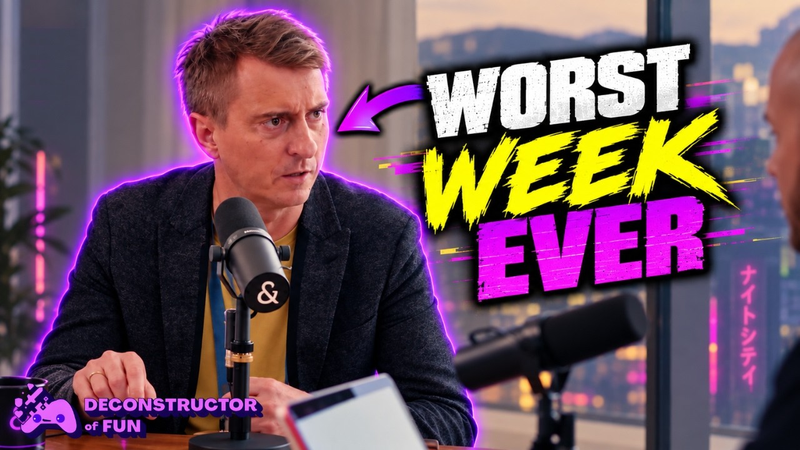
Why None of Us Saw Cyberpunk Coming Apart I Michal Nowakowski. joint CEO, CD PROJEKT RED
CD Projekt Red’s evolution from a regional distributor to a global AAA powerhouse is rooted in a strategy of intellectual property ownership and creative independence.
- CD Projekt Red restructured its development operations by abandoning proprietary technology in favor of Unreal Engine 5 to mitigate technical risks and streamline production.
- The studio transitioned from a siloed, waterfall production model to a unified, multi-platform approach that utilizes rigorous gating milestones to prevent future launch failures.
- Despite a 75% decline in stock value following the technical failures of Cyberpunk 2077, the studio achieved long-term commercial recovery with 35 million base game units sold and 10 million expansion units sold.

🎮 Playables Are Now 40-60% of Creative Spend: Here's what's working ńow
Playable advertisements have emerged as a dominant force in digital marketing, currently accounting for 40% to 60% of total creative spend across the gaming and non-gaming sectors.
- Playable advertisements now represent 40% to 60% of total creative spend across both gaming and non-gaming sectors.
- The industry is shifting toward 'Frankenstein playables,' which synthesize multiple proven, high-engagement mechanics like yarn puzzles and rescue scenarios into a single ad unit.
- Non-gaming sectors, including finance and social apps, are adopting gamified elements like obstacle-avoidance and item-catching to drive user engagement through low-friction interactions.

Apple's $2,000+ iPhone Duo and the backlash to new EU App Store rules | Week in Mobile Games podcast
Apple is aggressively targeting the premium mobile gaming sector with the introduction of the iPhone Duo, a foldable device priced at $1,999.
- Apple has launched the iPhone Duo, a foldable smartphone with a 7.6-inch internal display and 5.4-inch outer screen, priced starting at $1,999.
- Apple is collaborating directly with studios like Azra Games to optimize titles for the iPhone Duo and iPhone 18 Pro Max, including the implementation of 120Hz support and advanced graphics modes using Metal FX.
- Valorant Mobile saw significant growth in August 2026, with revenue reaching $53.7 million—a 68% month-over-month and 375% year-over-year increase—driven primarily by the Chinese market.

Sony Fumbles Kojima, Zelda’s Ocarina of Load Times & Skyrim LOVES Ikea | Games For Breakfast
The gaming industry is currently navigating a period of significant strategic volatility, characterized by shifting publisher priorities and evolving consumer expectations.
- IKEA has released a playable Skyrim mod featuring actor Matt Barry as part of a marketing campaign to promote a new shelving system.
- Sony and Kojima Productions have experienced a public disconnect regarding the developer's departure from the PlayStation ecosystem, with Xbox actively courting the studio.
- Nintendo has confirmed it will not provide refunds to customers for costs associated with past illegal tariffs, instead opting to host a customer appreciation sale to discount products.

🚨📢BREAKING NEWS: EA merging with Savvy? Chinese market hits $50bn, Pokemon GO record spend week
The gaming industry is currently experiencing significant shifts driven by market expansion in China, potential large-scale corporate consolidation, and aggressive monetization strategies.
- The Saudi Public Investment Fund is reportedly exploring a merger between Electronic Arts and Savvy Games Group, a move that would consolidate major franchises including EA Sports FC, Battlefield, and Monopoly Go.
- The Chinese gaming market has surpassed $50 billion in annual revenue, with a projected player base of 769 million by 2030 and mini-games now accounting for nearly 20% of mobile revenue.
- Live-service optimization continues to drive record-breaking performance, evidenced by Pokémon Go achieving its highest weekly revenue since launch and Delta Force reaching $10 million in daily spending.

TWIG #400: Is the Game Industry Actually Crashing, OpenAI's Astra and 8 Years of Hot Takes
The global gaming industry is currently undergoing a structural market correction rather than a catastrophic collapse.
- The gaming industry is undergoing a structural market correction rather than a collapse, with employment levels remaining stable at approximately 750,000 workers since 2022.
- The sector remains fundamentally robust, supported by a global player base exceeding 4 billion and a 16% compound annual growth rate in mobile advertising.
- Indie game revenue has increased sixfold over the past decade, highlighting a significant shift in market distribution alongside AAA development budgets that now range from $250 million to $400 million.
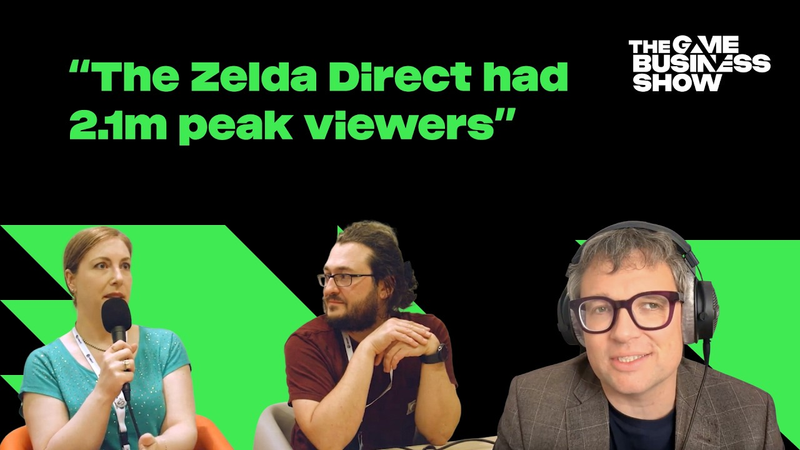
The Legend of Zelda: Ocarina of Time and GTA 6: The video game industry’s Barbenheimer moment
The simultaneous anticipation surrounding the upcoming remake of The Legend of Zelda: Ocarina of Time and the impending launch of GTA 6 represents a pivotal cultural moment for the gaming industry.
- The simultaneous anticipation for the Ocarina of Time remake and GTA 6 serves as a primary catalyst for market engagement, mirroring major industry showcases.
- The gaming industry is experiencing cyclical volatility, marked by significant layoffs in North America contrasted with growth in the Asia-Pacific region.
- Studios are shifting development strategies by balancing cost-effective outsourcing with the need for local talent retention and cultural alignment.

Games on iPhone Duo, Lego builds mobile arm, more App Store news, August’s top performers and more
The mobile games industry is currently navigating significant shifts in hardware, corporate strategy, and market performance.
- Apple's new iPhone Duo features a 7.6-inch Super Retina XDR display, an A20 Pro chip with a seven-core GPU, and performance metrics claiming up to 40% faster graphics and 35% better sustained performance than the iPhone 17 Pro.
- Reports indicate that new Apple leadership, including App Store boss Eddy Cue and CEO John Ternus, are seeking to increase App Store revenue, a strategy that reportedly contributed to the departure of former head Phil Schiller.
- LEGO Digital Play has acquired Offroad Games, the developer behind Chrome Valley Customs, as part of an expansion of its London-based mobile gaming division.
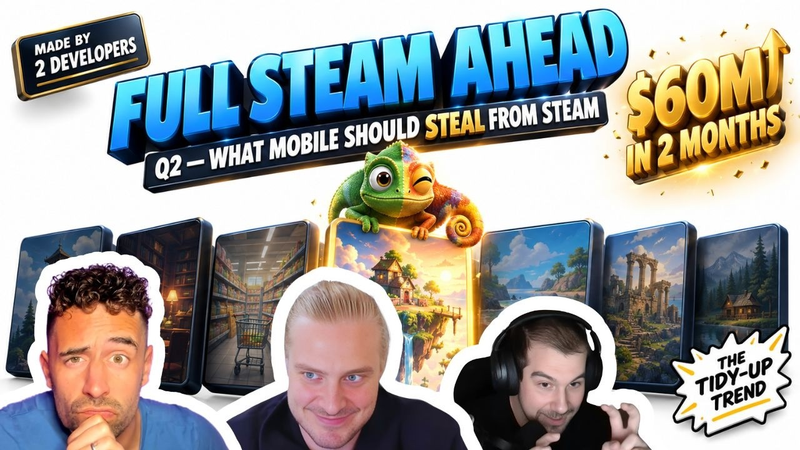
🚂 Full Steam Ahead Q2: 12 Steam Hits & which ones work on Mobile?
The second quarter of the year reveals a distinct trend in the gaming industry where mid-tier, non-AAA titles on Steam serve as a primary incubator for innovative gameplay concepts.
- Steam's most successful mid-tier titles prioritize addictive, loop-based core mechanics—such as inventory management and sorting—over high-fidelity production values.
- High-performing Steam releases, including Pratfall, Librarian, and Content Warning, demonstrate that revenue potential is increasingly driven by core gameplay engagement rather than traditional AAA complexity.
- The viral success of Make a Chameleon, which reached 60 million plays in two months, highlights the effectiveness of simple, streamable mechanics combined with community-driven tools like the Steam Workshop.

S07, E32: The CAPI revolution
The digital advertising landscape is undergoing a fundamental structural shift as the industry moves away from browser-based pixel tracking toward server-to-server Conversions APIs.
- The transition from browser-side pixels to server-to-server Conversions APIs (CAPI) represents a permanent structural shift in digital advertising, moving measurement away from browser-controlled environments to direct, authenticated data exchanges.
- CAPI allows platforms like Meta to receive deterministic conversion feedback by matching advertiser-supplied identifiers—such as email addresses, phone numbers, and IP addresses—directly against the platform's own authenticated user base.
- The 'everything is an ad network' phenomenon has intensified as retailers (e.g., Lowe's, Ace Hardware) and service providers (e.g., Chase, United Airlines) leverage their own first-party purchase and transaction data to build proprietary advertising businesses.

Why Video Game Developers Love Remakes
The prevalence of video game remakes is driven by a combination of strategic risk mitigation, operational efficiency, and creative opportunity.
- Remakes serve as a risk mitigation strategy by providing a clear, pre-defined vision, which reduces the uncertainty and decision-making overhead associated with developing entirely new intellectual property.
- Studios utilize remakes to train staff on new tools and development pipelines, such as transitioning from Unreal Engine 4 to 5, without the added complexity of inventing a new game concept simultaneously.
- Remakes provide a productive outlet for large development teams during the 'pre-production' phase of a new project, preventing the need to assign staff to low-value busy work while core directors prototype the next title.