Market Analysis
Documents

Cross-Platform Gaming: Bridging Mobile and PC/Console 2025
The global gaming landscape in 2025 is defined by a strategic synergy between the accessibility of mobile platforms and the immersive depth of PC and console ecosystems. Mobile serves as the primary engine for discovery and user acquisition, generating over 52 billion annual downloads and $82 billion in in-app purchase revenue. Meanwhile, PC and console platforms, led by storefronts like Steam, anchor brand loyalty and drive high-value engagement through seasonal peaks and premium content. By leveraging mobile’s massive reach to feed into high-fidelity ecosystems, publishers maximize total franchise growth and ensure long-term revenue stability.
Publishers are increasingly bridging these distinct markets through four primary models: companion apps, "lite" versions for mass-market discovery, adapted experiences, and full cross-platform progression. Success stories such as the EA SPORTS FC companion app, which reached 78 million downloads, demonstrate how mobile accessibility sustains franchise loyalty. Furthermore, titles like PUBG Mobile and Delta Force illustrate that mobile engagement frequently drives corresponding spikes in PC player activity. This interconnectedness is particularly effective for RPGs and Shooters, which utilize unified ecosystems and shared progression to significantly increase player lifetime value and retention.
Ultimately, a successful cross-platform strategy balances high-volume mobile genres, such as Simulation and Puzzle, with the prestige and monetization intensity of blockbuster PC and console releases. Adapting complex intellectual properties into accessible mobile formats allows franchises to capitalize on broader cultural trends, as seen with the resurgence of the Fallout brand. By treating mobile as a discovery engine and PC/console as the anchor for brand identity, publishers can effectively navigate the global market to capture both broad audiences and high-spending core players.
- Mobile platforms function as the primary discovery engine for the gaming industry, generating over 52 billion annual downloads and $82 billion in in-app purchase revenue.
- Publishers maximize franchise growth by using mobile to feed into high-fidelity PC and console ecosystems, which anchor brand loyalty and drive high-value engagement.
- Cross-platform progression and unified ecosystems are most effective for RPG and Shooter titles, significantly increasing player lifetime value and retention.
- Companion apps are a proven strategy for sustaining franchise loyalty, evidenced by the EA SPORTS FC companion app reaching 78 million downloads.
- Mobile engagement frequently correlates with increased player activity on PC, as demonstrated by titles like PUBG Mobile and Delta Force.

Digital Market Index: Q3 2025
Global mobile app consumer spending reached a record $43.2 billion in the third quarter of 2025, representing an 11.3% year-over-year increase. This growth was primarily fueled by a 20% surge in non-game revenue, particularly from Generative AI tools which generated $1.5 billion during the period. While total global downloads remained stable at 37.6 billion, a clear divergence emerged between sectors; non-game downloads grew by 5.5%, while gaming installs continued a post-pandemic decline. Geographically, the United States maintained its market leadership with $15 billion in revenue, though Brazil emerged as the fastest-growing major market with a 29% revenue increase. India simultaneously reached a two-year high in downloads, surpassing 6.5 billion.
The digital advertising landscape saw significant expansion, with U.S. spend rising 12% to $35.9 billion. Social media remains the dominant channel, capturing 72% of the market, but mobile app advertising is the fastest-growing segment at 42% year-over-year. Within specific industries, the gaming sector entered the top five spending categories for the first time following a 28% increase in investment. Strategic shifts were also evident in the insurance and consumer goods sectors, where companies like Geico and Procter & Gamble executed massive quarterly spending spikes to capitalize on premium fluctuations and seasonal demand.
Retail media has become a critical pillar of the digital economy, dominated heavily by Amazon. Generating over 80 billion impressions, Amazon’s reach surpassed the combined total of the next thirty major retailers. Outside of Amazon's ecosystem, retail media impressions grew 7% year-over-year, though performance was inconsistent across platforms; Target and Best Buy saw double-digit growth while Walmart experienced a decline. Personal care remains the most competitive retail category, driven by high-volume co-branded partnerships between major manufacturers and established retail platforms.
- Global mobile app consumer spending reached a record $43.2 billion in Q3 2025, an 11.3% year-over-year increase driven by a 20% surge in non-game revenue.
- Generative AI tools emerged as a significant revenue driver, contributing $1.5 billion to the mobile app market during the third quarter.
- U.S. digital advertising spend rose 12% to $35.9 billion, with mobile app advertising identified as the fastest-growing segment at 42% year-over-year.
- Gaming sector investment in digital advertising grew by 28%, securing its position as a top-five spending category for the first time.
- Amazon dominates the retail media landscape with over 80 billion impressions, exceeding the combined total of the next thirty major retailers.
Integrated Report: Value Creation Story
DeNA entered a transformative "Second Founding" phase in FY2024, marked by a significant financial recovery and a strategic pivot toward company-wide AI integration. Revenue reached 164.0 billion yen with a Non-GAAP operating profit of 32.9 billion yen, driven primarily by the global success of Pokémon Trading Card Game Pocket. While the Game Business remains the core profit engine, the organization is diversifying its portfolio across Live Streaming, Healthcare, and a record-performing Sports segment to mitigate the volatility of hit-driven cycles. The company has established a FY2026 Non-GAAP operating profit target of 15.0 billion yen, emphasizing sustainable, structural growth over short-term gains.
Central to this evolution is the "AI-ALL-IN" strategy, which aims to double productivity and launch approximately 10 AI-native products. This transition is supported by a robust human capital framework, including the DeNA AI Readiness Score (DARS) to track employee literacy and a shift toward market-linked, performance-based compensation. To manage development risks, the Game Business has adopted a "soft launch strategy" focused on iterative testing. Meanwhile, the Sports segment achieved 40 billion yen in revenue, and the Healthcare division is pivoting toward medical digital transformation despite facing recent impairment losses.
Governance and sustainability are integrated into this value creation story through a board composed of 50% independent directors and a rigorous risk management framework. DeNA maintains high standards for data security and has committed to a 58.8% reduction in Scope 1 and 2 emissions by FY2033. By balancing aggressive AI adoption with disciplined capital allocation—including strategic share sales and increased dividends—the organization seeks to harmonize social value with long-term profitability across its diverse digital and physical business ecosystems.
- DeNA achieved 164.0 billion yen in revenue and 32.9 billion yen in Non-GAAP operating profit in FY2024, largely fueled by the global performance of Pokémon Trading Card Game Pocket.
- The company is executing an 'AI-ALL-IN' strategy targeting a 100% increase in productivity and the launch of approximately 10 AI-native products.
- The Sports segment has become a major revenue pillar, generating 40 billion yen in the last fiscal year, helping to diversify the company away from hit-driven game cycles.
- Management has set a conservative FY2026 Non-GAAP operating profit target of 15.0 billion yen, prioritizing structural, sustainable growth over short-term volatility.
- To improve operational efficiency, the company implemented the DeNA AI Readiness Score (DARS) to track employee literacy and transitioned to a market-linked, performance-based compensation model.
Live Streaming Basics: A Comprehensive Introduction
The global live-streaming landscape underwent a transformative shift in the third quarter of 2025, characterized by record-breaking viewership and a significant redistribution of market power. Total viewership reached 9.6 billion hours across traditional platforms, representing a 13% year-over-year increase. However, the most profound development was the emergence of TikTok Live as a dominant force, recording 9.1 billion hours watched and nearly doubling the output of Twitch. This surge reflects a broader consumer pivot toward mobile-integrated content and has resulted in Twitch’s market share falling below 50% for the first time, a decline exacerbated by aggressive internal crackdowns on fraudulent viewbotting.
Content trends during this period favored non-gaming categories and massive live events over traditional gameplay. Non-gaming content led with 1.7 billion hours watched, while Ibai’s La Velada del Año V set a new industry benchmark with 9.2 million peak concurrent viewers. Although esports viewership grew by 8% to 805 million hours, the sector saw a notable migration of audiences from Twitch toward YouTube and TikTok, largely driven by the Esports World Cup. In the gaming sector, EA Sports FC 26 emerged as the quarter's premier release, generating 62.3 million hours watched within its first month.
Individual creator performance and brand integration reached new heights of commercial impact. Kai Cenat dominated the landscape, leading all creators with 91.4 million hours watched and setting a record with 1.1 million subscriptions during his "Mafiathon 3" event. This level of engagement translated into significant brand visibility, as evidenced by a 26,000-mention surge for Crocs during Cenat’s broadcast. While female viewership was led by ExtraEmily and the VTuber category saw Usada Pekora reclaim the top spot, the overarching trend indicates that high-production marathons and cross-platform accessibility are now the primary drivers of growth and monetization in the streaming economy.
- TikTok Live has emerged as a dominant market force with 9.1 billion hours watched, causing Twitch’s market share to drop below 50% for the first time.
- Total global live-streaming viewership reached 9.6 billion hours in Q3 2025, marking a 13% year-over-year increase.
- Non-gaming content is now the primary driver of viewership with 1.7 billion hours watched, while massive live events like 'La Velada del Año V' set new records with 9.2 million peak concurrent viewers.
- Esports viewership grew 8% to 805 million hours, though audiences are increasingly migrating from Twitch to YouTube and TikTok, influenced by events like the Esports World Cup.
- High-production marathon events are driving record engagement, exemplified by Kai Cenat’s 'Mafiathon 3' which generated 1.1 million subscriptions and significant brand spikes.
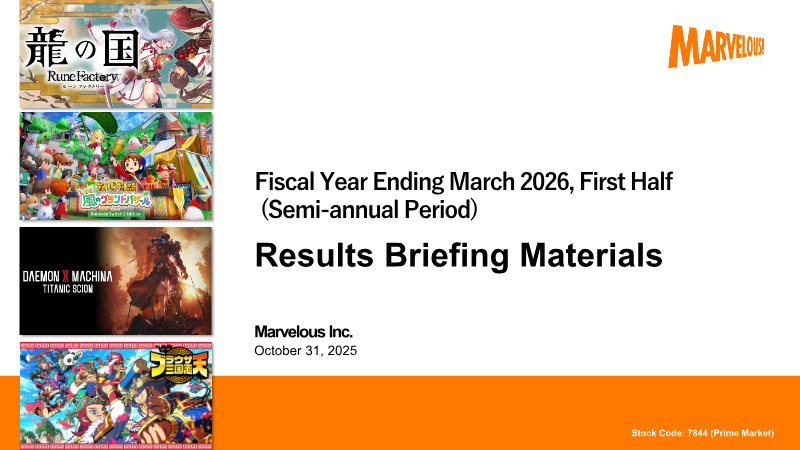
Results Briefing Materials: Fiscal Year Ending March 2026, First Half (Semi-annual Period)
Marvelous Inc. reported a significant revenue increase for the first half of the fiscal year ending March 2026, covering the period from April to September 2025. Net sales rose 157.5% year-on-year to 20,281 million yen, primarily driven by the launch of three core video games and robust performance in the amusement sector. Despite the revenue surge, operating profit fell 61.8% to 226 million yen due to high development costs for new titles. However, ordinary profit and net income saw modest gains, aided by a shift from foreign exchange losses to gains.
The Digital Contents business experienced nearly doubled sales, reaching 12,414 million yen. Key performers included Rune Factory: Guardians of Azuma and Story of Seasons: Grand Bazaar, both of which surpassed half a million units sold and contributed to profits ahead of schedule. Conversely, the segment recorded a loss of 1,070 million yen, and sales for Daemon X Machina: Titanic Scion were characterized as sluggish. The Amusement business remained a strong profit driver, growing 36.3% in revenue and 41.2% in segment profit, fueled by the domestic and international success of Pokémon-themed kids' amusement machines like Pokémon Frienda and Pokémon Mezastar.
The Audio & Visual business saw a revenue decline of 16% following the liquidation of unprofitable units, yet segment profit nearly tripled to 483 million yen due to high-performing stage productions and secondary usage of past anime titles. Looking ahead, the company maintained its full-year forecast of 35,000 million yen in net sales and 2,000 million yen in operating profit. Management plans to focus on the continued expansion of its core first-half releases and upcoming titles like The Thousand Musketeers: Rhodoknight for the Nintendo Switch.
- Marvelous Inc. reported a 157.5% year-on-year revenue increase to 20,281 million yen for the first half of FY2026, though operating profit dropped 61.8% to 226 million yen due to high development costs.
- The Digital Contents segment saw sales nearly double to 12,414 million yen, driven by 'Rune Factory: Guardians of Azuma' and 'Story of Seasons: Grand Bazaar' each surpassing 500,000 units sold.
- The Amusement business remains the company's primary profit driver, achieving a 36.3% revenue increase and 41.2% profit growth, largely due to the success of 'Pokémon Frienda' and 'Pokémon Mezastar'.
- Despite revenue growth in Digital Contents, the segment recorded a 1,070 million yen loss, with 'Daemon X Machina: Titanic Scion' noted for sluggish sales performance.
- The Audio & Visual business segment profit nearly tripled to 483 million yen despite a 16% revenue decline, following the liquidation of unprofitable units and strong performance from stage productions and back-catalog anime.

Sega Sammy Holdings Integrated Report 2025
Sega Sammy Holdings’ 2025 Integrated Report details a transformative strategic shift aimed at establishing a more balanced and resilient business portfolio. Historically reliant on the volatile Pachislot & Pachinko market, the Group is transitioning to a three-pillar structure: Entertainment Contents, Pachislot & Pachinko, and a newly formed Gaming Business. This "Welcome to the Next Level!" plan focuses on global expansion and transmedia integration to drive long-term growth through 2030.
The Entertainment Contents segment remains the primary revenue driver, contributing ¥321.5 billion of the Group’s ¥428.9 billion in FY2025 net sales. This growth is fueled by a "mille-feuille" revenue model that leverages major intellectual properties like Sonic the Hedgehog, Persona, and Like a Dragon across games, film, and licensing. Meanwhile, the Pachislot & Pachinko segment is being repositioned as a stable cash generator. To combat a shrinking domestic market, the Group is introducing innovative modular cabinet systems to reduce costs for operators and improve player engagement.
The most significant strategic development is the establishment of the Gaming Business as a third pillar, targeting the North American iGaming and B2B casino solutions markets. This expansion is underpinned by the major acquisitions of Rovio, GAN, and Stakelogic, totaling over ¥130 billion, alongside the divestment of non-core assets like the Phoenix Seagaia Resort. Financially, the Group reported a robust FY2025 performance with a profit of ¥45.1 billion and an ROE of 12.2%. Looking ahead, the Group targets a cumulative adjusted EBITDA of over ¥230 billion by FY2027, supported by a commitment to shareholder returns including a 50% total return ratio and a 3% dividend on equity. Sustainability and governance also remain central, with goals for carbon neutrality by 2050 and enhanced diversity within its global workforce.
- Sega Sammy is restructuring into a three-pillar business model comprising Entertainment Contents, Pachislot & Pachinko, and a new Gaming Business to reduce reliance on volatile domestic markets.
- The Entertainment Contents segment generated ¥321.5 billion of the Group's ¥428.9 billion total FY2025 net sales, driven by a transmedia strategy utilizing IPs like Sonic, Persona, and Like a Dragon.
- The company is aggressively entering the North American iGaming and B2B casino markets through over ¥130 billion in acquisitions, including Rovio, GAN, and Stakelogic.
- The Group reported a robust FY2025 financial performance with a profit of ¥45.1 billion and an ROE of 12.2%.
- Management has set a target of over ¥230 billion in cumulative adjusted EBITDA by FY2027, supported by a 50% total return ratio and a 3% dividend on equity.

Digital Marketing Index Report: Q4 2025
The analysis evaluates global digital‑marketing dynamics for the final quarter of 2025, emphasizing shifts in channel performance, the rise of generative‑AI as a discovery source, and the concentration of retail‑media reach among dominant platforms. Growth patterns reveal a stark regional divide: India stands alone among the five largest markets as the only one posting positive overall change, while other leading economies recorded declines or stagnation.
In the United States, retail‑media impressions expanded 13 percent quarter‑over‑quarter to reach 123 billion, with Amazon accounting for the entire volume and delivering more than six times the impressions generated by Walmart. This concentration underscores Amazon’s expanding role as the primary conduit for retail‑media exposure in North America. Across the same period, generative‑AI referrals, although still representing less than one percent of total traffic, surged dramatically—up 133 percent year‑over‑year in the United States, United Kingdom and France, and 126 percent in Canada. The rapid acceleration signals that chat‑based assistants such as ChatGPT, Claude and Gemini are emerging as significant discovery engines despite their modest share of overall visits.
Conversely, traditional organic search experienced the only decline among major acquisition channels, falling four percent year‑over‑year. Paid advertising, email marketing and other performance‑driven tactics continued to post gains, reinforcing a broader transition toward paid and AI‑augmented pathways for user acquisition. The findings collectively illustrate a digital‑marketing ecosystem increasingly dominated by platform‑centric retail media and AI‑driven referral mechanisms, while legacy search channels lose ground in mature markets.
- India was the only major global market to record positive overall digital marketing growth in Q4 2025, while other leading economies experienced stagnation or decline.
- Generative AI referrals surged by 133% year-over-year in the US, UK, and France, signaling their emergence as significant discovery engines despite currently accounting for less than 1% of total traffic.
- US retail-media impressions grew 13% quarter-over-quarter to 123 billion, with Amazon capturing the entire volume and delivering six times the impressions of Walmart.
- Traditional organic search was the only major acquisition channel to decline in Q4 2025, falling 4% year-over-year.
- Digital marketing strategies are shifting toward paid advertising and AI-augmented pathways as legacy search channels lose market share in mature economies.

Video Game Market Update: Q3 2025
The global video game industry experienced a notable resurgence in growth during the third quarter of 2025, driven by a rebound in mobile in-app purchases and robust performance across PC and console platforms. The launch of the Nintendo Switch 2 served as a primary catalyst for console sector strength, reinforcing the enduring value of established intellectual property. While the broader capital markets faced significant headwinds, characterized by multi-year lows in public fundraising and subdued early-stage venture activity, the industry’s transaction landscape was defined by high-value consolidation. The $55 billion public takeover of Electronic Arts stands as the definitive event of the period, signaling a strategic shift toward large-scale mergers and acquisitions as the primary mechanism for growth.
Market dynamics currently favor established entities, with diversified publishers and PC and console developers commanding significant valuation premiums due to their proven profitability and market stability. This environment has concentrated investment power among a select group of firms. BITKRAFT emerged as the most active participant in the early-stage ecosystem over the past twelve months, leading the sector with 16 deals totaling $113 million. Alongside other prominent investors like Bessemer Venture Partners and Menlo Ventures, these firms continue to deploy capital despite the broader contraction in private investment.
Ultimately, the industry is transitioning into a phase of maturity where scale and intellectual property ownership are paramount. While early-stage funding remains constrained, the surge in total transaction value through megadeals indicates that institutional confidence remains high for proven assets. The current landscape suggests a bifurcated market where high-growth, established publishers attract significant capital, while smaller, early-stage ventures face a more challenging environment for securing liquidity and growth funding.
- The $55 billion public takeover of Electronic Arts highlights a strategic shift toward large-scale consolidation as the primary driver of industry growth in Q3 2025.
- The launch of the Nintendo Switch 2 acted as a major catalyst for console sector strength, reinforcing the market value of established intellectual property.
- The global video game industry saw a Q3 2025 resurgence fueled by a rebound in mobile in-app purchases and strong performance across PC and console platforms.
- BITKRAFT led the early-stage investment ecosystem over the past twelve months with 16 deals totaling $113 million, despite a broader contraction in private venture activity.
- The market is currently bifurcated, with diversified publishers and established developers commanding valuation premiums while smaller, early-stage ventures face significant liquidity and funding challenges.
2025 Global Games Market Report
The global games market is entering a period of moderate maturation, with total revenue projected to reach $188.8 billion in 2025, a 3.4% increase over the previous year. The industry now serves 3.6 billion players, reflecting a 4.4% year-over-year expansion. While mobile gaming maintains its dominance, accounting for $103.0 billion or 55% of total revenue, console gaming is poised for the strongest growth at 5.5%, reaching $45.9 billion. PC gaming remains a stable pillar with $39.9 billion in revenue. Despite the growth in player counts, average spend per payer is experiencing a slight decline, signaling a strategic pivot toward maximizing engagement and retention within saturated markets rather than relying solely on aggressive monetization.
Strategic success in this environment increasingly depends on long-tail engagement and the effective management of post-launch content. Data indicates that releasing single-player titles during the second quarter yields 34% higher engagement compared to the saturated holiday season. Furthermore, simultaneous multi-platform launches significantly outperform staggered releases, and titles exiting Early Access after a six-month window demonstrate superior acquisition results. Developers are also increasingly leveraging remakes and remasters to mitigate rising development costs, while user-generated content platforms like Roblox continue to expand as foundational ecosystems for daily active users.
Geographically, the market continues to diversify, with Latin America emerging as a notable growth region projected to reach $8.3 billion, driven primarily by mobile adoption. The industry’s analytical framework, which focuses on consumer spending on software and services, highlights that player attrition typically stabilizes after 12 weeks. Consequently, long-term commercial viability is now inextricably linked to aligning content updates and discounting strategies with this post-launch retention curve, ensuring that community support remains as critical as initial sales performance.
- The global games market is projected to reach $188.8 billion in 2025, a 3.4% year-over-year increase, driven by a player base that has expanded to 3.6 billion people.
- Mobile gaming remains the industry leader with $103.0 billion in revenue (55% of the total), while console gaming is expected to see the highest growth rate at 5.5%, reaching $45.9 billion.
- Average spend per player is declining, forcing a strategic shift toward long-tail engagement and retention rather than aggressive monetization in saturated markets.
- Releasing single-player titles in the second quarter yields 34% higher engagement than holiday-season launches, and simultaneous multi-platform releases consistently outperform staggered strategies.
- Developers are increasingly utilizing remakes and remasters to offset rising production costs, while platforms like Roblox are becoming essential ecosystems for maintaining daily active users.
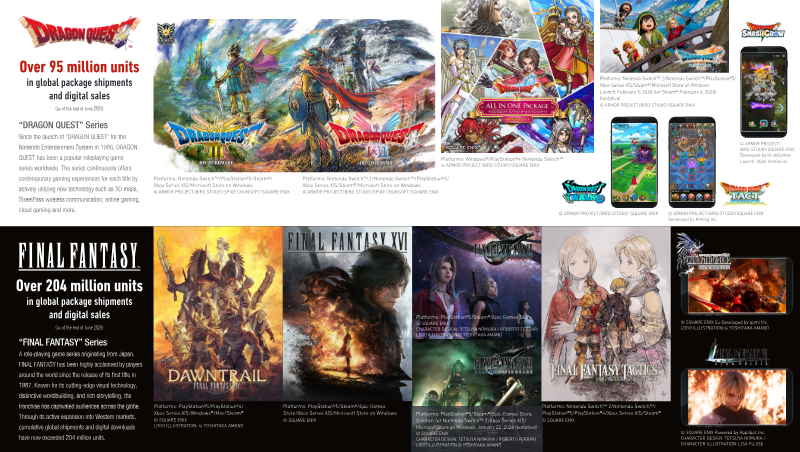
Square Enix Special Feature: Erdrick Trilogy Reimagined
The Dragon Quest franchise continues to expand its global footprint, reaching over 95 million units in total shipments and digital sales as of June 2025. A central focus of the current release strategy is the reimagining of the foundational Erdrick Trilogy through HD-2D remakes. Dragon Quest I & II HD-2D Remake is scheduled for a February 5, 2026, launch on a wide array of platforms, including the Nintendo Switch 2, PlayStation 5, Xbox Series X|S, and PC via Steam and the Microsoft Store. This multi-platform approach reflects a broader commitment to utilizing contemporary technology to modernize classic role-playing experiences for a global audience.
Beyond the core Dragon Quest series, the broader portfolio demonstrates significant market penetration across several flagship intellectual properties. The Final Fantasy franchise has surpassed 204 million units globally as of mid-2025, supported by the ongoing expansion of Final Fantasy XIV: Dawntrail and the continued rollout of Final Fantasy VII Rebirth across various ecosystems. Additionally, the Kingdom Hearts series, a collaborative effort with Disney, has achieved over 38 million units in sales, with new entries currently in development for unspecified launch windows.
The strategic roadmap emphasizes cross-platform accessibility and the revitalization of legacy content. By targeting next-generation hardware like the Nintendo Switch 2 alongside established consoles and PC storefronts, there is a clear intent to maximize reach across diverse geographic markets. This strategy is complemented by a robust pipeline of mobile and niche titles, including Dragon Quest Tact and various entries in the Bravely Default and Octopath Traveler series, ensuring a steady cadence of content across the role-playing game segment through 2026.
- The Dragon Quest I & II HD-2D Remake is scheduled for release on February 5, 2026, across Nintendo Switch 2, PlayStation 5, Xbox Series X|S, and PC.
- The Dragon Quest franchise has reached 95 million units in total shipments and digital sales as of June 2025.
- The Final Fantasy franchise has surpassed 204 million units globally as of mid-2025, driven by Final Fantasy XIV: Dawntrail and Final Fantasy VII Rebirth.
- Square Enix is prioritizing a cross-platform strategy that targets next-generation hardware alongside established consoles and PC storefronts to maximize global market reach.
- The Kingdom Hearts series has achieved over 38 million units in sales, with new entries currently in development.
Wyniki Finansowe 1H25
This financial summary details the performance of PCF Group (People Can Fly) for the first half of 2025, reflecting a period of organizational restructuring and portfolio transition. The group operates across two continents with a total workforce of 756 people as of June 30, 2025, a slight decrease from 2024 levels. This team is distributed primarily across studios in Warsaw, North America, and various European satellite locations, following the merger of PCF Chicago into PCF US.
Financial results for 1H 2025 show a significant recovery in profitability compared to the previous year. Revenue for the first half of 2025 reached 115.3 million PLN, a substantial increase over the 76.3 million PLN reported in 1H 2024. EBITDA improved from a loss of 11.3 million PLN in 1H 2024 to a positive 2.9 million PLN in 1H 2025. Despite these operational improvements, the group recorded a net loss of 21.3 million PLN for the period, though this represents a narrowing of the 33.3 million PLN net loss seen in the prior year. Key drivers for these results include the increased contribution of Project Echo, the inclusion of Project Delta in financial reporting, and accounting write-offs related to goodwill and licenses following the Chicago studio merger.
The group’s product strategy highlights a shift in its VR segment managed by Incuvo. While Green Hell VR continues to receive updates, including a successful co-op mode launch, the upcoming title Tracked: Shoot to Survive (Project Bison) is scheduled for a Q4 2025 release. This title will mark the final VR game published by PCF Group as it refines its long-term development focus. Quarterly revenue trends indicate a stabilization in the 50-60 million PLN range per quarter throughout late 2024 and early 2025, supported by a mix of work-for-hire projects and internal IP development.
- PCF Group revenue grew to 115.3 million PLN in 1H 2025, up from 76.3 million PLN in 1H 2024.
- EBITDA turned positive at 2.9 million PLN in 1H 2025, recovering from an 11.3 million PLN loss in the same period last year.
- The company narrowed its net loss to 21.3 million PLN in 1H 2025, compared to a 33.3 million PLN loss in 1H 2024, despite accounting write-offs from the Chicago studio merger.
- PCF Group is exiting the VR segment, with the Q4 2025 release of 'Tracked: Shoot to Survive' (Project Bison) serving as its final VR title.
- Quarterly revenue has stabilized in the 50-60 million PLN range, supported by a combination of work-for-hire projects and internal IP development.

Global Gaming Report Q3 2025
The third quarter of 2025 underscores the continued premium placed on hardware and platform players within the global gaming ecosystem, as investors assign a wide spectrum of valuation multiples that reflect divergent growth narratives and market positioning. Enterprise‑valued firms such as Dell and HP trade near a 1‑times EV/EBITDA ratio, indicating modest expectations for earnings expansion, while high‑growth entities like Nvidia and AppLovin command multiples exceeding 25‑times, with the latter reaching 42.8‑times, highlighting the market’s appetite for cutting‑edge processing power and mobile advertising integration. Across the board, most companies in the segment posted double‑digit year‑over‑year revenue increases, confirming robust demand for both traditional PC hardware and emerging cloud‑based gaming services.
Equity performance further illustrates the split between established hardware manufacturers and platform‑centric developers. Roblox delivered the strongest year‑to‑date appreciation at 136.9%, driven by expanding user engagement and monetization initiatives, while Unity recorded a 77‑percent gain, reflecting its pivotal role in cross‑platform development tools and the growing adoption of real‑time 3D content. These returns contrast sharply with the more muted trajectories of hardware‑only firms, suggesting that investors are rewarding firms that blend hardware capabilities with scalable software ecosystems.
Overall, the data portray a gaming market in which valuation is increasingly tied to the ability to integrate hardware performance with platform services, and where growth‑oriented companies enjoy markedly higher multiples and stock appreciation. The findings span a global landscape, covering major North American, European, and Asian players, and focus on the quarter ending September 2025, offering a snapshot of valuation dynamics and performance trends that are likely to shape strategic investment decisions throughout the remainder of the year.
- Investors are heavily favoring platform-centric companies over traditional hardware manufacturers, with high-growth firms like AppLovin and Nvidia commanding EV/EBITDA multiples exceeding 25x, compared to roughly 1x for legacy hardware firms like Dell and HP.
- Roblox led equity performance with a 136.9% year-to-date appreciation, driven by successful user engagement and monetization strategies.
- Unity recorded a 77% year-to-date gain, underscoring the market's high valuation of cross-platform development tools and real-time 3D content adoption.
- AppLovin reached a 42.8x EV/EBITDA multiple, reflecting strong market confidence in the integration of mobile advertising with gaming ecosystems.
- Most gaming companies reported double-digit year-over-year revenue growth in Q3 2025, confirming sustained demand across both PC hardware and cloud-based gaming services.