Key insights
7 slides
Balance sheet
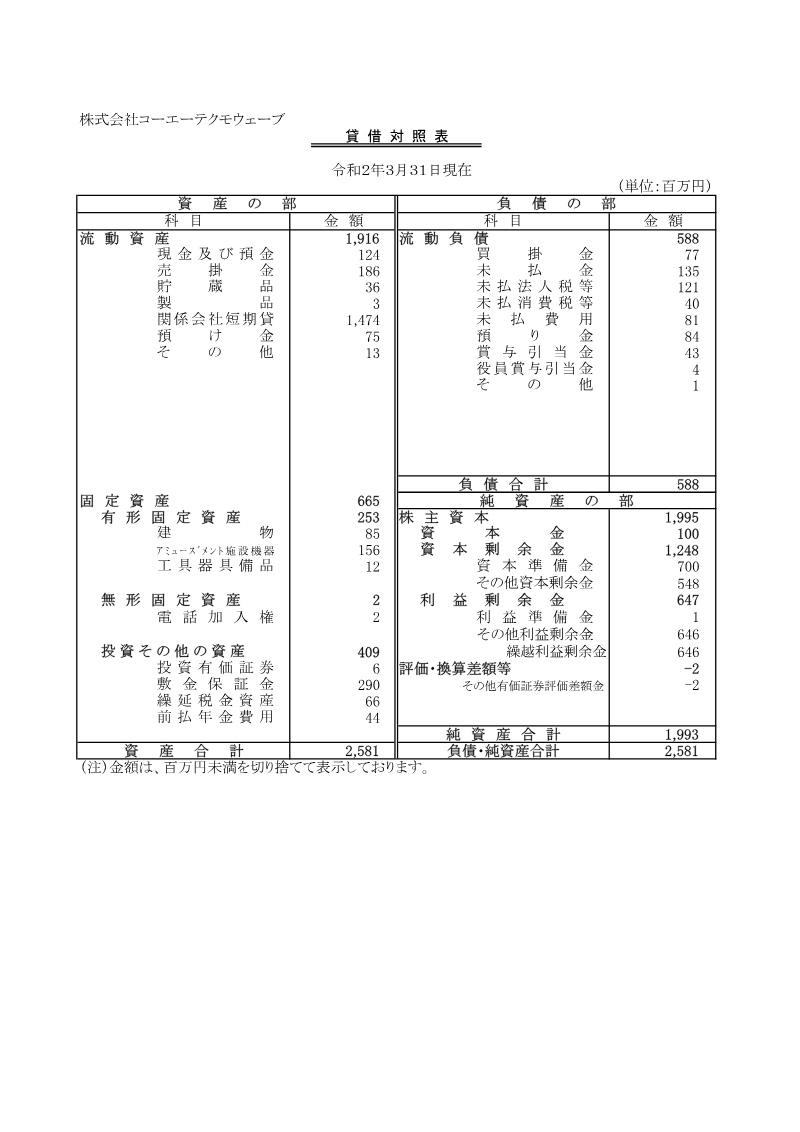
Koei Tecmo Wave reported total assets of ¥2,581 million as of March 31, 2020.
The balance sheet presents total assets of ¥2,581 million and a corresponding liability-and-equity balance. Current assets amount to ¥1,916 million, dominated by cash and deposits and accounts receivable.
Page 1 of the report¥2,581 million
Total assets as of March 31, 2020
- Equity base
- ¥1,993 million
- Fixed assets
- ¥665 million
Equity
The company's equity base was ¥1,993 million as of March 31, 2020.
The equity base comprises a paid-in capital of ¥1,995 million and an accumulated surplus of ¥998 million. Net income for the period is reported at ¥303 million, contributing to retained earnings.
Current assets
Current assets totaled ¥1,916 million, outweighing current liabilities of ¥588 million.
Current assets are dominated by cash and deposits of ¥124 million and accounts receivable of ¥186 million. Current liabilities stand at ¥588 million, with accounts payable and accrued expenses comprising the bulk.
Fixed assets
Fixed assets were valued at ¥665 million, split between tangible and intangible items.
Fixed assets total ¥665 million, split between tangible property of ¥253 million and intangible items such as software licenses. Intangible assets are subject to straight-line amortization over a five-year useful life.
Valuation methods
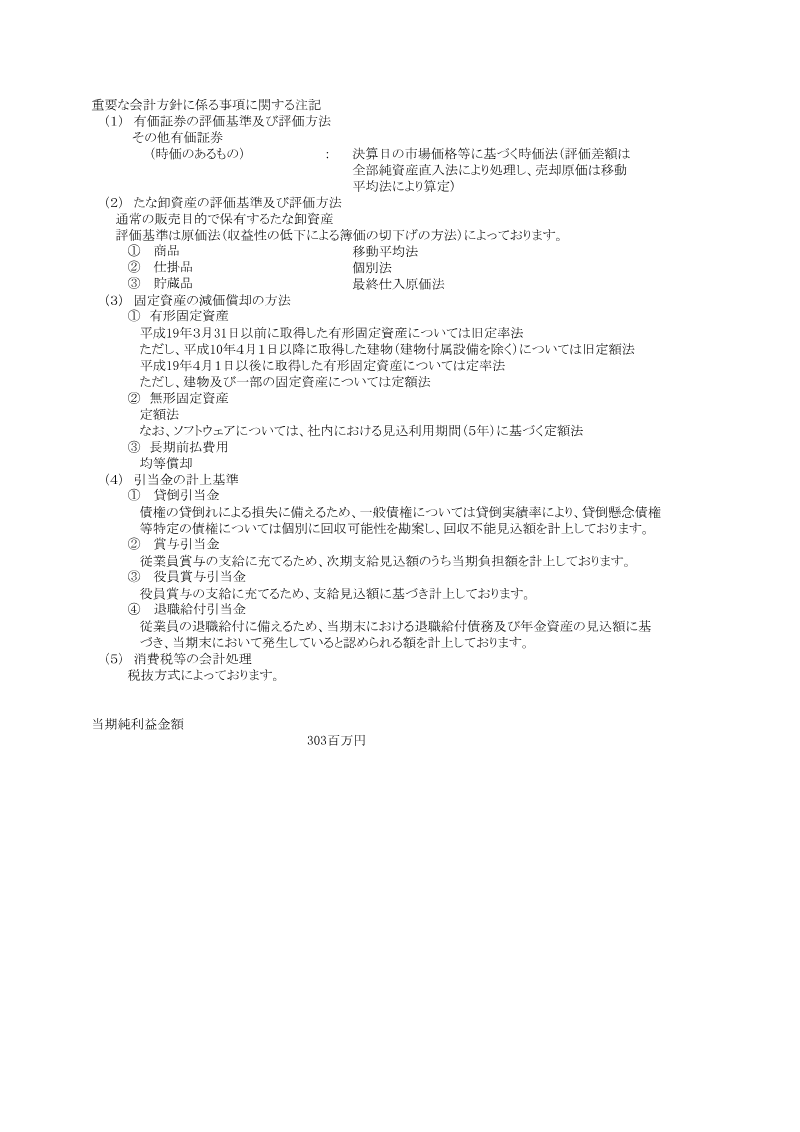
Inventory valuation uses a mix of weighted average, specific identification, and last-purchase cost.
Inventories, including finished goods and work-in-process, total ¥36 million. Cost-based inventory valuation uses weighted average for goods, specific identification for work-in-process, and last-purchase cost for finished goods.
Page 2 of the report- 01Weighted averageUsed for goods
- 02Specific identificationUsed for work-in-process
- 03Last-purchase costUsed for finished goods
Depreciation
Tangible asset depreciation follows a mix of declining balance and straight-line methods.
Depreciation of tangible assets follows a mix of declining balance and straight-line methods. Intangible assets use straight-line amortization over a five-year useful life.
Page 2 of the report- 01Declining balanceOne method for tangible asset depreciation
- 02Straight-lineAnother method for tangible asset depreciation
- 03Straight-line amortizationUsed for intangible assets over a five-year useful life
Net income
The company generated a net income of ¥303 million for the fiscal year ending March 31, 2020.
Net income for the period is reported at ¥303 million, contributing to retained earnings. The financial statements cover the Japanese domestic market.
1 / 7
Ask AI about this report
Summary
The balance sheet of Koei Tecmo Wave as of March 31, 2020 presents total assets of ¥2,581 million and a corresponding liability‑and‑equity balance. Current assets amount to ¥1,916 million, dominated by cash and deposits (¥124 million) and accounts receivable (¥186 million). Inventories, including finished goods and work‑in‑process, total ¥36 million. Current liabilities stand at ¥588 million, with accounts payable and accrued expenses comprising the bulk.
Fixed assets total ¥665 million, split between tangible property (¥253 million) and intangible items such as software licenses. The company’s equity base is ¥1,993 million, comprising a paid‑in capital of ¥1,995 million and accumulated surplus of ¥998 million. Net income for the period is reported at ¥303 million, contributing to retained earnings.
Key accounting policies include fair‑value measurement for marketable securities with gains and losses recorded directly in equity, cost‑based inventory valuation using weighted average for goods, specific identification for work‑in‑process, and last‑purchase cost for finished goods. Depreciation of tangible assets follows a mix of declining balance and straight‑line methods, while intangible assets use straight‑line amortization over a five‑year useful life. Provisioning for doubtful accounts, employee and executive bonuses, and pension obligations is based on historical loss rates or actuarial estimates.
The financial statements cover the Japanese domestic market, reflecting operations up to the fiscal year ending March 31, 2020. Data are presented in Japanese yen, with amounts rounded down to the nearest million yen.
Cite this report
Citation
Generating citation…