Global
Documents
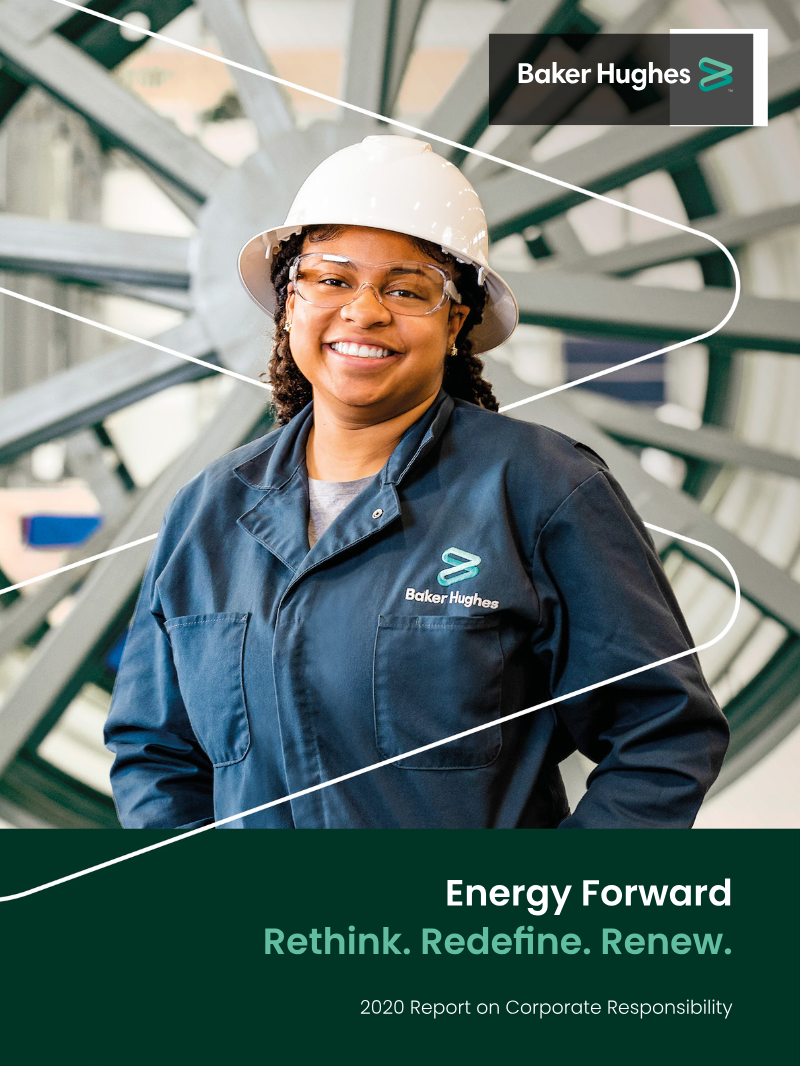
2020 Report on Corporate Responsibility
2020 Report on Corporate Responsibility Our frameworks: Our corporate responsibility report is prepared in accordance with the Global Reporting Initiative’s (GRI) Core Standards, and the Greenhouse Gas Protocol (GHG Protocol). We also provide reporting indices for the Task Force on Climate-related Financial Disclosures (TCFD), and the Sustainability Accounting Standards Board (SASB) Oil & Gas Services Industry Standard - Extractives & Minerals Processing Sector.
- Baker Hughes reduced its Scope 1 & 2 greenhouse gas emissions by 15% in 2020 compared to 2019, with Scope 1 emissions decreasing from 497,144 CO2e in 2019 to 432,316 CO2e in 2020, and Scope 2 market-based emissions decreasing from 303,647 CO2e to 252,069 CO2e.
- The company significantly increased its electricity from renewables and zero-carbon sources, reaching 22% of total electricity (163,075 MWH) in 2020, up from 15% (104,457 MWH) in 2019 and 3% (17,762 MW) in 2018.
- Baker Hughes increased female representation in its workforce from 17% in 2019 to 18% in 2020, with stronger hiring rates for women (27% in 2020 vs. 22% in 2019).
- Total combined contributions to communities, including financial and in-kind donations, increased substantially from $26 million in 2019 to $119 million in 2020, with company in-kind contributions rising from $24 million to $115 million.
- Water use decreased from 7,882 million liters in 2019 to 5,798 million liters in 2020, and the volume of significant spills decreased from 1,598 barrels in 2019 to 738 barrels in 2020.

IBM 2020 Corporate Responsibility Report
While the events of 2020 have tested and tried the world’s resolve in entirely new ways, they also revealed humanity’s determination to adapt and emerge stronger. It was a profound reminder that, when pressed for more, individuals and organizations will rise to reinvent themselves and apply ingenuity to the most challenging of societal problems.
- IBM transitioned 95% of its employees to remote work in March 2020 and is shaping the future of work for a post-COVID era, focusing on employee well-being and flexible innovation.
- IBM aims to achieve net-zero greenhouse gas (GHG) emissions by 2030 through energy conservation, efficiency, and renewable electricity, without using financial certificates or nature-based carbon offsets.
- IBM's SkillsBuild program has enrolled 215,000 people worldwide, completing 341,000 learning hours in technical and workplace skills, with over 4,000 learners in India finding full-time employment.
- IBM spent $2.1 billion directly with first-tier diverse suppliers in 2020, with the largest portion ($1.53 billion) in the United States.
- IBM plans to eliminate nonessential, single-use plastics from cafeteria operations by 2025 and from IBM logo hardware packaging by year-end 2024, aiming for 100% reusable, recyclable, or compostable essential plastic packaging.

Corporate Responsibility Report: 2024 Fiscal Year
About METRO 3 Message from Our President and CEO 5 Three Questions for Our Vice President, Public Affairs and Communications 6 12 35 45 Our Approach 7 Our Business Fundamentals 8 Materiality 9 Products and Services Colleagues Our Performance E...
- METRO's total GHG emissions increased significantly from 395,589.9 t CO2e in 2022 to 10,617,773.7 t CO2e in 2024, with Scope 3 emissions seeing the largest rise from 114,172.7 t CO2e to 10,333,846.0 t CO2e in the same period.
- METRO is transitioning to low-carbon transportation, piloting electric vehicles in e-commerce, and partnering with FLO to install over 500 fast-charging ports at more than 130 grocery stores in Quebec and Ontario starting spring 2025.
- METRO has made progress in sustainable packaging, replacing 91 tonnes of plastic with aluminum in Metro Go ready-to-eat meals in Quebec and reducing the weight of paper used in flyers by 53% compared to 2023.
- METRO's suppliers' average transition rate to alternative housing for laying hens was 61% in 2024, with 30% in enriched cages and 31% in cage-free systems. For pork, 65% of Canadian suppliers are transitioning away from gestation cages by 2029.
- METRO has documented the origin of 97% of its private brand and perishable beef products, confirming none come from high-risk deforestation areas, with Canada and the United States being primary sources.
2020 Corporate Responsibility Report
OVERVIEW 3 PEOPLE & COMMUNITIES 32 A Letter from our Chairman & CEO and CSO 3 Employee Health & Safety 33 About This Report Our Company 4 Employee Engagement & Development 35 Keurig Dr Pepper (KDP) has reported on Key Highlights 5 Diversity & Inclusion ...
- All K-Cup pods produced by Keurig Dr Pepper (KDP) are now recyclable, made from #5 polypropylene plastic.
- KDP achieved 90% recyclable or compostable packaging across its total portfolio in 2020, up from 86% in 2018, and increased post-consumer recycled (PCR) content to 22% in 2020 from 20% in 2018.
- KDP aims to replenish 100% of the water used for beverages in its highest water-risk operating communities by 2025, with a 20% improvement in water use efficiency targeted by the same year.
- KDP achieved its 100% responsibly sourced coffee commitment and has engaged over 1 million people in its supply chain since 2014 to improve their lives, with over $64 million in social impact investments since 2003.
- KDP's plastic packaging that is recyclable or compostable increased from 64% in 2019 to 74% in 2020, and PCR content in plastic packaging rose from 0.4% in 2019 to 2% in 2020.
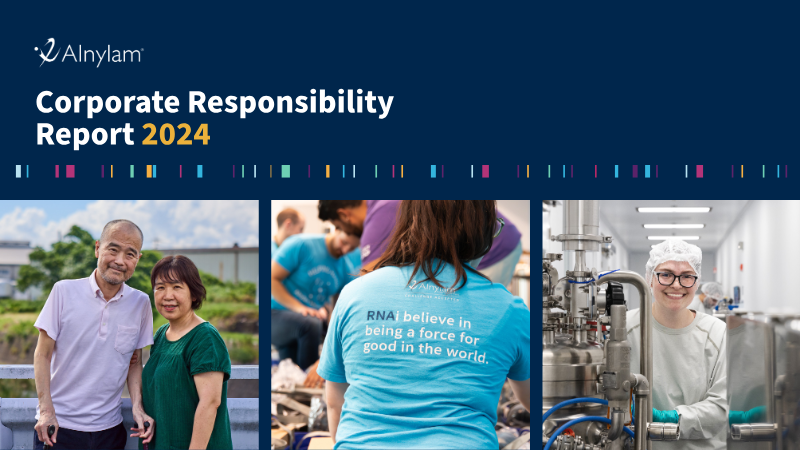
Corporate Responsibility Report 2024
Corporate Responsibility Report 2024 Introduction Patients Science Employees Communities Planet Governance Data <td>Corporate Responsibility at Alnylam</td> stol. S7 Catalina, patient (Spain) On the cover, left: Tsuyoshi, patient and his wife Rika (Japan) Corporate Responsibility Report 2024 Introduction Patients Science Employees Communities Planet Governance Data A Pivotal Year at Alnylam Transforming Lives Through Innovat...
- Alnylam's Patient Access Philosophy, established in 2017, was revisited in 2024 to expand its reach and ensure patients benefit from their medicines.
- Alnylam launched a 'Patient Perspectives series' in 2024 to help employees understand the experiences of patients, caregivers, and advocates impacted by the diseases they serve.
- In 2024, Alnylam focused on cardiovascular provider collaboration, engaging global cardiologists and other specialists to understand their needs due to two approved medicines and a robust pipeline in this area.
- Alnylam's modular drug discovery platform utilizes a three-pronged approach: delivery of RNAi therapeutics to new tissues, enhancement of existing platform designs, and investment in human genetics to identify drug targets.
- Alnylam was named to Newsweek’s 'America’s Most Responsible Companies 2025' for the third consecutive year, moving from #422 in 2023 to #153 in 2025.
2024 Annual Corporate Responsibility Report
The 2024 Annual Corporate Responsibility Report outlines the strategic framework and operational progress of RBC BlueBay Asset Management regarding its social, ethical, and community-focused initiatives. The primary thesis centers on the integration of corporate responsibility into the firm’s core business model, asserting that a transparent, inclusive, and community-engaged culture drives superior outcomes for both clients and employees. The firm operates under a centralized Corporate Responsibility Committee that monitors key performance indicators across four pillars: people, communities, conduct, and responsible investment.
Key findings for the 2024 fiscal year highlight significant engagement in community and social efforts. Over 50% of staff participated in volunteering activities, and employees collectively donated more than £210,000 to charitable causes, exceeding the annual target of £165,000. The firm transitioned to a single primary charity partnership with St Luke’s Community Centre to deepen its local impact. Additionally, the report details the success of talent development programs, including summer internships and the Catalyst Education Programme, which aim to foster diversity within the investment management industry.
The scope of this report covers RBC BlueBay’s global operations, with a specific emphasis on its EMEA-based activities and organizational structure. The methodology relies on internal data tracking, committee oversight, and performance monitoring against established annual targets. Looking ahead to 2025, the firm has set specific objectives to increase participation in employee resource groups by 10% and boost attendance at social events by 10%. The report emphasizes that these efforts are supported by a rigorous compliance framework, ensuring that ethical market practices and client-first philosophies remain central to the firm’s governance and long-term institutional strategy.
- RBC BlueBay Asset Management exceeded its 2024 charitable donation target of £165,000 by raising over £210,000.
- Over 50% of the firm's staff participated in volunteering activities during the 2024 fiscal year.
- The firm transitioned to a single primary charity partnership with St Luke’s Community Centre to consolidate its local social impact.
- Corporate responsibility is governed by a centralized committee that monitors performance across four pillars: people, communities, conduct, and responsible investment.
- The firm manages talent development through initiatives like the Catalyst Education Programme and summer internships to improve diversity in investment management.
2024 Corporate Responsibility Report
+ Publication Date: July 30, 2025 Publication Date: July 30, 2025 2 Introduction The Care The People The Planet 32 Governance, Policies & We Advance We Support We Share Systems Infrastructure 5 Who We Are 39 Appendix Overview 41 Sustainability Accounting 7 IDEXX Corporate ...
- IDEXX is a global leader in pet healthcare innovation, providing diagnostic and software products and services in veterinary medicine, employing approximately 11,000 people and serving customers in over 175 countries.
- In 2024, IDEXX's overall Greenhouse Gas (GHG) emissions increased by 10.5%, primarily due to increased energy consumption at the newly operational Horizon Center in Scarborough, Maine, though the company remains on track to meet its 2030 GHG emissions reduction goal of 37.8% for Scope 1 & 2.
- IDEXX donated over 21,000 SNAP™ tests in 2024 for disaster response, education, and community outreach, contributing to enabling access to care for over 79,000 animals in underserved communities.
- Employees logged over 86,000 hours of learning and development in 2024, including 23,200 hours in leadership and AI, and 50,200 hours in skill-based training.
- IDEXX reduced its freight forwarders from 18 to three in 2024 to ship products more sustainably, prioritizing ocean shipping over air when possible.
Winning on Google Discover: A Data-Driven Guide for Gaming Media
The brief explains how Google’s February 5, 2026 “Discover core update” expands the personalized content feed and shifts traffic from traditional search to Discover, especially for gaming media. Across 197 active gaming sites in the Raptive network, roughly half of Google traffic originates from Discover, with a 20 % rise in sites receiving feed impressions after the update. The report identifies three key performance drivers that correlate with both Discover visibility and overall revenue: high U.S. traffic concentration, deep session depth, and structured editorial content such as guides and reference databases. Sites that meet these criteria see stronger Discover performance, while those dominated by forum‑style or low‑differentiation content face greater volatility.
Methodologically, the analysis draws on internal Raptive data from 6,000+ sites and external sources like Chartbeat and Google Search Console. It highlights early post‑update signals: Discover traffic is growing for smaller publishers, click volatility remains high due to real‑time recommendation algorithms, and AI summaries now occupy about half of feed impressions. The brief recommends five high‑impact actions—optimizing Core Web Vitals, crafting Discover‑specific headlines, adding author voice, aligning publishing calendars with gaming events, and correcting meta tags—to boost Discover clicks.
The document concludes by outlining Raptive’s support services, including a forthcoming Discover Workbook and personalized audits that have historically yielded an 89 % RPM uplift for gaming publishers. The brief positions Discover as a critical, data‑driven channel for gaming media amid declining search traffic and AI‑generated content.
- Google Discover now accounts for roughly 50% of Google traffic for gaming sites within the Raptive network, following a February 5, 2026 core update that shifted traffic away from traditional search.
- Sites that prioritize high U.S. traffic concentration, deep session depth, and structured editorial content like guides and databases experience superior Discover performance and revenue stability.
- Following the February 2026 update, 20% more gaming sites began receiving Discover feed impressions, with smaller publishers seeing notable traffic growth.
- AI-generated summaries currently occupy approximately 50% of all Discover feed impressions, contributing to high click volatility for publishers.
- Publishers relying on forum-style or low-differentiation content face increased traffic volatility compared to those producing structured, expert-led editorial content.

Adjust Guide to Deep Linking
This technical guide outlines the strategic importance and functional mechanics of deep linking within the mobile app ecosystem. The primary thesis is that deep links are essential tools for streamlining the user experience, reducing friction, and driving higher conversion rates compared to standard mobile web interfaces. By directing users to specific in-app content rather than generic homepages, marketers can significantly improve retention and re-engagement through targeted campaigns across email, social media, and SMS.
The scope of the analysis covers the technical distinctions between three primary types of links: default, deferred, and contextual. Default deep links function only when an app is already installed, while deferred deep links—facilitated by specialized SDK integrations—route non-users to the appropriate app store before delivering them to the intended internal page upon installation. The guide also examines platform-specific solutions like Apple’s Universal Links, noting their ability to prevent error messages while highlighting limitations regarding attribution data and support within major apps like Facebook.
Key data points emphasize the commercial impact of native app environments, noting that consumers purchase at three times the rate of the mobile web. Furthermore, with 70% of emails opened on mobile devices, the integration of deep links into owned media channels is presented as a critical driver of revenue. The conclusion suggests that as digital interactions expand into voice, television, and automotive platforms, deep linking and cross-device tracking will remain the foundational technology for maintaining a cohesive and measurable mobile marketing strategy.
- Mobile app users purchase at three times the rate of those using mobile web interfaces, making deep linking a primary driver of conversion.
- Integrating deep links into owned media channels is critical for revenue, particularly as 70% of all emails are currently opened on mobile devices.
- Deferred deep links are essential for acquisition, as they route new users through the app store installation process before landing them on the specific content they originally clicked.
- Default deep links are limited to users who already have the app installed, whereas deferred deep links utilize SDK integrations to bridge the gap for non-users.
- Apple’s Universal Links prevent common error messages but face limitations regarding attribution data and compatibility with major platforms like Facebook.

The Dual Frontier: A Retailer’s Framework for Agentic Commerce
Retailers frequently adopt LLM‑powered chat widgets without addressing the core friction points that shape shopper behavior. The analysis argues that meaningful agentic commerce emerges when AI is tailored to a retailer’s specific product categories, customer profiles, and pain points. By deploying onsite ambient intelligence that proactively surfaces assistance when shoppers display confusion, retailers can intervene before friction escalates. Off‑site agent commerce remains nascent; catalog data quality and the availability of structured attributes are critical bottlenecks that must be resolved to enable reliable recommendations and transactions.
Data quality is identified as a pivotal differentiator. In an agentic environment, insufficient data can prevent a retailer from entering a shopper’s consideration set entirely, whereas in traditional e‑commerce it merely dampens conversion rates. The framework stresses the need to provide agent platforms with enough data for accurate recommendations while protecting proprietary signals from competitors. A calibrated approach—balancing “share freely,” “share selectively,” and “protect” signals—is essential to maintain trust, enhance recommendation confidence, and drive higher conversion rates.
A quantitative readiness diagnostic offers a pragmatic path forward. Four pillars—catalog, technical infrastructure, organizational capacity, and strategic urgency—are scored on a 32‑point scale. Scores of 26–32 signal mature foundations and immediate learning loops; 18–25 require focused catalog work over 8–12 weeks; 10–17 suggest a narrow pilot with partner support; and 0–9 indicate foundational improvements are needed before any agent rollout. Building these capabilities in‑house can take 12–18 months, whereas partnering with a platform such as Moloco Commerce Media accelerates deployment through catalog normalization, real‑time decisioning, and holdout‑based incrementality frameworks.
- Retailers must prioritize high-quality, structured catalog data, as insufficient data in an agentic environment causes total exclusion from a shopper's consideration set rather than just lower conversion rates.
- A 32-point readiness diagnostic across four pillars—catalog, infrastructure, organizational capacity, and strategic urgency—determines the viability of agentic commerce, with scores of 26–32 indicating immediate readiness and 0–9 requiring foundational work.
- Retailers should adopt a calibrated data-sharing strategy, categorizing signals into 'share freely,' 'share selectively,' and 'protect' to balance recommendation accuracy with the need to safeguard proprietary competitive advantages.
- Partnering with platforms like Moloco Commerce Media can bypass the 12–18 month timeline required for in-house development by providing immediate access to catalog normalization and real-time decisioning frameworks.
- Effective agentic commerce requires shifting from passive chat widgets to proactive ambient intelligence that intervenes when shoppers display signs of confusion.
The PC & Console Gaming Report 2025
The global PC and console gaming market is projected to reach $92.7 billion by 2027, driven by a significant recovery in the console sector. While PC growth remains modest at a 2.6% CAGR, the console segment is expected to expand by 7.0%, fueled by the anticipated launch of the Nintendo Switch 2 and blockbuster releases such as Grand Theft Auto VI. Despite a revenue dip in 2024 due to a lighter premium release schedule, total playtime grew by 6%, signaling robust engagement even as market dynamics shift toward a "near zero-sum" competition for player attention.
Player behavior is increasingly characterized by "calcification," where engagement is concentrated into a shrinking pool of established "forever games." Titles aged six years or older now command over 60% of playtime on PC and nearly half on consoles. This consolidation is most visible on PC, where just five legacy titles account for 30% of annual hours. While PlayStation has emerged as a growth leader with a 21% increase in playtime since 2021, the broader trend across all platforms shows players becoming more "unreachable," with a rising share of the audience engaging with only one to three games per year.
To combat stagnation, publishers are increasingly leveraging "recursive nostalgia" by reintroducing classic maps and mechanics. While this strategy yielded massive engagement spikes for Fortnite, its effectiveness varies, often serving as a short-term boost rather than a long-term retention tool unless structured as a permanent gameplay mode. Furthermore, the discoverability crisis has intensified as annual releases on Steam approached 19,000 in 2024. With the impact of traditional seasonal sales declining fourfold since 2019, success now requires a shift toward targeted global events, external traffic generation, and product differentiation to break through a market dominated by AAA franchises and entrenched free-to-play titles.
- The global PC and console market is projected to reach $92.7 billion by 2027, with the console segment expected to grow at a 7.0% CAGR driven by the Nintendo Switch 2 launch and Grand Theft Auto VI.
- Player engagement is increasingly 'calcified,' as titles aged six years or older now account for over 60% of PC playtime and nearly 50% of console playtime.
- Market competition for player attention has become a near zero-sum game, with a rising percentage of the audience now limiting their engagement to only one to three games per year.
- On PC, market consolidation is extreme, with just five legacy titles responsible for 30% of total annual hours played.
- Despite a 2024 revenue dip caused by a light release schedule, total player engagement grew by 6%, indicating that playtime remains robust even as monetization becomes more difficult.
Mobile Market Landscape 2026
The mobile ecosystem is undergoing a fundamental structural transformation as the industry shifts from a volume-based growth model to one defined by monetization efficiency and technological integration. By 2026, the market has reached a state of saturation where total app releases have surged by 25% year-over-year, yet only 10% of new titles successfully secure meaningful user attention. A pivotal milestone occurred in late 2025 when non-gaming applications surpassed gaming in total revenue for the first time, largely propelled by the explosive 273% revenue growth in generative AI and the strategic expansion of utility-based tools.
Within the gaming sector, traditional genres such as Casino and RPG have faced stagnation, forcing publishers to adopt hybridization strategies that blend deeper monetization mechanics into previously hypercasual titles. This pivot has yielded significant results, with hypercasual revenue increasing by approximately 80% as developers move toward puzzle and simulation subgenres. Meanwhile, midcore gaming revenue has plateaued at $33–34 billion, prompting a reliance on intensified LiveOps and direct-to-consumer strategies. Across the broader app landscape, the integration of generative AI into creative assets has become standard, with over half of top-grossing games utilizing these tools to scale production, despite ongoing concerns regarding creative monotony.
Geographically, growth patterns are diverging as emerging markets like Indonesia continue to drive massive download volumes, while mature Western markets focus on maximizing revenue per user. The utility and social segments are similarly prioritizing premium subscription models to combat plateauing download numbers. While tools such as antivirus and cloud storage are seeing a resurgence in demand, the industry faces a broader challenge in maintaining long-term retention. Ultimately, the market is transitioning away from hypergrowth toward a sustainable, mature phase characterized by subscription-driven monetization and the strategic application of AI to optimize both user experience and operational efficiency.
- Non-gaming applications surpassed gaming in total revenue for the first time in late 2025, driven by a 273% revenue surge in generative AI and utility-based tools.
- The mobile market has reached saturation, with a 25% year-over-year increase in app releases while only 10% of new titles successfully capture meaningful user attention.
- Hypercasual gaming revenue grew by approximately 80% as developers pivoted toward hybridization, blending deeper monetization mechanics into puzzle and simulation subgenres.
- Midcore gaming revenue has plateaued at $33–34 billion, forcing publishers to rely on intensified LiveOps and direct-to-consumer strategies to maintain performance.
- Over 50% of top-grossing games now utilize generative AI to scale production of creative assets, despite industry concerns regarding potential creative monotony.