Updated Mar 21, 2026 by 4A Games
Report
Published by 4A Games
About METRO 3 Message from Our President and CEO 5 Three Questions for Our Vice President, Public Affairs and Communications 6 12 35 45 Our Approach 7 Our Business Fundamentals 8 Materiality 9 Products and Services Colleagues Our Performance E...
Table of Contents About METRO 3 Message from Our President and CEO 5 Three Questions for Our Vice President, Public Affairs and Communications 6 12 35 45 Our Approach 7 Our Business Fundamentals 8 Materiality 9 Products and Services Colleagues Our Performance Engaging with Our Stakeholders 10 Responsible Procurement 13 Equity, Diversity and Inclusion 36 Scorecard 46 Corporate Responsibility Governance 11 Health, Nutrition and Well-being 18 Health, Safety and Well-being 37 ESG Performance Data 53 Packaging and Printed Materials 20 P 22 39 Environment Communities Climate Change 23 Socioeconomic Contribution 40 Waste 29 Food Loss and Waste 32
About METRO METRO is a food and pharmacy leader in Québec and Ontario. About this report As a retailer, franchisor, distributor, manufacturer and provider of e-commerce services, we operate or This corporate responsibility (CR) report covers the operations and activities of the entire Corporation service a network of 995 food stores under several banners, including Metro, Metro Plus, Super C and for the 2024 fiscal year ending on September 28, 2024. This is our third report since publishing our Food Basics, as well as 639 pharmacies, primarily under the Jean Coutu, Brunet, Metro Pharmacy third five-year CR Plan for 2022–2026 for our food and pharmacy activities. We continue to report on and Food Basics Pharmacy banners. metrics based on the Sustainability Accounting Standards Board (SASB) Food Retailers & Distributors and Drug Retailers standards and, for the third year, on the Global Reporting Initiative (GRI) 2021 Universal Standards. All financial figures are in Canadian dollars unless otherwise specified. In the CR Plan and this report, METRO refers to the Corporation, and Metro refers to the conventional store banner. This report was reviewed by internal auditors but was not audited externally. More than A network of over Forward-looking information $21 billion 1,630 Throughout this report, we have used statements that may constitute forward-looking information. In general, any statement in this report that does not constitute historical fact may be considered a
not audited externally. More than A network of over Forward-looking information $21 billion 1,630 Throughout this report, we have used statements that may constitute forward-looking information. In general, any statement in this report that does not constitute historical fact may be considered a in sales stores forward-looking statement. The use of the future tense as well as expressions such as “commit,” “aim,” “vision,” “ambition,” “seek,” “targets,” “objectives” and other similar expressions is generally indicative of forward-looking statements. The forward-looking statements that may be set out in this report refer to hypotheses on the Canadian food and pharmacy industries, targets and the economy in general as well as our 2025 action plan and 2022–2026 CR Plan. These forward-looking statements do not More than Founded in provide any guarantees as to the future performance of the Corporation and are subject to known and 97,000 1947 unknown risks and uncertainties that could cause the outcome to differ significantly. We believe these statements to be reasonable and relevant at the publication date and represent our expectations. METRO does not intend to update any forward-looking statements contained herein. colleagues For more information Marie-Claude Bacon Vice President, Public Affairs and Communications 11011 Maurice-Duplessis Blvd. Montréal (Québec) H1C 1V6 514-643-1086 [email protected]
Food (995 food stores) Supermarkets Discount stores Neighbourhood stores Specialized stores Québec 190 110 53 25 706 Metro Super C Marché Richelieu Première Moisson Metro Plus 315 2 11 Marché Ami Les 5 Saisons Adonis Ontario 132 145 1 1 283 Metro Food Basics Marché Ami Première Moisson UEUING Adonis New Brunswick 1 6 Marché Richelieu Marché Ami Total 337 255 375 28 Pharmacy (639 pharmacies) Québec 384 141 525 PJC Jean Coutu Brunet PJC Santé Brunet Plus PJC Santé Beauté Brunet Clinique Clini Plus Ontario 9 77 86 PJC Jean Coutu Metro Pharmacy PJC Santé Food Basics Pharmacy New Brunswick 28 28 PJC Jean Coutu PJC Santé PJC Santé Beauté Total 639
Message from Our Our long tradition of community involvement continues through both financial support and food President and CEO donations. We are well on the way to achieving our objective of donating an amount equal to 1% of average net earnings in the last three fiscal years. METRO is Prism certified by Imagine Canada, an organization that recognizes leaders in philanthropy. As a food and pharmacy leader, we believe it is our which sets out the measures we have taken to prevent This year, we also continued orts to promote duty to act every day to help create a sustainable and mitigate the risk of forced labour or child labour a diverse and our efforts to promote and inclusive future for our customers, colleagues, in our operations. Our Supplier Code of Conduct for inclusive organizational culture. The various actions we have implemented, such as the communities and partners. As we are halfway through responsible procurement, published in 2017, reflects n mental health implementing our Corporate Responsibility (CR) the importance we attach to this issue. We make launch of two new training courses on mental health Plan for 2022–2026, our rigorous approach in this considerable efforts to obtain the information required issues, have enabled us to make progress toward our regard, anchored in our business practices, continues from our business partners to ensure that they comply equity, diversity and inclusion (ED&I) objectives. In to create long-term value for the company and our with our Code. While the amount of information we need 2025, we will continue to raise awareness and develop stakeholders.
actices, continues from our business partners to ensure that they comply equity, diversity and inclusion (ED&I) objectives. In to create long-term value for the company and our with our Code. While the amount of information we need 2025, we will continue to raise awareness and develop stakeholders. Once again this year, the work of our to collect from them continues to grow, our ongoing our colleagues’ skills in this area. teams enabled us to make progress on our priorities, partnership with Sphera, formerly SupplyShift, enables I would like to acknowledge the tireless efforts of our and we are on track to achieve most of our objectives us to assess our suppliers’ practices and thus improve teams, at all levels of the company, who worked on within the next two years. transparency within our supply chain. our ESG priorities throughout the year and strived to continue offering the best value to our customers To boost our performance regarding environmental, The consequences of climate change are becoming in what continues to our customers social and governance (ESG) issues, we continue increasingly visible, and we are aware of the urgency be a challenging economic environment for many. I am grateful to be able to to evolve our executive compensation practices. In and necessity of implementing concrete measures to count to be able to fiscal 2024, the Human Resources Committee of make the transition to a lower-carbon economy.
Everplay maintains a zero-tolerance stance toward modern slavery and human trafficking across its global operations and supply chains. As a UK-centered video games developer and publisher, the organization identifies as having a relatively low inherent risk due to the nature of the digital entertainment industry. The operational scope covers the financial year ending December 31, 2025, and encompasses approximately 370 employees working across the United Kingdom, Ireland, Germany, the United States, and Canada. The primary supply chain expenditures involve milestone and royalty payments to third-party development partners, alongside work-for-hire contracts for game development, localization, and quality assurance testing. While the overall risk profile remains low, the organization identifies localization and quality assurance as areas carrying a slightly higher risk. To mitigate these concerns, all new and renewing contracts include mandatory compliance clauses regarding the Modern Slavery Act 2015, granting the company the right to terminate agreements in the event of a breach. Governance is managed through the Audit Committee, which reports to the Board of Directors at least twice annually. Due diligence efforts include a risk-based approach to supplier assessment and the implementation of internal policies such as whistleblowing, anti-bribery, and grievance procedures. Employees and third parties are provided with confidential reporting channels, including an external hotline. The effectiveness of these measures is tracked through an annual risk register assessment, which currently reports zero incidents of modern slavery. Training and awareness initiatives are provided to ensure that employees and stakeholders can identify and report potential risks effectively.
Take-Two Interactive Software establishes a comprehensive framework for maintaining ethical business practices and safeguarding human rights across its global operations as of October 2025. The primary objective is to eliminate modern slavery, forced labor, and human trafficking within the organization and its extensive supply chains. This commitment extends across all major publishing labels, including Rockstar Games, 2K, Private Division, and Zynga, covering the development and distribution of interactive entertainment for console, PC, and mobile platforms. The policy outlines rigorous hiring and employment standards, mandating that all employees be at least 16 years of age and that employment is strictly voluntary. Compensation and benefits are reviewed annually to ensure they meet or exceed legal minimums and market standards. Furthermore, the company enforces a strict non-discrimination policy, ensuring that recruitment and career advancement are based solely on ability and merit rather than protected characteristics. These internal standards are reinforced by a Global Code of Business Conduct and Ethics that applies to all directors, officers, employees, and contractors. To ensure compliance throughout the supply chain, which includes disc replicators, printers, and logistics providers in regions such as North America, Europe, and Japan, the company utilizes a dedicated Supplier Code. This requires third-party partners to represent that they do not utilize child, prison, or slave labor. Oversight is maintained through biennial training for employees and targeted training for consultants. Additionally, the company provides a confidential reporting hotline managed by an independent third party, protecting whistleblowers from retaliation. Key suppliers are also expected to conduct periodic internal or independent audits to verify adherence to labor, health, and safety standards.
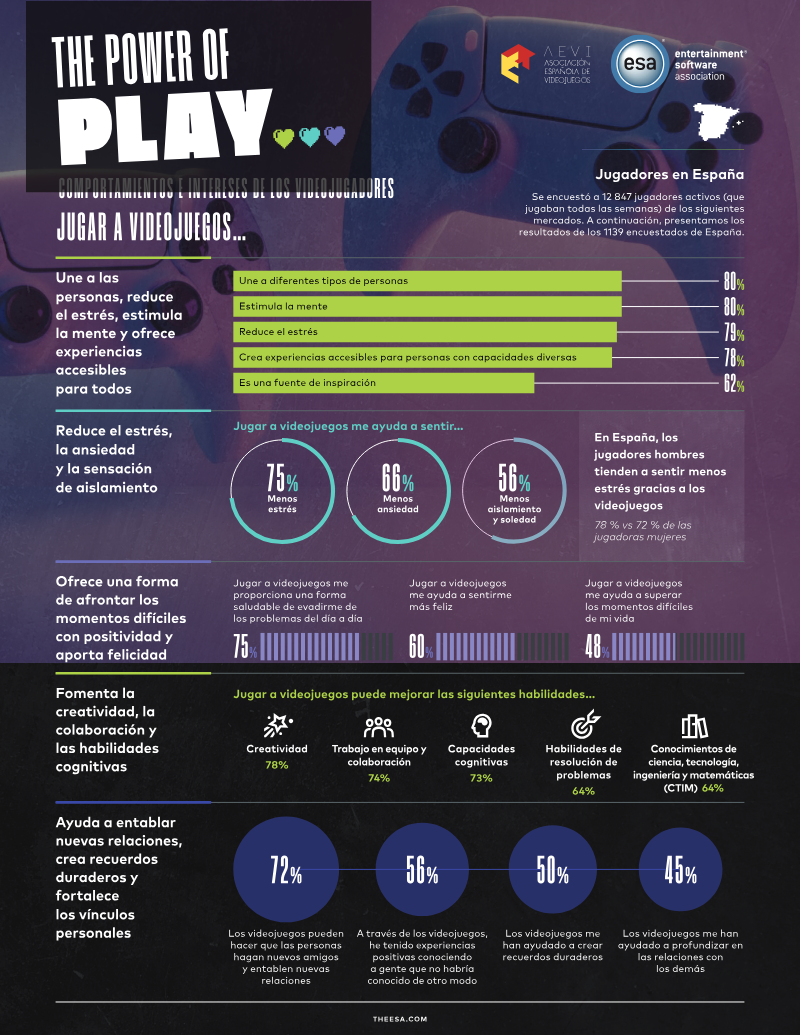
The research surveyed more than 24,000 active gamers from 21 nations on six continents, representing a broad cross‑section of the global gaming population (average age 41, 48 % female). Its central thesis is that video games function as a powerful catalyst for cognitive, social, educational, and mental‑health benefits, extending far beyond entertainment. Across all regions, a majority of players report gaming primarily for fun (56 %), stress relief (55 %) and mental stimulation (46 %). Mobile devices dominate usage (55 % of respondents), followed by PCs/laptops and consoles, while 73 % say gaming reduces feelings of isolation and 81 % view it as mentally stimulating. Perceived skill development is strong: 77 % associate gaming with enhanced creativity, 74 % with problem‑solving, and substantial portions note improvements in teamwork, resilience and social interaction. The survey highlights a professional impact, with 43 % globally—reaching 76 % in Nigeria and 70 % in India—believing gaming positively shaped their education or career. Mental‑health outcomes are equally pronounced; 70‑90 % report reduced stress, increased happiness and a healthier outlet for daily challenges, with the highest well‑being scores in India, Nigeria and Mexico. Online multiplayer is identified as the primary social connector, cited by up to 96 % of respondents. Complementary academic research corroborates these findings, showing that digital games boost learning engagement, reading skills and decision‑making, while immersive technologies such as AR/VR enhance performance in high‑stress professional settings, including medical surgery and aerospace training. Collectively, the evidence positions video games as a validated tool for skill development, education, and mental‑health recovery across diverse global markets.
The FY 2025 impact analysis presents Electronic Arts’ comprehensive ESG strategy, arguing that responsible stewardship of people, planet, and data is integral to sustainable growth in the interactive‑entertainment sector. By quantifying progress across talent, climate, privacy and security, the report demonstrates how the company translates corporate responsibility into measurable outcomes while maintaining its global market position. Across a workforce of more than 6,000 employees worldwide, 83 % now have access to internal AI tools, and 17 % of new hires are returning staff, contributing to an industry‑leading attrition rate of –0.1 %. Expanded benefits—including paid parental leave and bereavement support—paired with a balanced gender composition, underpin the talent‑focused results. Community engagement generated 18,000 volunteer hours and $5.9 million in investments, reinforcing the social dimension of the strategy. Environmental performance shows a clear downward trajectory: total operational emissions fell to 6.6 Mt CO₂e in FY25, down from 7.3 Mt in FY24 and 10.6 Mt in FY23, with Scope 1 emissions at 2.98 Mt and Scope 2 (market‑based) comprising the remainder, while energy consumption reached 380,859 GJ, fully sourced from office operations. The company’s carbon‑neutral status and renewable‑energy initiatives address identified climate risks such as acute physical events, volatile energy prices, rising carbon costs and emerging reporting regulations. Data‑privacy and security are governed by a privacy‑by‑design framework overseen by the Audit Committee, delivering explicit player notice, consent and control, data‑minimisation, and partner‑risk contracts. The security management system aligns with ISO, NIST and CIS standards, undergoes annual independent validation, operates a 24‑hour SOC and mandates annual training for all staff. An articulated AI governance model completes the governance pillar, ensuring responsible deployment of emerging technologies. Collectively, these initiatives illustrate a holistic, globally scoped commitment to ESG excellence throughout FY 2025.