Game Engines reports and market data
Documents
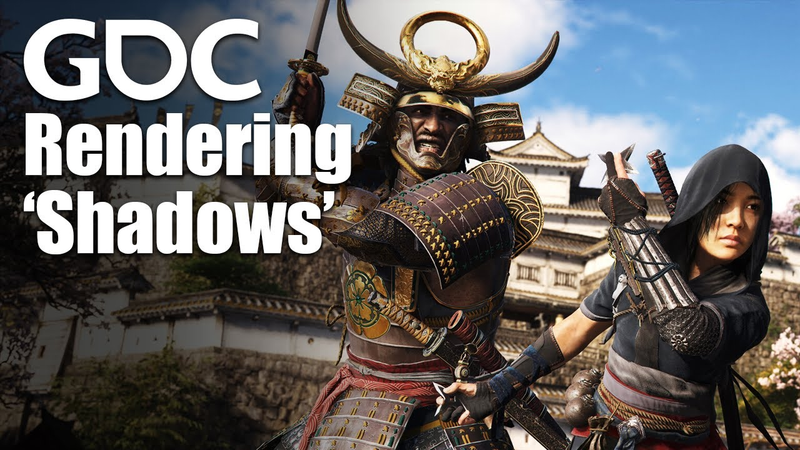
Rendering 'Assassin's Creed Shadows'
Assassin’s Creed Shadows represents a significant technical evolution for the Anvil engine, transitioning to a unified, monorepo codebase designed to streamline development across Ubisoft’s diverse portfolio.
- Assassin's Creed Shadows utilizes a multi-tiered rendering system for its open world, employing LOD meshes up to 4km, point cloud mass-imposter rendering up to 8km, and baked terrain vistas for distances beyond 8km.
- The engine architecture uses a database-driven approach to manage mesh relations and properties, allowing for C++-like data structures that automatically generate getters and setters for both CPU and GPU storage.
- The rendering pipeline incorporates a hybrid approach to Global Illumination (GI), combining baked volumetric GI with hardware and software-accelerated ray tracing to balance performance and visual fidelity.

What A $1,000,000 Game Looks Like In Unity (PontyPants' "A Difficult Game About Climbing")
A Difficult Game About Climbing demonstrates how sophisticated technical optimization allows a single developer to achieve high-fidelity visual results within Unity.
- To maintain high performance and keep draw calls around 100, use MeshBaker to combine individual meshes and create texture atlases, which significantly reduces the overhead caused by multiple materials and draw calls.
- For precise gameplay in rage-style games, use an orthographic camera setup to ensure consistent player movement and avoid the visual distortion inherent in perspective rendering.
- Implement a foreground camera layer to render non-climbable objects in perspective, using depth-ramping shaders to darken these elements as they approach the camera to visually communicate their status to the player.
How Unity's Asset Store Changed The Game Industry | Design Club!
The rise of commercial game engines and integrated marketplaces like the Unity Asset Store has fundamentally transformed the economics of game development.
- The Unity Asset Store has shifted game development economics by allowing studios to purchase pre-built infrastructure rather than investing time and capital into proprietary engine development.
- By outsourcing foundational technical tasks like pathfinding and save architectures, developers can reallocate resources toward the final ten percent of development that defines a game's unique identity.
- The marketplace democratizes high-end production by providing small teams and individual creators access to professional-grade systems, such as cloth animation and visual effects, previously reserved for large, well-funded studios.

How Ubisoft Brought Feudal Japan to Life: Rendering 'Assassin's Creed Shadows' with Nicolas Lopez
The development of Assassin’s Creed Shadows represents a significant technical evolution for the Anvil engine, necessitating a shift from traditional asset-based workflows to highly scalable, systemic solutions.
- The development of Assassin's Creed Shadows required a next-generation overhaul of the Anvil engine, incorporating a new ray-tracing pipeline and micropolyon technology.
- Managing the game's massive scale—which includes dynamic time-of-day, seasonal changes, and systemic weather—necessitated the development of specialized debugging tools, such as generating QR codes to replicate exact in-game environmental parameters for testers.
- Working on an open-world project of this magnitude requires shifting the engineering mindset from pursuing maximum individual asset quality to prioritizing scalable solutions across all production stages.

Which Engine Is Best? (Unity / Godot / Unreal / Game Maker)
The selection of a game engine is a strategic decision that significantly influences a developer’s creative output, technical workflow, and long-term career trajectory.
- The choice of game engine is a strategic decision that dictates a developer's creative output, technical workflow, and long-term career trajectory.
- Unreal and Unity offer advanced features like real-time global illumination but present steep learning curves that can lead to bloated, generic-looking projects for small teams.
- Specialized 2D engines like GameMaker provide a constrained environment that promotes faster iteration and a distinct, personal artistic style by avoiding the complexity of 3D pipelines.
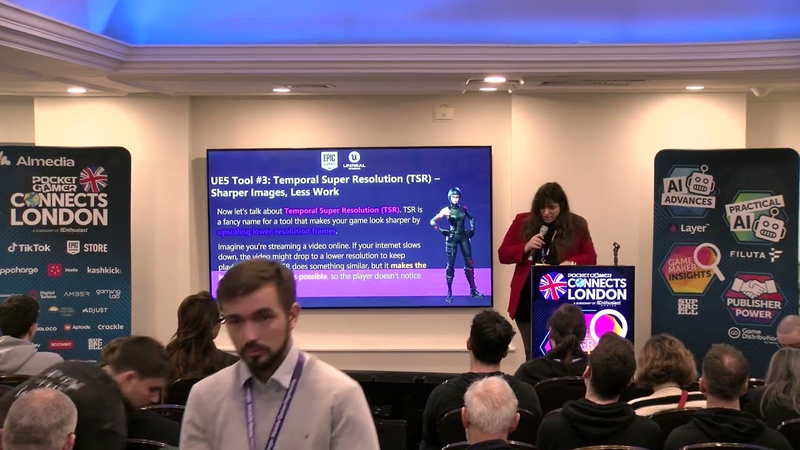
Session: Mobile Gaming With Unreal Engine – Performance, Optimisation, And Fortnite Mobile.
This presentation outlines strategies for optimizing mobile game performance using Unreal Engine, with a specific focus on the technical architecture behind Fortnite Mobile.
- Unreal Engine utilizes three core technologies—Nanite, Lumen, and Temporal Super Resolution (TSR)—to bridge the gap between mobile hardware limitations and AAA-quality visual fidelity.
- Nanite optimizes complex 3D environments by dynamically adjusting geometric detail based on camera distance, functioning similarly to a digital map that only renders high-resolution data when zoomed in.
- Temporal Super Resolution (TSR) enhances performance by rendering at a lower resolution and upscaling the image, allowing mobile games to maintain high visual sharpness without taxing the GPU.

Session: Bring Your Games to China With Unity – A Pathway for Games to Thrive in China - Junbo Zhang
The Chinese gaming market presents a unique, high-growth opportunity for international developers, despite significant regulatory and technical barriers.
- Unity China provides a localized, optimized version of the Unity engine (based on 2022 LTS) specifically designed to reduce runtime and loading times for the Chinese market, where Unity games now account for approximately 50% of WeChat Instant Game revenue.
- Unity China offers a comprehensive publishing service that handles regulatory compliance, ISBN filing, and technical integration across fragmented Android channels (e.g., Xiaomi, Oppo, Huawei) and emerging platforms like WeChat and Douyin.
- The Chinese gaming market is dominated by mobile gaming, which accounts for roughly 75% of the total market, with significant growth opportunities in the Instant Game sector and high-performance hardware like smart electric vehicles.



The Big Game Engine Report of 2025
The Big Game Engine Report 2025 examines the shifting landscape of game development technology, focusing on the transition from proprietary in-house tools to third-party public engines.
- The share of Steam releases powered by custom in-house engines plummeted from over 70% in 2012 to 13% in 2024.
- Custom engines have fallen below 50% of total unit sales for the first time, currently accounting for 42% of the market.
- Unity remains the volume leader, powering 51% of all Steam releases in 2024, primarily dominating the 'Tiny' and 'Small' categories under 100k units.
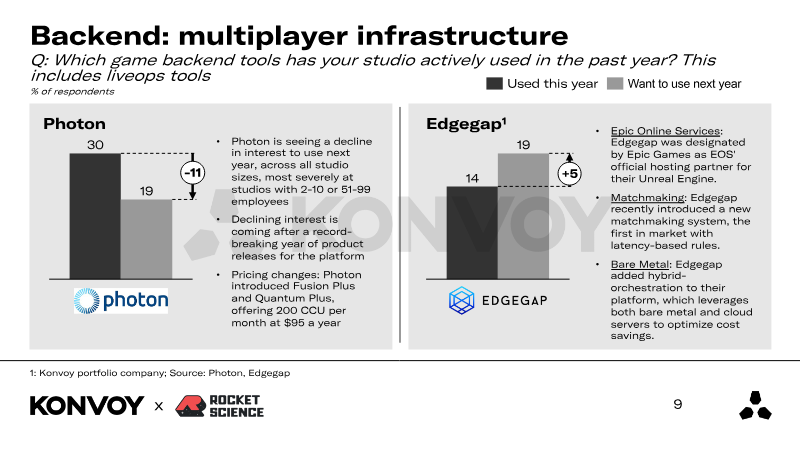
Game Developer Survey 2025
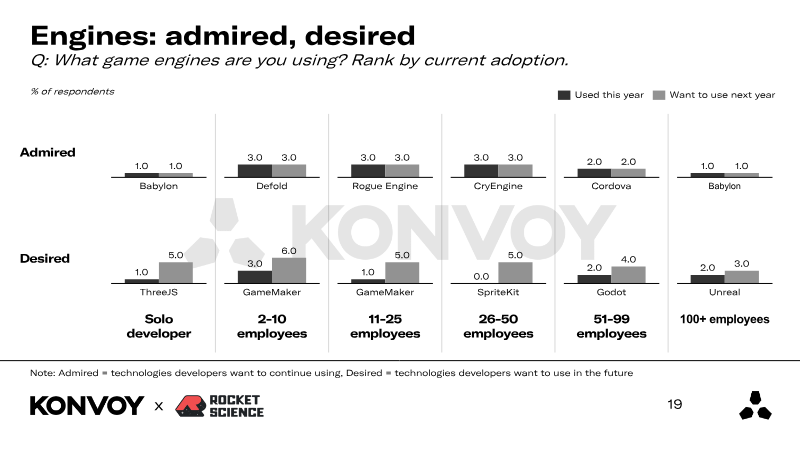
The 2025 Game Developer Survey captures the technology preferences and strategic shifts of game studios worldwide, focusing on platform targets, engine adoption, 3D creation tools, backend services, analytics, user-acquisition solutions, and generative-AI usage.
- Unity remains the dominant engine, but studios are increasingly planning to move away from the platform following a 25% enterprise license price hike and the introduction of a $2,200 per-seat fee for pro users.
- Open-source engines like Godot and Defold are gaining significant traction as alternatives to traditional engines, while ProBuilder and Houdini have become the fastest-growing 3D modeling tools for studios with fewer than 100 employees.
- Mixpanel has seen a 120% surge in interest among developers, driven by a new startup-focused pricing tier that offers over $150,000 in value.

Why Do Unreal Games All Look This Way — PontyPants
The discussion centers on the growing trend of asset-flipping in the indie game industry and the resulting homogenization of visual aesthetics, particularly among games developed in Unreal Engine.
- Creating custom assets instead of using store-bought ones ensures visual cohesion and prevents the 'generic' look often associated with Unreal Engine 5 titles.
- Relying on third-party assets carries legal risks, as demonstrated by the removal of the game 'Only Up' from Steam due to copyright issues regarding asset ownership.
- Players possess a subconscious ability to distinguish between 'asset-flipped' games and those with custom, intentional design, which can negatively impact the perceived quality of a title.

Remedy Capital Markets Day 2024: Northlight - There Are No Games Without Cutting Edge Technology
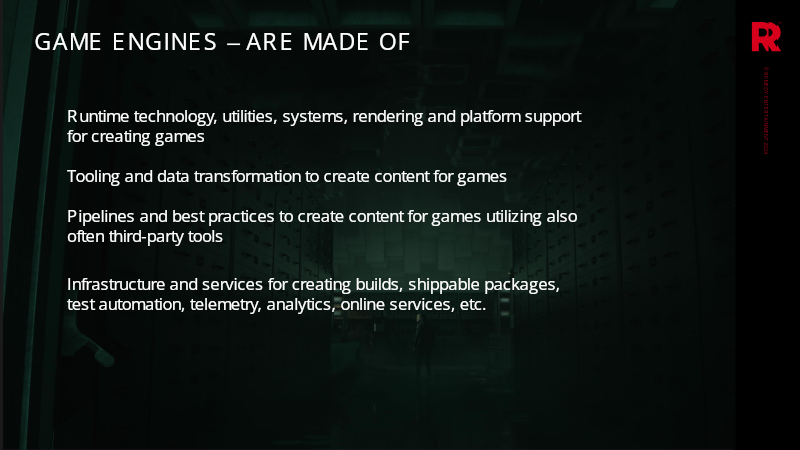
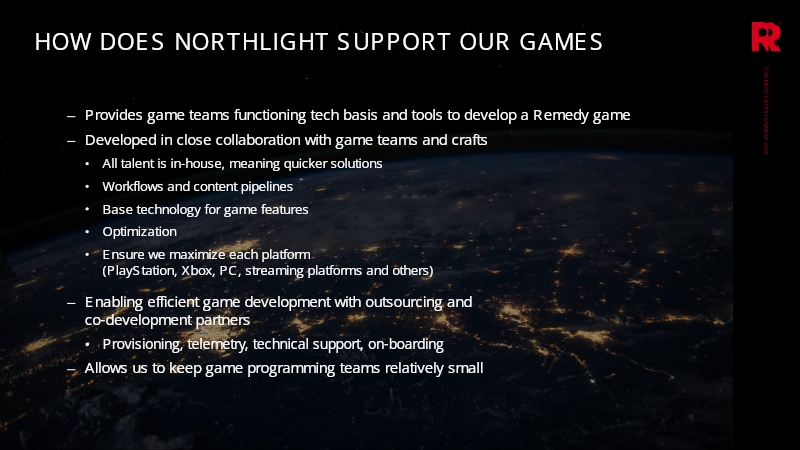
The Northlight engine serves as the foundational technological pillar for Remedy Entertainment, functioning as a proprietary ecosystem that integrates runtime technology, content pipelines, and infrastructure to drive game development.
- Remedy maintains its proprietary Northlight engine to ensure total control over development workflows, team composition, and the aesthetic quality of its titles.
- The engine architecture is designed to reduce production costs by streamlining the transformation of third-party digital content into game-ready assets.
- Strategic partnerships with hardware leaders Sony and Nvidia enable the early integration of advanced rendering technologies like ray tracing and AI-driven upscaling.

Independent Games Summit: A Case for Making Your Own Engine
Relying exclusively on large-scale, off-the-shelf game engines often introduces unnecessary technical bloat, rigid design constraints, and financial dependencies on third-party business policies.
- Building a custom game engine is a viable alternative to commercial engines like Unreal or Unity when the financial cost of licensing fees outweighs the time saved, or when the project requires specific design constraints that existing engines cannot solve.
- Relying on third-party engines ties a company's success to the external vendor's business decisions and platform whims, creating a dependency that can be mitigated by maintaining control over your own technical stack.
- Developers can reduce the burden of building from scratch by utilizing lightweight, open-source libraries like SDL for cross-platform OS, input, and sound management, which are proven in commercial shipping environments.