Game Development
Documents

職員募集(契約職員・業務委託パートナー):人材育成
The Computer Entertainment Society (CESA) announces a recruitment drive for contract personnel and outsourced partners to support its expanding human‑resource development initiatives within Japan’s video‑game sector. The role centers on planning and operating creator training programs, facilitating the introduction of game‑based curricula in schools in collaboration with government bodies, and acting as a liaison for industry‑wide issues. Additional responsibilities include coordinating with public agencies, conducting research on the gaming industry, managing outreach and publicity, overseeing committee activities, and handling web, event, and social‑media communications tied to commissioned projects.
Candidates are expected to possess at least five years of professional experience, demonstrable negotiation and coordination skills, and a strong interest in gaming. Preferred backgrounds include prior interaction with governmental entities, experience driving contract‑based projects, and familiarity with educational or certification activities related to games. Basic PC proficiency in spreadsheet, word‑processing, and presentation software is required, while prior employment in game companies or teaching roles is advantageous.
Employment is offered either as a full‑time contract employee with a standard 9:00‑17:30 schedule in Shinjuku, Tokyo, or as an outsourced partnership negotiated according to individual expertise. Contract terms are annual, renewable up to three years, with an hourly wage starting at ¥1,800, subject to experience. Benefits encompass health, pension, unemployment, and workers’ compensation insurance, a complete two‑day weekend, and a smoke‑free office environment. Applications are to be submitted via the CESA inquiry form, followed by a two‑stage interview process conducted online and in person.
- The Computer Entertainment Society (CESA) is hiring contract personnel and outsourced partners to lead human-resource development and creator training programs within the Japanese video-game industry.
- Core responsibilities include facilitating game-based curricula in schools, managing government relations, conducting industry research, and overseeing communications for commissioned projects.
- Candidates must have at least five years of professional experience, with preference given to those with backgrounds in government liaison work, project management, or educational certification.
- Contract employees are based in Shinjuku, Tokyo, with a standard 9:00–17:30 schedule and an hourly wage starting at ¥1,800.
- Employment terms are annual and renewable for up to three years, with full benefits including health, pension, unemployment, and workers' compensation insurance.
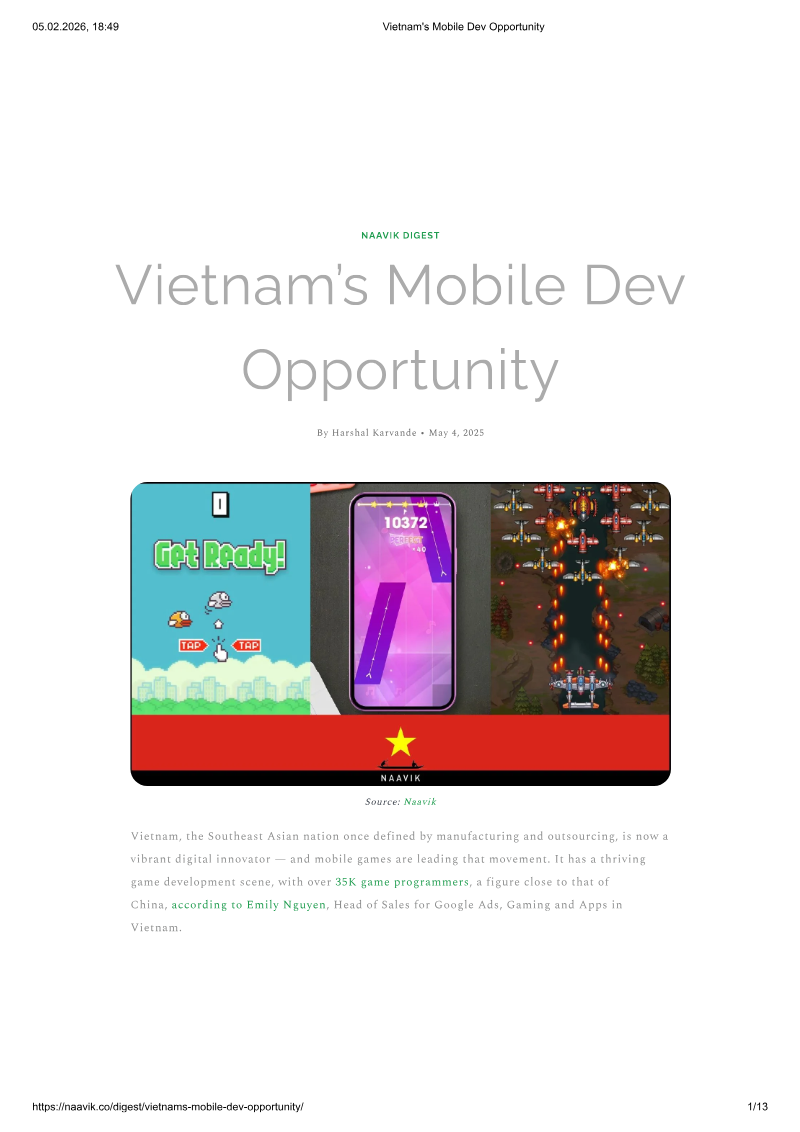
Vietnam's Mobile Dev Opportunity
Vietnam’s mobile game sector has evolved from a consumer‑centric market into a burgeoning production hub, driven by a skilled talent pool forged through outsourcing, stringent regulatory frameworks that forced local publishing entities to emerge, and the explosive rise of mobile gaming. The country now hosts over 35 000 game programmers—comparable to China’s workforce—and more than 300 active mobile publishers headquartered in Vietnam. In 2024, five Vietnamese studios ranked among the world’s top 25 publishers by downloads, contributing nearly 2.4 billion downloads and $133 million in revenue—a 67 % increase in downloads and an 82 % rise in earnings since 2020. Key titles such as Car Race, Wood Nuts & Bolts Puzzle, and Hair Salon: Beauty Salon Game illustrate the domestic IP pipeline, while globally recognized titles like Sky Garden: Farming Paradise, Magic Tiles 3, and Axie Infinity showcase the country’s capacity for high‑impact releases.
The transformation accelerated after 2013 when Vietnamese solo developer Nguyen Ha Dong’s Flappy Bird achieved worldwide chart dominance, proving that local talent could produce globally successful mobile games with limited resources. This success spurred a wave of small studios and startups, many of which transitioned from outsourcing or publishing roles to independent IP creation. Vietnam’s high smartphone penetration (84 %) and a youthful, digitally native demographic further underpin market growth.
Regulatory challenges remain: stricter limits on gaming time for minors, mandatory Ministry of Information and Communications approvals, and content censorship can constrain creative expression and international appeal. Future success will hinge on navigating the shift from hypercasual to more complex casual and social mobile games while adapting to evolving regulatory constraints. Despite these hurdles, Vietnam’s established talent base, rapid growth trajectory, and increasing foreign investment position it as a rising contender for global mobile game leadership over the next decade.
- Vietnam has emerged as a major global mobile development hub with over 35,000 game programmers and more than 300 active local publishers.
- In 2024, five Vietnamese studios ranked among the world’s top 25 publishers, generating 2.4 billion downloads and $133 million in revenue.
- Since 2020, the sector has experienced significant growth, marked by a 67% increase in downloads and an 82% rise in earnings.
- The industry’s transition from outsourcing to independent IP creation was catalyzed by the 2013 global success of Flappy Bird, which proved that local talent could achieve international chart dominance.
- Domestic market strength is supported by a digitally native population and an 84% smartphone penetration rate.
Financial Results Briefing FY2025
GungHo Online Entertainment is currently undergoing a fundamental strategic pivot, transitioning from a primary focus on the domestic Japanese mobile market toward a global, multi-platform distribution model. This evolution targets North America and Europe specifically through the development of action-oriented intellectual properties for console and PC. The success of this shift is evidenced by the dramatic rise in the overseas net sales ratio, which is projected to reach 66% in fiscal year 2025, up from just 11.4% in 2016. Key drivers for this international expansion include the upcoming launch of Let It Die: Inferno and the continued global scaling of the Ragnarok and Puzzle & Dragons franchises across more than 150 countries.
Despite this aggressive geographic expansion, the company faces immediate financial headwinds characterized by a contraction in consolidated net sales and operating profit. Quarterly performance data reveals a downward trajectory over a four-year period, with peak values declining from over 16,000 to approximately 7,750 in the most recent quarter. This downturn is largely attributed to softening sales of legacy mobile titles and a reactional decrease in revenue from the subsidiary Gravity. To stabilize these core assets, the company is utilizing high-profile collaborations with major brands such as Sanrio and Digimon to maintain domestic user engagement while simultaneously preparing for the launch of Ragnarok Online 3 in major Asian markets.
The long-term outlook centers on a diversified portfolio that balances established mobile revenue with new, high-scale global releases. While current financial indicators reflect a period of contraction and volatility, the commitment to 100-player raid mechanics in upcoming titles and the expansion of Ragnarok X: Next Generation into EMEA markets signal a move toward more technologically ambitious projects. Ultimately, the transition toward a global-first strategy represents a necessary adaptation to the maturing domestic mobile landscape, aiming to replace declining legacy revenue with sustainable growth from international console and PC audiences.
- GungHo is executing a strategic pivot from the domestic Japanese mobile market to a global, multi-platform model, with overseas net sales projected to reach 66% of total revenue in FY2025, up from 11.4% in 2016.
- Consolidated net sales and operating profit are in a four-year decline, with quarterly performance metrics dropping from a peak of over 16,000 to approximately 7,750.
- The company is addressing the softening sales of legacy mobile titles and decreased revenue from its subsidiary Gravity by leveraging high-profile collaborations with brands like Sanrio and Digimon.
- Future growth is anchored in the expansion of the Ragnarok franchise, including the upcoming launch of Ragnarok Online 3 in Asian markets and the introduction of Ragnarok X: Next Generation to EMEA regions.
- GungHo is shifting its development focus toward action-oriented console and PC intellectual properties, highlighted by the upcoming release of Let It Die: Inferno.
The State of Web Gaming Report 2026: A Data-Driven Guide to the Untold Reality of Contemporary Web Gaming
Web gaming is currently undergoing a significant renaissance, driven by a growing consumer preference for frictionless, instant-access experiences that bypass the cumbersome download and update requirements characteristic of traditional PC and console platforms. This shift reflects a broader evolution in gaming habits, where time-poor users increasingly favor rapid, cross-platform engagement. As of 2026, the sector has transitioned from a legacy medium into a high-value discovery layer, serving as a vital top-of-funnel acquisition tool for the wider gaming ecosystem.
Data indicates that web gaming audiences are remarkably engaged, with 37 percent of users playing multiple times daily. This high level of interaction is complemented by a strong conversion pipeline, as 62 percent of players eventually purchase or download titles they initially encountered through a browser. Despite these compelling metrics, a persistent perception gap remains among some developers who view the web as a low-quality channel. However, the industry is actively correcting this bias, with 53 percent of developers planning to port mobile titles to the web within the coming year to mitigate widespread discoverability challenges.
The global market for web gaming is characterized by low barriers to entry and high competition, yet HTML5 development provides a cost-effective strategy for reaching deeply engaged audiences. By leveraging the web as a primary discovery channel, developers can effectively bridge the gap between casual browser play and long-term ecosystem investment. Ultimately, the integration of web-based gaming into broader distribution strategies is no longer optional but a critical growth imperative for developers seeking to maintain relevance in an increasingly fragmented digital landscape.
- Web gaming has evolved into a primary top-of-funnel acquisition tool, with 62 percent of browser-based players eventually purchasing or downloading the titles they first encountered on the web.
- The web gaming audience demonstrates high retention, with 37 percent of users engaging with content multiple times per day.
- To combat mobile discoverability challenges, 53 percent of developers plan to port their mobile titles to the web within the next year.
- The shift toward web gaming is driven by a consumer preference for frictionless, instant-access experiences that eliminate the need for traditional platform downloads and updates.
- HTML5 development serves as a cost-effective strategy for developers to reach highly engaged audiences while navigating a market defined by low barriers to entry and high competition.
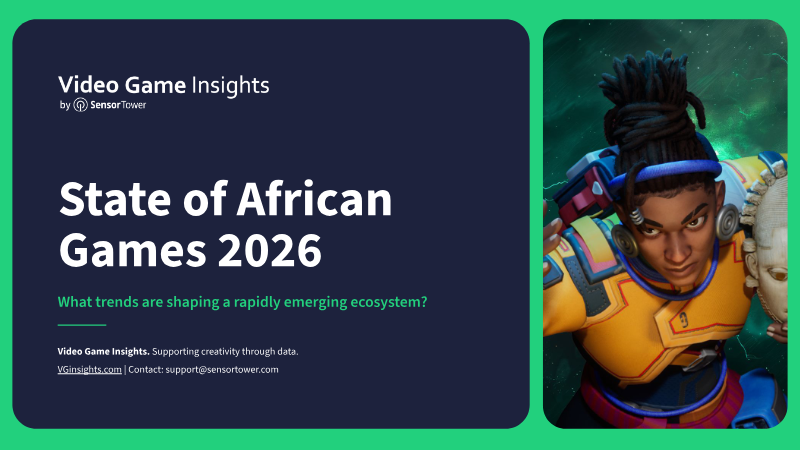
State of African Games 2026
The analysis delivers a data‑driven overview of African‑developed video games, concentrating on performance across global platforms—primarily Steam, with supplemental PlayStation and Xbox data—from 2015 through 2025. Its central thesis is that the continent’s game‑development ecosystem is emerging rapidly yet remains highly concentrated, especially in South Africa, and is transitioning from volume‑driven growth to a focus on higher‑quality, strategically positioned titles.
South Africa accounts for the overwhelming share of both developers and commercial success, supplying all titles in the top‑ten sales list and driving the continent’s 2 % share of Steam unit sales—higher than the Middle East and comparable to Oceania. Releases peaked in 2023 with 23 Steam titles before falling to 11 in 2025, suggesting a shift toward longer development cycles. Genre analysis reveals a mismatch: simulation games achieve the highest median sales (≈372 k units), followed by adventure and RPGs, while action titles dominate the release count. Pricing follows global indie norms, with most games priced between $5.99 and $19.99; premium pricing above $21.99 appears in only a small fraction of titles. Unity is the leading engine (≈18 % of releases), Unreal accounts for about 7 %, and the remaining 73 % use a diverse set of smaller tools, reflecting a decentralized technical landscape.
Methodologically, the study relies on Video Game Insights estimations for games launched after 1 January 2015, employing internal sales‑estimation algorithms that convert review counts and apply the Boxleiter method to infer unit sales and revenue. The scope encompasses all major platforms, covers the entire African continent, and isolates trends in genre, pricing, engine choice, and geographic distribution.
Conclusions point to a transitional phase where success will depend less on release volume and more on distinctive cultural content, genre diversification, and broader support structures beyond South Africa. If these dynamics persist, the African game‑development sector is poised to evolve from an emerging participant to a recognized creative force within the global industry.
- South Africa dominates the African game development sector, accounting for all top-ten selling titles and contributing to a 2% share of global Steam unit sales.
- The industry is shifting from volume-driven growth to longer development cycles, evidenced by a decline in annual Steam releases from a peak of 23 in 2023 to 11 in 2025.
- There is a significant genre mismatch in the market, as action titles dominate release volume while simulation games achieve the highest median sales at approximately 372,000 units.
- The technical landscape is highly decentralized, with Unity powering 18% of releases and Unreal Engine 7%, while 73% of titles rely on a diverse range of smaller development tools.
- Pricing for African-developed titles remains aligned with global indie norms, with the vast majority of games priced between $5.99 and $19.99 and very few exceeding $21.99.

Annual Review: 2025
The document outlines Ukie’s first year of its five‑year “Supercharged” strategy, aimed at accelerating the UK video games and interactive entertainment sector. The thesis is that a coordinated policy, industry‑wide campaigns, talent development and trade support can secure the UK’s position as a global leader in games. Key findings show that consumer spending reached £7.6 billion in 2024, a record high, and that Ukie’s advocacy generated three major policy wins: recognition of games as a growth sector, a tailored growth package and £30 million for the UK Games Fund. The organisation also secured £75 million in business wins through global trade activity at GDC and Gamescom, and delivered 19 consultations to government bodies. In talent development, Ukie supported 30 companies via its Growth Programme and ran the largest student game jam with over 200 participants, while Digital Schoolhouse won a national BETT award for best opportunities and experience. The scope covers the UK, with outreach to Scotland, Wales, Northern Ireland and international partners such as Tencent. Methodology includes evidence‑based lobbying, a national pulse survey network, and partnership with academic institutions for skills research. The report concludes that the next year will focus on deepening policy influence, expanding trade missions, and fostering emerging mobile, UGC and external‑engine opportunities to sustain industry growth.
- UK consumer spending on video games and interactive entertainment reached a record high of £7.6 billion in 2024.
- Ukie’s advocacy efforts secured £30 million in funding for the UK Games Fund and official recognition of the sector as a key driver of economic growth.
- Global trade activities at GDC and Gamescom generated £75 million in business wins for the UK games industry.
- The organization delivered 19 formal consultations to government bodies to influence policy and secure a tailored growth package for the sector.
- Talent development initiatives included supporting 30 companies through the Growth Programme and hosting a student game jam with over 200 participants.

Square Enix Next: That Excitement Once Again
Square Enix’s recent performance review exposes a persistent decline in revenue growth and profitability over the past three years, with operating income falling 32 % and ROE dropping 61 %. The downturn is driven primarily by weak margins in both high‑definition (HD) and small‑dungeon (SD) game segments, excessive portfolio fragmentation, sub‑optimal product design and promotion, and escalating development costs. While the MMO licensing arm remains the sole growth driver (+11 %), overall gaming revenue has slipped, with HD and SD titles declining 4 % and 5 % respectively. Operating margins for these segments hover around 35–40 %, noticeably higher than the industry average of 28 % but still lagging behind competitors, indicating inefficiencies that are not being adequately addressed.
The company’s medium‑term “Reboots” plan offers only high‑level directions without concrete key performance indicators or quantitative targets. Critical gaps include a lack of clear business‑portfolio strategy, insufficient disclosure on non‑core business rationales, and no defined mechanisms for monitoring progress or maximizing shareholder value. Capital allocation disclosures are similarly weak: cost‑of‑capital calculations, ROE and ROIC targets, and hurdle rates are absent, while share‑buyback authorization remains unused despite a sharp price decline. SG&A costs exceed peer norms by 5–6 ppt, driven largely by an oversized sales force, further eroding profit margins.
Geographically, SD game revenue is almost entirely domestic; the Japanese market has contracted 2 % annually since 2020, and overseas growth remains only 3 %. The company’s global SD strategy is inert, with a 7 % overseas expansion rate falling short of projected growth and flagship titles such as FFVII Ever Crisis deriving 70 % of revenue from Japan. Non‑core Amusement and Publishing businesses are undervalued, with a significant conglomerate discount relative to peers and declining sales and margins. Limited cross‑synergy between game and publishing arms further hampers value creation.
In summary, Square Enix faces a multifaceted challenge: declining core game performance, weak strategic direction and KPI setting, high SG&A costs, and an underperforming non‑core portfolio. Addressing these issues through tighter cost control, clearer performance metrics, aggressive overseas expansion, and potential portfolio optimization is essential to restore corporate value and achieve sustainable growth.
- Square Enix has experienced a significant financial decline over the past three years, marked by a 32% drop in operating income and a 61% decrease in return on equity (ROE).
- Core gaming segments are underperforming, with HD and SD game revenues falling 4% and 5% respectively, while MMO licensing remains the only growth driver at +11%.
- Operating margins for HD and SD segments remain inefficient at 35–40%, and SG&A costs exceed industry norms by 5–6 percentage points due to an oversized sales force.
- The company's 'Reboots' medium-term plan lacks concrete KPIs, quantitative targets, and clear capital allocation strategies, such as defined hurdle rates or ROIC goals.
- Square Enix’s SD game revenue is heavily reliant on the contracting Japanese market, with flagship titles like 'FFVII Ever Crisis' generating 70% of their revenue domestically.

Llibre Blanc de la Indústria Catalana del Videojoc 2024
I’m ready to combine the section summaries into a cohesive overview, but I’ll need the remaining sections to capture the full scope, key data points, and conclusions of the 2024 Catalan video‑game industry analysis. Could you please provide the rest of the section summaries?
- The Catalan video game industry generated €756 million in 2023, representing 53% of Spain's total revenue and a 6.6% increase from 2022. It employed 5,174 professionals, accounting for 50% of the national total.
- The industry is projected to reach €893 million by 2027, with an estimated compound annual growth rate (CAGR) of 4.3% for 2023-2027, despite an anticipated stagnation in 2024.
- In 2024, there were 262 video game studios in Catalonia, with 161 formally constituted as companies, a 10% increase from the previous year.
- Catalan studios primarily focus on original intellectual properties (91%), with self-publishing (54%) and third-party development (39%) being other popular activities. Serious games development increased to 22%.
- Digital premium sales are the main revenue source (40%), followed by outsourcing (16%) and service sales (14%). 74% of games developed in Catalonia include a Catalan language version.
Financial Results Q1 2025
The financial results for the first quarter of 2025 detail the operational and fiscal performance of PCF Group S.A., a global video game developer. The data reflects a period of strategic transition, characterized by rising quarterly revenues alongside shifting profitability margins. Total revenue for the first quarter of 2025 reached 63.0 million PLN, an increase from 56.9 million PLN in the same period of the previous year. Despite this growth, the group reported a net loss of 3.9 million PLN for the quarter, compared to a narrow loss of 0.9 million PLN in the first quarter of 2024. Adjusted EBITDA also saw a decline from 11.0 million PLN to 1.7 million PLN year-over-year.
The financial performance was influenced by several key operational factors, including the integration of PCF Chicago into PCF US and the inclusion of new projects such as Project Delta and Project Echo. Conversely, profitability was impacted by lower revenues from Project Gemini and the recognition of costs related to Project Bifrost within the cost of goods sold. The group’s workforce remained stable at 675 employees as of March 31, 2025, with a significant concentration of developers in Warsaw and North American studios.
In the virtual reality segment, the subsidiary Incuvo continues to manage Green Hell VR, which saw a successful co-op mode launch in late 2024. The group plans to release Project Bison in the fourth quarter of 2025, which is intended to be the final VR title published by PCF Group. Geographically, the group maintains a strong presence across Europe and North America, with its primary development hubs located in Poland and Canada. The methodology relies on consolidated financial data and internal project tracking as of the end of the first quarter of 2025.
- PCF Group S.A. reported Q1 2025 revenue of 63.0 million PLN, an increase from 56.9 million PLN in Q1 2024.
- The company recorded a net loss of 3.9 million PLN in Q1 2025, widening from a 0.9 million PLN loss in the same period last year.
- Adjusted EBITDA fell significantly year-over-year, dropping from 11.0 million PLN to 1.7 million PLN.
- Profitability was negatively impacted by lower revenues from Project Gemini and the recognition of costs associated with Project Bifrost.
- The group maintains a stable workforce of 675 employees, with primary development operations concentrated in Poland and North America.
Top Game Creators Academy: 入学式/懇親会を開催しました
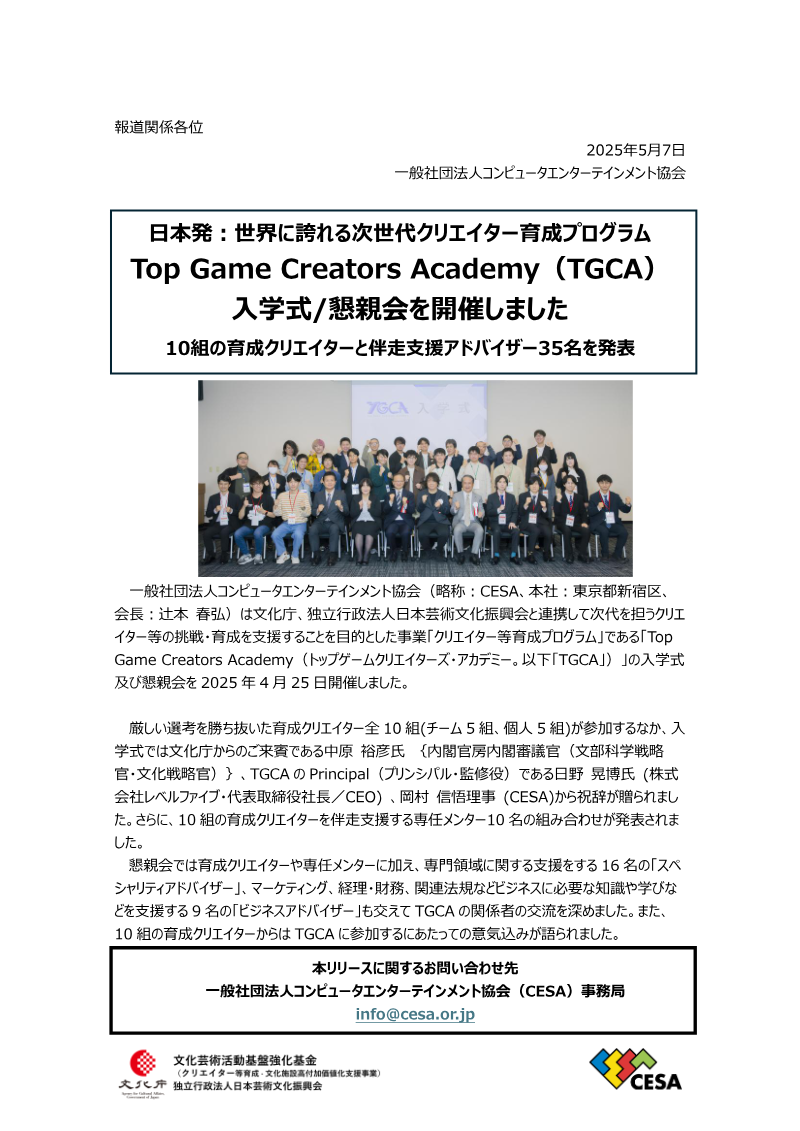
The Top Game Creators Academy (TGCA) was inaugurated on 25 April 2025 as a joint initiative of the Cultural Agency, the Japan Arts and Culture Promotion Agency, and the Computer Entertainment Association (CESA) to cultivate next‑generation game creators capable of delivering original IP that can compete globally. Ten selected teams—five groups and five individual creators—were formally admitted, accompanied by thirty‑five advisors who will provide ongoing mentorship, specialty guidance, and business support throughout a two‑year development cycle.
The program draws on the Cultural Arts Activity Strengthening Fund, allocating public resources to enable intensive, mentor‑driven training. Each creator cohort is paired with a dedicated mentor from leading studios such as Bandai Namco, Capcom, and Square Enix, while sixteen specialty advisors cover visual art, engineering, design, sound, and project management, and nine business advisors address marketing, finance, and legal matters. Progress meetings occur monthly, fostering collaborative feedback within multi‑person groups rather than one‑on‑one pairings.
Participants will showcase their work at major industry events, beginning with an online appearance at CEDEC in July 2025, a debut at Tokyo Game Show in September 2025, and subsequent exhibitions at the Taipei Game Show in January 2026, with potential expansion to international venues such as Gamescom in 2026. The cohort aims to graduate by March 2027, having refined both creative and commercial competencies to launch globally competitive titles.
- The Top Game Creators Academy (TGCA) launched on 25 April 2025 to develop globally competitive original IP through a two-year intensive mentorship program.
- The cohort consists of 10 teams—5 groups and 5 individuals—supported by a network of 35 advisors, including 16 specialty experts and 9 business consultants.
- Mentorship is provided by industry leaders from major studios, specifically Bandai Namco, Capcom, and Square Enix.
- The program is funded by the Cultural Arts Activity Strengthening Fund, a joint initiative involving the Cultural Agency, the Japan Arts and Culture Promotion Agency, and CESA.
- Participants will debut their projects at CEDEC in July 2025 and Tokyo Game Show in September 2025, followed by Taipei Game Show in January 2026.
Studie Vlaams Gamebeleid: Eindrapport
The Flemish game industry stands at a critical juncture, requiring a strategic pivot from project-based support toward comprehensive business scaling and economic consolidation. While the sector has seen a rise in the number of studios between 2020 and 2024, growth remains heavily concentrated among a few major players, creating a fragile ecosystem characterized by a lack of mid-sized companies. To ensure long-term viability and competitiveness within the global market—which is currently valued at approximately 187.7 billion dollars—Flemish policy must evolve to address the "missing middle" by facilitating access to private capital and fostering entrepreneurial maturity.
Current support mechanisms, including the VAF/Gamefonds and the Tax Shelter, have been instrumental in initial development but are increasingly viewed as insufficient for the demands of international scaling. Global competition, driven by aggressive fiscal incentives in regions like Canada and France, necessitates a more robust and integrated financial instrumentarium. Stakeholders emphasize that while talent development remains a strength, the sector suffers from a lack of commercial focus, high production costs, and difficulties in retaining intellectual property. Consequently, there is a clear mandate to shift policy priorities toward attracting foreign investment, enhancing international promotion, and streamlining governance through a centralized strategic body.
Ultimately, the objective for the 2026–2030 period is to transition the Flemish games sector into a more stable, economically diverse industry. This requires a dual approach: optimizing existing public funding to better support commercial growth and implementing new, flexible economic tools that bridge the gap between early-stage prototyping and market-ready maturity. By aligning educational outputs with industry needs, fostering cross-sectoral collaboration, and prioritizing business development over isolated project subsidies, the region can mitigate the risks of brain drain and build a resilient, internationally recognized gaming hub.
- The Flemish game industry lacks a 'missing middle' of mid-sized companies, with growth concentrated among a few major players despite an increase in total studio numbers between 2020 and 2024.
- To compete in the $187.7 billion global market, Flemish policy must shift from project-based subsidies toward business scaling and private capital access for the 2026–2030 period.
- Existing support mechanisms like the VAF/Gamefonds and the Tax Shelter are currently insufficient to match the aggressive fiscal incentives offered by international competitors such as Canada and France.
- The sector faces structural challenges including high production costs, difficulties in retaining intellectual property, and a lack of commercial focus despite strong local talent development.
- Strategic priorities for the next five years include attracting foreign investment, enhancing international promotion, and establishing a centralized governance body to oversee industry development.

The Game Development Renaissance
The global game development industry is undergoing a fundamental transition toward a more sustainable and efficient operational model, moving away from volatile hiring cycles in favor of long-term stability. With the market projected to reach $190 billion by 2025, industry leaders express significant optimism, as 77% of developers anticipate continued growth and a marked reduction in workforce instability. This evolution is characterized by a strategic shift toward leaner production cycles where studios prioritize creative intellectual property over the maintenance of internal technical infrastructure.
Central to this transformation is the widespread adoption of externalized technology and third-party backend services. While only 6% of developers intend to rely on internal builds in 2025, nearly half plan to integrate specialized third-party tools to manage complex requirements such as cross-platform synchronization and unified player inventories. By outsourcing non-core technical burdens, studios can accelerate time-to-market and mitigate the financial risks associated with building bespoke systems. This shift enables a deeper focus on LiveOps and "forever game" models, which are increasingly viewed as the primary drivers of player lifetime value and long-term revenue.
Furthermore, the industry is diversifying its financial and distributional strategies to bypass traditional gatekeepers. Developers are increasingly leveraging alternative funding sources, such as crowdfunding, and utilizing direct-to-consumer webshops to avoid high app store fees. As studios embrace sophisticated metagames and personalized engagement strategies, the integration of cross-platform capabilities and web-based distribution is becoming a strategic necessity. This new paradigm emphasizes technical agility and creative innovation, positioning the industry for a period of disciplined, technology-driven expansion.
- The global game development market is projected to reach $190 billion by 2025, with 77% of developers anticipating continued industry growth and reduced workforce instability.
- Studios are shifting toward leaner production models by outsourcing non-core technical infrastructure, with only 6% of developers planning to rely on internal builds by 2025.
- Nearly 50% of developers plan to integrate specialized third-party tools to manage complex requirements like cross-platform synchronization and unified player inventories.
- The industry is prioritizing 'forever game' models and LiveOps as the primary drivers for increasing player lifetime value and long-term revenue.
- Developers are increasingly bypassing traditional gatekeepers by utilizing alternative funding sources like crowdfunding and direct-to-consumer webshops to avoid high app store fees.