Europe
Documents
Cyprus Game Industry: Senior+ Employment Landscape 2025
The study examines the senior‑level employment landscape in Cyprus’s game industry for 2025, drawing on an anonymous survey of 113 professionals and a comparative analysis with European peers. Findings reveal that senior‑plus talent in Cyprus exhibits low job mobility, with 71 % reporting no change in the past year and only 20 % moving voluntarily. When moves occur, they are largely strategic, aimed at improving compensation or scope rather than reacting to instability. Senior professionals prioritize financial reliability, clear role definitions, and predictable work environments over brand visibility or rapid career acceleration. Lifestyle factors—including climate, taxation, and family considerations—reinforce long‑term retention and reduce relocation willingness.
Job security perceptions are higher in Cyprus (average 2.68 on a 5‑point scale) than across Europe, yet the expected risk of job loss in the next year is also higher for many roles. Burnout and limited professional development opportunities emerge as key structural risks, with 66 % reporting burnout and only 53 % receiving employer‑funded training. Overtime is common, with 27 % working one to two times a month and 45 % accepting it as part of leadership duties, contributing to long‑term fatigue.
Salary data show Cyprus median salaries for senior roles (e.g., €98 k for top management) below European averages, while desired salaries are substantially higher (e.g., €135 k for top management). Relocation openness is moderate, with 36 % not open and 32 % very open; visa support, health insurance, and relocation bonuses are the most valued benefits.
Overall, the market is mature but faces challenges in retaining talent through sustained engagement and development rather than short‑term compensation incentives. The primary risk for employers is gradual burnout and skill stagnation hidden behind long tenure, rather than sudden turnover.
- Senior-level talent in Cyprus exhibits low job mobility, with 71% of professionals reporting no change in employment over the past year.
- A significant retention risk exists in the form of burnout, which affects 66% of senior professionals, compounded by the fact that only 53% receive employer-funded training.
- Median salaries for top management in Cyprus are approximately €98k, falling significantly short of the €135k desired by professionals in these roles.
- Overtime is a systemic issue, with 45% of leaders accepting it as a standard duty and 27% of the broader senior workforce working overtime at least once or twice a month.
- While 36% of senior professionals are not open to relocation, 32% are very open, with visa support, health insurance, and relocation bonuses identified as the most critical incentives.

PEGI: European Game Information
The text serves as an educational and promotional overview of the Pan‑European Game Information (PEGI) rating system, using a comic‑style narrative to capture the attention of younger gamers while delivering core information about age‑based content classification. Its central thesis is that PEGI provides the most comprehensive mechanism for informing consumers about video‑game suitability, thereby ensuring safe and informed purchasing decisions across Europe.
Key points emphasize that PEGI operates in more than thirty countries and employs a traffic‑light colour scheme to convey age recommendations: green icons for games suitable for all audiences (ages 3 and 7), amber for intermediate levels, and red for titles restricted to adults (18+). The system also includes content descriptors that clarify specific elements that may affect suitability, reinforcing transparency for parents and players. The narrative illustrates the progression through various “worlds” representing age brackets—3, 7, 12, 16, and 18—highlighting that each tier is tailored to increasingly experienced gamers.
The scope is continental, covering the European video‑game market and all major platforms, with references to the official website and downloadable applications for iPhone, Android, and Windows 7 Phone. No empirical methodology is presented; the piece relies on descriptive exposition and visual storytelling rather than survey data. Overall, the material positions PEGI as a reliable, universally adopted standard that guarantees 100 % informed choice for consumers.
- The PEGI rating system is the standardized age-classification mechanism for video games across more than 30 European countries.
- Age suitability is communicated through a traffic-light color scheme: green for ages 3 and 7, amber for intermediate levels, and red for 18+ restricted titles.
- The system utilizes specific content descriptors alongside age ratings to provide transparency regarding the elements that influence a game's suitability.
- PEGI ratings cover all major gaming platforms and are designed to facilitate informed purchasing decisions for both parents and players.
- The classification framework is structured into five distinct age brackets: 3, 7, 12, 16, and 18.
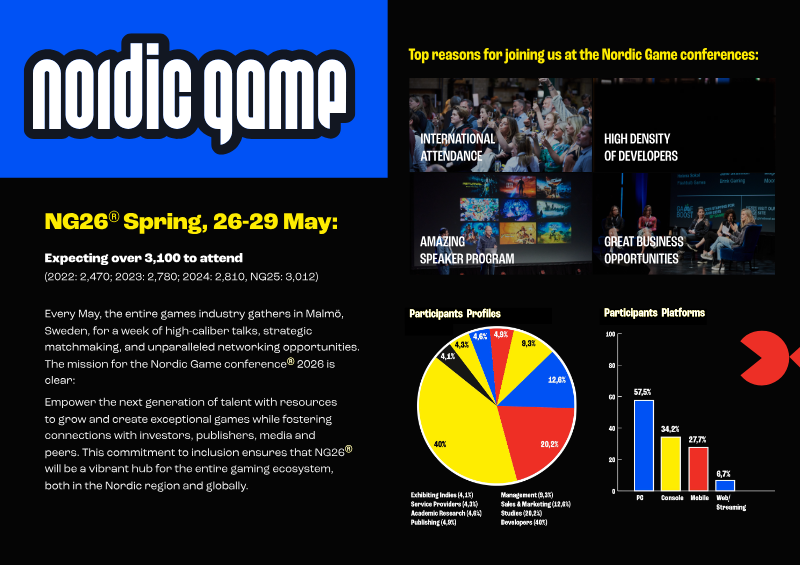
Nordic Game 2026: Participant Profiles and Platforms
Nordic Game 2026 serves as a primary hub for the Northern European video game industry, emphasizing a high density of developers and international attendance. The event facilitates business development and networking through a comprehensive speaker program, an expansive expo floor, and the annual Nordic Game Awards, which honors excellence among regional studios. The gathering targets a diverse range of industry professionals, including game startups, established studios, and service providers, with a specific focus on fostering connections between growing companies and global partners.
The participant base is heavily weighted toward production and leadership, with developers and artists making up the largest segment at 40% of all attendees. This is followed by professionals in sales and marketing at 12.6%, management at 9.3%, and service providers at 4.3%. Smaller contingents include exhibiting indies and various support roles. In terms of platform focus, PC remains the dominant sector for participants at 57.5%, followed by console development at 34.2% and mobile gaming at 27.7%. Web and other emerging platforms represent a smaller portion of the ecosystem at 6.7%.
The event infrastructure is designed to maximize return on investment through scalable exhibition options, ranging from small four-square-meter booths to large custom pavilions. Private meeting facilities are a core component of the offering, providing flexible spaces for four to fifty people to accommodate different business needs, from formal lectures to casual networking. By integrating sponsored content opportunities and specialized events like the Discovery Contest, the conference aims to support the entire lifecycle of game development within the Nordic region and beyond.
- PC development is the primary focus for 57.5% of Nordic Game 2026 participants, significantly outpacing console development at 34.2% and mobile gaming at 27.7%.
- Developers and artists constitute the largest attendee segment at 40%, followed by sales and marketing professionals at 12.6% and management at 9.3%.
- The event prioritizes business development by providing private meeting facilities that accommodate groups ranging from 4 to 50 people.
- Service providers represent 4.3% of the total participant base, which also includes a mix of startups, established studios, and exhibiting indies.
- Emerging platforms, including web-based gaming, account for 6.7% of the total development focus among conference attendees.

Annual Review: 2025
The document outlines Ukie’s first year of its five‑year “Supercharged” strategy, aimed at accelerating the UK video games and interactive entertainment sector. The thesis is that a coordinated policy, industry‑wide campaigns, talent development and trade support can secure the UK’s position as a global leader in games. Key findings show that consumer spending reached £7.6 billion in 2024, a record high, and that Ukie’s advocacy generated three major policy wins: recognition of games as a growth sector, a tailored growth package and £30 million for the UK Games Fund. The organisation also secured £75 million in business wins through global trade activity at GDC and Gamescom, and delivered 19 consultations to government bodies. In talent development, Ukie supported 30 companies via its Growth Programme and ran the largest student game jam with over 200 participants, while Digital Schoolhouse won a national BETT award for best opportunities and experience. The scope covers the UK, with outreach to Scotland, Wales, Northern Ireland and international partners such as Tencent. Methodology includes evidence‑based lobbying, a national pulse survey network, and partnership with academic institutions for skills research. The report concludes that the next year will focus on deepening policy influence, expanding trade missions, and fostering emerging mobile, UGC and external‑engine opportunities to sustain industry growth.
- UK consumer spending on video games and interactive entertainment reached a record high of £7.6 billion in 2024.
- Ukie’s advocacy efforts secured £30 million in funding for the UK Games Fund and official recognition of the sector as a key driver of economic growth.
- Global trade activities at GDC and Gamescom generated £75 million in business wins for the UK games industry.
- The organization delivered 19 formal consultations to government bodies to influence policy and secure a tailored growth package for the sector.
- Talent development initiatives included supporting 30 companies through the Growth Programme and hosting a student game jam with over 200 participants.
Wyniki Finansowe 3Q25
This financial analysis details the third-quarter 2025 performance of PCF Group S.A. (People Can Fly), a global game development studio. The primary thesis centers on a strategic pivot toward financial stability following a period of reorganization and disappointing performance from self-published titles. The scope covers the group’s global operations, including studios in Warsaw, Montreal, Newcastle, and Dublin, with a specific focus on the nine-month period ending September 30, 2025.
The financial data reveals a significant net loss of 117 million PLN for the first nine months of 2025, compared to a 33.3 million PLN loss in the same period of 2024. This deficit is largely driven by substantial non-cash write-offs totaling over 100 million PLN. Key impairments include a 92 million PLN write-down for the project Lost Rift (Victoria) following its Early Access launch on September 25, 2025, which failed to meet sales and player reception expectations. Other write-offs include 6 million PLN for PCF Chicago goodwill and 5 million PLN for Unreal Engine licenses. Despite these losses, revenues increased to 152.1 million PLN from 131.9 million PLN year-over-year, bolstered by work-for-hire (WFH) projects such as Delta, Zulu, and Echo.
The group’s methodology emphasizes "adjusted EBITDA" to illustrate underlying operational health, reporting a corrected EBITDA of 6 million PLN for the first nine months of 2025. Following a reorganization that left the workforce at 756 employees, the company is shifting its strategy to prioritize cash flow. Future objectives include securing at least one new WFH contract by the end of 2025, scaling back the Lost Rift team to achieve self-funding by 2026, and halting investment in new self-published projects until the group generates positive cash flow. Current active partnerships include ongoing projects with Microsoft, Krafton, and Sony.
- PCF Group S.A. reported a net loss of 117 million PLN for the first nine months of 2025, a significant increase from the 33.3 million PLN loss recorded in the same period of 2024.
- A 92 million PLN write-down for the project 'Lost Rift' (Victoria) following its September 25, 2025, Early Access launch was the primary driver of the group's financial deficit.
- Despite the net loss, total revenue grew to 152.1 million PLN in the first nine months of 2025, up from 131.9 million PLN in 2024, driven by work-for-hire projects including Delta, Zulu, and Echo.
- The company reported an adjusted EBITDA of 6 million PLN for the first nine months of 2025, which management uses to demonstrate underlying operational health despite total losses.
- PCF Group is halting investment in new self-published titles until the company achieves positive cash flow and is prioritizing securing at least one new work-for-hire contract by the end of 2025.
Wyniki Finansowe 1H25
This financial summary details the performance of PCF Group (People Can Fly) for the first half of 2025, reflecting a period of organizational restructuring and portfolio transition. The group operates across two continents with a total workforce of 756 people as of June 30, 2025, a slight decrease from 2024 levels. This team is distributed primarily across studios in Warsaw, North America, and various European satellite locations, following the merger of PCF Chicago into PCF US.
Financial results for 1H 2025 show a significant recovery in profitability compared to the previous year. Revenue for the first half of 2025 reached 115.3 million PLN, a substantial increase over the 76.3 million PLN reported in 1H 2024. EBITDA improved from a loss of 11.3 million PLN in 1H 2024 to a positive 2.9 million PLN in 1H 2025. Despite these operational improvements, the group recorded a net loss of 21.3 million PLN for the period, though this represents a narrowing of the 33.3 million PLN net loss seen in the prior year. Key drivers for these results include the increased contribution of Project Echo, the inclusion of Project Delta in financial reporting, and accounting write-offs related to goodwill and licenses following the Chicago studio merger.
The group’s product strategy highlights a shift in its VR segment managed by Incuvo. While Green Hell VR continues to receive updates, including a successful co-op mode launch, the upcoming title Tracked: Shoot to Survive (Project Bison) is scheduled for a Q4 2025 release. This title will mark the final VR game published by PCF Group as it refines its long-term development focus. Quarterly revenue trends indicate a stabilization in the 50-60 million PLN range per quarter throughout late 2024 and early 2025, supported by a mix of work-for-hire projects and internal IP development.
- PCF Group revenue grew to 115.3 million PLN in 1H 2025, up from 76.3 million PLN in 1H 2024.
- EBITDA turned positive at 2.9 million PLN in 1H 2025, recovering from an 11.3 million PLN loss in the same period last year.
- The company narrowed its net loss to 21.3 million PLN in 1H 2025, compared to a 33.3 million PLN loss in 1H 2024, despite accounting write-offs from the Chicago studio merger.
- PCF Group is exiting the VR segment, with the Q4 2025 release of 'Tracked: Shoot to Survive' (Project Bison) serving as its final VR title.
- Quarterly revenue has stabilized in the 50-60 million PLN range, supported by a combination of work-for-hire projects and internal IP development.

Llibre Blanc de la Indústria Catalana del Videojoc 2024
I’m ready to combine the section summaries into a cohesive overview, but I’ll need the remaining sections to capture the full scope, key data points, and conclusions of the 2024 Catalan video‑game industry analysis. Could you please provide the rest of the section summaries?
- The Catalan video game industry generated €756 million in 2023, representing 53% of Spain's total revenue and a 6.6% increase from 2022. It employed 5,174 professionals, accounting for 50% of the national total.
- The industry is projected to reach €893 million by 2027, with an estimated compound annual growth rate (CAGR) of 4.3% for 2023-2027, despite an anticipated stagnation in 2024.
- In 2024, there were 262 video game studios in Catalonia, with 161 formally constituted as companies, a 10% increase from the previous year.
- Catalan studios primarily focus on original intellectual properties (91%), with self-publishing (54%) and third-party development (39%) being other popular activities. Serious games development increased to 22%.
- Digital premium sales are the main revenue source (40%), followed by outsourcing (16%) and service sales (14%). 74% of games developed in Catalonia include a Catalan language version.
Financial Results Q1 2025
The financial results for the first quarter of 2025 detail the operational and fiscal performance of PCF Group S.A., a global video game developer. The data reflects a period of strategic transition, characterized by rising quarterly revenues alongside shifting profitability margins. Total revenue for the first quarter of 2025 reached 63.0 million PLN, an increase from 56.9 million PLN in the same period of the previous year. Despite this growth, the group reported a net loss of 3.9 million PLN for the quarter, compared to a narrow loss of 0.9 million PLN in the first quarter of 2024. Adjusted EBITDA also saw a decline from 11.0 million PLN to 1.7 million PLN year-over-year.
The financial performance was influenced by several key operational factors, including the integration of PCF Chicago into PCF US and the inclusion of new projects such as Project Delta and Project Echo. Conversely, profitability was impacted by lower revenues from Project Gemini and the recognition of costs related to Project Bifrost within the cost of goods sold. The group’s workforce remained stable at 675 employees as of March 31, 2025, with a significant concentration of developers in Warsaw and North American studios.
In the virtual reality segment, the subsidiary Incuvo continues to manage Green Hell VR, which saw a successful co-op mode launch in late 2024. The group plans to release Project Bison in the fourth quarter of 2025, which is intended to be the final VR title published by PCF Group. Geographically, the group maintains a strong presence across Europe and North America, with its primary development hubs located in Poland and Canada. The methodology relies on consolidated financial data and internal project tracking as of the end of the first quarter of 2025.
- PCF Group S.A. reported Q1 2025 revenue of 63.0 million PLN, an increase from 56.9 million PLN in Q1 2024.
- The company recorded a net loss of 3.9 million PLN in Q1 2025, widening from a 0.9 million PLN loss in the same period last year.
- Adjusted EBITDA fell significantly year-over-year, dropping from 11.0 million PLN to 1.7 million PLN.
- Profitability was negatively impacted by lower revenues from Project Gemini and the recognition of costs associated with Project Bifrost.
- The group maintains a stable workforce of 675 employees, with primary development operations concentrated in Poland and North America.
Studie Vlaams Gamebeleid: Eindrapport
The Flemish game industry stands at a critical juncture, requiring a strategic pivot from project-based support toward comprehensive business scaling and economic consolidation. While the sector has seen a rise in the number of studios between 2020 and 2024, growth remains heavily concentrated among a few major players, creating a fragile ecosystem characterized by a lack of mid-sized companies. To ensure long-term viability and competitiveness within the global market—which is currently valued at approximately 187.7 billion dollars—Flemish policy must evolve to address the "missing middle" by facilitating access to private capital and fostering entrepreneurial maturity.
Current support mechanisms, including the VAF/Gamefonds and the Tax Shelter, have been instrumental in initial development but are increasingly viewed as insufficient for the demands of international scaling. Global competition, driven by aggressive fiscal incentives in regions like Canada and France, necessitates a more robust and integrated financial instrumentarium. Stakeholders emphasize that while talent development remains a strength, the sector suffers from a lack of commercial focus, high production costs, and difficulties in retaining intellectual property. Consequently, there is a clear mandate to shift policy priorities toward attracting foreign investment, enhancing international promotion, and streamlining governance through a centralized strategic body.
Ultimately, the objective for the 2026–2030 period is to transition the Flemish games sector into a more stable, economically diverse industry. This requires a dual approach: optimizing existing public funding to better support commercial growth and implementing new, flexible economic tools that bridge the gap between early-stage prototyping and market-ready maturity. By aligning educational outputs with industry needs, fostering cross-sectoral collaboration, and prioritizing business development over isolated project subsidies, the region can mitigate the risks of brain drain and build a resilient, internationally recognized gaming hub.
- The Flemish game industry lacks a 'missing middle' of mid-sized companies, with growth concentrated among a few major players despite an increase in total studio numbers between 2020 and 2024.
- To compete in the $187.7 billion global market, Flemish policy must shift from project-based subsidies toward business scaling and private capital access for the 2026–2030 period.
- Existing support mechanisms like the VAF/Gamefonds and the Tax Shelter are currently insufficient to match the aggressive fiscal incentives offered by international competitors such as Canada and France.
- The sector faces structural challenges including high production costs, difficulties in retaining intellectual property, and a lack of commercial focus despite strong local talent development.
- Strategic priorities for the next five years include attracting foreign investment, enhancing international promotion, and establishing a centralized governance body to oversee industry development.
Games Industry Employment Survey: Europe 2025
The European games industry is currently navigating a period of profound instability, characterized by widespread layoffs and a significant exodus of talent. Over the past year, 26% of professionals have faced involuntary unemployment, with junior-level staff suffering a disproportionate 39% exit rate. This volatility is driven by a transition from rapid market expansion to a focus on operational optimization, further complicated by the rapid integration of artificial intelligence. While 63% to 69% of the workforce now utilizes AI for core tasks, this shift has fostered deep-seated skepticism among creative and quality assurance roles regarding long-term job security and the potential devaluation of human expertise.
Financial dissatisfaction has become a defining feature of the current landscape, exacerbated by salary freezes, reduced bonuses, and a persistent gender pay gap. With over a third of companies eliminating financial bonuses entirely, salary has emerged as the primary motivator for 87% of employees. This economic pressure, combined with a lack of structured support—such as the absence of dedicated diversity and inclusion specialists in 67% of firms—has contributed to a sharp decline in employee engagement. Burnout, affecting up to 63% of the workforce, and ineffective management are now the leading drivers for professionals considering career changes or leaving the industry altogether.
Despite these challenges, the workforce remains committed to hybrid work models, though a growing disconnect exists between employee preferences for flexibility and actual workplace mandates. Relocation trends have shifted toward a pragmatic focus on cost-of-living stability rather than traditional geographic mobility. As the industry matures, the data underscores a critical need for improved management practices and better alignment between organizational goals and employee well-being to mitigate the ongoing loss of talent and restore professional morale across the European sector.
- The European games industry is experiencing significant volatility, with 26% of professionals facing involuntary unemployment and a 39% exit rate among junior-level staff.
- Financial dissatisfaction is widespread, as 87% of employees now prioritize salary above all else following salary freezes and the elimination of bonuses at over one-third of firms.
- Burnout affects up to 63% of the workforce, serving as a primary driver for professionals considering leaving the industry alongside ineffective management practices.
- While 63% to 69% of employees now utilize AI for core tasks, the integration has triggered deep skepticism regarding job security and the devaluation of human expertise.
- Organizational support structures are lacking, evidenced by the absence of dedicated diversity and inclusion specialists in 67% of European gaming companies.
The Game Industry of Poland: 2025
Collective work under the direction of dr Jakub Marszałkowski dr Jakub Marszałkowski, Indie Games Poland, Poznan University of Technology (chapters 3, 5, 8, 9) Eryk Rutkowski, Polish Agency for Enterprise Development (chapters 2, 4, 6) Wojciech Trusz, Creative Industries Institute (chapters 1) Piotr Milewski, Sirius Game Studio, Gdynia Maritime University (chapters 7) Game Industry Conference team: Olga Matej, Agnieszka Wołoszyn, Kacper Żubryk, Hanna Marszałkowska, Dominik Latos Extra data minin...
- The provided report content contains only the title and author credits, lacking the body text, statistical data, or specific industry findings required to generate factual insights.
- Due to the absence of substantive data in the provided source, it is impossible to extract growth rates, company performance metrics, or industry trends for the Polish game industry in 2025.
- The source material consists exclusively of administrative metadata regarding the report's contributors and institutional affiliations.
- No concrete takeaways regarding market size, employment figures, or economic impact can be derived from the provided text.
- The input provided is insufficient to fulfill the request for a data-driven summary of the Polish game industry.
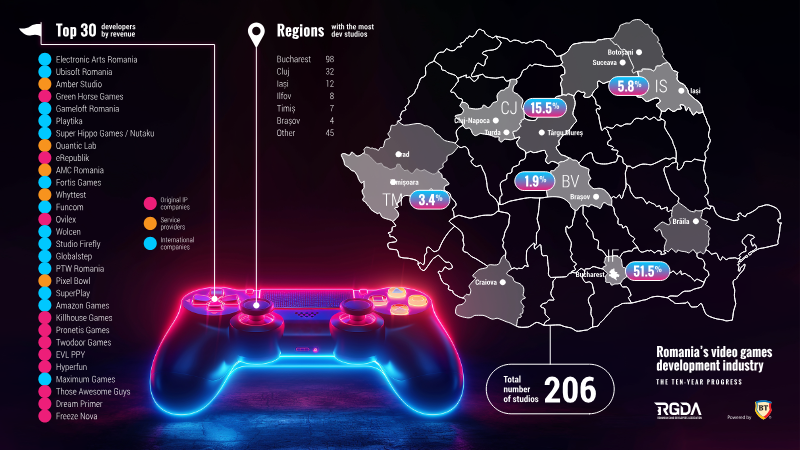
The Romanian Video Games Development Industry
The analysis presents a comprehensive overview of Romania’s video‑game development sector, focusing on revenue performance, geographic concentration, and workforce trends over the past decade. Its central thesis is that the industry has experienced rapid expansion, with total turnover rising from roughly €119 million in 2015 to more than €340 million in 2024, while the number of active studios grew by 70 % within the same period.
Revenue concentration is illustrated by a ranking of the top thirty developers, highlighting that multinational publishers such as Electronic Arts Romania (Bucharest) and Ubisoft Romania (Cluj‑Napoca) dominate the market, together accounting for a substantial share of the €340 million total. Mid‑size studios—including Amber Studio (Iași), Green Horse Games (Ilfov), and Playtika (Brașov)—contribute notable percentages, ranging from 5 % to 15 % of overall earnings. The data also maps studio locations, revealing a strong clustering in Bucharest, Cluj‑Napoca, Iași, and Brașov, with emerging hubs in Timișoara, Turda, and Arad.
Workforce figures show headcount increasing from 279,986 employees in 2015 to a projected 343,160 in 2024, reflecting a 12 % annual growth rate in personnel. Productivity, measured as turnover per employee, rose by 7.4 % over the ten‑year span, indicating that revenue gains are not solely driven by hiring but also by higher efficiency. Service‑oriented companies and international providers together represent 51.5 % of the sector, underscoring the importance of outsourcing and cross‑border collaborations.
The scope encompasses the entire Romanian market, covering all development, publishing, and service activities from 2015 through 2024. Figures appear to be compiled from company‑reported revenues, employee registers, and regional studio counts, suggesting a mixed methodology of financial reporting and industry surveys. Overall, the evidence points to a robust, diversifying ecosystem that is increasingly integrated with the global video‑game supply chain.
- The Romanian video game industry has nearly tripled its turnover in the last decade, growing from approximately €119 million in 2015 to over €340 million in 2024.
- The sector’s workforce has expanded at an annual rate of 12%, with total headcount projected to reach 343,160 employees by 2024.
- Market dominance is held by major multinational publishers like Electronic Arts in Bucharest and Ubisoft in Cluj-Napoca, while mid-size studios such as Amber, Green Horse Games, and Playtika contribute between 5% and 15% of total earnings.
- Industry efficiency has improved alongside growth, with productivity—measured as turnover per employee—increasing by 7.4% over the ten-year period.
- The number of active development studios in Romania has increased by 70% since 2015, with operations clustering in major hubs like Bucharest, Cluj-Napoca, Iași, and Brașov.