Employment

163 documents·66 publishers

Documents

Page 1
Report26 pages

Annual Report of the German Games Industry 2021

01 Players in Germany 8 02 German market for computer 14 03 The games industry in Germany 24 .1 Employment figures and companies .4 The ten demands of the games industry 04 gamescom 38 05 About game – the German 42 .1 Diversity initiative Hier spielt Vielfalt .2 Environmental and climate protection in the .3 Foundation for Digital Games Culture .5 Entertainment Software Self-Regulation Body 06 D...

  • The German games market experienced significant growth in 2020, with overall sales revenue increasing by over 30% due to the COVID-19 pandemic. Hardware sales, including consoles and gaming PCs, reached a record high, and subscription services saw a 44% increase in sales revenue.
  • Germany launched a major EU-notified games funding guideline in late 2020, with several studios receiving over one million euros in funding, marking a significant first for the country's games industry.
  • The number of companies in the German games industry increased by 5% for development and publishing companies and 7% for publishing-focused companies in 2021. However, employment in the core market grew by only 8% to 10,906 people, indicating that most new companies are microenterprises.
  • gamescom 2020 successfully transitioned to a digital format due to the pandemic, attracting millions of viewers from over 180 countries and featuring 370 partners across five show formats, with gamescom: Opening Night Live being a highlight.
  • game – the German Games Industry Association, with approximately 340 members including developers and publishers, advocates for improved industry conditions, youth protection, and diversity, and has been climate-neutral since early 2021.
+1
game – Verband der deutschen Games-Branche e. V.Jan 2021
Page 1
Report80 pages

European Video Games Industry Insight Report: 2021

By European Game Developers Federation (EGDF) Supported by Video Games Europe European Video Games Industry Data 5 Number of game developer studios 7 Number of game publishers 8 Number of people working in the video games industry 9 Percentage of women working in the industry ...

  • In 2021, the EU video game industry comprised 5,500 game developer studios and over 250 game publishers, employing 85,000 people and generating a turnover of €18.3 billion, up from 78,000 employees and €15.1 billion in 2020.
  • Many European countries offer cultural aid for video game production, with common forms including grants (e.g., Austria, Denmark, Finland), loans (e.g., Belgium, France), and tax credits (e.g., Belgium, France, Germany, Greece).
  • Europe has a robust educational infrastructure for game development, with numerous institutions offering study programs; for example, Austria has 13 institutions, Belgium 8, and the Czech Republic 8.
  • Individual European countries show varying industry sizes and growth; for instance, Denmark had 168 studios and 911 employees in 2021, while Norway had 17 studios and 368 employees in the same year.
  • The report defines a game developer studio as a sole trader or company whose main turnover comes from developing games, including one-man teams and those using external publishers, and an active company as one registered, employing people, and generating turnover.
+2
European Games Developer FederationJan 2021
Page 1
Report66 pages

Serbian Gaming Industry Report 2021

In 2021 Serbia’s gaming ecosystem emerged as a rapidly expanding, export‑oriented sector that combined a sizable studio base with a vibrant indie community. Roughly 130 development studios employed 1,548 people, of whom 30 % were women, and produced about 2,200 titles that generated an estimated US$125 million in revenue. The majority of earnings—between 75 % and 100 %—derived from markets outside the country, and 64 % of games relied on a free‑to‑play model supplemented by advertising.

Mid‑sized studios such as Nordeus and Playrix RS demonstrated strong user bases, while larger contributors including Ubisoft Belgrade and the VFX house Bunker underscored Serbia’s capacity to support AAA‑level production and international client work. The esports landscape, led by Fortuna’s Balkan League, attracted roughly half a million viewers and distributed €220 k in prize money, highlighting the sector’s growing competitive dimension. Indie developers, ranging from solo creators to teams of forty, pursued diverse platforms—PC, mobile, VR/AR—and increasingly leveraged tools like Epic’s MetaHuman Creator, signalling a shift toward high‑fidelity, narrative‑driven experiences.

Policy initiatives reinforced this momentum. The “Serbia Innovates” super‑cluster, backed by U.S. assistance, positioned gaming, VR, and Web3 technologies as a multidisciplinary hub, while tax‑incentive reforms such as the IP‑Box and double R&D deductions attracted capital and talent. Educational collaborations, exemplified by new university programs and industry‑led training platforms, created a pipeline that bridges skill gaps and sustains growth.

Sustainable development is viewed as dependent on three pillars: compelling IP, robust publishing partnerships, and cross‑sector cooperation, suggesting that continued alignment of studio capabilities, policy support, and talent development will cement Serbia’s role as a notable exporter in the global games market.

  • In 2021, Serbia’s gaming sector comprised approximately 130 studios employing 1,548 people, generating $125 million in revenue with 75% to 100% of earnings derived from international exports.
  • The industry is heavily reliant on the free-to-play model, which accounts for 64% of all games produced, while the total output reached roughly 2,200 titles.
  • The ecosystem supports a diverse production scale, ranging from indie developers using high-fidelity tools like MetaHuman Creator to major contributors such as Nordeus, Playrix RS, and Ubisoft Belgrade.
  • Government policy has actively fostered growth through tax incentives like the IP-Box and double R&D deductions, alongside the 'Serbia Innovates' super-cluster initiative.
  • The esports sector is a significant competitive pillar, with the Fortuna-led Balkan League attracting 500,000 viewers and distributing €220,000 in prize money.
+1
SGAJan 2021
Page 1
Report38 pages

Romanian Game Development Industry Report: 2020

The Romanian game‑development sector has emerged as a rapidly expanding component of the national digital economy, delivering €218.5 million in revenue in 2020—a 19.1 % year‑on‑year increase that pushed total earnings beyond the €200 million threshold. This growth builds on a foundation laid in the late‑1990s by early publishers such as AMC and Fun Labs and accelerated by a wave of indie activity that has diversified the market across hyper‑casual, mid‑core and AAA support segments.

Policy measures have been pivotal: a tax‑exempt status for developers introduced in 2004, a state‑aid scheme for large IT investments in 2012, and the “Startup Nation” programme of 2016 have collectively fostered an IT sector employing over 113 000 people and contributing roughly 6.8 % of GDP in 2020. The exemption, however, applies only to technical staff, leaving creative roles under‑supported and prompting the Romanian Game Developers Association to propose dedicated incentives.

The ecosystem now includes hyper‑casual studios that have amassed more than 10 million downloads, mid‑core and AAA support firms such as EA Romania, Ubisoft Romania and Gameloft that together employ around 750 developers and work on franchises like FIFA and Assassin’s Creed, and independent studios such as Ovilex, whose simulators have exceeded 500 million installs.

Case studies illustrate the sector’s breadth: Whyttest operates a cross‑border QA‑outsourcing service with senior and junior testers in Bucharest and Belgrade, while XSA, an indie start‑up focused on Android/iOS car games, reaches over one million players each month. The analysis draws on multiple European industry sources, including ISFE‑EGDF, EGDF, Goldstein Research, and regional surveys, providing a comprehensive view of Romania’s game‑development landscape during the 2020 period.

  • The Romanian game development industry generated €218.5 million in revenue in 2020, marking a 19.1% year-on-year growth rate.
  • The broader IT sector, bolstered by state-aid schemes and tax exemptions, employed over 113,000 people and contributed approximately 6.8% of Romania's GDP in 2020.
  • Major AAA support studios including EA Romania, Ubisoft, and Gameloft employ roughly 750 developers in the country, contributing to global franchises like FIFA and Assassin’s Creed.
  • Independent studios have achieved significant scale, with firms like Ovilex recording over 500 million installs for their simulator titles.
  • Current tax-exempt status for developers is limited to technical staff, leading the Romanian Game Developers Association to lobby for new incentives to support creative roles.
+2
RGDA – Romanian Game Developers AssociationJan 2021
Page 1
Report152 pages

The Game Industry of Finland 2020

The Finnish game industry has transitioned from a hobbyist niche into the nation’s largest cultural export, maintaining an annual turnover exceeding €2 billion for six consecutive years. By 2020, the sector reached a turnover of €2.4 billion, driven by a maturing "middle class" of 46 studios generating over €1 million in annual revenue. While the total number of active studios decreased to approximately 200 due to global competition and regional funding shifts, employment reached a record 3,600 professionals. The industry demonstrates increased stability through a decreasing reliance on its largest player, Supercell, whose share of total turnover fell to 54% as other studios scaled.

Geographically, the industry remains highly concentrated in the Capital Region, which accounts for 96% of turnover and nearly 80% of the workforce. However, vital regional hubs in Tampere, Oulu, and Turku provide specialized support through incubators and university programs. While mobile gaming remains the dominant sector—anchored by global giants like Rovio and Fingersoft—there is a notable shift toward a "post-mobile" era. This evolution is defined by growth in multiplatform console and PC development, led by studios such as Remedy Entertainment and Housemarque, as well as emerging interests in cloud gaming, the metaverse, and AI integration.

The ecosystem is supported by a robust infrastructure, including over €150 million in R&D funding from Business Finland and a proactive private investment climate that attracted over €100 million between 2019 and 2020. Despite this strength, the industry faces challenges such as a global shortage of senior talent, increased protectionism in foreign markets, and platform volatility. Future growth is expected to stem from strong intellectual property, significant M&A activity, and a commitment to workforce diversity and social responsibility. The industry remains a resilient economic driver, characterized by high professional organization and a collaborative culture that sustains its status as a premier global hub for game development.

  • The Finnish game industry generated €2.4 billion in turnover in 2020, marking six consecutive years of exceeding the €2 billion threshold.
  • Industry stability has improved as Supercell’s share of total turnover declined to 54%, supported by a maturing 'middle class' of 46 studios each generating over €1 million annually.
  • Despite a consolidation in the number of active studios to approximately 200, the sector reached a record high of 3,600 professional employees.
  • The industry is diversifying beyond its mobile-first foundation, with significant growth in console and PC development led by studios such as Remedy Entertainment and Housemarque.
  • The Capital Region remains the dominant economic hub, accounting for 96% of total industry turnover and nearly 80% of the workforce.
+1
Finnish Game Developer Studios AssociationJan 2021
Page 1
Report108 pages

Análisis del Impacto del COVID‑19 y Mejores Prácticas de Teletrabajo en el Sector de los Videojuegos: Dec 2020

Resumen Ejecutivo Documento: Análisis del Impacto del COVID‑19 y Mejores Prácticas de Teletrabajo en el Sector de los Videojuegos – Diciembre 2020

El informe examina cómo la pandemia de COVID‑19 transformó los mercados financieros, la producción, el consumo y la organización de la industria de los videojuegos. A partir de datos de mercado, encuestas a desarrolladores y análisis de herramientas de trabajo remoto, se extraen lecciones y recomendaciones que siguen siendo relevantes para 2024‑2025.

1. Mercados y comportamiento del consumidor | Aspecto | Observaciones clave | Implicaciones | |---|---|---| | Acciones | Los índices globales cayeron al inicio de la pandemia, pero los valores vinculados a videojuegos (Tencent, Ubisoft, etc.) superaron a los índices generales, que permanecen por debajo de los niveles pre‑COVID. | Los videojuegos se consolidan como “refugio defensivo” y sector de crecimiento. | | Actividad de juego | Picos de usuarios concurrentes en Steam dejaron de seguir patrones semanales; ventas de hardware (Nintendo Switch) y de software digital se dispararon en marzo‑mayo 2020. Las ventas físicas cayeron drásticamente. | La demanda se desplazó a canales digitales; los fabricantes de hardware que ofrecieron portátiles (Switch, Switch Lite) se beneficiaron. | | Móvil | (Resumen incompleto en el texto) – se indica un aumento de la actividad en plataformas móviles, reforzando la tendencia “play‑anywhere”. | Los estudios con presencia móvil ganaron cuota de mercado y deben reforzar sus pipelines cross‑platform. |

2. Impacto en la fuerza laboral de los estudios IGDA Survey (2 500 devs) 18,5 % detuvieron contrataciones. 13,3 % cancelaron pasantías. 8,6 % (dato incompleto) redujeron equipos o pospusieron proyectos. Consecuencias Reducción de la capacidad de escalar proyectos a medio plazo. Aumento de la incertidumbre laboral y de la carga de trabajo para los equipos existentes.

3. Cambios en los hábitos de consumo de juegos Servicios de suscripción (e.g., Xbox Game Pass, PlayStation Now) mostraron resiliencia y crecimiento sostenido. Nuevas suscripciones aumentaron rápidamente al inicio de la pandemia, pero su ritmo se estabilizó por debajo del crecimiento de los usuarios activos de juegos tradicionales. Implicación: Los modelos basados en suscripción son ahora una pieza central de la estrategia de ingresos y requieren inversión en contenido continuo (LiveOps, DLCs).

4. Esports y eventos competitivos Los torneos migraron totalmente a entornos online. League

  • Video game stocks, including companies like Tencent and Ubisoft, outperformed global market indices during the pandemic, establishing the sector as a defensive asset class with long-term growth potential.
  • Consumer demand shifted decisively toward digital channels between March and May 2020, causing a sharp decline in physical sales while hardware platforms offering portability, such as the Nintendo Switch, saw significant spikes in sales.
  • Subscription services like Xbox Game Pass and PlayStation Now proved resilient, becoming a central pillar of revenue strategy that necessitates ongoing investment in LiveOps and DLC content.
  • The IGDA survey of 2,500 developers revealed that 18.5% of studios halted hiring and 13.3% canceled internship programs, leading to reduced project scalability and increased workforce instability.
  • Gaming activity patterns shifted during the pandemic, with concurrent user counts on platforms like Steam breaking traditional weekly cycles and mobile gaming activity increasing, reinforcing the industry-wide 'play-anywhere' trend.
+1
IDG ConsultingDec 2020
Page 1
Report33 pages

State of the Game Industry 2020

The global game development landscape in 2020 is characterized by a transition toward next-generation hardware and a diversifying array of digital storefronts. While PC and mobile remain the primary platforms for the majority of the nearly 4,000 surveyed professionals, significant momentum is building for the PlayStation 5 and Xbox Series X, with over a third of developers working on cross-generational titles. In the immersive reality sector, the Oculus Quest has emerged as the leading platform for both interest and active development, signaling a shift away from tethered VR solutions. Despite this technological evolution, the industry remains heavily self-funded and continues to struggle with demographic representation, as three-quarters of the workforce identifies as male and nearly half of all studios lack formal diversity or accessibility initiatives.

Labor practices and monetization models are currently undergoing intense scrutiny. Although a majority of developers support unionization, there is widespread skepticism regarding its near-term implementation. Workweeks exceeding 40 hours remain common, often driven by self-imposed pressure rather than external mandates. Economically, the industry is moving toward "pay to download" and subscription models, yet deep dissatisfaction exists regarding traditional revenue splits. Only a small fraction of developers believe the standard 30% platform cut is justified, with most advocating for a more equitable 10-15% share.

Confidence in emerging digital ecosystems varies significantly based on perceived infrastructure and business viability. The Epic Games Store maintains the highest level of long-term optimism among developers, whereas Google Stadia faces substantial doubt regarding its technical requirements and pricing. Apple Arcade occupies a speculative middle ground, reflecting a broader uncertainty about the long-term profitability of subscription-based gaming. As the workforce remains relatively young—with over 60% of professionals possessing less than a decade of experience—the industry’s future trajectory depends on balancing these rapid technological shifts with sustainable labor practices and more equitable distribution models.

  • The industry is experiencing a significant shift in revenue expectations, as most developers reject the standard 30% platform fee in favor of a 10-15% revenue split.
  • Workforce demographics remain stagnant, with 75% of professionals identifying as male and nearly 50% of studios lacking formal diversity or accessibility initiatives.
  • Labor concerns persist as workweeks exceeding 40 hours remain common, and while a majority of developers support unionization, there is widespread skepticism regarding its near-term feasibility.
  • The Oculus Quest has become the dominant platform for immersive reality development, signaling a clear industry pivot away from tethered VR solutions.
  • Developer sentiment toward digital storefronts is polarized: the Epic Games Store leads in long-term optimism, while Google Stadia faces significant doubt regarding its business viability.
+4
Game Developers ConferenceJan 2020
Page 1
Report63 pages

Slovak Game Industry Annual Report 2020/2021

04 Slovak Game Development Industry 2020 59 Outsourcing and Services To currently speak about the games industry without mentioning the unprecedented times we’re all living through is a neary impossible task. I would like to express a huge amount of gratitude towards every single studio’s and individual’s hard work and dedication - continuing not only to create, but also to support our association.

  • Slovak game development includes studios like Tater Games (founded 2019, 7 employees, released Nunu Spirits, Cyber Forge), Atomic Realm (founded 2019, 4 employees, released Magnet Run, developing Squabble), and Fatbot Games (founded 2015, 6 employees, released Vaporum).
  • Larger studios include Pixel Federation (founded 2007, 220 employees, titles like Diggy's Adventure, TrainStation 2) and Inlogic (founded 2005, 60 employees, titles like Football Championship 2020, Zombie Hill Race 3).
  • Several studios focus on specific niches: Incidental Minds (founded 2018, 6 employees) develops 2D illustrated story-driven and strategic games, while Neutraworks (founded 2018, 6 employees) is an independent studio.
  • MATSUKO (founded 2016, 10 employees) is a deep-tech company specializing in holographic communication and 3D video games, with experience collaborating with Ubisoft.
  • Educational initiatives include OpenLab, a technological accelerator for high school students, and Summer Game Dev, a summer school for game development aimed at moderately experienced and advanced developers.
+1
Slovak Arts CouncilJan 2020
Page 1
Report83 pages

Economic Analysis of the Audiovisual Sector in the Republic of Ireland

A Report from Olsberg SPI with A Report from Olsberg•SPI with Economic Analysis of the Audiovisual Sector in the Republic of Ireland Glossary 1 1. Executive Summary 4 1.1. Economic Contribution 5 1.2. Key Strategic Issues and Recommendations 6 2. Introduction 10 2.1.

  • The audiovisual and radio sectors contributed over €1 billion in Gross Value Added (GVA) to the Irish economy in 2016, with Film, TV, and animation accounting for the largest share at €692 million.
  • The sectors generated an estimated €191 million in export earnings for Ireland in 2016, primarily from film, television, and animation. Inward production of live-action films and TV programs alone contributed €123.3 million to these export earnings.
  • Irish animation studios earned an estimated €48.2 million from foreign clients in 2016, representing 74% of their total turnover.
  • The Section 481 Tax Relief is crucial for the Irish film and TV industry, enabling local projects, attracting international co-productions, and making Ireland competitive for high-budget inward investment. Its future beyond 2020 requires clarification.
  • Ireland faces a shortage of studio capacity, hindering both inward investment and domestic productions. Existing facilities are often booked, too small, or lack local crew support, increasing costs and limiting growth.
+1
Olsberg SPIJan 2020
Page 1
Report19 pages

Baromètre Annuel du Jeu Vidéo en France: 2020

The 2020 Annual Barometer of the Video Game Industry in France provides a comprehensive analysis of the sector’s economic health, production landscape, and educational ecosystem. Based on a survey of 1,131 industry structures conducted between June and September 2019, the report highlights a robust industry characterized by steady growth, strong entrepreneurial spirit, and significant international reach. The findings underscore France's position as a highly attractive hub for video game development, ranking second globally behind the United States.

Key findings reveal that the industry is heavily focused on production, with half of all sector entities operating as development studios. These studios demonstrate a strong commitment to independence, with 93% identifying as independent and 74% actively creating original intellectual properties. Production remains largely centered on PC platforms, though mobile and console markets remain vital. Financially, the sector relies heavily on self-financing, supplemented by public support mechanisms such as the Video Game Tax Credit (CIJV) and regional aids. Despite this, access to traditional bank credit remains a challenge for many studios.

The report also details a positive outlook for employment, noting a trend toward stable, qualified, and permanent positions, with significant hiring intentions for the coming year. The educational sector is identified as a critical pillar of this growth, with 40 surveyed institutions training a growing pipeline of talent across design, technology, and management roles. While the industry shows resilience and optimism, it faces ongoing industrial transitions, including the rise of cloud gaming, immersive technologies, and new distribution models. Overall, the sector maintains a strong export orientation, with 44% of studio revenue generated internationally, reinforcing the strategic importance of the French video game industry within the global market.

  • France ranks as the second-largest global hub for video game development, trailing only the United States.
  • The industry is primarily composed of independent development studios, with 93% identifying as independent and 74% focused on creating original intellectual properties.
  • International markets are a primary revenue driver, accounting for 44% of total studio income.
  • The sector relies heavily on self-financing and public support mechanisms like the Video Game Tax Credit (CIJV), as traditional bank credit remains difficult to access.
  • The workforce is characterized by stability and growth, with a trend toward permanent, qualified positions and high hiring intentions.
Syndicat National du Jeu VidéoJan 2020
Page 1
Report3 pages

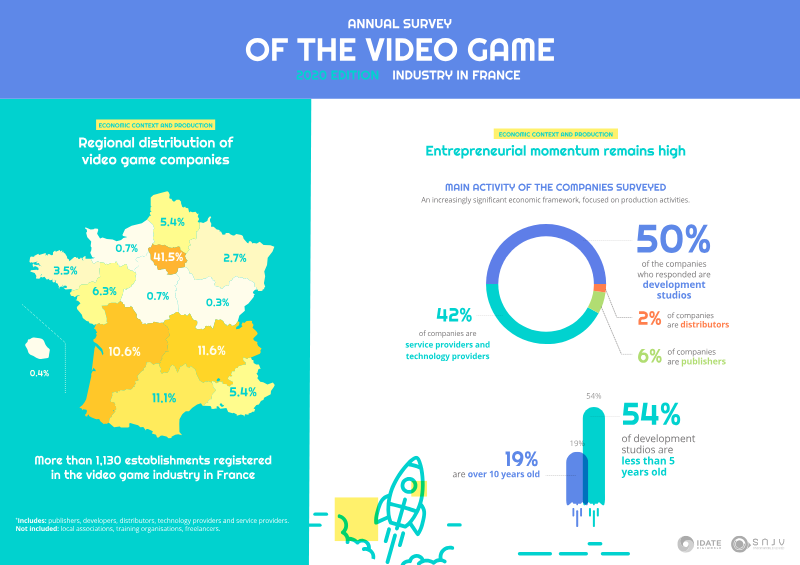
The Video Game Industry in France: 2020 Edition Economic Context and Production

The French video game industry demonstrates robust entrepreneurial momentum and a strong focus on production, characterized by a diverse ecosystem of over 1,130 establishments. The sector is primarily composed of development studios, which account for 50% of industry entities, followed by service and technology providers at 42%, publishers at 6%, and distributors at 2%. This landscape is marked by a youthful demographic, with 19% of development studios having been established within the last five years, while another 19% have operated for over a decade.

Production output remains stable, with 530 titles marketed in 2019 and a significant pipeline of projects in development. Notably, 63% of these titles are based on new intellectual properties, reflecting a strong commitment to original content. Employment trends are equally positive, with 75% of employees working under permanent contracts. The industry is actively expanding, with projections indicating the creation of 800 to 1,200 new jobs by the end of 2019. Despite this growth, gender diversity remains a challenge, as women and non-binary individuals comprise only 16% of the workforce, with women holding just 11% of management roles.

The findings are based on a comprehensive survey conducted between June and September 2019, targeting 1,131 industry entities, including both members and non-members of the French Video Game Trade Association. The data highlights a strong educational pipeline, with a 26% growth in student enrollment and a high placement rate, as one in two graduates secures employment within the video game sector within a year. These metrics underscore the industry's role as a vital economic engine, supported by a specialized talent pool and a clear focus on sustainable, long-term production.

  • The French video game industry comprises over 1,130 establishments, with development studios representing 50% of the sector and service/technology providers accounting for 42%.
  • The industry demonstrates a strong commitment to original content, with 63% of the 530 titles marketed in 2019 based on new intellectual properties.
  • Employment is characterized by stability and growth, with 75% of the workforce on permanent contracts and projections for 800 to 1,200 new jobs created by the end of 2019.
  • Gender diversity remains a significant industry challenge, as women and non-binary individuals make up only 16% of the total workforce and women hold just 11% of management positions.
  • The sector benefits from a robust talent pipeline, evidenced by a 26% growth in student enrollment and a 50% placement rate for graduates within the industry one year after completion.
+1
Syndicat National du Jeu VidéoJan 2020
Page 1
Report9 pages

Games Monitor: The Netherlands 2020 Update – COVID Impact

This update provides an analysis of the Dutch video game industry’s performance during 2020, specifically examining the operational and economic impacts of the COVID-19 pandemic. The findings are based on a survey of over 100 industry professionals conducted in late 2020, supplemented by desk research and database updates. The report tracks industry growth, employment trends, and the shift in business dynamics necessitated by global lockdowns.

The Dutch games sector demonstrated resilience, growing from 575 companies in 2018 to 615 by the end of 2020, with total employment reaching approximately 4,000 jobs. While the industry largely transitioned to remote work with minimal impact on output quality, the pandemic created a divide between business-to-consumer (B2C) and business-to-business (B2B) entities. B2C entertainment companies generally benefited from increased consumer demand for home-based entertainment. Conversely, B2B and applied game developers faced significant challenges in the spring of 2020 as client projects were paused or canceled, though some firms in the healthcare sector identified new opportunities.

Operational challenges were primarily centered on human resources and networking. While productivity remained stable for most, employee engagement declined due to the loss of informal office culture, and nearly half of respondents reported increased stress levels. The absence of physical industry events hindered the establishment of new business relationships, with one-third of respondents unable to pursue new business opportunities effectively. Despite these hurdles, the industry maintained its growth trajectory, supported by government labor cost subsidies that assisted approximately 85 companies during the initial lockdown phases. Overall, the sector proved adaptable, leveraging digital infrastructure to sustain operations while navigating a volatile market environment.

  • The Dutch video game industry grew from 575 companies in 2018 to 615 by the end of 2020, supporting approximately 4,000 total jobs.
  • B2C entertainment developers experienced increased consumer demand during the pandemic, while B2B and applied game developers faced project cancellations and delays.
  • Operational productivity remained stable despite the transition to remote work, though nearly 50% of industry professionals reported increased stress levels.
  • The loss of physical industry events hindered business development, with one-third of surveyed professionals unable to effectively pursue new opportunities.
  • Approximately 85 companies in the sector utilized government labor cost subsidies to maintain operations during the initial 2020 lockdown phases.
+2
Dutch Game GardenJan 2020

Publishers

Related Topics