China has accounted for the most user spend on mobile games at $42.4 billion.
Source: The Xsolla Report: The State of PlayJapan accounted for $13.1 billion in user spend on mobile games.
Source: The Xsolla Report: The State of PlayIt is expected that 80% of all smart phones shipped in China will be 5G capable by year-end.
Source: PaaS for Mobile Cloud GamingArcane was the most-watched show on Netflix in 38+ countries in that month.
Source: Games, Esports, Live Streaming, Cloud and the Metaverse: 2022accounted for almost 60% of esports revenues last year.
Source: Games, Esports, Live Streaming, Cloud and the Metaverse: 2022party channels accounted for two-thirds of the event’s live in the media mix strategy
generating over 100 million minutes watched in just three months
Source: Games, Esports, Live Streaming, Cloud and the Metaverse: 202267M Views for Arcane (Based on League of Legends IP) on Twitch in the first 28 days after its release.
Source: Games, Esports, Live Streaming, Cloud and the Metaverse: 2022The image displays a bar graph representing the annual recurring revenue of Sakura Internet, which is a company that provides financial services
Dividend Policy
The image displays a bar graph and a line graph
A bar graph showing the decrease in operating profit for a company over time
The image displays a slide from a presentation about the market for cloud computing services in Japan
The image displays a bar graph representing the changes in main business area for Sakura Internet from 2013 to 2020
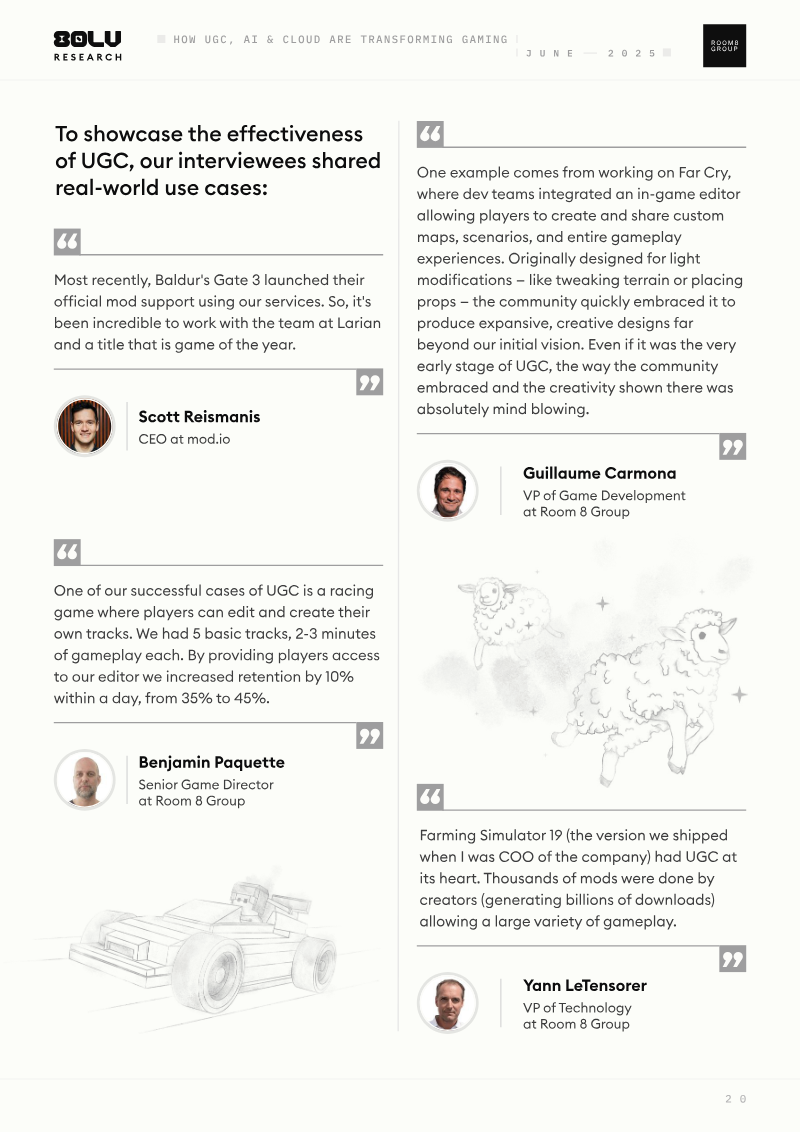
The report argues that user‑generated content (UGC), artificial intelligence (AI) and cloud gaming are reshaping the industry by lowering entry barriers, democratizing creation and expanding cross‑platform reach. Data show that Gen Alpha and Gen Z spend a majority of their daily gaming time, with UGC platforms such as Roblox attracting 85 million active users and cloud‑gaming subscribers rising from 62.5 million to nearly 396 million in four years. AI‑driven tools are projected to generate $4.2 B by 2029, while cloud‑gaming revenue grew from $1.1 B in 2020 to $6.9 B in 2024 and is expected to reach $18.7 B by 2027. Indie developers benefit from cloud infrastructure that allows anyone to play AAA titles and AI engines such as Unity Muse or Unreal Engine that reduce development costs. Indie releases on Steam generated $4 B in 2024, matching AAA revenue streams, and UGC has extended the life of titles like Fortnite and Roblox, boosting retention by up to 10 % in some cases. However, quality control, cross‑platform compatibility and monetization remain challenges; dedicated mod QA teams, “mod hub” interfaces and transparent pricing are recommended to sustain high‑quality ecosystems. Player surveys reveal mixed feelings about AI, with 54 % seeing more benefits than drawbacks but 52 % feeling nervous. Creators view AI as a productivity aid, with 83 % adopting it and reporting improved content quality (66 %) and asset variation speed (70 %). Cloud gaming is praised for cost savings (47 %) and accessibility (44 %), yet latency (76 %) and bandwidth (68 %) issues persist, underscoring the need for edge computing, AI‑based compression and better economic models. The analysis projects cloud gaming as the dominant play model within a decade, initially targeting B2B use cases before expanding to consumers. Advances in 5G and internet infrastructure are expected to unlock low‑latency streaming, enabling cross‑platform play and the convergence of AI, UGC and live‑service models into socially connected gaming ecosystems. The report concludes that while continuous evolution and community engagement will drive growth, depth in specific genres may ultimately define the next wave of innovation.
This analysis examines the evolving landscape of game development tools and services amidst a period of significant market volatility. Based on a November 2024 survey of the Game Developer Collective, the findings track shifts in engine preference, cloud infrastructure, and overall industry sentiment. The survey includes a global sample of developers, with 48% based in North America and 39% in Europe, primarily representing roles in programming, management, and game design. A primary focus is the game engine market, which continues to react to Unity’s 2023 "runtime fee" controversy. Despite Unity eventually scrapping the fee, the company has steadily lost market share to Unreal Engine. While the percentage of Unity users planning to switch engines dropped from a peak of 70% in late 2023 to 36% in late 2024, this remains significantly higher than the 14% switch rate seen among users of competing engines. Sentiment toward Unity has moderated, but only 30% of developers report being happy with the company, suggesting a lasting impact on brand trust. The broader industry environment is characterized by increasing financial pressure and underperformance. Approximately 55% of developers now describe market conditions as "bad," a notable increase from 47% six months prior. Business performance has also declined, with 41% of studios reporting they are underperforming against expectations. Consequently, while investment in tools remains steady for most, there is a growing emphasis on productivity and efficiency as the primary drivers for new purchases. AI-powered tools are a rare area of growth, with studios more likely to increase spending in this category compared to traditional services. In specialized segments, Blender has emerged as the leading 3D modeling tool, used by 50% of studios. Cloud platform usage is at an all-time high, led by AWS and non-hyperscaler options, though these services remain highly "sticky" with low intent to switch providers. Conversely, specialist backend platforms struggle with low penetration, as only 38% of studios currently utilize these centralized solutions. Overall, the findings depict a cautious industry prioritizing efficiency and stability while navigating a difficult commercial climate.
Video Games Europe argues that Europe’s digital infrastructure policy should reinforce, rather than reshape, the existing market dynamics that underpin the continent’s thriving video‑game ecosystem. Representing roughly 110 000 employees and a €24.5 billion industry in which 53 percent of Europeans play, the association stresses that the sector’s growth is driven by digital distribution, which already reduces the environmental burden of physical media and, in many cases, relies on cloud delivery to limit data transfer. Typical online gameplay consumes between 60 and 80 megabytes per hour, with even the most data‑intensive titles rarely exceeding 250–300 megabytes, a fraction of the traffic generated by video streaming services. The response highlights that network operators successfully managed the surge in traffic during the COVID‑19 lockdowns and that game publishers have collaborated with ISPs and content‑delivery networks to smooth peak loads through measures such as off‑peak download scheduling. It refutes claims that content providers “free‑ride” on ISP infrastructure, noting that publishers already pay for enhanced upload capacity and invest in their own CDN and data‑centre assets. Consequently, the relationship between content and application providers and ISPs is portrayed as symbiotic, fostering competition and consumer choice. Against proposals to impose network fees or extend the European Electronic Communications Code to cloud services, the association warns that such pre‑emptive regulation could undermine net neutrality, increase consumer prices, and jeopardise Europe’s digital competitiveness. It calls for regulatory stability to protect investment security and urges that any infrastructure deployment be guided by concrete market demand rather than aspirational targets. The position draws on industry data, BEREC assessments of network resilience, and the sector’s own mitigation practices, concluding that preserving the current regulatory framework will best support sustainable growth and innovation across Europe’s digital economy.
This analysis examines the implications of Microsoft’s $68.7 billion acquisition of Activision Blizzard, specifically focusing on the cloud gaming remedies proposed to global competition authorities. The assessment centers on the ten-year commitment to provide free licenses for streaming Activision PC games to third-party cloud service providers. While the cloud gaming market remains a nascent segment—valued at $446 million in 2022 and representing less than 0.3% of global consumer spending—the acquisition is scrutinized due to Microsoft’s end-to-end control over cloud infrastructure and content. The findings suggest that the proposed remedies would significantly alter the market by increasing consumer access points and service provider choices. Under a "bring-your-own-game" (BYOG) model, consumers who purchase Activision titles or access them via subscriptions like Xbox Game Pass could stream those games on various competing platforms. This shift is expected to benefit BYOG service providers by enhancing their value propositions, though it may force them into routine adoption of these titles to remain competitive. Conversely, multi-game subscription services face greater complexity, as they would need to manage disparate licensing regimes for Activision content compared to their standard catalogs. Ultimately, the analysis concludes that while the remedies address certain competition concerns, they simultaneously extend Microsoft’s industry influence. By decoupling game licensing from specific streaming hardware, Microsoft can expand the reach of the Xbox Game Pass ecosystem and the Microsoft Store without further investment in cloud infrastructure. This strategy allows Microsoft to leverage third-party server capacity to grow its subscriber base, positioning Xbox Game Pass as the most cost-effective entry point for Activision content across a global, multi-platform footprint.
The global gaming market is undergoing a structural transformation driven by multiplatform integration and the rapid evolution of financial technologies, with total revenues projected to reach $211.2 billion by 2025. A significant catalyst for this growth is the rise of real-time payments, which are expected to account for 28% of global electronic transactions by 2027. This shift is particularly pronounced in emerging markets across the MEA and LATAM regions, where systems like India’s UPI and Brazil’s PIX are facilitating new revenue streams. To bypass traditional platform commissions and rising acquisition costs, developers are increasingly adopting mobile web shops and hybrid monetization models, including Buy Now, Pay Later services, which are forecasted to reach a $309 billion market value by 2030. Technological advancements in cloud gaming and artificial intelligence are further reshaping the industry landscape. Cloud gaming is anticipated to reach 2.5 billion users by 2024, though it continues to face technical challenges regarding latency and infrastructure. Simultaneously, generative AI is becoming a fundamental development pillar, with over 50% of top studios expected to utilize the technology by 2024 to improve efficiency by up to 30%. Within the next decade, AI is projected to support more than half of the entire game creation process, significantly reducing production timelines and costs. The industry is also pivoting toward a more interconnected ecosystem where cross-platform capabilities are a primary consumer demand, supported by 87% of multiplayer gamers. This integration, combined with advancements in virtual reality and blockchain, is fueling the expansion of the metaverse, which is forecasted to reach a $710 billion valuation by 2027. As privacy regulations and shifting ad efficiencies challenge traditional growth strategies, the sector is prioritizing flexible payment solutions and immersive, cross-play environments to maintain global momentum.
The gaming industry is currently undergoing a fundamental transformation driven by the social behaviors of Gen Alpha and Gen Z, over 90% of whom utilize gaming as their primary interactive outlet. This demographic shift has catalyzed the rise of User-Generated Content (UGC), artificial intelligence, and cloud infrastructure, collectively democratizing development and allowing indie titles to compete with AAA productions. The cloud gaming market is expanding rapidly, reaching nearly 400 million users within four years, while the integration of AI in gaming is projected to achieve a $4.2 billion valuation by 2029. UGC has emerged as a critical driver of retention, with dominant platforms like Roblox, Minecraft, and Fortnite accounting for 19% of total global playtime and distributing over $1.3 billion to creators in 2023. To overcome the technical and legal hurdles of content creation, the industry is increasingly turning to generative AI, a sector expected to reach $1.8 billion by 2025. These tools automate complex processes such as texture upscaling and level generation, lowering the barrier to entry for creators across diverse genres. While cloud technology offers the potential for real-time updates and massive concurrency, infrastructure limitations remain a significant bottleneck. Approximately 76% of players identify latency as a primary concern, suggesting that while 5G will eventually facilitate mass consumer adoption, the immediate utility of the cloud lies in B2B applications like secure playtesting and instant discoverability. The convergence of these technologies is ultimately moving the industry toward a live-service ecosystem of "endless games," where the boundaries between traditional media and interactive community-driven platforms continue to blur.
The global cloud gaming market is entering a phase of maturity, with 2022 revenues projected to reach $2.4 billion supported by a base of 31.7 million paying users. Despite high-profile shifts in the ecosystem, such as the closure of Google Stadia, the industry remains fundamentally viable as major platform holders like Xbox and PlayStation successfully integrate cloud technology to complement traditional hardware. This evolution is primarily driven by the increasing seamlessness of services, which allows players to bypass local hardware limitations and access high-end content instantly across a diverse range of devices. Market projections indicate a robust growth trajectory through 2025, at which point paying users are expected to reach 86.9 million and annual revenues are forecasted to climb to $8.2 billion. This expansion is underpinned by the global rollout of 5G networks, improved service profitability, and the emergence of cloud infrastructure as the foundational backbone for the metaverse. Strategic scaling by major players, including Alibaba’s YuanJing, aims to support massive concurrent user experiences while overcoming the constraints of physical hardware on a global scale. Technological innovation in infrastructure-as-a-service models is further accelerating adoption by lowering costs for both telecom operators and consumers. By utilizing GPU edge computing within carrier networks, providers can deliver high-quality gaming experiences with reduced latency. The industry is also refining its internal metrics and consumer segmentation, distinguishing between cloud-enabled and cloud-native content to better target diverse player demographics. These developments suggest that cloud gaming is transitioning from a niche technology into a central pillar of the broader interactive entertainment landscape.
The global gaming industry is currently undergoing a structural transformation characterized by the integration of emerging technologies and a pivot toward cross-platform accessibility. Central to this evolution is the expansion of cloud gaming, which serves as a critical bridge to overcome hardware constraints, allowing publishers to reach broader audiences on mobile devices and legacy consoles. Simultaneously, the metaverse is maturing into a robust commercial ecosystem, fueled by significant venture capital investment, the proliferation of virtual real estate, and the integration of digital fashion. These developments signal a broader industry shift toward enhanced creator-viewer interactivity and the adoption of Web3.0 business models. Monetization strategies are diversifying as companies experiment with blockchain-based player trading and fan engagement tools, despite notable consumer resistance toward non-fungible tokens. This period is also defined by a surge in high-quality cross-media intellectual property adaptations and a crowded release calendar, which intensifies competition for consumer attention. Furthermore, regulatory and consumer pressures are forcing a transition toward more open app store ecosystems, challenging traditional distribution gatekeepers. Within the esports sector, organizations are actively diversifying revenue streams by prioritizing mobile-first titles and leveraging co-streaming to maximize viewership reach. These trends, observed throughout 2022, reflect a strategic effort to sustain growth across global markets. By synthesizing market intelligence and tracking key performance metrics, the industry continues to navigate the complexities of digital transformation, balancing the pursuit of innovative monetization with the necessity of maintaining user trust in an increasingly interconnected virtual landscape.
The global gaming industry is undergoing a fundamental transformation characterized by the convergence of traditional media, high-fidelity content, and emerging Web3 technologies. The primary thesis posits that the sector is shifting toward an interconnected, cross-platform ecosystem where revenue diversification and creator-driven engagement models are essential for growth. While consumer skepticism persists regarding blockchain-based assets and NFTs, publishers are successfully navigating this transition by prioritizing mobile esports, co-streaming strategies, and efforts to circumvent restrictive app store ecosystems to foster deeper fan loyalty. Technological infrastructure is evolving to support this expansion, with cloud-based solutions and Platform-as-a-Service models playing a critical role in mitigating hardware limitations. By integrating gaming experiences into smart TVs and leveraging cloud technology, companies are effectively broadening their reach to new demographics. Simultaneously, the metaverse has emerged as a significant focal point for venture capital and brand investment, as corporations increasingly utilize digital fashion and virtual real estate to capture the attention of younger, digitally native audiences. Geographically, the market remains dominated by the Asia-Pacific region, which generates $88.2 billion in annual revenue, representing over half of the global total. North America follows with $42.6 billion, maintaining a strong position in the industry landscape. However, the long-term trajectory of the market is increasingly influenced by emerging territories in Latin America, the Middle East, and Africa. These regions are currently expanding at rates exceeding the global average, signaling a gradual decentralization of revenue and a more diverse, globalized future for the interactive entertainment sector.
The analysis examines how emerging technologies and shifting consumer behaviors are reshaping the global gaming ecosystem. Blockchain‑based monetisation, particularly non‑fungible tokens (NFTs), has met with mixed reception. While the promise of secure, legitimised trading is evident in titles such as Axie Infinity, major publishers have reacted cautiously. Valve’s ban of crypto games on Steam and Ubisoft’s withdrawal from NFT initiatives after player backlash illustrate a broader industry reluctance, compounded by regulatory constraints in jurisdictions like South Korea and platform‑level anti‑steering rules from Apple and Google. Consequently, publishers are exploring “NFT‑like” features under less controversial branding to satisfy investor appetite while mitigating gamer discontent. Live‑streaming and cloud gaming are emerging as pivotal drivers of player engagement. Interactive shows such as Facebook’s Rival Peak and PAC‑MAN Community have amassed over 100 million minutes of viewership in three months, opening new monetisation avenues. The semiconductor shortage is accelerating the migration of high‑end titles—Elden Ring, Starfield—to cloud platforms. Services like NVIDIA GeForce NOW and Google Stadia have already recorded user growth, while publishers leverage cloud to deliver AAA content on legacy hardware (e.g., Nintendo Switch) and broaden access through subscription bundles such as Game Pass Ultimate. This trend signals a shift toward broader platform reach and subscription retention. Geographically, the Asia‑Pacific region dominates global game revenues at $42.6 billion, driven by China’s mobile‑first market and an 8.7% compound annual growth rate (CAGR). North America matches this revenue figure at $42.6 billion, with a 7.9% CAGR. Latin America, the Middle East, and Africa are projected to grow faster than the global average, increasing their share of worldwide revenues. COVID‑19’s impact on Asia‑Pacific was muted, partly due to a strong console gaming emphasis that helped sustain growth. The findings collectively underscore the importance of balancing innovative monetisation models, expanding platform accessibility, and regional market dynamics in shaping the future of gaming.
This analysis provides a comprehensive overview of the cloud gaming sector in 2021, focusing on how network infrastructure and global economic conditions have accelerated industry adoption. The primary thesis asserts that while the COVID-19 pandemic provided an initial surge in engagement, the market is now transitioning toward sustainable growth driven by technological maturity, strategic business partnerships, and a global semiconductor shortage that has made cloud streaming a viable alternative to expensive, unavailable local hardware. The scope of the research is global, with specific emphasis on ten subregions and thirty-three individual markets, including deep dives into China, North America, and Western Europe. Data was gathered through a proprietary model incorporating internet connection speeds, urbanization rates, and service availability, supplemented by a July 2021 survey of 6,788 gamers across China, Germany, Japan, and the United States. The methodology utilizes three forecasting scenarios—base, optimistic, and pessimistic—to account for the inherent volatility of a nascent technology market. Key findings indicate that the global cloud gaming market reached $1.6 billion in revenues and 23.7 million paying users in 2021. Projections suggest significant expansion, with revenues expected to exceed $6.5 billion and paying users reaching 60.7 million by 2024. While North America and Europe currently account for 59% of consumer spending, emerging markets in Asia-Pacific, Latin America, and the Middle East are poised for rapid growth due to the rollout of 5G infrastructure and high consumer interest in regions where gaming hardware is prohibitively expensive. The analysis concludes that the industry is moving toward a more frictionless user experience through edge computing and B2B partnerships between service providers and telecommunications companies. Despite the closure of some first-party studios, investment remains high among stakeholders like NVIDIA, Haima Cloud, and now.gg. Consumer sentiment remains positive, characterized by high satisfaction levels and low churn, though long-term success depends on overcoming hardware ownership preferences and continuing to improve global network stability.
Platform as a Service (PaaS) for mobile cloud gaming represents a transformative shift in the video game industry, moving beyond traditional consumer-facing cloud services to provide developers and publishers with essential infrastructure tools. The primary thesis is that mobile cloud PaaS serves as a strategic B2B solution to streamline user acquisition, circumvent restrictive app store fees, and expand the addressable market by removing hardware and storage constraints. Unlike premium, subscription-based cloud gaming models that depend on widespread consumer adoption, mobile cloud PaaS integrates directly into the existing free-to-play (F2P) ecosystem, making it a more viable and rapidly maturing segment. The industry landscape is currently anchored by developments in China, where 5G infrastructure—essential for the low latency required for cloud gaming—has reached over 365 million users. While the B2C cloud gaming market in China faces challenges from saturation and fragmented content, the B2B PaaS segment is gaining momentum through providers such as Tencent, Haima Cloud, and WeLink. These platforms enable developers to host titles in the cloud, allowing high-end games to run on low-end hardware and facilitating instant, link-based game discovery via social media and browsers. This approach is particularly critical given that user acquisition costs currently account for 30% to 40% of total game revenue. Methodologically, the analysis draws on market data from 2021, highlighting that while 1.5 billion gamers exist in Asia, the majority have yet to convert to cloud gaming, leaving significant room for growth. The research emphasizes that the shift toward distributed, edge-based infrastructure and ARM-based hardware allows for more efficient, on-demand resource allocation compared to earlier, centralized server models. As mobile titles increasingly adopt cross-platform strategies, mobile cloud PaaS is positioned to become a global standard, fundamentally altering how games are marketed, distributed, and monetized by bypassing traditional app store gatekeepers.