Action-Adventure reports and market data
Documents
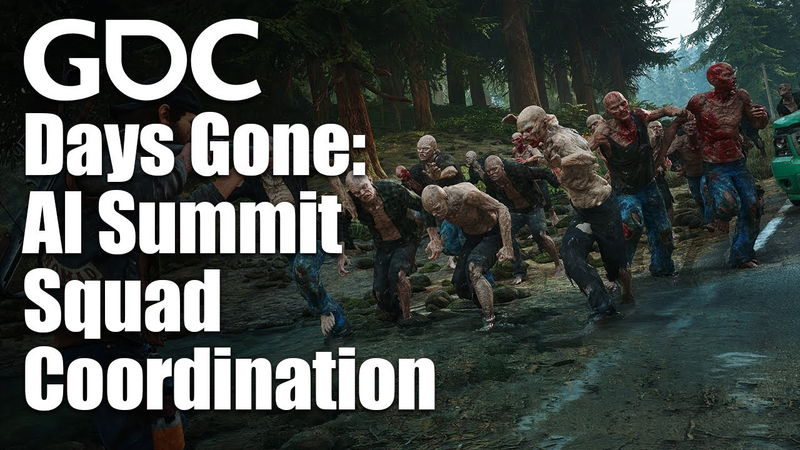
Squad Coordination in 'Days Gone'
Combat believability in Days Gone is achieved through a systemic, squad-based artificial intelligence model that replaces traditional scripted encounters with dynamic, role-based coordination.
- Sony Bend Studio implemented a 'frontline' system in Days Gone that defines the spatial relationship between a squad and its enemies, using a sliding window average to stabilize combat movement and ensure squad members maintain clear lines of fire.
- The AI uses a behavior hierarchy where high-priority reactive tasks, such as avoiding grenades, override assigned combat roles, while low-priority behaviors are suppressed when a valid role is active.
- Squad members are assigned to specific lanes along the frontline to minimize movement, prevent collision, and ensure optimal positioning relative to both the enemy and fellow squad members.

Making the Believable Horses of 'Red Dead Redemption II'
The development of Red Dead Redemption II prioritized the creation of a grounded, autonomous equine experience by abandoning traditional, rigid animation blend trees in favor of a sophisticated, data-driven locomotion system.
- Rockstar Games replaced manually authored state graphs with an automated locomotion system that extracts root motion and bone movement data to eliminate the need for human-intensive animation blending.
- The team implemented a 'drift' mechanic that uses indirect control, allowing horses to oversteer and skid naturally rather than relying on stiff, discrete turning animations.
- To ensure fluid movement across varying speeds, the developers moved away from fixed-range gait transitions in favor of a continuous control system that synchronizes foot strikes and playback speeds dynamically.

Interactive Wind and Vegetation in 'God of War'
The development of God of War prioritized deep environmental immersion through a sophisticated, interactive wind and vegetation system.
- Sony Santa Monica implemented a spatial wind system for God of War that uses a 3D noise texture filled with random vectors, allowing wind to vary dynamically across both time and space rather than relying on a single global vector.
- To prevent visual popping when resetting noise textures, the team utilized a flow-map approach that fades between two textures phased out of sync, using logarithmic binning based on powers of two to keep wind speeds synchronized.
- The studio adopted the Beaufort scale, reducing its 12 wind categories to five standardized settings to ensure consistent environmental behavior and provide artists with a reliable reference for authoring vegetation models.

Creating Feudal Japan from Across the Pacific
The development of Ghost of Tsushima serves as a case study in navigating the complexities of representing a foreign culture within the interactive medium.
- To ensure cultural authenticity in 'Ghost of Tsushima,' Sucker Punch Productions prioritized hiring and collaborating with cultural consultants throughout the development process, viewing this investment as a necessary cost of entry rather than a production burden.
- The development team adopted a 'student' mindset, which included conducting field research in Tsushima and Japan to move beyond superficial internet-based assumptions and gain a deeper understanding of historical details like sword artistry.
- When game design requirements conflicted with cultural accuracy, the team prioritized authenticity by making significant changes, such as renaming characters to better fit historical naming conventions and removing mindless hunting mechanics that clashed with Japanese cultural values.

An Explosive New Spider-Man: Creating VFX for Miles Morales
The visual identity of Miles Morales in his standalone title is defined by a deliberate departure from Peter Parker’s tech-centric aesthetic, favoring a biological, bio-electric power set.
- Developers established a distinct visual identity for Miles Morales by prioritizing bio-electric effects over Peter Parker’s tech-centric aesthetic, utilizing soft-body simulations and parallax occlusion mapping to create an x-ray effect of the character's internal anatomy.
- The project utilized GPU-driven particle systems and rigid-body simulation pipelines to manage complex combat mechanics like Venom Blast and Camouflage while maintaining high-fidelity performance across both PlayStation 5 and PlayStation 4.
- To balance narrative spectacle with cross-generational hardware constraints, the team implemented vertex-controlled material wipes and internal lattice structures to manage high mesh density and environmental destruction.

Take 'Control' of Animation
The development of the animation system for Control centered on the necessity of replacing discontinued middleware with a custom, high-performance engine capable of supporting fluid, gameplay-driven movement.
- The development team replaced discontinued middleware with a custom, data-driven animation engine based on motion matching to support fluid, gameplay-responsive movement.
- Implementing an 'ignore tags' system optimized performance by reducing the animation frame search space by 80 percent.
- The team mitigated common motion-matching artifacts like foot sliding by using a curated data approach featuring precise acceleration curves and a strategic category-tagging system.

Real-Time Cloth Solutions on 'Marvel's Spider-Man'
Real-time cloth simulation in Marvel’s Spider-Man serves as a critical component for achieving dynamic, responsive character movement within an open-world environment.
- Insomniac Games used a hybrid cloth solution for 'Marvel's Spider-Man' that combined real-time Havok physics simulation with corrective blend shapes to achieve high-fidelity movement while maintaining performance.
- The team addressed the lack of cloth-to-cloth collision in the engine by using strategically placed collision capsules and limiting cloth complexity to prevent clipping issues.
- To achieve specific visual targets, the team used a three-tier approach: simulated blend shapes for initial poses, real-time cloth for dynamic follow-through, and additional corrective blend shapes for final polish.

I made Resident Evil 4... BUT IT'S 2D
The process of reimagining Resident Evil 4 as a 2D side-scrolling experience serves as a technical case study in game design, art direction, and rapid prototyping.
- A functional 2D prototype of Resident Evil 4 was developed in a seven-day rapid development cycle using the Unity engine.
- Core gameplay loops including exploration, combat, and inventory management were successfully translated from 3D to 2D by prioritizing atmospheric consistency and visual hierarchy.
- Environmental depth was achieved in a 2D space through the strategic use of color theory, gradient-based lighting, and trigger-based overlays for interior transitions.

Building a Mixing Sandbox for 'Just Cause 4'
The development of the audio mix for Just Cause 4 at Avalanche Studios centered on transitioning from a traditional, compression-heavy approach to a modular, system-driven "sandbox" framework.
- Avalanche Studios transitioned from a dynamics-driven mix in 'Just Cause 3' to a state-based, siloed architecture in 'Just Cause 4' to eliminate audio pumping and CPU-heavy side-chain compression.
- By implementing granular microstate snapshots for vehicle audio, the team reduced the authoring time for a single vehicle mix from several hours to just a few minutes.
- The team abandoned traditional side-chaining and compressor-based mixing in favor of a priority-based system that uses game-design parameters to modulate EQ, balance, and spatial imaging in real-time.

Honoring the Blade: Lethality and Combat Balance in 'Ghost of Tsushima'
The primary objective in the development of Ghost of Tsushima was to reconcile the mechanical requirements of a 30-hour open-world action game with the core samurai fantasy of lethal, high-speed sword combat.
- To maintain the 'samurai fantasy' of lethal blade combat, Sucker Punch limited the number of hits required to kill enemies, keeping the engagement window short even as players progressed through 30 hours of open-world gameplay.
- The team avoided traditional RPG-style level scaling—which often relies on artificial health bars and 'skull' indicators—because it undermined the grounded, realistic nature of the game's combat.
- Developers implemented a stagger meter system to force offensive play, allowing players to break enemy defenses using specific stances rather than relying solely on parrying, which had become a repetitive, dominant strategy.
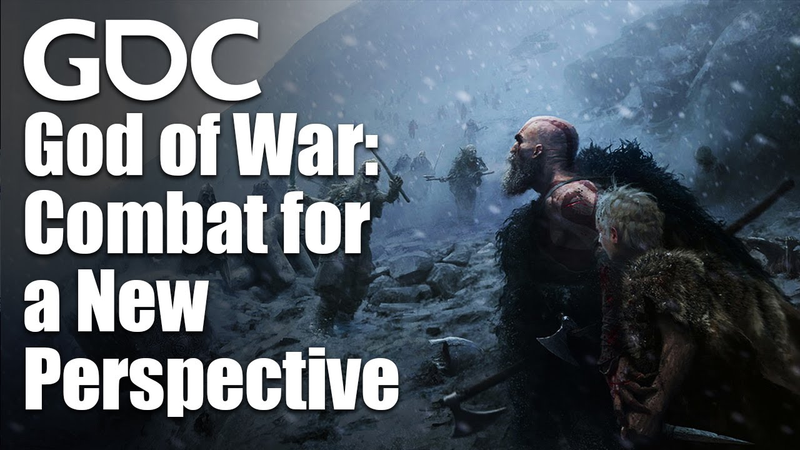
Evolving Combat in 'God of War' for a New Perspective
The transition of the God of War franchise to an intimate, over-the-shoulder camera perspective necessitated a complete overhaul of combat mechanics to preserve the series' signature offensive power fantasy.
- To maintain an offensive power fantasy with a restricted over-the-shoulder camera, developers implemented a data-driven zone constraint model that forces enemies into a predictable crescent-shaped area in front of the player.
- An aggression token system limits the number of active threats simultaneously engaging the player, preventing them from being overwhelmed by off-screen enemies.
- Combat fluidity is maintained through a hybrid targeting approach that combines analog stick input with motion warping, removing the necessity for traditional lock-on mechanics.

Maximizing Animation and Cinematic Content Workflows for 'Just Cause 4'
The production of Just Cause 4 required the creation of over 7,200 unique animations and 65 minutes of cinematic footage, a massive undertaking managed by a lean technical team.
- Avalanche Studios developed a centralized batch-processing tool driven by JSON configuration files to automate animation exports and transfers between Maya and MotionBuilder, significantly reducing the need for manual DCC interaction.
- To manage the complexity of a AAA open-world title with limited technical animation staff, the team implemented a 'driver root control' system that functions as a high-performance locator, allowing animators to bake and transfer animation across rigs with immediate space-matching functionality.
- The studio optimized locomotion workflows by implementing a distance-threshold script that automatically identifies and tags foot-plant positions by analyzing frame-to-frame world-space movement, effectively filtering out non-planted data.