Showing 30 of 89 results · 0.41s
Jan 2025
How UGC, AI, & Cloud Are Transforming Gaming Report
Room 8 Group, 80 Level
report argues that user‑generated content (UGC), artificial intelligence (AI) and cloud gaming are reshaping the industry by lowering entry barriers, democratizing creation and expanding cross‑platform reach
Report66 pages
Jun 2023
Microsoft’s Activision Acquisition: Implications for the Cloud Gaming Market and Industry
Ampere Analysis
free licenses for streaming Activision PC games to third-party cloud service providers. While the cloud gaming market remains a nascent segment—valued at $446 million
Report9 pages
Jan 2021
PaaS for Mobile Cloud Gaming
Niko Partners
titles on cloud infrastructure and monetize through F2P mechanics. Key players include Tencent, Now.gg, Ubitus, WeLink, and Alibaba Cloud, with China’s telecoms using cloud gaming to spur
Report23 pages
Oct 2019
Impact of Cloud Gaming and Other Trends in the Indie Ecosystem: Spain
AEVI
gaming and emerging distribution models are reshaping the Spanish indie game ecosystem, arguing that while the broader gaming audience is expanding across new platforms and financing structures, cloud
Report35 pages
Sep 2022
Global Cloud Gaming Report: 2022
Newzoo
consumer segmentation, distinguishing between cloud-enabled and cloud-native content to better target diverse player demographics. These developments suggest that cloud gaming is transitioning from a niche technology
Report43 pages
Sep 2021
Global Cloud Gaming Report: The Infrastructure Edition 2021
Newzoo
This analysis provides a comprehensive overview of the cloud gaming sector in 2021, focusing on how network infrastructure and global economic conditions have accelerated industry adoption. The primary
Report39 pages
Jan 2020
The Past, Present and Future of Games
Newzoo
into gameplay, while mobile gaming accounts for a growing share of revenue. The report highlights the rise of “games as a service,” cloud gaming, and esports ecosystems, citing
Report33 pages
Jan 2023
The Xsolla Report: The State of Play
Xsolla
forecasted to reach a $309 billion market value by 2030. Technological advancements in cloud gaming and artificial intelligence are further reshaping the industry landscape. Cloud gaming is anticipated
Report51 pages
Jan 2022
Games, Esports, Live Streaming, Cloud and the Metaverse: 2022
Newzoo
playing a critical role in mitigating hardware limitations. By integrating gaming experiences into smart TVs and leveraging cloud technology, companies are effectively broadening their reach to new demographics
Report30 pages
Jan 2019
Tencent Games Strategy 2019
Niko Partners
console markets. Future growth is anchored in emerging technologies and infrastructure, specifically cloud gaming and esports. Leveraging a cloud network that already supports 75% of China
Report14 pages
Jan 2022
Games, Esports, Live Streaming, Cloud and the Metaverse: 2022 Trends to Watch
Newzoo
pivot toward cross-platform accessibility. Central to this evolution is the expansion of cloud gaming, which serves as a critical bridge to overcome hardware constraints, allowing publishers
Report30 pages
Strong Growth of Profitability: 2019/20 Full Year Results
Nacon
both games and accessories. Planned investments target AA‑grade titles, studio acquisitions, 5G cloud gaming, and Game‑as‑a‑Service models, while premium accessory development—highlighted
Report3 pages
Jan 2025
Video Gaming Report 2025: How Platforms Are Colliding and Why This Will Spark the Next Era of Growth
Boston Consulting Group
structural shift is underpinned by the integration of generative AI, the expansion of cloud gaming, and the diversification of distribution channels, which collectively aim to move the industry
Report26 pages
Jan 2022
Newzoo’s Games, Esports, Live Streaming, Cloud and the Metaverse
Newzoo
controversial branding to satisfy investor appetite while mitigating gamer discontent. Live‑streaming and cloud gaming are emerging as pivotal drivers of player engagement. Interactive shows such as Facebook
Report30 pages
Jan 2023
Gametech Report Q1 2023: Global & MENAP Outlook
Shorooq Partners
SKAN 4.0 and Android privacy changes are reshaping monetisation strategies, while cloud‑gaming infrastructure is projected to grow 250 % by 2030. Investment flows reflect these trends: seed‑stage
Report98 pages
Jan 2020
Catálogo de Servicios – Desarrolladores: España
AEVI
Nintendo e‑shop sales; Sorastream enables cost‑free integration of games into its cloud‑gaming platform with revenue‑share terms for AEVI affiliates. Additional collaborations with Enumbers, Screenglitch
Report11 pages
Jan 2020
The State of the Finnish Game Industry 2020
Neogames Finland
industry is currently undergoing a strategic transformation driven by technological shifts toward cloud gaming, artificial intelligence, and Games as a Service models. While developers benefit from a robust
Report147 pages
Jan 2022
Analyzing the Consumer and Market Impacts of Chinese Games Market Policies: China
Newzoo
process, yet many unlicensed titles persist on platforms such as Steam, VR services, cloud gaming, and mobile ad‑only games. Enforcement remains uneven; fines are issued but monitoring
Report29 pages
Jan 2025
How Developers Are Using Generative AI to Create a New Generation of Games
Google Cloud
research, conducted by Google Cloud and The Harris Poll in mid-2025, examines the transformative role of generative AI within the global games industry. Based on a survey
Report19 pages
Jan 2026
The State of Video Gaming in 2025
Epyllion
billions of engagement hours and pay developers substantial sums, albeit with limited autonomy. Cloud gaming, AI‑driven content, and ad‑supported SVOD models are emerging growth levers
Report231 pages
Apr 2023
Gaming Industry Report: Q1 2023
Konvoy
conversational tools, alongside a strategic shift by major tech firms toward cloud-based gaming infrastructure. Competitive dynamics are evolving as Epic Games introduces self-publishing tools to challenge
Report30 pages
Aug 2025
Vorhaus Digital Strategy Study: All Findings 2025
Vorhaus Advisors
mobile games daily. The industry is seeing a significant rise in social and cloud gaming, alongside a burgeoning interest in user-generated content and non-programmer creation tools
Report133 pages
Jan 2020
2020 Global Games Market Report
Newzoo
engagement and revenue, the industry faces long-term shifts toward platform-agnostic cloud gaming and subscription models. Additionally, it highlights the successful globalization of Chinese gaming firms, which
Report31 pages
Oct 2024
Game Development and the Green Transition: Code, Climate, Creativity
Dataspelsbranschen
Emissions Come From Primary Sources: Production & use of consoles and PCs. Emerging Mitigation: Cloud‑gaming and thin‑client streaming can lower the energy needed for high‑performance gaming
Report68 pages
Jan 2024
State of Play: Winter 2024
Xsolla
reflecting an average annual growth rate of 3.9 percent. Mobile and cloud gaming are identified as the primary engines of this expansion, with the mobile sector alone expected
Report55 pages
Jan 2021
Beyond 2021: Where Does Gaming Go Next?
Newzoo
industry is moving toward a platform-agnostic future. Cross-platform play and cloud gaming are dissolving traditional hardware barriers, a trend reinforced by global semiconductor shortages and game
Report19 pages
Nov 2024
Game Developer Collective Survey Results: November 2024
Game Developer Collective
November 2024 Game Developer Collective Survey examines how game developers allocate resources to software tools and services, focusing on the adoption of game engines, cloud platforms, and ancillary
Report21 pages
Jan 2025
Annual Report of the German Games Industry 2025
game
pronounced in game purchases, which fell 17 %, while online gaming and subscription services surged 43 % to €3.26 billion, underscoring a decisive shift toward digital and cloud‑based play
Report39 pages
Jan 2020
The Past, Present and Future of Games: Global and Local Opportunities
Newzoo
dominant segment, accounting for 49% of global consumer revenues. Furthermore, the rise of cloud gaming is expected to generate $4.8 billion in revenue by 2023, supported by major
Report33 pages
Jan 2025
Game Developer Survey 2025
Konvoy
leverages bare‑metal and cloud resources to deliver cost‑effective matchmaking. Xsolla’s recent rollout of loyalty programs, regional tiering, and cloud‑gaming integration underscores a broader move
Report29 pages
How UGC, AI, & Cloud Are Transforming Gaming Report
Jan 202566 pages15k words
Summary
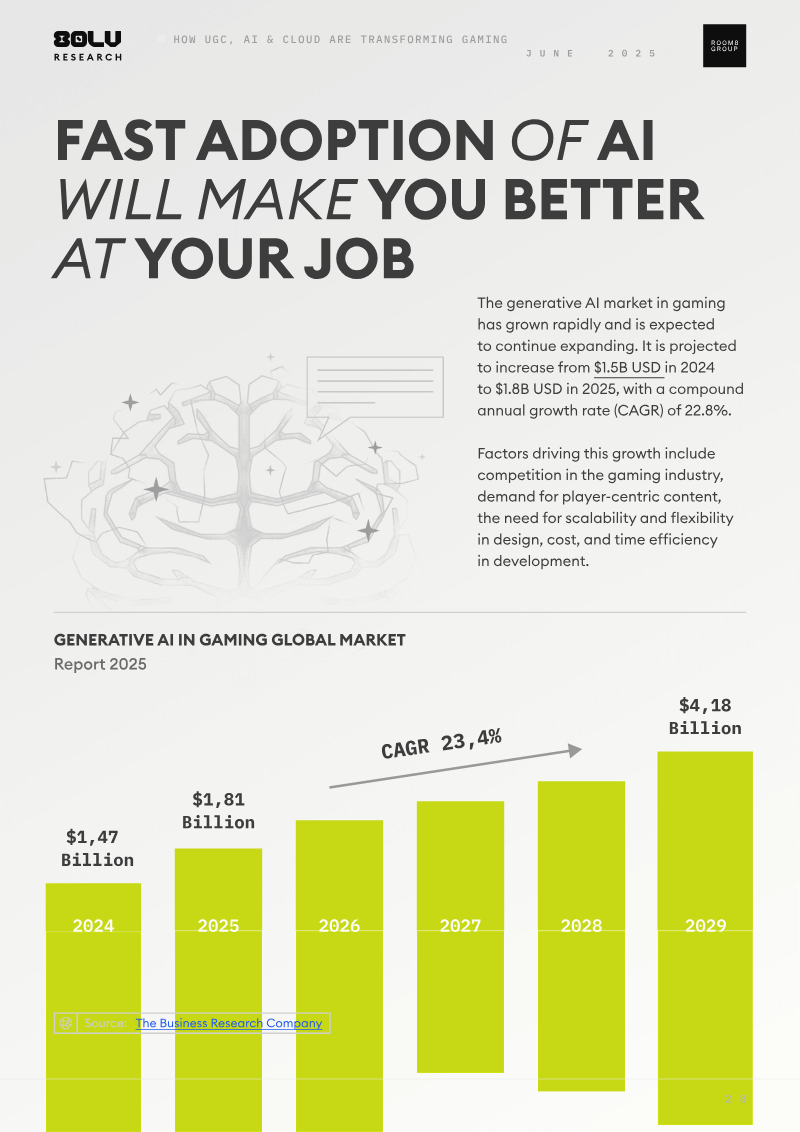
The report argues that user‑generated content (UGC), artificial intelligence (AI) and cloud gaming are reshaping the industry by lowering entry barriers, democratizing creation and expanding cross‑platform reach. Data show that Gen Alpha and Gen Z spend a majority of their daily gaming time, with UGC platforms such as Roblox attracting 85 million active users and cloud‑gaming subscribers rising from 62.5 million to nearly 396 million in four years. AI‑driven tools are projected to generate $4.2 B by 2029, while cloud‑gaming revenue grew from $1.1 B in 2020 to $6.9 B in 2024 and is expected to reach $18.7 B by 2027.
Indie developers benefit from cloud infrastructure that allows anyone to play AAA titles and AI engines such as Unity Muse or Unreal Engine that reduce development costs. Indie releases on Steam generated $4 B in 2024, matching AAA revenue streams, and UGC has extended the life of titles like Fortnite and Roblox, boosting retention by up to 10 % in some cases. However, quality control, cross‑platform compatibility and monetization remain challenges; dedicated mod QA teams, “mod hub” interfaces and transparent pricing are recommended to sustain high‑quality ecosystems.
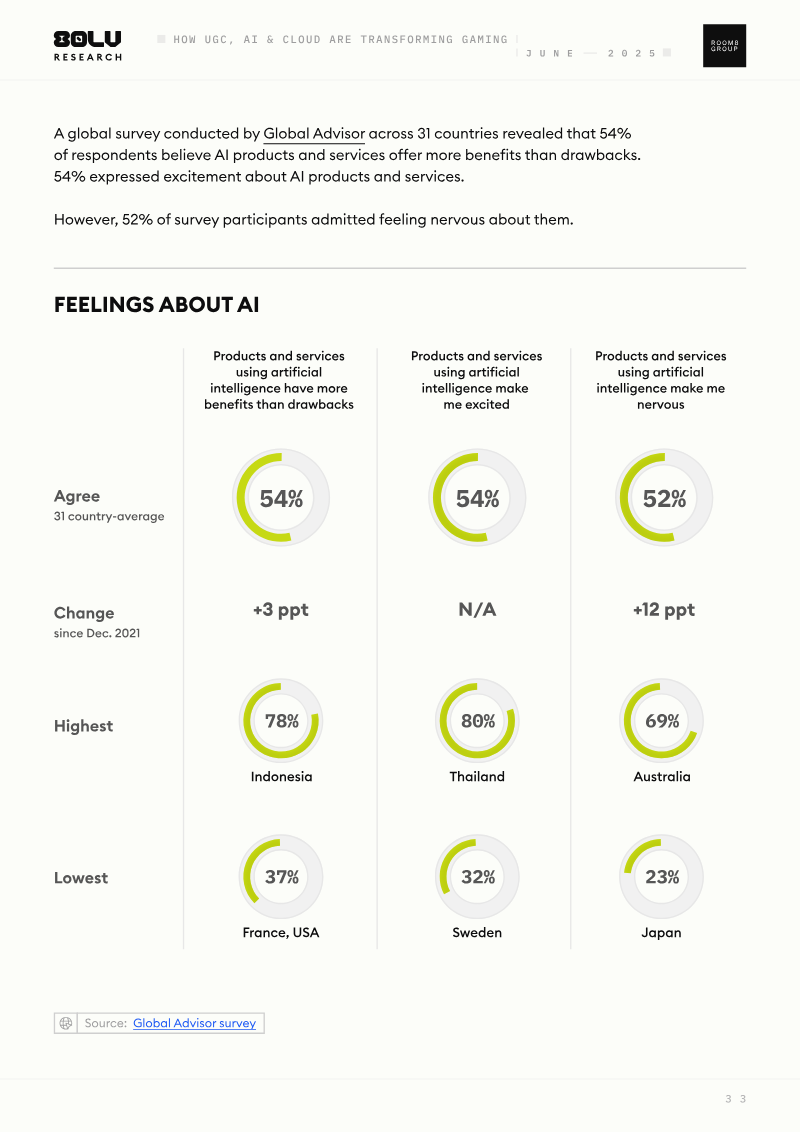
Player surveys reveal mixed feelings about AI, with 54 % seeing more benefits than drawbacks but 52 % feeling nervous. Creators view AI as a productivity aid, with 83 % adopting it and reporting improved content quality (66 %) and asset variation speed (70 %). Cloud gaming is praised for cost savings (47 %) and accessibility (44 %), yet latency (76 %) and bandwidth (68 %) issues persist, underscoring the need for edge computing, AI‑based compression and better economic models.
The analysis projects cloud gaming as the dominant play model within a decade, initially targeting B2B use cases before expanding to consumers. Advances in 5G and internet infrastructure are expected to unlock low‑latency streaming, enabling cross‑platform play and the convergence of AI, UGC and live‑service models into socially connected gaming ecosystems. The report concludes that while continuous evolution and community engagement will drive growth, depth in specific genres may ultimately define the next wave of innovation.
Pages

Insights
- Cloud gaming revenue grew from $1.1 billion in 2020 to $6.9 billion in 2024, with projections reaching $18.7 billion by 2027 and a trajectory to become the dominant play model within a decade.
- Cloud gaming subscribers have surged from 62.5 million to nearly 396 million over the last four years, while AI-driven development tools are projected to generate $4.2 billion by 2029.
- Indie developers are increasingly competitive, with indie releases on Steam generating $4 billion in 2024, a figure that now matches AAA revenue streams.
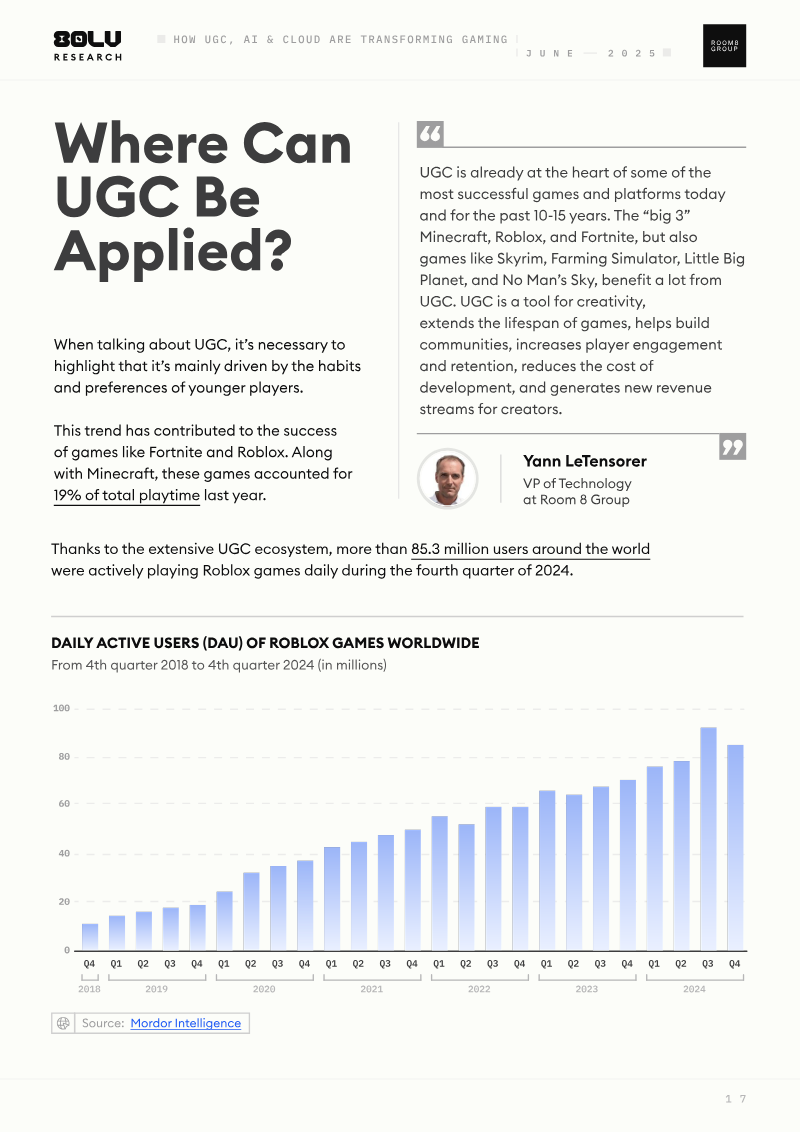
- UGC platforms like Roblox have reached 85 million active users, with UGC integration in titles like Fortnite and Roblox boosting player retention by up to 10%.
- While 83% of creators have adopted AI to improve asset variation speed (70%) and content quality (66%), player sentiment remains divided, with 52% expressing nervousness regarding the technology.
GENERATIVE AI IN GAMING GLOBAL MARKET
Showing 1 – 30 of 89