Showing 30 of 654 results · 1.00s
Jan 2022
Games: India Plays!
EA
report examines the rapidly expanding Indian mobile gaming market, highlighting a projected 91 % share of online gamers playing on smartphones and an estimated revenue of US$2.2 billion
Report24 pages
Apr 2026
2026 Global Non‑Gaming App Trends Report
Mintegral
report argues that non‑gaming mobile applications are experiencing accelerated growth driven by AI integration, short‑form content, and intensified user acquisition competition. Key findings show that Android
Report33 pages
Jun 2025
The Xsolla Report: State of Play Q2 2025
Xsolla
Mobile gaming has become the dominant engine of the global video‑game market, now accounting for more than half of total industry revenue and projected to exceed
Report28 pages
Jan 2022
Stream Hatchet Video Game Streaming Trends Report 2022 First Quarter Report
Stream Hatchet
total hours and are 24 times more likely to engage with repeated advertising. Mobile game streaming remains largely casual, yet core audiences drive 78 % of mobile stream hours
Report23 pages
Jan 2025
State of Mobile 2025: TikTok Edition
Sensor Tower
gaming sectors, specifically Entertainment, Productivity, and Photo & Video, alongside a recovering mobile gaming market where eleven titles surpassed $1 billion in annual revenue. Geographically, North America and Europe
Report80 pages
Jan 2021
How to Win on Mobile in LATAM: 2021
App Annie
segments. Overall, the report highlights LATAM as a high‑growth mobile market with distinct platform dynamics, strong gaming and finance opportunities, and an emerging preference for mobile‑first
Report29 pages
Cyprus Video Game Industry Report 2025
Cyprus Game Makers Association
underpinned by a mobile-first strategy, a favorable IP Box tax regime, and a high concentration of mobile game installs per capita. Despite its small population, Cyprus ranks
Report72 pages
Financial Highlights: 1st Half of the Fiscal Year Ending March 2016
Koei Tecmo
Real Estate sales increased 67.7 %. Operating income was strongest in Game Software (¥7.8 billion) and Online & Mobile (¥1.3 billion), with Media & Rights showing a 155.4 % decline. Balance‑sheet
Report2 pages
Jan 2020
For the Win: Breaking Down the Preferences of Asia's Mobile Gamers
Niko Partners
Asia represents the world’s most significant mobile gaming hub, housing over half of the global player base and generating the majority of the industry's mobile revenue
Report22 pages
Jan 2020
From Playing to Paying: The Art of Monetizing Games in Asia
Niko Partners
overwhelming success of the F2P model, which accounted for 98.5% of all mobile games revenue in 2019. In China, 100% of the top-grossing mobile titles utilized
Report15 pages
Dec 2022
Hyper-Casual Games Benchmark Report: Q4 2022
Tenjin, GameAnalytics
benchmark focuses on hyper‑casual mobile games during the fourth quarter of 2022, comparing performance metrics across iOS and Android and highlighting shifts from the previous quarter. Data
Report17 pages
Jan 2025
Mobile Growth and Monetization Report 2023
Unity
report establishes that mobile game monetization is most effective when focused on early‑stage conversion and strategic ad placement. Analysis of 31 billion in‑app purchase events shows
Report41 pages
Financial Highlights: 1st Quarter of Fiscal Year Ending March 2013
Koei Tecmo
over‑year to ¥35,525 million, driven primarily by declines in Game Software (−19.2 %) and Online & Mobile (−10.0 %). Media & Rights sales were essentially flat, while Pachislot & Pachinko
Report1 pages
Dec 2025
CESA Game Industry Report 2025
CESA – Computer Entertainment Supplier's Association
reached 31.042 trillion yen in 2024, marking a 5.0 % year‑on‑year increase. Mobile games accounted for 18.433 trillion yen, roughly 60 % of total sales, and grew
Report4 pages
Jan 2022
State of Mobile Indonesia 2022
data.ai
Gaming remained the dominant category, with hyper‑casual action and puzzle games surpassing 5 B downloads worldwide in 2021. The most lucrative genre, 4×‑march‑battle strategy games
Report61 pages
Jan 2021
Beyond 2021: Where Does Gaming Go Next?
Newzoo
gaming are dissolving traditional hardware barriers, a trend reinforced by global semiconductor shortages and game development delays that have hampered the console and PC segments more than mobile
Report19 pages
Jan 2022
Hyper-Casual Games Benchmark Report
Tenjin
report presents a quarterly benchmark of hyper‑casual mobile games, focusing on cost‑per‑install (CPI), cost‑per‑lead (CPL), and retention metrics across Android and iOS platforms
Report18 pages
Mar 2024
Mobile App Trends 2024: Japan Edition
Sensor Tower, Adjust
gaming sector, signaling a resilient ecosystem for data-driven marketing and monetization. Mobile gaming remains the primary revenue driver, with RPGs accounting for nearly half of all consumer
Report53 pages
Gaming in Africa 2024
GeoPoll, Pan Africa Gaming Group
high smartphone penetration. In Kenya, mobile‑first economics and widespread mobile money usage create a fertile environment for in‑game purchases. Across the four surveyed countries
Report30 pages
Jan 2025
Video Gaming Report: How Platforms Are Colliding and Why This Will Spark the Next Era of Growth
Boston Consulting Group
generated content (UGC) creator economy, the mainstream adoption of cloud gaming, and the regulatory opening of mobile app stores. Key findings indicate that Generative AI is already being
Report26 pages
Jan 2019
Evolution of Mobile Esports for the Mass Market
Niko Partners
billion that already surpasses the combined reach of PC and console gaming. In 2018, mobile esports titles generated $15.32 billion in revenue, representing over a quarter
Report45 pages
Aug 2025
Vorhaus Digital Strategy Study: All Findings 2025
Vorhaus Advisors
population engaging across various platforms and over half of the country playing mobile games daily. The industry is seeing a significant rise in social and cloud gaming, alongside
Report133 pages
Jan 2022
Key Insights Into German Gamers
Newzoo
most prevalent, reflecting a mix of casual mobile play and more dedicated multi-platform engagement. Platform preferences show that mobile gaming has the highest reach, utilized
Report18 pages
Jan 2022
Global Esports & Live Streaming Market Report 2022
Newzoo
console markets, whereas YouTube and Facebook are capitalizing on the rapid proliferation of mobile gaming in emerging economies. These platforms are further evolving by integrating non-gaming content
Report51 pages
Feb 2022
Motivations and Demographics Snapshot Report
GameRefinery
mobile gaming landscape in the United States is defined by a complex interplay between game mechanics and player psychology, categorized through a framework of twelve distinct motivational drivers
Report31 pages
Sep 2021
Gaming Deals Activity Report Q1‑Q3 ’21
InvestGame
segment remained the primary driver of activity, representing 75% of total deal value. Mobile gaming emerged as a particularly dominant force, contributing 84% of M&A value
Report21 pages
Jan 2019
Tencent Games Strategy 2019
Niko Partners
esports. Leveraging a cloud network that already supports 75% of China’s top mobile games, Tencent is positioned to lead the domestic market in the absence of major
Report14 pages
Jan 2021
Deconstructing the Superstars: The Metrics Behind Hyper-Casual Games 2020 Industry Snapshot
GameIntel
This industry snapshot provides a detailed analysis of the hyper-casual mobile gaming sector throughout 2020, utilizing aggregated data from a network of over 140,000 integrated games
Report10 pages
Jan 2022
Newzoo Gamer Insights: The Future of Gaming
Newzoo
Alpha and 48% of Gen Z spending money on games, primarily on mobile platforms. The top spending motivators include unlocking exclusive content and personalizing in-game experiences through
Report22 pages
Jan 2025
Newzoo's Generations Report: How Different Generations Engage with Games
Newzoo
players prioritize relaxation. Platform preferences differ markedly; Gen Z spends 77% of gaming spend on mobile, whereas Baby Boomers allocate 73% to PC. Younger gamers also engage more
Report21 pages

Games: India Plays!
Jan 202224 pages4k words
Summary
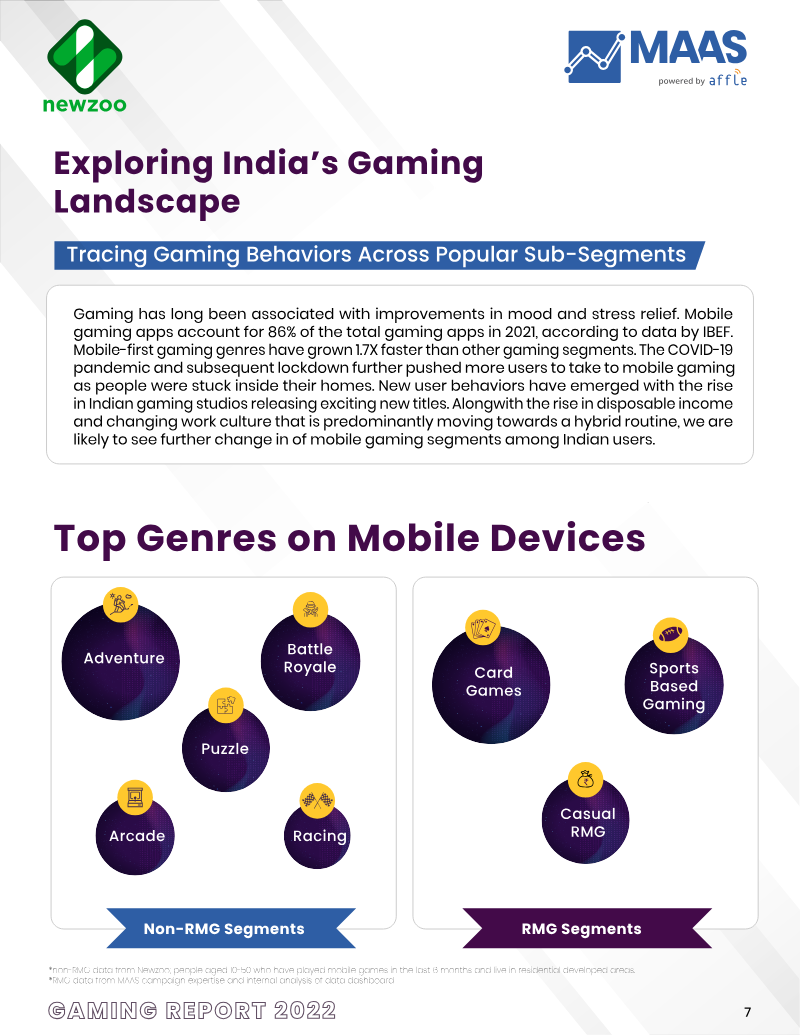
The report examines the rapidly expanding Indian mobile gaming market, highlighting a projected 91 % share of online gamers playing on smartphones and an estimated revenue of US$2.2 billion in 2022, with a projected average revenue per user of US$1.5 by 2027. It distinguishes between non‑real‑money gaming (non‑RMG) and real‑money gaming (RMG), focusing on the top five non‑RMG genres—Adventure, Battle Royale, Puzzle, Arcade, and Racing—and key RMG categories such as card‑based games, sports‑fantasy, and casual RMG. Data sourced from Newzoo consumer research and MAAS campaign analytics reveal that 62 % of non‑RMG players are male, while RMG users skew slightly more balanced at 55 % male. Millennials and Gen‑Z (ages 13–41) dominate, with 55 % of adventure and battle royale players in the 13‑27 bracket. Motivations differ: non‑RMG gamers seek entertainment and challenge, whereas RMG players are driven by seasonal events like cricket tournaments or festive card‑game gatherings.
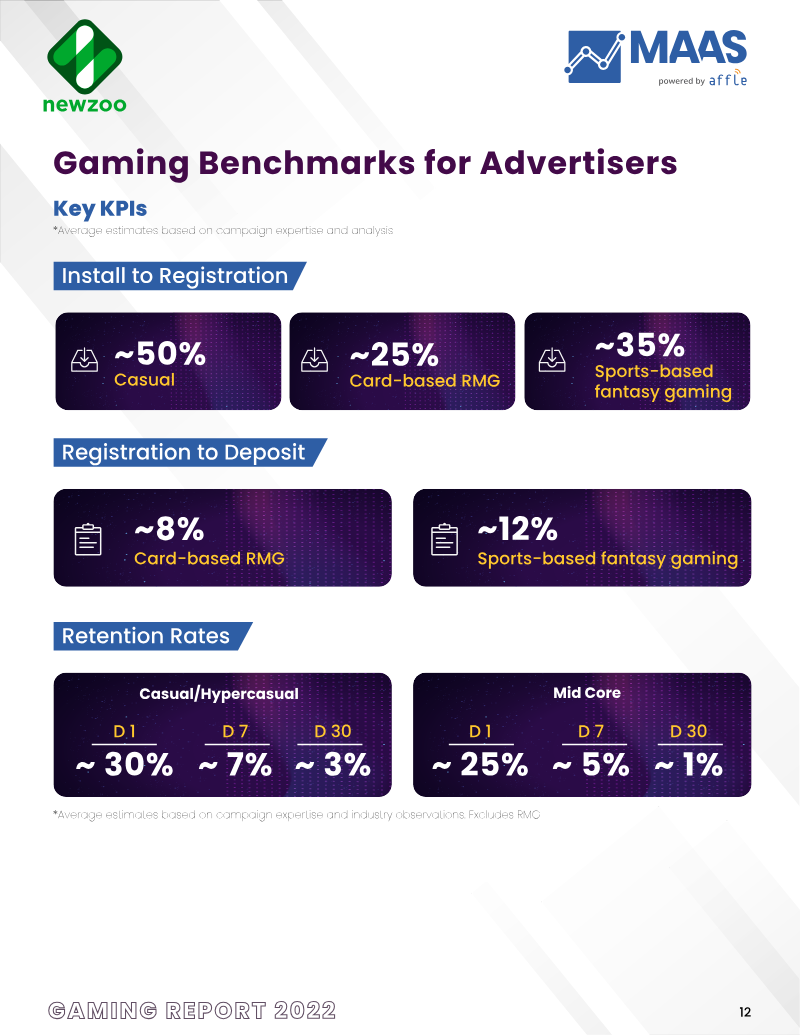
Key performance indicators for advertisers include install‑to‑registration rates of ~50 % for casual games and ~25 % for card‑based RMG, with retention dropping from 30 % on day one to 3 % by day thirty for casual titles. The analysis underscores the importance of vernacular creatives, cross‑interest programmatic targeting, and multi‑channel optimization to reduce audience overlap. It also notes emerging trends—Web3 play‑to‑earn models, esports growth, and super‑app consolidation—that signal continued market maturation. The report concludes that while monetization remains a challenge for non‑RMG segments, strategic acquisition and in‑game advertising innovations can unlock substantial growth across India’s diverse gaming ecosystem.
Pages

Insights
- The Indian mobile gaming market generated US$2.2 billion in 2022, with smartphones accounting for 91% of the online gaming audience.
- Non-real-money gaming (non-RMG) is dominated by Adventure, Battle Royale, Puzzle, Arcade, and Racing genres, while real-money gaming (RMG) centers on card games and sports-fantasy.
- Demographics skew young, with 55% of Adventure and Battle Royale players falling into the 13–27 age bracket, and 62% of non-RMG gamers being male.
- Advertiser performance metrics show a 50% install-to-registration rate for casual games compared to 25% for card-based RMG, with casual game retention dropping from 30% on day one to 3% by day thirty.
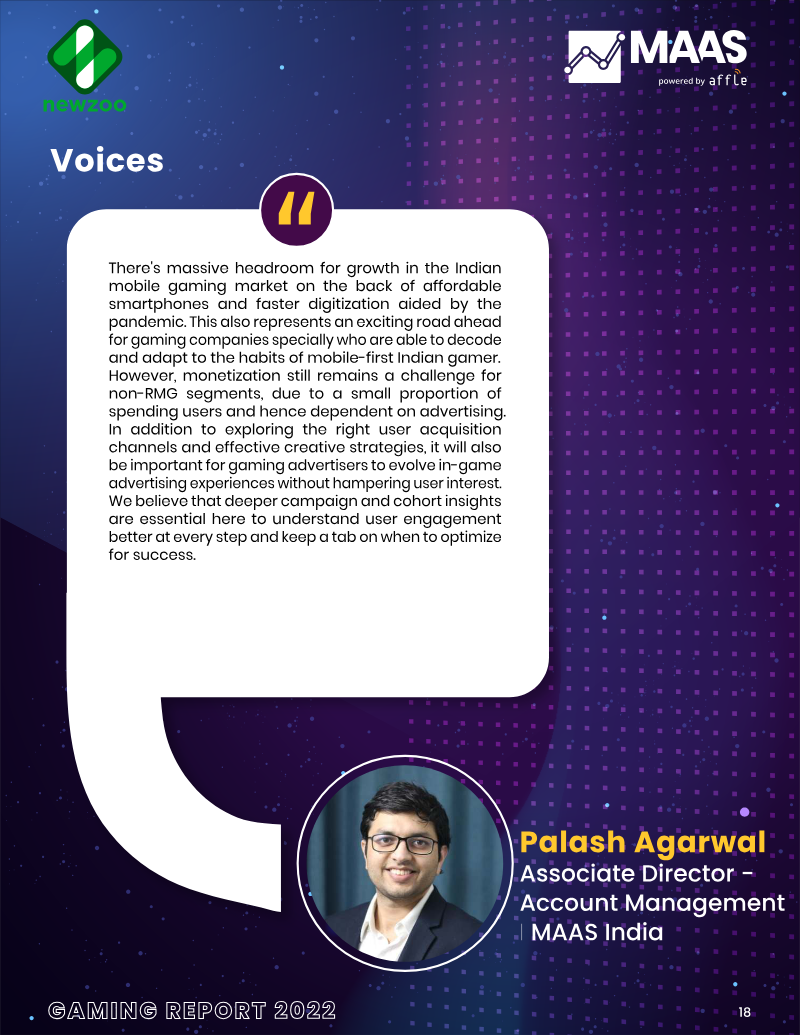
- Average revenue per user is projected to reach US$1.5 by 2027, necessitating a focus on vernacular creatives and in-game advertising to overcome current monetization challenges.