Market (Overall)·Updated Apr 30, 2026 by VG Insights
Report · January 1, 2025
Published by VG Insights
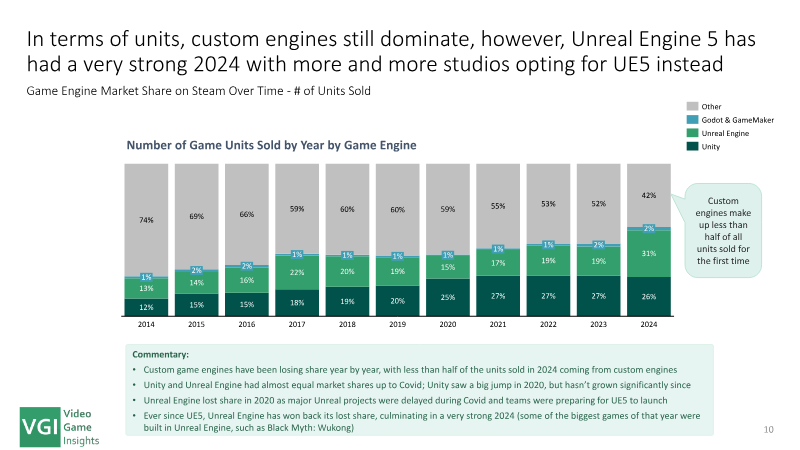
The game engine landscape is undergoing a significant transition as developers increasingly move away from proprietary, in-house solutions in favor of established third-party platforms. This shift is driven by the need for immediate development readiness, access to advanced graphical features like Nanite and Lumen, and the ability to leverage a broader, pre-trained talent pool. While custom engines historically dominated the industry, their market share has declined sharply over the last decade, falling to approximately 13% of new releases by 2024. Unreal Engine has emerged as the primary beneficiary of this trend, particularly among large-scale AAA studios. By 2024, Unreal Engine and custom engines collectively accounted for the majority of unit sales on Steam, with Unreal Engine 5 becoming the industry standard for high-fidelity projects. Conversely, Unity maintains a dominant position in terms of the sheer volume of games released, particularly within the indie and smaller-scale development sectors. However, Unity faces intensifying competition from smaller, specialized engines like Godot and GameMaker, which have captured a growing segment of the indie market. The analysis, which covers over 13,000 games released on Steam, utilizes proprietary tagging and estimation methodologies to track engine adoption trends. Data indicates that engine preference is heavily influenced by game scale and genre; high-graphics, large-budget titles skew heavily toward Unreal Engine, while strategy and simulation games remain strongholds for Unity. Looking toward 2030, the industry is expected to see continued consolidation as more studios abandon legacy in-house tools to mitigate the high costs of engine maintenance, further cementing the market dominance of third-party public engines.
VGI Video The Big Game Engine Report of 2025 Game Insights End of the Era of In-House Engines CONHNES Supporting creativity through data VGinsights.com Contact: [email protected]
Table of Contents State of Game Engines 5-7 Game Engine Market Share Trends 8-12 Deep Dive – Unreal Engine 13-15 Deep Dive – Smaller Public Engines 16-17 Game Engines Popularity by Genre 18-19
Game engines space has been changing rapidly with strong established public engines winning share from historically dominant custom game engines Overview of the Report CRYENGINE@ Unity source Overview: • This report explores the game engines used in games released on Steam over time. Summary • Unity, Unreal Engine and custom game engines of large AAA studios continue to dominate the game engine market. FROSTBITE • However, the trends have been shifting significantly over the last 10 years, especially so in the last 5. • Unreal Engine is quickly winning share from custom engines, becoming the go to game engine for many AAA studios. • Unity has also started to see an impact as UE5 competes with Unity over simplicity and user experience, often becoming the preferred platform even among indie developers. GODOT Methodology Game engine • The methodology relies on VGI’s estimations and tagging of games against game engines. The final slides of the report delve more into methodology. • We capture game engine data for over 13,000 games on Steam. UNREAL Gam TM
This report looks at 3 groups of game engines – from the industry leaders to smaller open-source projects Key Game Engines Covered in the Report Tier 1 Unreal Engine and Unity have been the dominant publicly available Unity Public Engines third-party game engines for a long time UNREAL ENGINE Tier 2 Other third-party game engines have a significantly smaller market GameMaker TM Public Engines share, but are often used by indie developers GODOT erᵀᴹ Ren'Py visual novel engine Game engine Custom In-House Game In-house engines are proprietary tools built by large developers for rce ource CREATION Engines their specific needs ENGINE DECIMA
Over half of the games released in 2024 were made in Unity, but only 26% of the units sold as Unreal Engine and custom AAA engines dominate large games Overview of Game Engine Popularity on Steam in 2024 Number of Games Released All Units Sold in 2024 Commentary: in 2024 by Game Engine by Game Engine¹ • Unity is still the dominant game engine in terms of sheer volume of games being released on 10% • Steam 2% 26% Unity However, in terms of actual units sold, both 4% Unreal Engine custom in-house engines as well as Unreal 5% • Engine beat Unity in 2024 41% Godot Godot, RPG Maker, GameMaker and other 51% GameMaker similar public engines count for just over 10% of all games released, but barely 2% of the actual Ren’Py units sold on Steam 28% 0% Other² 1% 31% 1% Notes: Data includes only games that have sold at least 1 000 units over their lifetime. Games with almost no sales would distort the picture
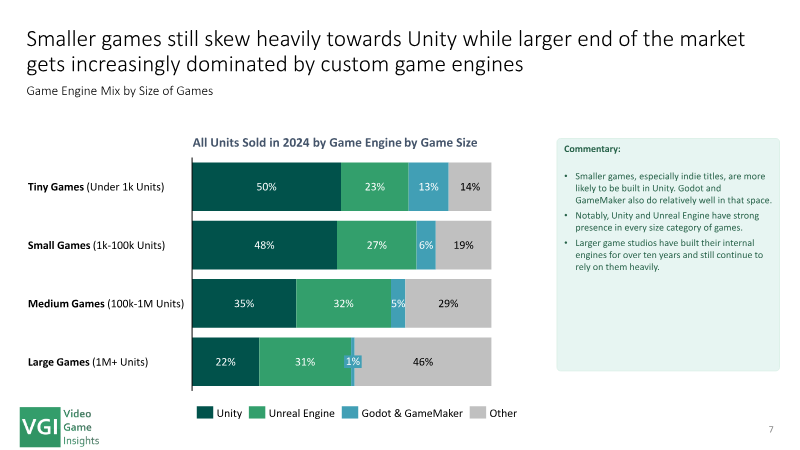
Smaller games still skew heavily towards Unity while larger end of the market gets increasingly dominated by custom game engines Game Engine Mix by Size of Games All Units Sold in 2024 by Game Engine by Game Size Commentary: Tiny Games (Under 1k Units) 50% 23% 13% 14% • Smaller games, especially indie titles, are more likely to be built in Unity. Godot and GameMaker also do relatively well in that space. • Notably, Unity and Unreal Engine have strong presence in every size category of games. Small Games (1k-100k Units) 48% 27% 6% 19% • Larger game studios have built their internal engines for over ten years and still continue to rely on them heavily. Medium Games (100k-1M Units) 35% 32% 5% 29% Large Games (1M+ Units) 22% 31% 1% 46% ~~Unity~~ ~~Unreal Engine~~ ~~Godot & GameMaker~~ Other
The game engine landscape is undergoing a significant structural shift, characterized by the decline of proprietary in-house technology in favor of established third-party platforms. While custom engines historically dominated the industry, their market share has eroded substantially over the last decade, falling to approximately 13 percent of new releases by 2024. This transition is driven by the increasing complexity of modern development, which makes the maintenance of internal engines cost-prohibitive and less efficient compared to the immediate, high-fidelity capabilities offered by public alternatives. Unreal Engine has emerged as the primary beneficiary of this trend, particularly within the AAA segment. Following the release of Unreal Engine 5, the platform has successfully reclaimed market share lost during the pandemic, becoming the preferred choice for large-scale, high-budget productions. Conversely, Unity maintains a dominant position in terms of total volume of games released, particularly among indie and smaller developers, though it faces increasing competition from smaller engines like Godot, which has seen notable growth since 2020. Despite Unity’s high release volume, Unreal Engine and custom AAA engines continue to command a larger portion of total units sold, underscoring their prevalence in high-performing commercial titles. The analysis relies on data from over 13,000 games released on Steam, utilizing proprietary estimation algorithms and tagging methodologies to categorize engine usage by game size, genre, and unit sales. The findings indicate that while the choice of engine is often dictated by project scale—with smaller titles favoring Unity and larger, graphics-intensive projects gravitating toward Unreal Engine—the industry is moving toward a standardized ecosystem. As studios weigh the benefits of third-party support, talent accessibility, and advanced graphical features against the loss of proprietary control, the reliance on external engines is expected to continue its upward trajectory through 2030.
The study aims to map the contemporary PC game distribution ecosystem and evaluate whether Steam functions as a de‑facto monopoly, while outlining alternative channels, associated risks, and growth opportunities for developers and publishers. It positions Steam’s dominance against emerging storefronts, physical media, and gray‑market platforms, offering strategic guidance for navigating a fragmented market beyond 2025. Steam’s market power is evident: 2024 revenue reached $10.8 billion and concurrent active users rose from 25.4 million in 2021 to 40.5 million by September 2025. Eighty‑eight percent of surveyed studios report that Steam delivers over 75 % of their revenue, with 37 % relying on it for more than 90 %. Consequently, 72 % of respondents view Steam as a monopoly and 53 % express concern over this reliance. Nonetheless, diversification is growing—48 % have launched titles on the Epic Games Store, a similar share on the Xbox PC store, while 10 % and 8 % have used GOG and itch.io respectively. Physical releases persist, with 32 % of developers still issuing boxed copies and 72 % of consumers indicating a continued appetite for them. Alternative distribution via e‑stores (e.g., Humble, Fanatical) and marketplaces (e.g., G2A, Kinguin) is gaining traction: 38 % of developers sell through e‑stores and 30 % through marketplaces. Seventy‑five percent anticipate at least a 10 % revenue uplift from these channels, and 80 % expect them to become
Steam wishlists serve as a critical metric for predicting commercial success in the video game industry, functioning as a primary indicator of pre-launch momentum. Data analysis reveals that wishlist distribution is highly top-heavy, with a significant majority of games launching with fewer than 10,000 wishlists, while only a small fraction of titles achieve the 100,000-plus threshold required to reliably forecast a breakout performance. There is a strong 70% correlation between pre-launch wishlist counts and first-month unit sales, particularly for titles that surpass the 100,000-wishlist milestone. Genre-specific trends highlight that action and adventure titles consistently generate the highest levels of pre-release buzz, often benefiting from the brand equity and marketing budgets of AAA and AA publishers. Conversely, casual and MMO titles frequently rely on post-launch engagement, such as live updates and community building, rather than pre-release wishlist accumulation. Regardless of genre, the timing of a Steam page launch is vital; top-performing games typically establish their presence six to twelve months before release, utilizing a steady stream of trailers and development updates to build and maintain audience interest. The findings are based on an analysis of games launched on Steam from March 2024 onwards, utilizing proprietary estimation models and industry data. The research emphasizes that while wishlists are not a guarantee of success for every title, they act as a essential barometer for market interest. For developers and publishers, the data underscores that early visibility and sustained marketing efforts are necessary to reach the wishlist tiers that statistically correlate with long-term commercial viability.
The 2025 Game Developer Survey captures the technology preferences and strategic shifts of game studios worldwide, focusing on platform targets, engine adoption, 3D creation tools, backend services, analytics, user‑acquisition solutions, and generative‑AI usage. By segmenting respondents across six studio‑size categories—from solo developers to enterprises with over 100 employees—the survey reveals how development priorities evolve as companies scale and as pricing models change. Unity remains the most widely used engine, yet studios of all sizes report a notable decline in planned future use, driven by Unity’s revised pricing that introduced a 25 % increase for enterprise licenses and an $2,200 per‑seat fee for pro users. Open‑source alternatives such as Godot and Defold are gaining traction, while Unity’s ProBuilder and SideFX’s Houdini emerge as the fastest‑growing 3D modeling and level‑design tools, especially among studios under 100 employees focused on PC and web titles. Conversely, Adobe’s suite and Autodesk products experience the steepest drop‑offs, with declines ranging from 4 % to 10 % in anticipated usage. Backend infrastructure shows a shift away from Photon, whose hybrid‑plus offering has sparked a modest decline, toward Edgegap, which leverages bare‑metal and cloud resources to deliver cost‑effective matchmaking. Xsolla’s recent rollout of loyalty programs, regional tiering, and cloud‑gaming integration underscores a broader move toward web‑based delivery and progressive‑web‑app capabilities, particularly in the MENA region. Analytics remain dominated by Google, but Mixpanel records a 120 % surge in interest, buoyed by a new startup‑focused pricing tier that promises over $150 k in value for qualifying studios. User‑acquisition trends indicate a universal retreat from Apple Search Ads after its shift to a cost‑per‑tap model, while privacy‑centric platforms such as Tenjin and Branch experience rapid adoption, leveraging OpenAI‑enabled features and enhanced compliance tools. Generative AI is employed across a spectrum of development stages—from storyboarding to performance optimization—but studios report a consistent decline in its use for content creation, with smaller teams showing a 7 % drop and larger teams a 5 % reduction. Overall, the survey highlights a diversification of technology stacks, a cautious response to pricing reforms, and an accelerating embrace of open‑source, cloud‑native, and AI‑augmented solutions as the industry navigates