Report16 pages
Rapport Annuel 2020 de l’ALD
Canada’s video‑game sector continued to function as a high‑growth engine in 2020, supporting roughly 48 000 full‑time‑equivalent positions, of which 27 700 are direct industry jobs, and generating about C$4.5 billion in GDP. The number of development studios expanded by 16 percent to approximately 700, and sales increased despite the disruptions of the COVID‑19 pandemic. A remote‑work guide and a targeted outreach campaign helped maintain employment levels, while an economic‑impact study of 185 respondents confirmed a favourable policy and investment climate for the industry.
Leadership within the sector is exemplified by senior figures such as Tania, a veteran with more than 15 years of experience and a champion of diversity through the EA Women’s Employee Resource Group, and Éric Martel, director of AI and machine‑learning at Eidos‑Montréal, who oversees research for flagship franchises. Their profiles underscore the growing technical sophistication and inclusive culture emerging across Canadian studios.
Strategic initiatives in 2020 focused on talent development and cultural recognition. Partnerships with the Conseil des technologies de l’information et des communications launched the Integrated Work‑Based Learning program to place students in industry roles, while the inaugural Canadian Game Awards moved to a digital format. Support for the Canadian Screen Awards introduced three new video‑game categories, signalling the medium’s expanding cultural relevance despite modest submission volumes. Financially, the association reported a solid position, reinforcing its capacity to sustain growth‑oriented programs and diversity‑focused pipelines throughout the Canadian gaming ecosystem.
- Canada’s video game sector generated approximately C$4.5 billion in GDP and supported 48,000 full-time-equivalent positions in 2020.
- The number of development studios in Canada grew by 16 percent in 2020, reaching a total of approximately 700 studios.
- The industry maintained employment levels throughout the COVID-19 pandemic by implementing remote-work guides and targeted outreach campaigns.
- Strategic talent development was bolstered by a partnership with the Conseil des technologies de l’information et des communications to launch an Integrated Work-Based Learning program for students.
- The Canadian Screen Awards increased the cultural recognition of the sector by introducing three new video-game categories.
+1
ESAC – Entertainment Software Association of CanadaJan 2020

Whitepaper2 pages
Good Conduct Guidelines for the Danish Games Industry
The Good Conduct Guidelines for the Danish Games Industry, published in November 2019, establish a standardized framework for fostering a safe, inclusive, and professional work environment across the Danish game development sector. The primary objective is to protect the personal integrity of industry professionals by promoting a culture of mutual respect, diversity, and accountability. These guidelines serve as a foundational reference for businesses to integrate into employee handbooks or internal policy discussions, ensuring that workplace practices align with both ethical standards and Danish labor legislation.
The guidelines mandate that all industry participants uphold principles of dignity and fairness, with a specific emphasis on eliminating systemic crunch, excessive overtime, and all forms of harassment or discrimination. The policy adopts a zero-tolerance stance toward abusive behavior, noting that harassment is defined by its impact rather than the intent of the perpetrator. Furthermore, the framework places a heightened responsibility on management to act as ethical role models, proactively prevent unsafe conditions, and ensure that employees can report grievances without fear of retaliation.
To support enforcement, the guidelines outline clear procedures for addressing workplace misconduct. Employees are encouraged to engage with internal representatives, such as HR or management, while also being reminded of their rights to seek external support through labor unions, occupational health providers, or the Danish Working Environment Authority. By formalizing these expectations, the industry aims to standardize professional conduct and ensure that all developers and staff operate within a healthy, sustainable, and welcoming environment.
- The Good Conduct Guidelines, published in November 2019, establish a standardized framework for professional behavior and workplace safety across the Danish game development sector.
- The policy mandates the elimination of systemic crunch and excessive overtime to ensure a sustainable working environment for all industry staff.
- Harassment is defined by its objective impact on the victim rather than the intent of the perpetrator, and the industry maintains a zero-tolerance stance toward all forms of abusive behavior.
- Management holds a heightened responsibility to act as ethical role models, proactively prevent unsafe conditions, and guarantee that employees can report grievances without fear of retaliation.
- The guidelines align internal workplace practices with Danish labor legislation to promote a culture of mutual respect, diversity, and accountability.
+1
Danish Games IndustryNov 2019

Report48 pages
Swedish Game Developer Index 2019
Published by the Swedish Games Industry Illustration, cover: Pontus Ullbors Text & analysis: Johanna Nylander The Swedish Games Industry is a collaboration between trade organizations ANGI and Spelplan-ASGD. ANGI represents publishers and distributors and Spelplan-ASGD represents Dataspelsbranschen Swedish Games Industry Magnus Ladulåsgatan 3, SE-116 35 Stockholm Contact: [email protected] KEY FIGURES 2018 2017 2016 2015 ...
- The Swedish games industry experienced significant growth in 2018, with a 33% increase in value to EUR 1.87 billion, marking its tenth consecutive profitable year with total profits exceeding EUR 335 million.
- The industry is expanding, with 41 new companies and over 600 new employees added in Sweden in 2018, an increase of 12% in new companies.
- The corporate landscape has shifted, with seven companies now having revenues over EUR 100 million; Embracer Group, after acquiring Koch Media, is the largest Swedish games company, surpassing previous dominators Mojang and King.
- Swedish game companies contribute significantly to the economy, with the 25 largest companies paying EUR 114 million in tax on profits and the 15 largest contributing over EUR 100 million in wage taxes.
- Swedish game developers are expanding globally, with 31 Swedish-owned studios employing 2,604 people outside Sweden in 2018, and notable acquisitions and investments by Swedish companies in international firms.
+1
Swedish Games IndustryJan 2019
Whitepaper22 pages
Game Industry Policy Recommendations for 2019‑2024: Finland
Three ways to bring Finland to the forefront of the digital shift............. 3 More than half of Finns and nearly a third of the global population 4 play games actively............................................................................... The Finnish game industry 5 is the success story of the 21st century.....
- The Finnish game industry is a significant success story, with almost 3,000 employees and a growing number of companies employing over 50 people with turnovers exceeding 10 million euros by 2017.
- Finland has a high rate of game players, with over half of Finns and nearly a third of the global population actively playing games. The average age of a Finnish player is 38 years old.
- The shift to digital distribution revolutionized the game industry, allowing developers to retain 70% of profits, a significant increase from the previous 15-25%. Rovio's Angry Birds was an early beneficiary of this change.
- Key policy recommendations include allocating 100 million euros to address the talent shortage, making Finland an attractive place for digital development, and advocating for Europe to drive global regulation of digital markets.
- Finnish game development has a long history, starting with Chesmac in 1979, and saw its first boom with the advent of WAP in 1999, despite WAP not meeting expectations. Notable successes include Housemarque’s Supreme Snowboarding, Remedy’s Max Payne, and Sulake’s Habbo Hotel.
Neogames FinlandJan 2019
Report45 pages
Slovak Game Industry 2019
It’s said to be a small world, and the digital games world is smaller still. Yet nevertheless, without the right partner and guidance it’s easy to get disorientated. When we started the annual monitoring of Slovakia’s game development industry, we had a clearly defined vision and goal. And the results of the first Game Developer Census comprehensive report confirmed that we were on the right track.
- The Slovak game development industry is growing, with increasing numbers of studios, profits, project quality, and employed professionals.
- Self-funding is the primary source of funding for Slovak game companies (81%), followed by public funding (35%) and investors (22%).
- 42% of Slovak game studios self-publish their games, while 42% use a publisher (11% foreign, 8% Slovak) and 16% are publisher holders.
- Programmers (10%), Game Designers (10%), and Producers (13%) are among the least represented positions occupied by women, while Graphic Artists (29%) and Marketing/Sales (19%) are more common.
- Two vocational art schools in Košice and Trenčín offer specialized programs in digital painting, animation, and digital application design, including game environment and character design.
+1
Slovak Game Developers AssociationJan 2019
Report27 pages
Jahresbericht der deutschen Games-Branche 2019
01 Gamer in Deutschland 6 02 Markt für Computer- und 12 03 Games-Branche in Deutschland 22 .1 Beschäftigtenzahlen und Unternehmen .4 Die 10 Forderungen der Games-Branche 04 eSports 36 05 gamescom 40 06 Deutscher Computerspielpreis 42 07 Unterhaltungssoftware 44 08 Stiftung Digitale Spielekultur 46 09 Über den game – Verband 48 Herausgeber ...
- The German games market grew by 14% to 3.5 billion Euros in 2018, driven by a 97% increase in revenue from online service fees (to 305 million Euros) and a 57% increase in in-game purchases (to 297 million Euros).
- 34.3 million Germans play computer and video games, with 48% being female. The average age of gamers has risen to 36.4 years, with nearly 10 million players over 50 years old, representing 29% of all gamers.
- The purchase of games as downloads or on physical media is no longer the largest market segment, declining by 10% to 1.1 billion Euros. Downloads accounted for 41% of sales and 28% of revenue in 2018, a slight decrease from 2017.
- Germany's games industry faces a challenging financing situation, making game production up to 30% more expensive than in other countries like France, the UK, and Canada, which have stronger government support.
- eSports is rapidly growing in popularity and economic potential in Germany, with major events like ESL One tournaments and the League of Legends Championship Series hosted there. Many German sports clubs and companies like Mercedes-Benz, Audi, and Vodafone are investing in eSports.
game – Verband der deutschen Games-Branche e. V.Jan 2019
Report27 pages
Arbeiten in der Games-Branche: Kreativität trifft Technologie
14 und kreative Köpfe, 14 folgende Frage höre und lese ich immer wieder: „Wie werde ich Spiele-Entwickler/in und was muss ich dafür mitbringen?“ Das ist auf die Schnelle gar nicht so leicht zu beantworten. Das Arbeiten in der Games-Branche ist unglaublich vielfältig und genauso zahl- reich sind auch die Wege, die dahinführen.
- The German games market is experiencing significant growth, with revenue increasing by 15% in 2017 compared to the previous year, and projections showing continued growth from 3689 million Euros in 2016 to an estimated 5295 million Euros in 2021.
- Digital sales and microtransactions are booming in the German games market, driven by mobile games and the free-to-play model, while sales of physical media are stagnating or declining.
- The average German gamer is 36.1 years old, with the largest player group being over 50, and women constitute 47% of players, indicating a broad and diverse audience for games.
- Game development is a highly interdisciplinary and collaborative process, typically involving teams of dozens or even hundreds of specialists (e.g., programmers, graphic designers, game designers, sound designers) working together, rather than individual creators.
- Key roles in game development include Game Designers (who conceive game ideas and systems), Programmers (who develop core systems), Graphic/Animation Artists (who create game worlds), Audio Designers (who create soundscapes), and Producers (who manage project completion, budget, and quality).
game.deJan 2019
Report42 pages
Serbian Gaming Industry Report 2018
The inaugural Serbian Games Association report maps a rapidly expanding national gaming ecosystem that now comprises more than 60 members across indie development, esports, visual‑effects houses and internationally linked studios, employing over 1,500 skilled professionals. Funding is diversified, with roughly 40 % of capital sourced from angel investors, 30 % from crowdfunding and 20 % from venture capital, and the largest single infusion recorded at €650 k. Flagship entities such as 3Lateral (recently integrated into Epic Games), Nordeus with its 200 million‑user “Top Eleven” platform, and Ubisoft Belgrade’s 107‑person team working on major AAA titles illustrate the sector’s growing global relevance.
A vibrant indie segment is driven by small, highly creative teams—often one to three developers—producing titles ranging from cyber‑punk point‑and‑click adventures to hyper‑casual mobile games. Studios like Munzesky Games, Oraharo Entertainment, PWN.RS, Stargazer, Superverse Industries, Tummy Games and Zero Gravity showcase cross‑border collaborations and distinctive artistic approaches, while highlighting the need for stronger B2B networking, regular industry events and formalized game‑art education to sustain momentum.
Technical education underpins this growth, with approximately 30 000 university students enrolled in IT‑related programs and programming introduced at the primary‑school level. Government incentives, EU grants and private investment have bolstered studio formation, yet most companies still rely on organic installs and limited ad‑network usage for user acquisition. Community initiatives—including frequent association meet‑ups, two industry‑backed GameJams, the annual GameUp expo attracting over 2 500 participants, and the Nordeus Hub co‑working space offering a six‑month mentorship—are actively closing knowledge gaps and fostering collaboration.
Media outlets such as Svet kompjutera, JVC Gamer and the online PLAY! Zine maintain visibility for Serbian developers both domestically and abroad. Surveyed stakeholders anticipate a rise in paid user‑acquisition capabilities and an increase in successful Serbian titles, positioning the country to become a more prominent player in the regional and global gaming market.
- The Serbian gaming industry comprises over 60 member entities and employs more than 1,500 professionals, anchored by major players like Nordeus, Ubisoft Belgrade, and 3Lateral.
- Funding for the sector is diversified, with 40% sourced from angel investors, 30% from crowdfunding, and 20% from venture capital, with the largest single investment reaching €650,000.
- A robust pipeline of technical talent is supported by approximately 30,000 university students in IT-related programs and the integration of programming into primary-school curricula.
- The indie segment is characterized by small, highly creative teams of one to three developers, though these studios currently rely heavily on organic installs rather than paid user-acquisition strategies.
- Industry growth is bolstered by community-led initiatives such as the GameUp expo, which attracts over 2,500 participants, and mentorship programs like the Nordeus Hub.
+1
SGAJan 2019
Report55 pages
Serbian Gaming Industry Report 2019
The Serbian games sector is emerging as a rapidly expanding, diversified ecosystem that now supports more than 80 companies and roughly 2,000 employees, reflecting a 3.4 % year‑on‑year increase in staff. Studios range from micro‑teams of five to large developers of up to 180 personnel, many of which are actively recruiting, indicating robust talent demand. Revenue generation has risen to approximately €100 million, with 2019 mobile‑first, free‑to‑play titles produced on modest budgets of €0‑100 k and average team sizes of six to ten, while flagship projects such as Nordeus’s Top Eleven and Playrix RS’s titles have amassed over 100 million monthly active users, underscoring Serbia’s capacity for both high‑volume mobile and higher‑budget productions.
The market is highly fragmented, comprising dozens of small‑to‑mid‑size studios that specialize in mobile, hyper‑casual, AR/VR, backend services, and outsourcing. Notable commercial successes include Sozap’s Armed Heist with more than 14 million installs and PixQuake’s server‑side analytics suite. Institutional support has intensified through the Serbian Gaming Association, the Nordeus Hub, and university initiatives, including a multi‑university “Master 4.0” curriculum that integrates IT, business, and creative disciplines and has spawned dozens of new gaming degree programmes.
Mentorship and structured education that blend soft‑skill and technical training are identified as critical for talent development, with studios such as Digital Arrow, Two Desperados, and Ubisoft Belgrade highlighting the need for custom tech‑art pipelines, AI integration, and data‑driven design. The coordinated push toward professionalisation, exemplified by accelerator programs and community events, positions Serbia to sustain its growth trajectory and increase its contribution to both regional and global game markets.
- The Serbian gaming sector generated approximately €100 million in revenue in 2019, supported by an ecosystem of over 80 companies and 2,000 employees.
- Flagship mobile titles from companies like Nordeus and Playrix RS have achieved massive scale, amassing over 100 million monthly active users.
- The industry is experiencing steady growth with a 3.4% year-on-year increase in staff and robust recruitment demand across studios ranging from micro-teams to 180-person developers.
- Market production is highly diversified, ranging from low-budget mobile and hyper-casual titles costing €0–100k to specialized work in AR/VR, backend services, and server-side analytics.
- Institutional support has matured through the Serbian Gaming Association and the 'Master 4.0' university curriculum, which integrates IT, business, and creative disciplines to formalize talent development.
SGAJan 2019
Report48 pages
Baromètre Annuel du Jeu Vidéo en France 2017
SYNDICAT NATIONAL DU JEUVIDEO DIGIWORLD X Une vidéo Pictanovo! a production, types d'aide : dedieau jeu ide paprojet, dgdi poes ades ! a egion Hauts-de 20.00€ rprojet. A4 frane lanait te f onds regional COUV Comit de lecture 16/02/18 2E DE May fone.con 1 503/18 Comnite de lecture21/09/18 B A R O M È T R E A N N U E L D U J E U V I D É O E N F R A N C E 08<sup>LE </...
- The global video game market is projected to grow from €60 billion in 2017 to nearly €80 billion by the end of 2021, with mobile gaming being the largest segment at €22.5 billion in 2017.
- The 'premium' economic model (paid-at-purchase with no additional content) has become dominant in 2017, adopted by 63.9% of studios, surpassing the free-to-play model which saw a significant 26.8-point decline.
- French video game companies are predominantly small, with an average of 29.5 full-time equivalent (FTE) employees in 2017, an increase of 3.2 FTE since 2016, though half of companies have 6 FTE or fewer.
- CDI (permanent contracts) remain the majority (60%) in the sector in 2017, increasing by 3.8 points from 2016, while the use of fixed-term contracts (CDD) also rose by 1.2 points.
- Developer studios are increasingly self-publishing, with 63% engaged in direct commercialization, though reliance on traditional publishers for expertise and resources remains necessary.
+1
Syndicat National du Jeu VidéoFeb 2018
Report48 pages
Spelutvecklarindex 2018
Framsida (collage) & fristående illustrationer: Anna Nilsson Text & analys: Johanna Nylander Dataspelsbranschen är en samarbetsorganisation för ANGI och Spelplan-ASGD. ANGI representerar förlag samt distributörer och Spelplan-ASGD representerar utvecklare Dataspelsbranschen | Swedish Games Industry Klara norra kyrkogata 31, Box 22307 SE-104 22 Stockholm Kontakt: [email protected] NYCKELTAL Förändring 2012-2017 Oms.
- The Swedish game industry's revenue reached 14,695 MSEK in 2017, continuing a strong growth trend from 3,715 MSEK in 2012.
- Employment in the Swedish game industry increased by 24% (1,047 full-time positions) in 2017, nearly doubling the 558 new positions from 2016, but companies still face recruitment challenges and a shortage of skilled developers.
- The number of women in the Swedish game industry has quintupled in six years, with women now making up 20% of all employees, and more women are taking leadership roles, such as Ebba Ljungerud becoming CEO of Paradox in August 2018.
- Swedish game companies are active in mergers and acquisitions, with notable examples in 2017 including THQ Nordic acquiring Black Forest Games and Pieces Interactive, and Starbreeze acquiring Dhruva Interactive and Enterspace AB.
- The industry benefits from diversified revenue streams like 'games as a service' (GaaS), microtransactions, and subscription models, leading to more stable income and higher valuations for publicly traded game companies.
+1
DataspelsbranschenJan 2018
Report46 pages
Koulutusta Suomessa
• Ahlmannin koulun säätiö /Oriveden • Opisto • • Joutsenon Opisto • • Kauhajoen evankelinen opisto • • Laajasalon opisto • • Prakticum • • AEL Ammattienedistämislaitossäätiö • • Amiedu • • HEO Media • • Kouvolan seudun ammattiopisto • • Lybeckerin opisto ...
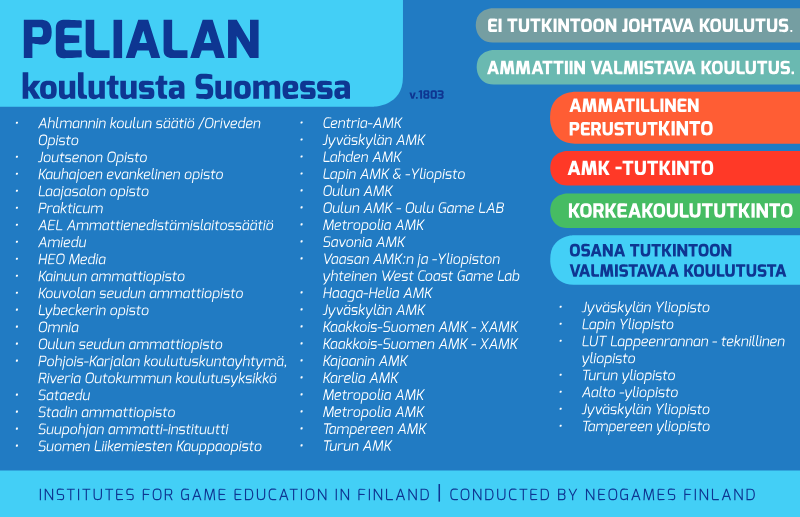
- Finland offers a wide range of game industry education, from vocational training to university degrees, including programs focused on game programming, design, art, and business.
- Vocational education (AMMATILLINEN PERUSTUTKINTO) includes programs like Datonomi, Media-alan perustutkinto (Animation and Game Industry), and Peliohjelmoija, with durations typically ranging from 2 to 3 years.
- Universities of Applied Sciences (AMK) offer Bachelor's degrees (AMK-TUTKINTO) in fields such as Information Processing (Tietojenkäsittely) and Culture and Arts (Game Design), generally lasting 3.5 to 4 years.
- Several institutions offer non-degree game-related training, such as 'Kohti Pelialaa' at Joutsenon Opisto (9 months, 31 ECTS), 'Spelproduktion' at Prakticum (1 year, 60 ECTS), and 'Pelisuunnittelu' at HEO Media (9 months, 60 ECTS).
- Specialized programs exist, like Oulu Game LAB (Oulun AMK), West Coast Game Lab (Vaasan AMK & Yliopisto), and Metropolia AMK's 3D-animation and visualization with a focus on game graphics.
+1
Neogames FinlandJan 2018

Report17 pages
Baromètre Annuel du Jeu Vidéo en France Edition 2018
The 2018 Annual Barometer of the Video Game Industry in France provides a comprehensive analysis of the French gaming sector’s economic health, employment trends, and production landscape. Produced through a collaboration between the Syndicat National du Jeu Vidéo (SNJV) and IDATE DigiWorld, the study aims to capture the industry's current activity levels and future outlook. The methodology involved an online survey conducted between June and August 2018, targeting both SNJV members and non-member companies, including development studios, publishers, and service providers.
Key findings reveal a dynamic and predominantly independent industry, with 93% of studios identifying as independent. The sector is characterized by a strong entrepreneurial spirit, as 56% of development studios are less than five years old. Production remains robust, with 1,200 games in development during 2018, two-thirds of which represent new intellectual properties. Studios show a clear preference for PC development, followed by mobile and console platforms. Financially, the industry relies heavily on self-financing, though there is a growing reliance on public support mechanisms, with 62% of studios utilizing regional, national, or European aid.
Employment in the sector is marked by high qualification levels and steady growth. In 2018, the industry supported an average of 9.5 full-time equivalent employees per studio, with 86% of these roles held under permanent contracts. Projections indicate the creation of 650 to 850 new jobs annually, reflecting a positive outlook. Industry leaders express significant confidence in both their individual companies and the broader French gaming ecosystem, with 76% of respondents viewing France as an attractive territory for video game production. The report concludes that the industry is increasingly export-oriented, with 40% of studio revenue generated internationally.
- The French video game industry is overwhelmingly independent, with 93% of studios operating independently and 56% of development studios being less than five years old.
- In 2018, the sector had 1,200 games in active development, with two-thirds of these projects representing new intellectual properties.
- Public funding is a critical pillar of the industry, with 62% of studios utilizing regional, national, or European financial support mechanisms.
- The sector demonstrates strong export performance, with 40% of total studio revenue generated from international markets.
- Employment is stable and growing, with 86% of the average 9.5 full-time equivalent employees per studio held under permanent contracts.
Syndicat National du Jeu VidéoJan 2018
Report51 pages
The Games Monitor 2018
We are honored to present The Games Monitor 2018 edition with the latest facts, figures, trends and developments in the Dutch games industry. The Games Monitor was first published in 2012 and was followed by new research in 2015. Both reports generated a lot of interest into the Dutch games industry’s facts and figures, which is why we are pleased to be able to provide you with an update for 2018.
- The Dutch games industry saw a net job growth of over 60% concentrated in Utrecht, Eindhoven, and Amsterdam between 2015 and 2018.
- The total number of entertainment game companies increased by over 50 since 2015, continuing a previous trend, while the number of applied game developers stabilized at 114 companies.
- Applied games have a strong foothold in the Dutch industry, with healthcare and education remaining the largest market segments for applied game companies, and 62% of studios working on five or more projects in 2018.
- Dutch game companies are most positive about growth for mobile games, consoles/PC, and Augmented Reality (AR), but less so for Virtual Reality (VR) due to expensive hardware and lack of user-friendliness.
- Key challenges for both applied and entertainment game studios include finding enough players/sales, acquiring sufficient funds, and securing suitable personnel, with a noted lack of investors in the Netherlands.
+2
Dutch Games AssociationJan 2018
Report6 pages
Games Monitor: The Netherlands 2018
The Games Monitor 2018 provides a comprehensive analysis of the Dutch video games industry, tracking its evolution and maturation between 2015 and 2018. The industry is defined by companies whose core activities involve the development, production, publication, or distribution of electronic games, categorized into entertainment and applied (serious) games. The research methodology combined desk research with a survey of 165 companies, supplemented by industry roundtable discussions to validate findings.
The Dutch games sector experienced accelerated growth during the 2015–2018 period, characterized by an average annual job increase of 10 percent. By the end of 2018, the industry comprised 575 companies and 3,850 jobs, generating an estimated annual turnover of €225–300 million. While the average company size remains small at approximately seven employees, there is a clear trend toward scaling up, evidenced by a significant increase in mid-sized firms employing between 11 and 100 people. Geographically, the industry is concentrated in major urban centers, with Amsterdam, Utrecht, and Eindhoven accounting for over 60 percent of net job growth.
Market dynamics show a strong expansion in entertainment game development, which grew by 33 percent, while the applied games sector—primarily serving healthcare, education, and government—has stabilized. Business models in the entertainment sector rely heavily on premium monetization and in-app advertising, whereas applied studios frequently utilize work-for-hire models. The educational landscape remains robust, with 44 game-related study programs producing over 900 graduates annually. Overall, the industry is transitioning toward a more mature, competitive state, marked by increased productivity, strategic acquisitions, and international expansion.
- The Dutch games industry reached 575 companies and 3,850 jobs by the end of 2018, generating an estimated annual turnover of €225–300 million.
- The sector experienced accelerated growth between 2015 and 2018, maintaining an average annual job increase of 10 percent.
- Entertainment game development expanded by 33 percent, while the applied games sector, serving healthcare, education, and government, stabilized.
- Industry growth is highly centralized, with Amsterdam, Utrecht, and Eindhoven accounting for over 60 percent of net job gains.
- While the average firm size remains small at seven employees, there is a clear trend toward scaling, with a notable increase in mid-sized companies employing 11 to 100 people.
+1
Dutch Games AssociationJan 2018
Report121 pages
Videojuegos en España: Impacto Económico y Escenarios Fiscales
Spain’s video‑game industry is presented as a dynamic component of the national ICT services sector, whose economic relevance extends far beyond direct production. Using 2016 input‑output tables updated with INE data, the analysis quantifies the sector’s contribution to GDP, employment and value‑added, and evaluates how fiscal incentives and inter‑industry linkages shape its growth trajectory.
In 2016 the industry generated €1.177 billion in direct output, representing roughly 0.11 % of national GDP, and created 8 790 high‑skill jobs. When indirect and induced effects are incorporated, total activity rises to €3.577 billion, value‑added reaches €1.452 billion and employment expands to 22 828 positions, implying that each euro invested yields three euros of economic activity and that a game‑industry job supports 2.6 additional jobs elsewhere. The sector supplies 14.3 % of publishing output, 9.6 % of audiovisual production and 3.8 % of related services, yet its forward absorption and diffusion coefficients are low, indicating limited downstream impact compared with professional services.
Productivity analysis shows a 6.4 % annual decline in value‑added per employee within the broader editing segment, while revenue per worker remains modest at €144 k. Between 2014 and 2024, software publishing and cable‑free telecommunications emerge as the fastest‑growing Spanish activities, with annual expansions of 4.7 % and 4.2 % respectively, underscoring the sector’s alignment with broader digital trends.
Four fiscal‑policy scenarios are compared, and the tax‑credit option (E2) delivers the strongest stimulus, adding €627 million of production, €254 million of value‑added and 4 000 full‑time jobs, albeit at the cost of a modest deterioration in public‑finance balance. Methodologically, the study follows Frascati and Oslo standards, aggregates data at the two‑digit CNAE level, and employs a Leontief inverse to trace demand‑driven effects, ensuring international comparability of R&D, innovation and ICT metrics.
- The Spanish video game industry generates a total economic impact of €3.577 billion, with every €1 invested yielding €3 in total economic activity.
- The sector supports 22,828 total jobs when accounting for indirect and induced effects, with each direct industry position sustaining 2.6 additional jobs elsewhere.
- Implementing a tax-credit fiscal policy (Scenario E2) is projected to provide the strongest stimulus, adding €627 million in production and 4,000 full-time jobs to the economy.
- In 2016, the industry directly contributed €1.177 billion to GDP (0.11% of the national total) and employed 8,790 high-skill workers.
- Software publishing has emerged as a high-growth activity in Spain, expanding at an annual rate of 4.7% between 2014 and 2024.
+2
AEVIJan 2018
Whitepaper32 pages
How to Enable Digital Growth in Europe
HOW TO Game developer studios in Europe 4 What EGDF does 5 ENABLE Number of people working in game development 7 Turnover of the national game development ecosystems 9 DIGITAL The shorter the value chain, the more growth in Europe 10 Games are the driving force of the digital revolution 11 Content drives innovation 12 GROWTH Creative E...
- Network neutrality is crucial for the European games sector, as easing it risks dividing Europe, allowing network providers to slow access to competing virtual services, and strengthening dominant media companies over independent developers.
- Video games are a driving force in the digital revolution, creating a new interactive language that transcends cultures and influences other forms of cultural expression like films, books, and music.
- European game developers are frequently targeted by patent trolls, with legal battles in the US potentially costing hundreds of thousands to millions of Euros and fully occupying developers.
- The current copyright framework is problematic; a clear general exception for cultural heritage is needed, and the limitations on liability for internet service providers as intermediaries are highly necessary.
- Public support for game development should prioritize direct grants and well-working soft-loan schemes for SMEs, as these are more effective than loans or loan guarantees for risky, innovative businesses.
+1
European Games Developer FederationJan 2016
Report9 pages
Dossier de Prensa AEVI 2016
AEVI was founded in 2014 to unify Spain’s video‑game ecosystem and to position the sector as a leading technological and cultural industry. Its institutional goals focus on fostering local development, attracting investment, collaborating with public authorities, defending intellectual‑property rights, and promoting responsible consumption through the PEGI rating system.
In 2014 the Spanish video‑game market generated €996 million, a 6.8 % increase over the previous year, with physical sales accounting for €755 million and online sales €241 million. Software contributed €364 million, hardware €301 million and accessories €90 million. The sector served 13 million users—36 % of the population—making Spain one of the four largest European markets after France, Germany and the United Kingdom. Players aged 11‑64 spent an average of 5.9 hours per week gaming; 40 % of adults played, 26.2 % regularly, and gender participation reached 45.3 % for men and 32.8 % for women. Physical copies remained the preferred format (7.9 million users), followed by online (5 million) and mobile applications (4.9 million).
AEVI highlighted the persistent challenge of piracy, reporting 240 million illegal downloads and 2 million physical infringements in 2014, which translated into a €226 million loss of revenue. Legislative reforms in intellectual‑property law and the criminal code were cited as recent advances in combating these practices. The association also noted a 21 % rise in development studios, reaching nearly 400 companies, and projected that employment in the sector could double to over 7 000 highly qualified jobs by 2019.
Through advocacy, data collection from sources such as GfK, ISFE, Gametrack and its own surveys, and partnerships with institutions like the Federation for the Protection of Intellectual Property, AEVI seeks to sustain growth, enhance the cultural perception of video games, and ensure a responsible, innovative market environment in Spain.
- The Spanish video-game market generated €996 million in 2014, marking a 6.8% year-over-year growth and establishing Spain as one of the four largest markets in Europe.
- Piracy remains a significant economic challenge, with 240 million illegal downloads and 2 million physical infringements causing an estimated €226 million in lost revenue in 2014.
- The sector served 13 million users in 2014, representing 36% of the population, with players aged 11–64 averaging 5.9 hours of gaming per week.
- The number of development studios in Spain grew by 21% to nearly 400 companies, with projections suggesting sector employment could double to over 7,000 jobs by 2019.
- Market revenue in 2014 was split between €755 million in physical sales and €241 million in online sales, with software contributing €364 million, hardware €301 million, and accessories €90 million.
+1
AEVIJan 2016
Report116 pages
Finnish Game Industry Report 2014
17 | The Founding Years of Studios 29| Financial Outlook ob 40 | Finnish game developer studios assn. Fingersoft • Hill Climb Racing Rovio Entertainment • Angry Birds, Supercell • Clash of Clans, Hay Day Two Men and a Dog • Zombie Catchers THE OLDEST Finnish game companies still in existence are turning 20 this year (2015).
- The Finnish game industry experienced explosive growth in 2014, with turnover reaching approximately €1.8 billion, a 100% increase from the previous year, though accounting practice changes affect direct comparability.
- The industry's turnover per employee significantly increased, from €75,850 in 2008 to €720,000 in 2014, largely due to digital distribution and the Free-to-Play (F2P) model in mobile games.
- Employment in the Finnish game industry has grown steadily, reaching 2,500 people in 2014, up from 1,147 in 2008.
- The concentration of game developer studios in the capital area (Helsinki, Vantaa, Espoo) has decreased from 64% in 2009 to 38% in 2014, with regional clusters emerging in cities like Turku and Tampere.
- The Finnish game industry has a history rooted in the late 1990s 'Internet bubble,' with Nokia's investment in WAP protocol influencing its direction into the next decade.
+1
Neogames FinlandMar 2015
Report36 pages
Dutch Games Monitor: The Netherlands 2015
In 2012 the first edition of the Dutch Games Monitor was presented. Whilst maybe not the first research focusing on the Dutch games industry, it was the first where an extensive survey and a series of interviews provided a broad insight into the state of the industry. In the past few years interest in games and data about the games industry has increased. Many people were interested in an updated version of the Games Monitor .
- The Dutch games industry saw its number of professionals grow from 2730 in 2011 to 3030 in 2015, an annual job growth of 2.6%, which is above the national average of -0.4% for the same period.
- Over half of Dutch game companies are less than 5 years old, and the average company size is 7 employees, indicating a young industry dominated by small studios.
- Access to funding, availability of qualified staff, and sales are the top three challenges for Dutch game companies, with over 40% reporting issues in obtaining funds.
- Applied games are a significant domain, with expected growth in healthcare and education. However, 42% of applied game companies' turnover is fully realized domestically, while 58% have international clients.
- The mobile market is dominated by Free to Play games, the PC marketplace by mid-sized games, and the console market by high-production-value games. Forty-four percent of respondents developed for the PC platform Steam in 2015, but its popularity makes success increasingly difficult.
+2
Dutch Games AssociationJan 2015